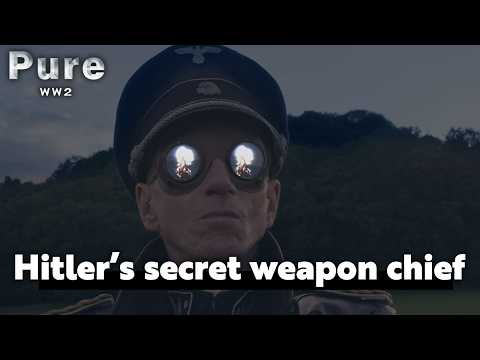
He was a devoted family man, a proud father—and a cold-blooded technocrat in the Nazi war machine. By official records, Hans Kammler took his own life in May 1945 while fleeing near Prague. But no body was ever found. No ID tag. No personal effects. Nothing but a web of contradictory stories that would haunt historians for decades.
In the final days of the war, as American troops pushed into Czech territory and Czech militias hunted former occupiers, Kammler’s SS entourage gave wildly different accounts of his end. Some said he bit a cyanide capsule. Others claimed he shot himself. One version even insisted he ordered a subordinate to fire the fatal bullet. Six different versions of his death. Zero confirmed graves.
His wife Julia, left without financial support, desperately needed proof of death. She contacted his former comrades, but their testimonies clashed at every turn. A Berlin district court finally declared Kammler dead based on the word of his second driver—a man who claimed the general had killed himself on May 9. Case closed. Or so it seemed.
But new evidence would shatter the official story. Documents that had never seen the light of day pointed to something far more unsettling: Hans Kammler did not die in the final days of the war. He fell into American hands.
A high-ranking former SS officer wrote to Kammler’s wife with a chilling message. Her husband had been in Prague just a day before the war ended. His farewell words: “The Americans are after me. They’ve made me offers. I will never serve the enemy. They won’t get me alive.”
Was it all a smokescreen? Allied intelligence knew exactly what a general of the SS special forces possessed—deep insights into Germany’s most advanced weapons technology. They were particularly hungry for the so-called “wonder weapons” of the Third Reich. Getting their hands on Kammler and his knowledge was a priority.
Yet the Allies also knew that tens of thousands of concentration camp prisoners had perished under Kammler’s construction programs. He had played a leading role in designing Auschwitz-Birkenau itself. British intelligence even placed him on a kill list alongside nine other top SS men targeted by commando assassination squads.
Instead, according to recent evidence, Kammler ended up in American custody. A senior officer from the Office of Strategic Services—the OSS—reportedly supervised his interrogation. Donald Richardson served in a special OSS unit. In 2014, his son revealed for the first time that Kammler had indeed been in US hands. “My father interrogated him. Changing someone’s identity—you can change a good German’s identity and hide him from Russian intelligence. That was my father’s job.”
So what really happened in those final days? Did Kammler intend to cooperate with the victorious Allies, trading data on the latest weapons developments for a new life? Official records still insist his life ended in May 1945—along with his meteoric rise through the SS ranks.
Historian Matthias Uhl has assessed the appointment diary of SS chief Heinrich Himmler. Kammler’s name appears regularly among his appointments. Hans Kammler was a model example of the many young SS officers who saw the organization as a springboard for their careers. After studying architecture and civil engineering, he had a solid technical background and was driven by a desire for rapid advancement.
The SS offered him that chance. The Black Order, the self-proclaimed elite of the Third Reich. Those who joined its ranks with unconditional loyalty could go far. The SS relentlessly sought to expand its influence. Its leader was always looking for ambitious talent. Men like Hans Kammler, whose rapid rise began almost immediately.
In 1941, he was assigned to the SS Construction Branch and soon became head of Division C—responsible for all major construction projects. Through these large-scale activities, he acquired more and more authority across a wide range of fields. As the war intensified, Kammler wanted to prove his worth behind the front lines.
Just weeks after taking charge of Division C, Germany invaded the Soviet Union. As the campaign progressed, the construction division’s tasks within the SS Economic and Administrative Main Office multiplied. These ranged from building new prisoner-of-war camps to new SS barracks and much more. Kammler’s duties also led him to occupied Poland—to a site that would become the symbol of systematic mass murder: Auschwitz-Birkenau.
He didn’t just sign off on the blueprints for the crematoria and gas chambers. He personally designed the railway tracks so that the distance between the train and the gas chamber would be as short as possible. Kammler had a direct influence. He was deeply involved in all of it. Alongside Himmler, he observed the first gassing operations at Auschwitz, where his division was responsible for building the crematoria and furnaces.
Mass murder was, to him, merely a technical challenge. No moral qualms. If I complete this task efficiently and according to the orders I’ve received, I can rise to higher positions. That must have been what he thought. And clearly, that was all that mattered to him.
Indeed, in the eyes of the SS leadership, Kammler seemed the natural choice to take over Germany’s secret weapons program. The army research center at Peenemünde on the Baltic coast was a hive of frantic activity, aimed at producing weapons capable of reaching enemy cities unimpeded despite Allied air superiority. At Peenemünde, the “Aggregate 4″—a ballistic missile later known as the V-2—was being developed under the authority of the Armaments Ministry.
Himmler was determined to seize this new technology and the scientists involved. But the men around rocket pioneer Wernher von Braun were initially hesitant. When British bombers destroyed the Peenemünde site in August 1943, Kammler was immediately tasked with creating alternative underground facilities near Nordhausen. He succeeded in just two months. And he stopped at nothing—which meant human lives had no value.
Kammler ordered kilometers of tunnels dug into the Harz mountains. As he was in charge of construction, he soon controlled any underground weapons production—and finally, the entire rocket program. Meanwhile, forced laborers and concentration camp inmates were herded into the tunnels to expand the facilities under indescribable conditions. Tens of thousands perished.
Brutality and cutting-edge technology. The two worlds Hans Kammler inhabited. He became one of the most powerful members of the SS, responsible for dozens of top-secret construction sites comprising hundreds of thousands of square meters of bomb-proof factories across the Reich.
As a rather ordinary document—Kammler’s personal roadmap—makes clear, it is filled with dots, crosses, and dashes, each marking a different location under his control. Like Lehesten in Thuringia, where a quarry was converted into a factory for V-2 rocket propulsion units, with underground production lines and test stands. Kammler was building a vast network of technical facilities. His superiors showered him with praise. “He has achieved something unique in this field so far, successfully shortening the deadlines significantly despite initial difficulties.” Signed: Heinrich Himmler.
In recognition, Himmler appointed Kammler as his special representative for the A4 project—the ballistic missile program. But he soon took on additional responsibilities, including the development of jet fighter aircraft. He was now familiar with nearly every important weapons project in the Reich. Fully informed.
June 1944. Hitler’s European fortress is collapsing. Western Allied forces storm the beaches of Normandy. The final chapter of the war has begun. But the Germans keep fighting. They still have some cards to play. It was well known. For the Germans, it was clear time was running out. We cannot hold the front much longer, so we must come up with new weapons. For that, we need a man who stops at nothing to complete tasks as quickly as possible. And I believe that is the role they assigned to Kammler.
Accordingly, his scope expanded from overseeing development to managing the actual operation of rockets. In early September 1944, the first V-2s were launched toward Great Britain. Lacking accuracy, they could not target military objectives precisely. Their purpose was to spread terror by appearing suddenly out of nowhere, killing indiscriminately in London and in liberated Antwerp.
But however sinister and deadly, they were no substitute for air power. With the Allied breakthrough in Normandy, all missile bases under construction along the French coast were abandoned. Like this base near Paderborn—a giant concrete dome. Called “the Dome,” it measured 30 meters in width and depth, with a reinforced concrete roof five meters thick. It was designed to launch an entire array of missiles of various sizes with warheads carrying a devastating payload. The Dome was supposed to fire 70 missiles per day. The Allies captured the site just in time.
For the Germans, it was a race against time. Blueprints and essential materials were hastily moved from secret weapons factories near the shrinking front lines to the interior of the Reich. Kammler planned to concentrate experts and key equipment in southern Germany. His mission: deny the Allies access to vital research and prototype models of Germany’s secret weapons arsenal for as long as possible.
In his search for potential sites, Kammler focused on the Bavarian and Austrian Alps. Unknown to the Germans, their radio communications were being intercepted and decoded by the Allies. One report concluded that a large part of Kammler’s attention would be on redistributing equipment and supplies. He also ordered the transfer of forced laborers and concentration camp inmates to the new sites. Many scientists and their families were evacuated and moved south.
But travel in Germany in those days was perilous. Rail and road traffic were easy targets for Allied aircraft. Moreover, reconnaissance planes brought back damning evidence of the scale of the redistribution effort. Their images showed fully loaded trains up to 500 meters long—like this one near Linz in Upper Austria.
American forces advanced into German territory. One of their objectives was to search for possible underground weapons production sites. Like Ordruf in Thuringia—another marker on Kammler’s roadmap. Ordruf is one of the so-called special construction projects of the Nazis. To this day, no files indicating this site have been found. There are only a few hints about its inspection by American units when a reconnaissance patrol encountered an explosive trap.
In April 1945, the Americans reached the underground rocket factories in central Germany. What they saw was both disturbing and astonishing. The Germans appeared to be at least ten years ahead of the world in rocket technology. Yet there were also images of their contempt for humanity in this underworld of mass-produced rockets.
The Allies quickly shifted their focus to the men behind this technology and its facilities. Each victorious power was determined to get its hands on their knowledge—from factories, laboratories, test sites, and blueprints that might shed light on the latest developments in the modern arsenal of war. Special units closely followed the advancing troops.
There were reports that greatly alarmed the Americans. These indicated that the Germans—especially the SS—were preparing to make a final stand in the Alps. The Bavarian and Austrian mountains were ideally suited for defensive warfare. At the OSS branch in Bern, Switzerland, they were on high alert. The talk was of the “Alpine Redoubt.” What if hundreds of thousands of well-armed Germans now fortified themselves here, when the war seemed almost won?
American fears reached bizarre proportions. The Alps—a mountain fortress full of fanatics backed by the latest weapons from Hitler’s secret factories. This was certainly the worst-case scenario. And because of this horrifying idea that became a nightmare for Allied military planners, it began to gain traction. By spring 1945, top Allied commanders—above all General Eisenhower himself—were convinced that the war in Europe would not end without a bloody guerrilla war in the southern Bavarian and Austrian Alps.
What if weapons never seen before were used? The Germans had already moved a large part of their secret developments to the Alpine region. Among them: rockets, jet aircraft, and apparently parts of their nuclear research program—plus many other special projects about which little is known and around which legends swirl.
The truth is that Kammler met Hitler repeatedly in private, and the Führer and Luftwaffe chief Hermann Göring granted him full authority as plenipotentiary for special weapons. Some blueprints were personally signed by Kammler—for example, the so-called high-pressure pump intended to fire artillery shells up to 400 kilometers, capable of covering vast areas. However, it never progressed beyond the planning stage.
So there were definitely rockets, jet aircraft, and according to the latest research, possibly parts of a nuclear weapons program. Kammler’s intention was to consolidate these developments to finish these projects despite the Allied advance.
The Third Reich and the atomic bomb. While Germany’s elite nuclear physicists had long been exiled, there were many branches of the armed forces, the communications service, and the SS that appeared to be active in this field. It is clear to me that scientists working under or with the SS were trying to build new types of weapons until the end of the war. It is not clear whether these weapons were actually effective or truly worked. But it seems quite clear that they were trying to build them.
The actual state of German nuclear research remains disputed. However, in the final days of 1944, Allied intelligence believed the possibility of a small-scale German atomic bomb was plausible. Even Soviet intelligence reported a series of tests of small nuclear devices. We know from Soviet military intelligence (GRU) reports that Ordruf was among the most important German nuclear research sites. As early as November 1944, a source in Soviet military intelligence reported that preparations for nuclear tests had begun. In March 1945, the head of Soviet military intelligence personally briefed Stalin and his closest advisers on two nuclear tests conducted in Thuringia.
Other sources indicate that Kammler was clearly present at those tests. On March 6—two days after the first test—he met with Himmler and apparently presented him with a report on the result. He met Himmler again on March 13, a day after the alleged second test. This again suggests a close connection between Himmler, Kammler, and possible nuclear tests in Thuringia.
But what tests could have been conducted, and what were their results? Well, I only know Kammler’s work in the field of rockets. Although I know he was extremely aggressive in his pursuit of control over more and more weapons systems. I am certainly prepared to believe that he was also interested in uranium bombs or other things—that seems entirely logical. Even the GRU report describes a detailed blueprint of the alleged bomb. So could it have worked at all?
As far as I can tell, the design in the GRU report looks like a fully functional fission bomb. In fact, some features of the GRU design appear even more advanced than the American design. So it seems to be the product of a very long-term, massive program. But even if the bomb could theoretically work, how could it detonate without a significant amount of highly enriched material capable of sustaining fission?
One possible way to initiate a chain reaction could be to use a particle accelerator—a “betatron” in this case—possibly mounted outside the bomb. This particle accelerator would send electrons with an energy of 6 million electron volts toward the bomb’s core at the moment implosion begins, as described in the GRU report. Then, gamma rays with an energy of 6 million electron volts would cause fission of some uranium nuclei in the bomb’s core.
However, no evidence has been found of any uranium enrichment by the Germans. Doubts remain. Reports of Hitler’s bomb appear primarily in secret Allied intelligence reports. At least until late 1944, senior SS leaders pinned their hopes on their ability to win the war with new weapons. They aimed to combine rockets with weapons of mass destruction. They wanted to load V-2 rockets or their successors with poison gases or radioactive materials. And the Allies were already afraid of exactly that.
Allied strategic aerial reconnaissance under American General MacDonald closely monitored one of Kammler’s most important sites: St. Georgen near Linz in Austria. Photo interpreters noted extensive excavation work and hints of underground activity. Their conclusion: a fortified stronghold, without a doubt. However, it was not a fortification system for the Alpine Redoubt, but part of an underground factory network. It consisted of several complexes. And again, Kammler’s roadmap testifies to their locations. The delivery protocols of the Reichsbahn—the state railway—list these sites as destinations for shipments from secret weapons factories. Some were even addressed personally to Kammler.
Trains from Fallersleben, for example—the largest production site for the V-1 flying bomb. Or from Limburg an der Lahn, a research facility of the notorious IG Farben, infamous for developing chemical warfare agents. Or from Ordruf, the alleged site of nuclear tests. Everything points to the area around Gusen in Upper Austria.
The focus on Gusen stems from the fact that the SS had begun establishing a large industrial complex there since at least 1943. In cooperation with major armaments companies like Steyr-Daimler-Puch. These were large-scale projects intended to provide maximum security. In a network of tunnels eight kilometers long, as Austrian authorities still officially state. However, American documents refer to facilities up to 26 kilometers long. They explicitly mention Gusen and St. Georgen.
Immediately after the war, senior American officers and military intelligence officers inspected the facilities and wrote their reports. One such report mentions a length of 26 kilometers. So there must have been something here that troubled Kammler enough to leave Berlin and come here. And that would only have happened for a matter of the utmost importance—a vital project in the secret weapons arsenal.
American reports mention a complex of three facilities in St. Georgen and refer to four other underground facilities near the Gusen concentration camp. Few eyewitnesses remain to tell what happened at the time. A photo of the former Gusen camp commander, Karl Schmelovsky. His son Walter was 15 years old in 1944 and eavesdropped on SS men talking at work. There was talk of a total of 30 to 40 kilometers of tunnels, partially driven on two levels. This is what Transpydan talked about with the SS men. Since we lived in the SS village, there were always SS men we could talk to. There was always talk of an underground concentration camp, that it consisted of two levels. One part for the factory and the second where the concentration camp workers had to live without any daylight. As for ventilation, there were just air vents. That was basically common knowledge among the SS men.
However, the official history of the Mauthausen-Gusen concentration camp complex does not mention any underground camp. The idea of an underground concentration camp must be treated with the utmost caution. Yet there is some evidence to support it. American intelligence reports cite witnesses who not only mentioned the rocket production line at Gusen but also reported that in December 1944, plans were made to keep workers inside the factory at all times, using artificial sunlight to maintain their health. This plan was devised to eliminate recurring security breaches. And a January 1945 entry in the railway delivery protocols provides further evidence. It refers to a delousing facility in the B3 tunnel complex, codenamed “Mountain Crystal.” This also points to underground accommodation. It is understandable that prisoners would be held inside and underground to maintain secrecy. This is what intelligence reports available in the US for some time indicate. It is also indicated by the testimony of the camp commander’s son.
Then there are those strange shipments to Gusen. And there are the aerial photographs available to us as well. So there is a lot of evidence worth following up. If there was an underground concentration camp for prisoners from Poland, Russia, or elsewhere, it would be an incredible story beyond imagination. It would mean that thousands of people must have died here.
One survivor recalls at least one underground camp. The day after we arrived at Mauthausen, ten of us were selected—all technical experts—immediately. The next day we were transferred to Gusen, where there was an underground camp at Gusen 3. German files about secret weapons production in St. Georgen do not mention a concentration camp, but they do refer to the transfer of labor to bomb-proof tunnels. The original plans for the Mountain Crystal facility show a 13-meter-high tunnel with two levels separated by an intermediate concrete ceiling. This is directly linked to the process of placing the factory underground. The underground camp was part of the production facilities. The machines, all equipment, and raw materials were underground. So were the workers. Hence the theory of an underground camp for workers. They were supposed to spend their working hours on the production line, and during breaks, their accommodation was also in the tunnels. It was intended as shelter for the workers. That’s how it was planned from the beginning.
An American report on the post-war inspection of the facilities bears the note: “Plan for the St. Georgen underground camp.” But was there more than just a plan? This file about the underground camps that has come to light proves that new documents can still be found. This calls for more precise research. Which, by the way, we owe to those who were forced to do hard labor there as forced laborers.
Kammler imposed tight control over his secret weapons projects. Kammler was there very often. He even came to our apartment. I know that because my mother used to say repeatedly: “Oh yes, Kammler and his kind.” He was certainly in St. Georgen frequently. It is known that Gusen was an assembly plant for jet aircraft. But were there other secret weapons projects underground? In local historical research, Gusen 2 has been treated almost exclusively as a production site for the Me 262 or its components. Interestingly, however, foreign authors repeatedly mention V-1 and V-2 rockets as being on par with Me-262 production. The idea was that there were prototype models of high-speed rockets. In fact, we know that the wind tunnel of the Technical University of Graz was moved to Gusen. At the site, in one of the few still accessible tunnels of the Mountain Crystal facility in St. Georgen, Walter Kemilevsky recalls underground structures up to 30 kilometers long. Here were parts of aircraft fuselages and also rocket fuselages. Yes. Even rockets? Definitely. What type? Can you… I would say maybe two meters. And the diameter approximately? Oh my, I think… like a rain barrel or bigger? I would say about a meter wide. Approximately, but round? Yes, yes. Not oval? No, no, no. A meter wide and round and maybe about 12 meters long. A meter long. That’s interesting. So definitely. According to Walter Kummer Yefsky, the SS men spoke of even more exciting events in Gusen. Production was to be completely stopped with the aim of converting it to nuclear research. That was known to almost everyone. And at what time approximately? When did this order arrive at Georgen? It arrived in mid or late 1944.
The actual state of nuclear research in St. Georgen has not yet been determined. As the Western Allied armies advanced, special units accompanied them, tasked with searching for Hitler’s wonder weapons. Their intelligence reports recall a directive from the Armaments Ministry: all scientific research related to weapons in Germany is to be stopped, except that related to weapons of a revolutionary nature, which could be decisive in itself in battles, if not decisive in the war for Germany. From 1943 onward, top priority was given to so-called wonder weapons. Albert Speer, armaments minister since 1942, was a driving force behind this. And of course, Gusen may have been one of the sites selected for their production.
I believe this is where we should bring together, on the one hand, secret weapons projects like V-2 rocket production and nuclear fission—in other words, uranium—and on the other hand, the use of forced laborers and concentration camp prisoners. Because in the Third Reich, their lives meant nothing at all.
At his final meeting with Armaments Minister Albert Speer, Kammler is said to have stated his intention to buy his freedom with the latest technology. He told Speer more or less: “I have the rockets, the jet aircraft, and perhaps—though it was not explicitly mentioned—knowledge of nuclear weapons research. These are the trump cards I can use against the Americans, since everyone knew the Americans, as well as the Soviets, had a great interest in the latest German technology.”
Wernher von Braun, the mastermind behind the V-2 rockets, had long since decided to surrender to the Americans. On Kammler’s orders, he and his team gathered near Oberammergau in Bavaria. When the Americans captured von Braun and his men, he knew what he could offer them. His only injury—a broken arm—was the result of a car accident. But what happened to the former head of the rocket program?
OSS officers and US Army Counterintelligence Corps (CIC) agents searched occupied Germany for the masterminds behind Nazi technology. Hans Kammler allegedly ended his life near Prague on May 9, 1945. But did he ever leave the Alpine region? Recently discovered documents indicate that Kammler was captured by the Americans and interrogated by the CIC.
In 1949, the US denazification office in Germany ordered an investigation into the biography of Hans Kammler, who was officially presumed dead since 1948. The report bears the signature of a man named Oskar Parker. It states that on May 9, 1945, the person in question was arrested by American forces at the Messerschmitt factories in Oberammergau along with his staff. The alleged suicide of the person in question, as confirmed by witnesses, is contradicted by precise CIC statements about his capture and escape in May 1945. Parker cites an intelligence report stating that Kammler surrendered to the CIC on May 9, 1945. In light of this, I am inclined to give greater weight to the American documents than to the statements of Kammler’s associates, who may have been instructed to mislead the investigation into Kammler’s disappearance by staging a suicide.
And what about the alleged escape of Kammler, and his now possibly being in Soviet hands? That is a common practice for intelligence agencies around the world. I have considered this a kind of cover-up to explain Kammler’s disappearance.
New discoveries from Kammler’s private archive have revealed additional evidence. In the final days of the war, Kammler carried important blueprints and files relating to the latest German weapons. The records and his personal roadmap allow us to trace his path. There is also a letter to his wife that does not read like a final farewell. I owe you for enabling me to face all this. Rest assured that we will meet again. I have no intention of abandoning the last support of those I have been entrusted with like a coward and ending my life. On the contrary, now more than ever, I believe that the Führer and the Reichsführer-SS had the best intentions and that through their sacrifice they have laid a new foundation. I cannot thank you enough for what you have been to me and always will be.
Interrogation transcripts and reports provide further evidence of the SS general’s movements. They summarize a series of events beginning on May 4, 1945. On that day, near the Gusen-Mauthausen concentration camp complex, Kammler and his driver Friedrich Baum appear to have left the convoy heading to Prague. That same day, they seem to have fallen into an ambush. Kammler’s driver was seriously wounded. Documents show that on May 23, Baum was in American custody at Cumberland Castle near Gmunden in Austria—a former military hospital and now a counterintelligence headquarters. Baum’s medical file. The famous forensic expert Christian Reiter examined the document and found puzzling details. Baum died of his injuries six days after arrival. An autopsy was performed. But why? And what about Kammler? This remains a mystery.
There are many contradictions in the file. The date and place of birth as well as the actual residence are unclear. Above all, the physical description of the deceased is very vague. The cover-up of the chronology fits perfectly with the assumption that an intelligence agency may have been interested in matching another person’s identity to the name Baum. Another American report mentions that Kammler was interrogated by counterintelligence at the same time and place where his driver died—in Gmunden.
Matters became even more mysterious given that this man was buried in the Protestant cemetery in Gmunden in grave number 111. According to another record, however, he was buried in grave number 112. Apparently, there are two graves. And rumors say that when the French army opened them, both were empty. Indeed, there are two graves. According to their crosses, Friedrich Baum lies in each of them. One was born in 1906, the other in 1910. But there is not even one body, and no explanation either. It seems that both Baum and Kammler vanished, both officially considered dead.
Meanwhile, history enters a new phase. In the summer of 1945, the victors meet at the Potsdam Conference to decide the future world order. Among those present is a high-ranking intelligence officer said to have been tasked with capturing Kammler. Donald Richardson was close to the Supreme Allied Commander in the West, General Eisenhower. So he was presumably Eisenhower’s man for special missions. Richardson attended the Big Three conferences—Stalin, Churchill, and Roosevelt—as a security officer. This shows he enjoyed the trust of the president and his supreme commander. Only such a man would have been entrusted with special missions involving state secrets of the highest order.
Only on his deathbed in 1997 did Richardson reveal to his sons that he had received orders to secure Kammler’s knowledge for the American side. In 2014, his son John recalled what his father had told him about those final days of the war. He couldn’t talk about it. Seventy years have passed now. So we are here to tell the story. We may reveal some secrets. We are here to discuss a man who died—or was said to have died—six times. I am here to tell you that my father met him after his sixth death. I asked my father if he had interviewed Hans Kammler. He said, “Yes.” This man, Hans Kammler, doctor of engineering, brought treasures from Austria and Germany in the Third Reich to North America and to the United States, which served the development of weapons and instruments of war, death, and destruction throughout the Cold War, and formed a platform for future armament. The usual method of intelligence and counterintelligence work is to change a person’s identity. You can change a good German’s identity and hide him from Russian intelligence. That was my father’s job.
A memo issued by British military intelligence highlights the danger that could arise if Kammler’s knowledge became available to the Russians, revealing the locations of secret factories in the Soviet-occupied zone. Kammler mentioned that in the final phase of the war, the Germans planned to launch two new weapons from Austria. There was talk of rockets with warheads of unprecedented destructive power aimed at Paris. Just talk? Whatever the case, Donald Richardson appears to have completed his mission. Kammler remained in American custody.
Even this brief glimpse into the world of intelligence shows that there are things we had no idea about until now. Or where we have only just begun to lift the curtain, especially when it comes to the final days of the war. And for the first time, recently discovered archival materials reveal written evidence proving that Kammler was indeed in American hands. A document dated May 30, 1945, lists a number of high-ranking German prisoners of war available for interrogation. Among them: SS General Hans Kammler. Five months later, the head of US Air Force intelligence, Brigadier General George C. McDonald, requested additional interrogations regarding German underground facilities. Among those to be personally interrogated were Albert Speer and Kammler. The focus of interest was the underground areas in Austria, now part of the Soviet occupation zone. The document concludes that as long as these underground facilities remained intact, they would be available to house important industries safe from bombs in any future war.
Private photos of the Kammler family during the war. They never saw him again. For his wife and children, he was considered dead since the end of the war. However, doubts arose among his descendants about the circumstances of his death. If there was a deal with the Americans, perhaps this man also took the secret with him to his grave.
In 1953, Dwight D. Eisenhower took office as the thirty-fourth President of the United States. Was intelligence about modern weapons more important than atonement for war crimes? Only more research into Kammler’s period in American custody could provide the answer. His second life did not last long. According to John Richardson, after two years in isolation, the former SS general hanged himself.
John Richardson’s revelation hung in the air like a verdict. Two years in American isolation—then the noose. Not a suicide of despair, perhaps, but of a man who had traded everything and received nothing but a gilded cage.
His wife Julia had been told he died in May 1945. She collected her widow’s pension and raised their children in the shadow of a ghost. She never knew he had outlived the war by twenty-four months.
The engineers who built the V-2 and the tunnels of Gusen became American assets. Von Braun went to NASA. Kammler went to a grave marked by no cross, no name, no record.
Six deaths, one life. And still, no body.
If the victors rewrote the end of one man’s story to win the next war, how many other ‘suicides’ of May 1945 were actually the first chapter of a secret American life?
Report this article
Select a reason for reporting:






