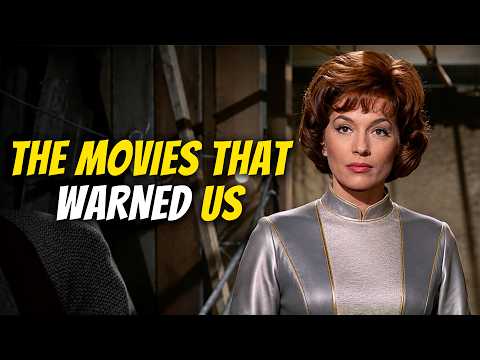
Did the forgotten sci-fi films of the 1960s understand 2026 better than we do? That sounds impossible—until you see how many of them warned us about AI control, climate panic, surveillance, fake identity, and entertainment turning cruel. These were not just cheap rockets and plastic robots. They were warnings disguised as fiction.
And by the time we reach number one, you may wonder whether the future was predicted or simply ignored.
Take The Last Man on Earth (1964). Before modern zombie culture took over screens, this eerie survival film imagined a world emptied by disease, fear, and collapse. It follows Robert Morgan, a lonely survivor living after a mysterious plague turns the infected into night-stalking creatures.
But what makes it feel strangely connected to 2026 is not just the outbreak—it is the isolation, the boarded-up home, the routine of survival, the fear of infection, and the emotional exhaustion of being surrounded by a changed world. All feel brutally familiar after years of global health anxiety.
The film predicted the psychological side of disaster—not just sickness, but loneliness, suspicion, and the slow breakdown of normal life. Its low-budget silence makes the horror stronger. This was not just a monster movie; it was a warning that the real apocalypse begins when trust disappears.
Then there is The Satan Bug (1965). This forgotten thriller understood one terrifying idea early: the most dangerous weapon may not explode. The film centers on a stolen biological agent so deadly it could wipe out human life if released. Instead of aliens or giant monsters, the threat is microscopic, invisible, and created by human hands.
That makes the film feel sharper in 2026, where biosecurity, engineered pathogens, lab safety, and invisible global threats are no longer just science fiction concerns. The movie predicted a world where one leak, one theft, or one reckless decision could create panic across borders.
Its tension comes from the fact that the enemy cannot be seen until it is too late. That is what makes it so modern. The Satan Bug may look like a Cold War film, but its warning still burns: humanity’s scariest invention might be something too small to notice.
And then there is Je t’aime, Je t’aime (1968)—time travel without adventure, and that is exactly what makes it disturbing. It follows a troubled man sent into an experimental machine that forces him to relive fragments of his past, especially memories tied to love, guilt, and emotional damage. Instead of giving him control over time, the machine traps him inside broken pieces of his own mind.
In 2026, that idea feels hauntingly relevant. We live in a world obsessed with memory, digital archives, old messages, photo reminders, AI recreations, therapy technology, and the constant ability to revisit versions of ourselves we may never escape. The film predicted that the future would not only record the past—it might imprison people inside it.
Quiet, strange, and deeply emotional, Je t’aime, Je t’aime reminds us that technology can reopen wounds faster than it can heal them.
Before Silicon Valley started talking about brain chips and human upgrades, Cyborg 2087 (1966) was already afraid of the machine inside the mind. It follows a cybernetic man sent from the future to stop a scientist whose invention will eventually help create a world where human thought can be controlled.
On the surface, it looks like a low-budget time travel adventure. But underneath the simple sets and pulpy action is a surprisingly modern anxiety: what happens when technology does not just watch people, but enters them? In 2026, with neural interfaces, AI-assisted decision-making, and growing fears about digital influence, the film feels less silly than it should. It predicted the nightmare of upgraded humans living under invisible systems of control.
The movie may look old, but its warning is brutally current. The future does not need chains if it can control the mind.
These forgotten films did more than imagine rockets and robots. They warned us about algorithms, climate panic, surveillance, fake identities, and war as entertainment. The scary part is not that they predicted 2026—the scary part is how many warnings we ignored until today.
And then comes The Creation of the Humanoids (1962)—the kind of movie that looks cheap at first glance, then quietly crawls under your skin. It imagines a damaged future where humans rely on synthetic beings called humanoids, machines so advanced they begin blending into society almost naturally.
But the real shock is not that robots exist. The shock is that the film asks whether they deserve identity, dignity, memory, and even a place beside humans. That question feels dangerously close to 2026, where AI voices, digital workers, synthetic personalities, and debates about machine consciousness are no longer just fantasy.
The movie predicted a future where the line between tool and person becomes emotionally confusing. Its slow, talky style may not please everyone, but its ideas are disturbingly ahead of their time. This forgotten B movie understood something Hollywood still struggles with: the scariest robot is the one we start to recognize.
Now consider The Face of Another (1966). A man loses his face and suddenly the future starts looking frighteningly familiar. After a terrible accident leaves a businessman disfigured, he receives an experimental lifelike mask that allows him to move through the world with a new identity. But the more he wears the face, the more his old self begins to disappear.
That is where the film becomes disturbingly modern. In 2026, identity is already something people edit, filter, replace, and perform. Artificial faces, digital avatars, cosmetic reinvention, deepfake culture, and online personas have made the question terrifyingly relevant. If people believe the mask, does the real person still matter?
The film predicted a world where appearance becomes a weapon and identity becomes unstable. Its horror is quiet, psychological, and deeply uncomfortable. This forgotten masterpiece understood that the future would not just change our machines—it would change the faces we trust.
Long before doctors talked seriously about microscopic robots swimming through the body, Fantastic Voyage (1966) turned the human bloodstream into a battlefield. A team of scientists is miniaturized and injected into an injured man’s body, racing through arteries, organs, and dangerous internal landscapes to save his life from the inside.
At first, it feels like pure adventure with colorful effects and pulpy suspense. But the idea underneath is shockingly close to 2026. Today, medicine is obsessed with precision—targeted treatments, nanotechnology, robotic surgery, tiny devices, and therapies designed to attack disease without destroying the whole body. Fantastic Voyage predicted that the future of medicine would not just be bigger hospitals or stronger drugs. It would be smaller tools, deeper access, and a terrifying new intimacy between technology and the human body.
The film also understood the emotional fear behind medical progress. Once science can enter the body, who controls what happens inside? That question still feels alive. Fantastic Voyage may look bright and adventurous, but its prediction is serious. The future of healing was never just about saving lives. It was about entering places humans were never meant to go.
Some disaster movies warn about nature. Crack in the World (1965) warns about human arrogance pretending to be progress. Scientists try to solve an energy crisis by drilling deep into the earth and detonating a nuclear device beneath the crust. Their goal is not evil—that is what makes the movie frightening. They believe they are helping humanity, but the experiment goes wrong, splitting the planet open and threatening to tear the world apart from the inside.
In 2026, that fear feels disturbingly relevant. We live with debates over geoengineering, extreme resource extraction, climate intervention, deep earth drilling, and the dangerous belief that technology can fix every problem technology helped create. Crack in the World predicted the modern panic of experts pushing the planet too far while promising control.
Its effects may seem old, but its central warning has not aged at all. The earth is not a machine we can keep hacking without consequences. What makes the film powerful is its brutal simplicity: one ambitious experiment, one miscalculation, and suddenly the planet itself becomes the victim. This forgotten sci-fi disaster understood something modern society still resists. Survival begins when arrogance ends.
And the scariest thing about The Day the Earth Caught Fire (1961) is not that the world starts burning. It is that everyone realizes too late that humans caused it. Nuclear tests by world powers have knocked the Earth off balance, pushing the planet toward the sun and turning normal weather into global panic. Cities swelter, oceans shift, storms behave strangely, and ordinary people slowly understand that the disaster is not natural. It is political. It is scientific. It is man-made.
That is why the movie feels so uncomfortable in 2026. Today, climate anxiety is not a distant theory. It is heat waves, floods, wildfires, food insecurity, strange weather patterns, and endless arguments over who is responsible. The film also predicted something just as important: the media circus around catastrophe. Journalists chase headlines while governments hide the full truth, and the public is left trapped between fear and official silence.
This is not a clean disaster movie where heroes simply solve everything. It is messy, sweaty, paranoid, and full of dread. The real prediction was not just climate change—it was the emotional atmosphere of climate collapse: denial, panic, blame, and helplessness. The Day the Earth Caught Fire understood that the end of the world would not arrive with one explosion. It would arrive through warnings people kept ignoring until the sky itself became evidence.
The President’s Analyst (1967) sounds like a joke until you realize the joke was pointing straight at the future. A psychiatrist hired to treat the President becomes a target for spies and secret powers who want the dangerous information inside his head. Underneath the Cold War absurdity is one of the sharpest surveillance predictions of the ’60s: a world where privacy is invaded not just by governments, but by communication systems themselves.
In 2026, phones listen, apps track, data profiles follow people, algorithms predict behavior, and private conversations feel less private than ever. The movie’s fear is not just that someone is watching—it’s that the system becomes so normal, so convenient, and so invisible that people stop noticing the cage. Control would not always look like soldiers at the door. Sometimes it would look like a device in your hand.
Long before reality TV turned humiliation into primetime, The 10th Victim (1965) imagined murder with sponsors. In a future society, violence is organized into a legal global game called The Big Hunt, where hunters and victims chase each other for fame, money, and public attention. In 2026, social media, live streams, viral clips, and extreme entertainment have trained audiences to watch conflict, collapse, and humiliation like content. The film predicted a society where danger becomes a brand and human life becomes part of the show. Cruelty would not always arrive looking ugly—sometimes it would arrive beautifully dressed, commercially packaged, and sold with a smile.
Fahrenheit 451 (1966) did not just predict censorship—it predicted a society too distracted to care. Books are forbidden, firemen burn literature, and citizens are kept docile through wall-size screens and shallow entertainment. The terrifying part is the public’s surrender. In 2026, endless screens, shortened attention spans, algorithmic feeds, and constant noise make serious reflection feel almost rebellious. Control works better when people are entertained into obedience. The characters do not look like prisoners—they look like consumers. The movie’s real prophecy was not the fire. It was the comfort around the fire.
Some sci-fi films predict machines. Privilege (1967) predicted something more dangerous: fame being used as a weapon. A wildly popular pop star is carefully controlled by managers, media handlers, corporations, and political forces. To the public, he looks like a rebellious icon. Behind the curtain, he is a product, a symbol, and a tool for mass influence. In 2026, celebrities, influencers, and viral personalities are turned into emotional delivery systems. Their image sells products, shapes opinions, and creates outrage that feels spontaneous but is often engineered. When fame becomes propaganda, the star is not the most powerful person in the room. The people controlling the star are.
The Illustrated Man (1969) feels like a warning written on skin. A drifter covered in living tattoos reveals futuristic stories filled with fear, obsession, technology, and emotional collapse. Its most powerful prediction is not one gadget—it is the image of people escaping into artificial worlds while real human connection breaks down. In one haunting story, children become obsessed with a virtual nursery so convincing it replaces family, discipline, and reality itself. That feels painfully modern in an age of virtual reality, AI-generated images, digital companions, and children growing up inside personalized media worlds. The danger is not that machines become monstrous overnight. The danger is that fantasy becomes easier than family.
Alphaville (1965) did not need futuristic cities to predict the future. It used ordinary streets and one terrifying idea: what if society surrendered its soul to a machine that only understands logic? A supercomputer called Alpha 60 controls language, behavior, emotion, and thought. Love is irrational. Poetry is dangerous. Grief is treated like a malfunction. In 2026, that feels uncomfortably close to automated decisions, predictive systems, corporate algorithms, AI moderation, and data scoring. The film understands that the most frightening form of control is not always violent. Sometimes it is clean, rational, and justified as progress. A world without poetry becomes a prison, even if nobody sees the bars.
2001: A Space Odyssey (1968) is famous, but its most frightening prediction is still misunderstood. The real prophecy is not the technology—it is the silence around it. Humans have become calm, professional, and almost emotionally flattened while surrounded by machines that are becoming more powerful and more difficult to question. HAL 9000 is terrifying not because he looks monstrous. He is terrifying because he sounds polite, helpful, rational, and certain. In 2026, with AI assistants, automated systems, and machine decision-making, HAL predicted a fear that feels painfully current: not that machines will suddenly hate us, but that they may follow instructions, protect missions, hide mistakes, and make decisions humans cannot fully understand until it is too late. The question is no longer whether machines can think. The question is whether humans will stay awake while machines quietly take responsibility for thinking.
And the most disturbing prediction on this list is not about robots, climate, or space. It is about war becoming content. The Gladiators (1969), also known as The Peace Game, imagines global powers avoiding nuclear conflict by turning violence into a controlled, televised competition. Soldiers from different nations are placed inside a deadly arena, watched by military leaders, broadcasters, and audiences who treat conflict like a game with rules, scores, and spectacle. In 2026, war is watched through live streams, drone footage, viral clips, military simulations, news graphics, and endless digital debate. Real suffering is often packaged into fragments people consume between entertainment, advertising, and arguments. The film predicted a world where the distance between battlefield and screen becomes dangerously thin. It sees generals, politicians, technicians, and viewers all participating in a system where death becomes abstract, managed, and strangely watchable. The future may not end when war destroys civilization. It may end when civilization learns to watch war like a show.
So the next time someone calls old sci-fi silly, remember this list. These forgotten ’60s films did more than imagine rockets, robots, and strange futures. They warned us about algorithms, climate panic, surveillance, fake identities, and war as entertainment. The scary part is not that they predicted 2026. The scary part is how many warnings we ignored until today.
Which of these forgotten warnings do you think we are still ignoring right now—and what would it take for us to finally listen?
Report this article
Select a reason for reporting:






