At 3:00 AM on July 7, 1944, a Marine artillery officer named Arnold Hoffsteader heard the crack of rifle fire in the darkness ahead. Then came an order that made no sense for a field battery: cut the fuses to 4/10 of a second—the shortest setting the shell had. There is only one reason a crew trained to kill men seven miles away sets a fuse that short. They expect to fire at something close enough to touch.
Hoffsteader did not yet know what was coming down that coastal plain toward his guns. He had less than two hours to find out.
To understand why thousands of men would walk into artillery in the dark, you have to understand what Saipan was worth. It sat roughly 1,300 miles south of Tokyo—close enough that B-29 Superfortresses flying from its airfields could reach the Japanese capital and come home. For the United States, Saipan was a runway to the enemy’s heart. For Japan, losing it meant the home islands would burn.
By the first week of July, that fight was almost over, and Japan had lost it. Three American divisions had driven the defenders into the island’s northern end. The senior Japanese commander, Lieutenant General Yoshitsugu Saito, was wounded, sick, unable to keep food down. His men were eating grass and tree bark. His artillery was gone. His radios were dying.
On the morning of July 6, he dictated a final order: “Whether we attack or whether we stay where we are, there is only death.” He told the survivors to take seven American lives for each of their own and to leave their bones on Saipan. Then he ate a last meal of canned crab and sake, turned to face the east, and had his aide shoot him in the head. He would not live to see the charge he ordered. Remember that. It matters later.
What stood in the attack’s path was thin. Two battalions of the Army’s 105th Infantry Regiment had been pushed forward across the Tanapag plain, a flat coastal shelf about 800 yards wide, hemmed by the sea on one side and limestone ridges on the other. They had dug in late in the dark after a rushed advance ordered over their own colonel’s objection. Between the First Battalion and the high ground on its flank lay a gap of several hundred yards. The battalion commanders asked for men to fill it. They were refused.
The day before, the ground had already shown what close-range killing on that plain looked like. A platoon of Army light tanks under Lieutenant Willis Dory had rolled into a drainage ditch packed with Japanese soldiers jammed almost shoulder-to-shoulder and cut down well over a hundred of them with machine guns and canister at point-blank range. The plain was a killing floor. The only question left was who would do the killing and in which direction.
Behind the infantry sat the artillery. And the artillery is where this story turns. The Third Battalion, 10th Marines, belonged to the Second Marine Division. It was a field artillery outfit—four batteries of howitzers whose job was to sit well behind the front line and drop high-explosive shells on targets miles away, called in by radio. Its commander was Major William Crouch. Its forward battery, Battery H, left behind one account that survives, written by one of its officers, First Lieutenant Arnold Hoffsteader. His report is the reason we know what the inside of that gun line felt like when it ended.
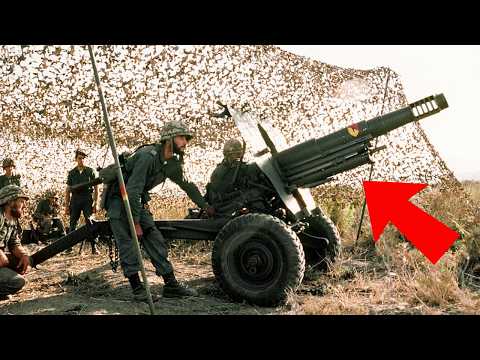
Their weapon was the 105 mm howitzer—the 105 to the men who served it. It was the backbone of American artillery in the war. A split-trail piece a crew of eight could work, throwing a 33-pound shell more than seven miles. That was the entire point of it. A howitzer kills people it cannot see. The crew never meets the enemy. They take down coordinates, set the fuse, pull the lanyard, and somewhere beyond the horizon, men they will never look at come apart. The whole weapon is built around distance. Hold on to that number—seven miles—because before this morning is over, it collapses to 50 yards.
These guns had fought hard just to get onto the island. On June 15, the day of the landings, the surf off Charan Kanoa was too rough for landing craft, so the howitzers came ashore inside amphibious trucks driven through a channel under intermittent Japanese shellfire. Crouch brought the battalion in by that same route late in the afternoon. Two days later, they proved their worth. In the pre-dawn dark of the 17th, the Japanese threw more than 40 tanks and their infantry against the Marine line near Garapan—the largest tank attack of the Pacific War. Naval star shells turned the night into a flickering gray day, and bazookas, halftracks, Shermans, and masked artillery tore the attack apart. The guns did what guns do from behind the line at range.
By the first week of July, the pattern held. When American patrols picked up movement around the village of Makunsha on the night of the 6th and a captured Japanese sailor told interrogators that an all-out attack was coming, the division’s artillery went to work on the assembly areas in the dark. In one hour that morning, the 27th Division’s howitzers alone fired more than 2,600 rounds into the ground where the enemy was massing.
Down on the gun line, Battery H’s fire started far off at around 3:00 in the morning. The order came down to cut the time fuses on the shells to 4/10 of a second—the shortest setting the fuse had. A shell cut that short bursts almost the instant it clears the barrel. There is only one reason to set a fuse that way: you expect to fire at something close enough to touch.
So the gunners were ready. They had the warning. And what came at them would still do something that field artillery has no word for. And before it was over, one of those guns would be pointed the wrong way, firing backwards into its own position.
At 4:00 in the morning, the charge came out of Makunsha. It came down the coast in three streams—along the beach, along the coast road, and along the narrow-gauge sugar-cane railway that ran the length of the plain. Somewhere between 3,000 and 5,000 men. No one would ever count them cleanly. Among them were riflemen and machine gunners, but also cooks, clerks, sailors, the walking wounded on crutches, men carrying nothing but a bayonet lashed to a wooden pole. Three tanks rolled with them. And behind the fighting men came the ones who could barely stand, because Saito’s order had been simple: Everyone who could move would attack. Everyone who could not would die where they lay.
At 4:45, it struck the First and Second Battalions of the 105th Infantry. The two Army battalions had machine guns, mortars, and artillery on call. For a few minutes, it was enough. Then the sheer weight of bodies closed the distance, poured through the open gap on the flank, and came at the perimeter from the front, the side, and the rear all at once. Communications went down almost immediately. The fight became a thing measured in feet. In places, the soldiers stacked so many enemy dead in front of their foxholes that they had to shift position just to keep a clear field of fire.
Lieutenant Colonel William O’Brien commanded the First Battalion. When his lines broke, he emptied a pistol in each hand, then got behind a .50-caliber machine gun and kept firing. His last message out before the radios died was not a report. It was a plea: “For God’s sake, get us some ammunition and water.” He was last seen alive standing upright at that gun, firing into the mass closing over him. They found his body there afterward.
In the same battalion, Sergeant Thomas Baker had already been hit. He refused to be carried out. The line kept collapsing around the men trying to drag him back. So, in the end, he asked to be propped against a tree with a pistol and eight rounds. When the Americans retook the ground, they found him in that exact position. The pistol was empty. Eight dead Japanese soldiers lay in front of him.
About 50 yards behind the line, Captain Ben Solomon was running an aid station. Solomon was not an infantry officer. He was a dentist, filling in as the battalion surgeon, and his tent was crowded with wounded men when the attackers tore through the canvas. He killed the first few with a rifle and bayonet, screamed at the wounded to get out, and took over a machine gun after its four-man crew was killed. They found him later slumped over the gun. In front of it lay 98 dead.
Major Edward McCarthy, who commanded the Second Battalion and lived, later compared it to a cattle stampede out of an old western. “You could shoot the men in front and the ones behind would trample over them and keep coming.” In roughly 25 minutes, two battalions—more than a thousand men—were effectively destroyed. One in four walked away.
Which brings the wave back to the gun line. Three field artillery batteries, crews trained to fight a war they would never have to look at, and a mass that has just erased a thousand infantrymen now turning south toward the howitzers. What a field battery is supposed to do when the enemy is inside 50 yards is written in no manual anywhere. In the next few minutes, Hoffsteader’s gunners are going to have to invent it.
The charge did not stop at the infantry. It kept coming south down the railway and the road toward the guns. The first Marine battery in its path was Battery I, dug in astride the railroad track. At 4:55, the attackers came out of the half-light. The gunners fought them off with rifles and carbines. And when the first wave fell back, another came. It went on like that for nearly two hours.
By ten minutes to seven, Battery I had no small-arms ammunition left. Its commander, Captain John Allen, ordered the firing locks stripped out of his howitzers so the guns could never be turned on his own men, and pulled his gunners back to the next battery in line. Battery H had no room to fall back. It was the forward gun closest to the enemy, and the enemy was now in front of it in the open.
Out of the gray, Hoffsteader’s gunners saw a column of men coming up the plain at about 600 yards. They held their fire. American soldiers might still be out there falling back. They waited until the range closed to 400 yards and they could see the mob clearly for what it was. Then they opened up.
They fired the 105s flat into the crowd. With the fuses cut to 4/10 of a second, the shells burst in the air barely 50 yards past the muzzles—a wall of steel splinters sweeping the ground at the range of a city street. When even cutting fuses took too long, the gunners dropped the barrels lower and skipped the shells off the hard ground so they would ricochet up into the men behind. There was no careful laying of the piece. There was no calculating. There was only loading and firing as fast as human hands could move.
The Marine Corps history of that morning records it in a single plain line: in this fight, the ammunition handlers and the loaders were kings. The officers trained to compute firing data had nothing left to compute. The entire science of artillery had come down to how fast a man could shove a shell into a breech and slam it shut.
Private First Class Philip Spry stood at his piece and loaded shell after shell into a gun firing straight into men less than a hundred yards away. He kept loading it until he was badly wounded and could not stand. Then a Japanese medium tank broke through behind the battery, in among the guns, on the wrong side where nothing was pointed. There was no time to displace. The crew of one howitzer threw their weight against the trails and physically wrestled the whole piece around—a ton and a half of steel—until it faced the rear. They fired on the tank over open sights from less than 50 yards and destroyed it. A field howitzer built to kill men seven miles away had just killed a tank it could nearly have hit with a thrown rock.
It could not last. The attackers kept walking into the fire, climbing over their own dead, and they got in among the guns with rifles and grenades. Hoffsteader’s account is stark. The cannoneers, he wrote, were shot from their posts. Men fell across the breeches they had been loading. The howitzer fire faltered, stuttered, and finally stopped, because there was no one left standing to serve the pieces.
Just behind Battery H sat the battalion headquarters and the fire direction center. The wave rolled over it. Major Crouch, the battalion commander, was killed there by rifle fire among his own command group. The survivors of Battery H broke to the rear. A Japanese penetration through a wooded ravine on their left drove them back about 150 yards across a road into an abandoned Japanese machinery dump—a junkyard of rusting equipment. There they made a stand. Hoffsteader counted their whole arsenal: a handful of carbines, one automatic rifle, a single pistol, and eight Japanese rifles they had picked up off the dead. With that, a battery of artillerymen held a scrapyard against a banzai charge.
In the rush to get out, they had made a mistake that should have been fatal. They had left the guns intact—breech blocks and firing locks still in place. Perfectly good howitzers abandoned to the enemy, ready to be turned around and fired into the American rear. The Japanese who swarmed over Battery H’s position never touched them, never turned the guns, never tried. They had been sent to die, not to win. And men who have come to die do not stop to learn artillery.
Through all of it, one man kept driving into the fire. Private First Class Harold Agerholm, 19 years old, from the sister battalion next door, found an abandoned ambulance jeep and drove it back and forth across open ground, swept by rifle and mortar fire for more than three hours, loading and hauling out the wounded by himself. He evacuated something close to 45 men. When he spotted two more figures he thought were wounded Marines and ran for them, a sniper killed him.
Behind Battery H, Batteries G and I held their ground through the morning. A Battery G man, Private First Class Max Timonss, ran 50 yards out ahead of his own guns to an abandoned machine gun, fired it dry into the attackers, then went and fetched a captured enemy gun to cover a neighboring battery before he would pull back. The spearhead of the charge pushed on past the guns another quarter mile, all the way to the command post of the 105th Infantry, where headquarters clerks and a few tanks fought from old Japanese holes. Their perimeter was never broken.
And then the counterattack came the other way. Around midmorning, two battalions of the 106th Infantry pushed up the plain against the shattered mass. By early afternoon, Company F had retaken the first overrun Marine battery. By around three in the afternoon, the guns of Battery H were back in American hands—some of them recovered with the help of the very Marine gunners who had stayed in the area and fought on. The relief reached the survivors in the machinery dump at about the same hour. They had held since seven that morning.
Not everything went right even then. Around noon, American artillery observers mistook the surviving infantry perimeter at Tanapag for a Japanese position and shelled their own men, driving survivors into the sea, where destroyers and amphibious tractors pulled them off the reef under fire. The last of them came out by tractor at ten that night.
By late morning, the attack had spent itself. In places, the surviving Japanese had begun turning their last grenades on themselves. The largest banzai charge of the war had reached its limit, and the limit was a line of men who would not move.
The men who made that charge knew it was hopeless before they stepped off. Saito’s order had promised that death itself was a kind of life. But the officers who planned the attack admitted under interrogation afterward that they expected it to achieve nothing. There was no breakthrough to exploit, no reinforcement coming, no plan for anything past Tanapag. It was, in the cold phrasing of a captured staff officer, not intended to serve any tactical purpose. It was a way to die attacking rather than die waiting.
Not every man believed in it. Sergeant Teo Yamuchi of the 136th Infantry, a conscript who had read banned books and quietly wanted to live, understood exactly what the order meant. General attack, he said later, meant suicide. Men too hurt to walk were handed grenades or cyanide. When Yamuchi hesitated, his own soldiers called him a traitor and told him to act like a soldier. He lived because he chose to surrender—which the code he fought under treated as the deepest disgrace a man could choose.
The horde that came down the Tanapag plain was not a wave of fanatics by nature. It was a column of ordinary men driven forward by a military state that had decided their deaths were worth more than their lives.
And here is where the popular version of this morning and the record on the ground part ways. The story gets told as a wall of Marine howitzers firing muzzle to muzzle into the horde. The truth is narrower and in its way harder. Only one battery, Battery H, ever fired its guns point-blank. The others were masked by friendly troops in front of them and fought the entire morning as infantry with rifles and carbines and whatever they could pick up off the dead.
The American side of that morning was not clean either, and the record does not pretend it was. The gap in the Army line that led the charge into the rear had been left open after the men holding it asked for help and were told no. Tanks had been sent forward without infantry and lost. The relief column halted a few hundred yards short of the trapped men against the advice of one of its own commanders, and perfectly good howitzers had been abandoned in the retreat.
In the weeks that followed, the Army and Marine commands fought a quieter, uglier battle over the dead. Who had killed how many? Whether the Army infantry had held or broken? Whether the 4,311 bodies counted on that plain had all fallen in the charge or had been dying there for days. The men who did the actual fighting had no part in that argument. A Navy admiral’s investigation settled the only question that mattered. The soldiers and Marines on that plain had fought with courage, it found. And the Army infantry and the Marine gunners deserved particular mention.
And remember the order that started it—the one that ended with “Follow me.” The general who wrote it never followed anyone anywhere. Saito was already dead by his own hand before the first man stepped off. The largest banzai charge of the Pacific War went forward without the commander who sent it, toward a line he never saw.
Saipan fell on the 9th of July 1944. The cost of taking it ran to more than 14,000 American casualties. The Japanese garrison, over 30,000 strong, was almost entirely destroyed. In the days that followed, hundreds of Japanese civilians, convinced by their own government’s propaganda that the Americans would torture them, walked off the cliffs at the island’s northern end, some of them carrying their children. It is a part of Saipan that no account should pass over, and none should linger on.
What the Americans wanted were the airfields. They got them. On the 24th of November 1944, more than 100 B-29 bombers lifted off from Saipan and flew north to strike Tokyo—the first raid on the Japanese capital since the Doolittle attack two and a half years earlier. The runway to the enemy’s heart was open. Within days of Saipan’s fall, the government in Tokyo had collapsed. A Japanese admiral said afterward simply that the war was lost with the loss of Saipan.
Of the men who fought that charge, four received the Medal of Honor. Colonel O’Brien and Sergeant Baker of the Army infantry, Captain Solomon the dentist, and Private Agerholm with his stolen ambulance jeep. Three of the four were awarded for deaths no one survived to witness, pieced together afterward from the positions of their bodies and the enemy dead heaped around them. The Third Battalion, 10th Marines, received the Navy Unit Commendation for the morning it fought as infantry over its own guns. The gunners who lived called it ever after simply the raid.
They had trained to be the men who never saw the enemy, who worked by map coordinate and radio and the clean mathematics of distance, killing at seven miles. For one gray morning on the Tanapag plain, every yard of that distance was taken from them, until the enemy was close enough to load against, close enough to touch, close enough to kill a tank with a gun they turned around by hand. The howitzers were built to fight a war the crews would never have to look at. On the 7th of July, 1944, they looked at it.
What would you have done, standing at that gun line when the distance collapsed to fifty yards?
Report this article
Select a reason for reporting:






