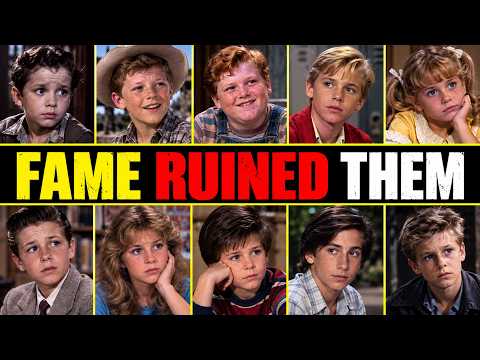
They were the faces that defined our childhoods, the voices that echoed through our living rooms, the children who made us laugh and cry on screen. But when the cameras stopped rolling and the reruns began, many of them were left to navigate a world that had already used them up and tossed them aside. Hollywood is a machine that chews up talent and spits out broken souls, and nowhere is that more evident than in the stories of classic TV child stars whose lives spiraled into tragedy.
These are the forgotten children of television, the ones who gave us unforgettable performances but were never given a fair shot at a normal life. Their stories are not just cautionary tales; they are indictments of an industry that profits from youth and discards it without a second thought. From the boy who voiced Peter Pan to the girl who played Wednesday Addams, their fates are a chilling reminder of what happens when the spotlight fades and no one is there to catch you.
Take Bobby Driscoll, the voice of Disney’s Peter Pan. He was the most valuable child in Hollywood, winning a Juvenile Academy Award and starring in hit after hit. But when puberty hit and acne scarred his face, Disney cut him loose at 16. He spiraled into heroin addiction, was arrested, and ended up dead in an abandoned tenement at 31, buried in an unmarked grave. The boy who promised never to grow up grew up, and the studio that owned him threw him away for it.
Then there’s Carl Switzer, forever known as Alfalfa from The Little Rascals. He earned pennies for shorts that played for decades, while he struggled to pay bills as an adult. He took odd jobs, battled a reputation for drinking and fighting, and was shot dead over a $50 debt at 31. The man who made millions laugh died for pocket change, and Hollywood barely noticed because a bigger star died the same day.
Jeremy Miller, who played Ben Seaver on Growing Pains, had his first taste of alcohol on the set as a young child. By his teens, he was drinking regularly, and after the show ended, he became a full-blown alcoholic. Doctors warned him his body couldn’t take it, and he credits his sobriety since 2015 with saving his life. But the damage was done, and his story is one of the luckier ones on this list.
Lonnie O’Grady, the eldest daughter on Eight Is Enough, suffered from severe panic attacks and self-medicated with prescription drugs and alcohol for over a decade. She checked into a mental health ward to detox but died at 46 from a lethal mix of Vicodin and Prozac. The dependable big sister on screen couldn’t hold herself together off screen.
Billy Gray, the wholesome son on Father Knows Best, was arrested for marijuana possession at 24 and found his career instantly over. He became bitter about the show, believing it sold a false picture of American family life. He spent decades away from Hollywood, working in motorcycle racing and mechanical design, but never escaped the shadow of Bud Anderson.
These are just a few of the names on a long and heartbreaking list. The stories that follow are even darker, from a 20-year-old who took his own life after his career ended at 10, to a beloved child actress who died of a drug overdose at 18. Each one is a reminder that the price of fame can be far higher than anyone imagines, especially for those who never asked for it in the first place.
Trent Lehman was only ten years old when Nanny and the Professor was cancelled, and with it went everything. There was no scandal, no dramatic fall—just silence. He picked up a few small guest parts, but by the middle of the decade even those had dried up. At school, kids recognized him from television and wouldn’t leave him alone. As a teenager, he found it harder and harder to fit in anywhere.
His family later described a young man who struggled to find his place without the attention that had once surrounded him, and without any clear direction for the rest of his life. In an industry with no system at all for helping child performers after the cameras stopped, nobody stepped in. Today there are laws and support groups that try to protect young performers, but almost none of them existed when he needed them.
In January of 1982, at just twenty years old, Trent Lehman took his own life at an elementary school near his home in Los Angeles. Eleven years had passed since his last episode. His death received only brief attention in the press, and today his name is known mostly to people who study what happened to television’s forgotten children. His former co-star, Kim Richards, who played his sister on the show, would go on to face her own long and very public struggles decades later.
Tracy Gold was carrying a secret that the show made much worse. She had first shown signs of anorexia around the age of twelve, and in her late teens the illness returned with frightening force—fed in part by jokes about her weight that were written into the scripts themselves. After she gained some weight as a teenager, the writers began including cracks about Carol’s size, and the teasing on screen deepened a struggle she was already fighting in private.
By 1992, her weight had dropped to a dangerous level and she was hospitalized. She had to leave the series before its final season ended, and the public watched her disappear from the screen almost literally. Gold later wrote a memoir about her battle with the eating disorder and became an advocate, speaking to young women and families about a disease that was rarely discussed openly at the time.
Then in 2004, she made headlines again for a very different reason when she was arrested for driving under the influence after the SUV she was driving rolled over on a freeway with her husband and three young sons inside. Nobody was killed, and she publicly accepted responsibility, but the images of the overturned vehicle reminded everyone how much she had been struggling out of sight. She has spent the years since focused on her family and her recovery, and in 2011 she hosted a television series following women fighting eating disorders, turning the illness that nearly killed her into a way to reach others.
Scotty Beckett’s adult life was a long string of disasters. Beginning in the late forties, he was arrested again and again—for drunk driving, for carrying a concealed gun, for writing bad checks, for assault. Each arrest landed in the newspapers alongside photographs of him as a cute little boy, which made him an embarrassing reminder of better days and guaranteed that no studio would take a chance on him. He struggled with alcohol and drugs, attempted suicide at one point, and went through failed marriages.
He tried to leave acting behind, including working outside the industry, but the problems followed him. In May of 1968, Beckett was admitted to a nursing home in Hollywood after being badly beaten. He died two days later, just thirty-eight years old. Pills and a note were reportedly found, but the exact cause of death was never clearly established. At one point he had enrolled at the University of Southern California with plans for a completely different career, but he never managed to escape the downward spiral long enough to finish. He died only weeks after Bobby Driscoll’s body had been found in New York.
Willie Ames was earning serious money as a teenager, but by his own account, almost none of it was handled well. A large share was lost through bad management, and the rest went into a cocaine addiction that began in the early eighties and followed him for years. He went through a divorce and has spoken publicly about a suicide attempt during his darkest period.
Then remarkably, he reinvented himself as a Christian television hero, creating and starring in a children’s series called Bibleman, which ran for years. The series was sold mainly on video through churches and Christian bookstores rather than broadcast on network television, and it never brought in the kind of money his earlier fame had. It did not fix his finances.
In 2008, Ames filed for bankruptcy, and he has described losing his home and going through a period with nowhere to live—a staggering fall for someone who had once lived in a house with an ocean view. He took a job as a cruise ship director, organizing entertainment for passengers who may not have realized who he was. Later, he trained to work in financial planning, saying he wanted to help other people avoid the mistakes he had made with money.
Danny Pintauro had already made a name for himself as a small child in the horror film Cujo, and from 1984 to 1992 he was part of one of the most popular sitcoms on television. But as an adult, he struggled to find his footing. He had come out as gay in the late nineties after learning that a tabloid was preparing to reveal it anyway. At the time, very few actors in Hollywood were openly gay, and it was a risky step for someone whose career had been built on playing a sweet, wholesome little boy in one of the top ten shows in America.
Later, after the end of a relationship, he began using crystal meth and the addiction took over his life. In a 2015 interview with Oprah Winfrey, Pintauro revealed publicly for the first time that he was HIV positive and had been since 2003. He explained that his meth use had led to the risky behavior through which he contracted the virus. He told Winfrey that he had wanted to share it for a long time but had not been ready.
The confession made headlines around the world and he said he chose to share it to warn others about the connection between drugs and HIV. He has spent the years since in recovery speaking about addiction and health and building a quieter life away from the industry. He married his husband in 2014. He has since spoken at events about addiction recovery and HIV awareness, trying to reach young people who might be heading down the same road.
Johnny Whitaker was one of the busiest child actors in Hollywood, starring in Family Affair and later as Tom Sawyer. But the story around him was already turning dark. His on-screen twin, Anissa Jones, died of a drug overdose in 1976 at just eighteen, a loss that stayed with him. As Whitaker grew up, the roles dried up and he struggled to find his way in an industry that had no use for a grown-up Jodie.
He left for a religious mission overseas, returned, and eventually fell into serious drug addiction that took over much of his adult life. He has talked openly about how far he fell. Tragedy followed the rest of that television family, too. Brian Keith, who played the children’s uncle, took his own life in 1997, not long after the death of his own daughter.
In 1995, Whitaker got sober and he went on to work as a drug and alcohol counselor, using his own experience to help people fighting the same addiction. He has also spoken out about the lack of protection for child performers and about how many of the children from his era did not survive to tell their stories. His life has become one of the more hopeful endings on this list, but only after years that nearly destroyed him.
Kim Richards was one of the most successful child actresses of the seventies, starring in Disney’s Escape to Witch Mountain and later on The Real Housewives of Beverly Hills, where her struggles played out in front of millions. In April of 2015, she was arrested at the Beverly Hills Hotel, and only months later she was arrested again for shoplifting from a Target store. It took years of court-ordered probation before her legal problems were finally behind her.
And then there is Lisa Loring, the original Wednesday Addams. She was only five when she was cast, and actors in sixties television, especially children, had no rights to income from reruns. The show earned money for decades without paying her. In January of 2023, she suffered a massive stroke and died at sixty-four—just weeks after the new Wednesday series had made the character more famous than ever. Many fans learned her name for the first time from the tributes that followed.
These are the children Hollywood left behind, the ones who gave us unforgettable performances but were never given a fair shot at a normal life. Their stories are not just cautionary tales; they are indictments of an industry that profits from youth and discards it without a second thought.
So here is the question we have to ask ourselves: when we watch those old reruns and smile at the faces that once lit up our screens, do we owe them more than just our nostalgia?
Report this article
Select a reason for reporting:






