The first wave of Soviet tanks reached the outskirts of Berlin on April 21, 1945, and with them came a tide of revenge that no one had prepared for. Women and children huddled in cellars, their faces blackened with ash, their hands trembling as they whispered prayers to a God who seemed to have abandoned them. The Nazi propaganda machine had promised them that the Red Army would show no mercy—and for once, the propaganda was not a lie.
What followed was a nightmare of rape, murder, and starvation that would scar generations. An estimated one in three women in Berlin suffered sexual assault at the hands of Soviet soldiers, many of them survivors of Nazi atrocities themselves. The line between justice and vengeance blurred into a river of blood.
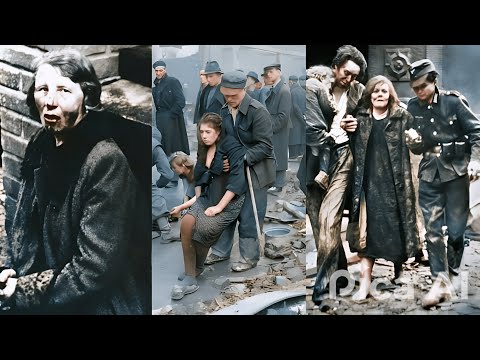
But Berlin was not alone. Across the crumbling Reich, from the burning streets of Dresden to the frozen fields of East Prussia, millions of German civilians faced a fate that history books often gloss over. They were not the architects of Hitler’s war—they were the elderly, the women, the children who had stayed behind while the men fought and died.
And now, the war had come home to them.
The collapse had been swift. By early 1945, Soviet forces had pushed relentlessly from the East, crushing German defenses and leaving a trail of destruction in their wake. Hitler, holed up in his bunker, grew increasingly delusional, feeding his people lies about nonexistent victories while Soviet artillery thundered just miles away. The German people, trapped between a madman’s orders and an approaching storm, had nowhere to run.
When the end finally came—Hitler’s suicide on April 30, the raising of the red flag over the Reichstag on May 2, the unconditional surrender on May 7—it did not bring peace. It brought a new kind of terror.
Allied armies raced to capture Nazi war criminals, but the common German citizen was left to face the consequences of a war they had never wanted. The reprisals were brutal and indiscriminate. Soviet soldiers, many of whom had lost families to German extermination policies, unleashed their fury on anyone they found. Rape, execution, and deportation became daily realities.
In the town of Demmin alone, hundreds of residents chose death over surrender—whole families drowned themselves in the river rather than face what was coming. It was a mass suicide unprecedented in modern history, a collective act of despair that spoke to the sheer terror of those final days.
And yet, this was only the beginning. The expulsions from Eastern Europe, the forced labor camps, the hunger, the cold—the suffering of the German people after the war would continue for years, a silent echo of the horrors they had unleashed upon others.
This is the story of what happened when the guns fell silent—and the reckoning began.
The reckoning came first to the East. In the territories of Poland, Czechoslovakia, and Hungary, millions of ethnic Germans who had lived there for generations suddenly found themselves declared enemies of the state. Between 1945 and 1950, an estimated 12 to 14 million Germans were expelled from their homes, herded onto trains and forced to march westward into a shattered Germany that could barely feed its own.
The journeys were brutal. Refugees pushed carts through snow and rain, carrying whatever they could salvage. Many died of hunger, exposure, or disease along the way. Children were separated from parents. The elderly, too weak to walk, were left behind.
In Czechoslovakia, the expulsion of Germans from the Sudetenland was accompanied by public beatings and summary executions. In Poland, entire villages were emptied overnight. The Allies had sanctioned the transfers at Potsdam, calling them “orderly and humane,”—but there was nothing humane about what actually happened.
By the time the transports reached Germany, the country itself was in ruins. Cities lay in rubble. Food was scarce. Housing was nonexistent. The refugees arrived in a land that had nothing left to give them.
For the German prisoners of war in Soviet hands, the ordeal was even longer. Of the roughly 3 million German soldiers captured by the Red Army, nearly a third would never return. They were marched through the Russian winter to camps where hunger, disease, and forced labor claimed lives by the thousands.
The survivors spoke of eating bark and grass, of watching comrades die of typhus and dysentery, of being worked to exhaustion in mines and factories. Repatriation, for most, did not begin until 1949 or later.
Back home, their families waited in vain. Women searched lists of the missing, wrote letters to authorities that went unanswered, and slowly learned to live with uncertainty.
The war was over, but for the German people, the suffering had only just begun.
In the Western zones, the situation was different but no less desperate. American, British, and French occupation authorities faced a population on the verge of collapse. In the winter of 1946–1947, known as the Hunger Winter, average daily caloric intake in some German cities dropped below 1,000 calories—less than half of what was needed to sustain a human being. Children developed rickets. Tuberculosis swept through overcrowded shelters. The elderly died quietly in unheated rooms, their bodies sometimes undiscovered for days.
The Morgenthau Plan, though never fully implemented, had cast a long shadow. Factories were dismantled, mines flooded, and industrial output deliberately suppressed. Germans who had once cheered Hitler’s victories now scavenged through rubble for firewood and traded family heirlooms for a sack of potatoes.
Yet even in this darkness, something unexpected began to stir. In the ruins of Cologne, a group of former soldiers and students met in a bombed-out church to discuss a new beginning. They called themselves the Ruinenmänner—the men of the ruins.
Their leader was a former Wehrmacht officer named Konrad Adenauer’s protégé, a quiet man who had refused to join the Nazi Party and had spent the war years in internal exile. He spoke not of revenge but of responsibility. “We cannot undo what was done,” he told the small gathering. “But we can ensure that our children inherit something other than ashes and shame.”
Similar groups were forming across the Western zones. In Hamburg, dockworkers organized to clear rubble from the port. In Munich, a former schoolteacher opened a makeshift classroom in a cellar, teaching children to read from salvaged books. These small acts of defiance against despair would later be remembered as the first seeds of the German economic miracle.
But the road ahead was long. The Allied denazification program, meant to purge former Nazis from public life, had become a bureaucratic nightmare. Millions of Germans were forced to fill out questionnaires detailing their wartime activities, and the line between perpetrator and bystander blurred into a gray haze of half-truths and convenient forgetfulness.
Many former party members simply lied. Others found that their technical skills were too valuable to lose—rocket scientists, engineers, and doctors were quietly rehabilitated while lesser functionaries faced public shame.
Meanwhile, the political landscape was hardening. The Soviet Union, under Stalin’s direction, was tightening its grip on its occupation zone, while the Western Allies began to see Germany not as a defeated enemy but as a potential ally against the growing communist threat.
The Cold War had begun, and the German people—still hungry, still grieving, still burying their dead—were about to become pawns in a new global struggle.
The Berlin Blockade of 1948 made the division permanent. When Stalin cut off all land routes to West Berlin, the Americans and British responded with an airlift that kept the city alive for nearly a year. Children stood on rubble piles waving at the planes, calling them Rosinenbomber—raisin bombers—for the sweets dropped from the sky.
It was a strange kindness after so much cruelty. For many Germans, the airlift marked the moment they began to believe they might one day be seen as human again.
By 1949, two Germanys stood facing each other across a hardening border. In the West, Adenauer’s Christian Democrats embraced the Marshall Plan and the new deutsche mark. In the East, the Socialist Unity Party built its workers’ paradise on the bones of the old order.
Families were split overnight. A farmer near Eisenach found his fields on one side of the wire and his brother’s house on the other. Letters took weeks to arrive, if they arrived at all.
The 1950s brought a fragile prosperity to the West. Factory chimneys rose again. Cafés reopened. But beneath the surface, silence reigned. Fathers who had served in the Wehrmacht spoke little of the war. Mothers who had endured the rapes of 1945 locked their memories away. Children grew up sensing a void they could not name.
It was not until the 1960s, when a new generation began asking questions, that the silence cracked. The Auschwitz trials of 1963 forced Germans to confront what their parents had done—and what they had chosen not to see.
Some wept. Some denied. Some walked out of the courtroom. But the truth, once spoken, could not be unspoken.
And in the East, a different reckoning was brewing. In 1953, workers rose up against the regime and were crushed by Soviet tanks. In 1961, the Wall went up, sealing the last open wound of the war.
For twenty-eight years, the Wall stood as the final monument to a conflict that had never truly ended.
When the Wall fell on November 9, 1989, Germans on both sides wept and embraced. But even as the crowds celebrated, the ghosts of 1945 lingered. The refugees of the expulsions, now elderly, still carried the keys to homes they would never see again. The prisoners who returned from Siberia still woke at night remembering the cold.
Reunification in 1990 brought a new beginning—and new anxieties. The past, it seemed, was never far behind.
Today, in quiet German towns, small plaques mark the places where families once drowned themselves in rivers. Museums display the letters of soldiers who never came home. Schoolchildren learn the names of the camps and the crimes committed in their grandparents’ name.
The suffering of the German people in 1945 was real. It was also the bitter harvest of a war they had allowed to be sown. Both truths must be held together—or neither can be understood.
What do you think—can a nation truly heal from such a wound, or do the scars of 1945 still shape the Germany of today? Share your thoughts below.
Report this article
Select a reason for reporting:






