The transport planes came in low over the Cretan coast, engines droning against the midday heat. Below them, the men of the 2nd Parachute Regiment stood ready—veterans of Holland and Greece, expecting another swift victory. They had been told the airfield at Rethymno was lightly defended. It was supposed to be the easiest of the three airborne objectives on the island. No one in those planes expected anything different.
But on the hills south of the runway, two Australian infantry battalions and two Greek regiments had been waiting for days. They had no tanks, no air support, and almost no artillery. What they had was the high ground—and the time to dig in. From those ridges, they could see every inch of the airfield and every parachute that descended toward it.
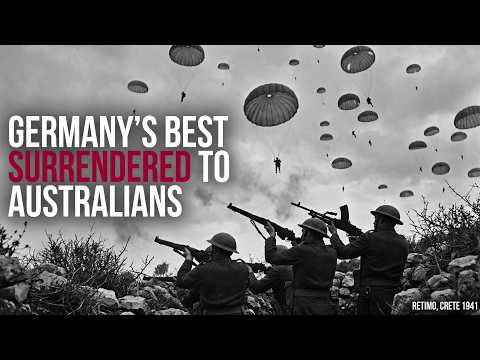
When the first paratroopers began to jump, they dropped directly into the waiting guns. The Australians opened fire the moment the transports appeared. Men dangling beneath silk canopies became targets before their boots ever touched the earth. Among them was Colonel Alfred Sturm, commander of the 2nd Parachute Regiment. He landed—not near the Australian headquarters, but inside it.
Sturm had jumped expecting to direct the battle from a position near the airfield by evening. Instead, he found himself surrounded by Australian staff officers who had been sitting in that same trench since dawn. Within minutes, the regimental commander was killed or captured—along with his entire headquarters staff. The men on the ground were left leaderless, their plan lost with the man who understood it.
The battle for Rethymno had begun with a catastrophic miscalculation. German intelligence had painted a picture of a lightly held airfield, and the drop zones had been chosen accordingly. No one in the transports could have known that the fields below had been ranged, the machine guns sighted, and the entire descent would unfold under enemy fire.
On the ground, chaos reigned. Paratroopers scattered across a wide area, many landing far from their weapons containers. Some fought with pistols and grenades; others scrambled for rifles dropped in separate canisters. The Australians and Greeks, meanwhile, poured fire into every descending figure. It was less a battle than a slaughter from the sky.
By nightfall on the first day, the Germans had managed to establish footholds on both flanks—a village to the west and an olive oil factory to the east. But the hills and the airfield remained in Allied hands. The force that had jumped expecting to seize the runway by tea-time was now fighting for its life.
What happened next would decide the fate of Rethymno—and the story of Crete itself. The Germans attacked Hill A, the highest point overlooking the eastern approach to the airfield. On May 21, they took it. From that summit, they could observe and fire directly onto the runway. The Australian defense, built on holding the high ground, suddenly faced an enemy looking down on them.
Campbell ordered a counterattack. The first attempt failed. The second failed too. Two uphill assaults against entrenched positions, in broad daylight, across open ground—the oldest losing proposition in infantry warfare. But on May 22, a third attack was launched in four separate columns, hitting the Germans from multiple directions at once. It worked. The Germans were driven off Hill A and fell back to the olive oil factory at Stavromanos.
From that point, the battle settled into a siege. The Germans held two strongpoints—the village of Perivolia and the stone factory—while the Australians and Greeks controlled the hills and the airfield between them. Neither side could dislodge the other. The only thing that mattered was who would hold the runway when the fighting ended.
For nine days, no German transport plane landed at Rethymno. The airfield—the entire reason the 2nd Parachute Regiment had been dropped—remained closed. Every aircraft that could not land there had to divert to Maleme, where the German effort was concentrating. The paratroopers who had jumped expecting a quick victory found themselves trapped in a grinding battle of attrition.
Supplies ran low. Ammunition came from what had been carried in, from captured stocks, and increasingly from the Germans themselves—their weapons containers had landed in the wrong places, and the Australians and Greeks were only too happy to use them. There was a particular satisfaction in firing a captured German machine gun at the men who had supplied it.
But the defenders knew little of the wider battle. Communications on Crete had collapsed in the first hours and only worsened. They did not know that Maleme had fallen, that German transports were landing there by the hour, or that the Allied position on the island was crumbling behind them. They knew only their own sector—and their sector was holding.
That ignorance was a double-edged sword. It meant no one at Rethymno spent the week waiting for reinforcements that would never come. It meant they fought as if the battle for Crete was still open—which, from their perspective, it was.
They held through the 23rd, the 24th, the 25th. Attacks against Hill A and the airfield perimeter were beaten back. German forces in Perivolia and Stavromanos were reinforced by additional drops and kept up pressure from both ends. The Australians and Greeks held them in place.
For a week, in the heat of late May on a landscape almost devoid of water, both sides rationed what they had. Men on both sides learned that lying still in the open under the midday sun was an injury in itself. Neither side could move by day without being seen.
Then the rest of Crete caught up with them. On May 29, the Greek units, out of ammunition and everything else, left their positions. The Australians tightened their perimeter. By then, German forces from the west—having landed by sea and air after the fall of Maleme—were arriving in full strength on the Rethymno road. The defense had not been defeated. It had been outflanked by the collapse of everything around it.
On May 30, Campbell made his decision. He knew that continuing meant only more casualties in a position that could no longer be held or supplied. He ordered his men to surrender. It was the right call, and he made it himself, knowing exactly how it would look in the histories written later.
Major Sandover of the 2/11th Battalion did something slightly different. He told his men the situation, then gave them a choice: surrender with the rest, or take their chances on foot. Many chose to walk. They headed south into the mountains in small groups and hid.
In late May, water on that coast came from wells and cisterns, both behind enemy lines. What that meant in practice was months spent hiding among the Cretan population. Men were moved from house to house, fed from the meager rations of families in a year when the island itself was starving, and guided across the hills away from German patrols. The Cretans who did this knew exactly what the punishment would be—German reprisals against villages had already begun.
Some of those Australians eventually left the island. Others remained under the protection of the locals long after. The debt those Australians owed to the people of Crete is one of the few parts of this story that both sides have agreed on for the rest of their lives. Men returned to Crete decades later to search for those families, and some succeeded.
Now, these are the accounts that remain whenever the story is told. Australian casualties at Rethymno were 120 killed and 182 wounded. German casualties were approximately 700 killed and 500 captured. These are the numbers the records later showed, and they are worth relying on because everything else about Rethymno is disputed—but these are not.
A commander who sacrifices his men to hold ground that has lost its value is not brave, and Campbell was not. Compare the numbers and the picture becomes clear. About six Germans killed for every Australian, and on top of that, 500 men of a parachute regiment taken out of the war entirely—by a force with no tanks, no aircraft, and almost no artillery, on nine days’ rations and captured ammunition.
It is worth saying clearly that some of that ratio comes down to the arithmetic of airborne assault, not the brilliance of the defender. Men who jump into prepared fire are not in a battle. They are in a fall.
The prisoners are the detail that gets lost in the telling. The 500 are not a handful of stragglers. The 500 represent most of a battalion. Every one of them was an elite paratrooper, the product of a long and expensive selection and training process that Germany could not replace quickly. They were captured by infantrymen dug in on two hills above an airstrip.
Germany had built that regiment over years. It was dismantled in nine days by a force sent to Crete because there was nowhere else for it to go after Greece. Guarding them was a problem in itself. Five hundred prisoners needed food, water, and guards—provided by men already short of food, water, and sleep inside a perimeter under attack from two directions. The Australians did it for over a week.
And when the surrender came at the end of the month, those prisoners walked out of captivity and back to their army—a detail the victorious narrative of this story tends to omit. That is the number to remember whenever someone describes the defense of Crete as a defeat from start to finish.
Here is where Rethymno fits into the larger picture. Crete cost the German air force so heavily across the island that Hitler never authorized another major airborne operation for the rest of the war. The paratrooper—the most expensive infantryman in the German army—spent the next four years fighting as ordinary ground infantry. The loss of 700 and the capture of 500 at Rethymno was part of that bill, presented by two Australian battalions and two Greek regiments on a coastal strip no one outside the island had ever heard of.
The sector never actually fell. Every other part of the Crete story is a story of a position lost. This is the story of a position handed over because the island around it was already gone. From May 20 to May 30, the Germans at Rethymno held two strongpoints and a village, and never controlled what they came for. It is the only sector in the Crete campaign of which that can be said.
The Germans took the island on that coastal strip east of the town over nine days. But they never took the airfield. Not one plane landed there—not for an hour, not once. That strip of leveled ground about 8 km east of the town had been the entire basis of the operation. For nine days of fighting, with a parachute regiment on the ground and the rest of Crete collapsing to the west, no aircraft landed there.
Everything else on that island in May 1941 is a story of a position taken. This is a story of a position surrendered intact.
The men who walked into the hills carried more than their rifles. They carried the knowledge that they had held the line longer than anyone had a right to expect. For nine days, the airfield at Rethymno stayed closed—and that was the only thing that ever mattered.
When the histories were written, Rethymno became a footnote. Maleme was the decisive battle. Heraklion was the bloody diversion. Rethymno was the one that didn’t quite fit the narrative—a defeat that looked suspiciously like a victory, a surrender that left the enemy holding ground they had never wanted in the first place.
The paratroopers who survived would remember the hills above that runway for the rest of their lives. So would the Australians and Greeks who dug in there. Some debts are never repaid, and some stands are never forgotten—even when the map says otherwise.
What do you think—was Rethymno a defeat, or the most successful failure of the entire Crete campaign?
Report this article
Select a reason for reporting:






