He could have been anyone—an apprentice mechanic from Brisbane, a university student from Melbourne, or a young farmhand from the Outback. But in the late 1960s, like thousands of others, he was handed a letter that would change his life forever. National service had called, and soon he would trade his civilian clothes for khaki greens. Before he ever set foot in Vietnam, he first had to survive Canungra, the jungle training center nestled deep in the forests of Queensland.
Known unofficially among soldiers as the land of pain, Canungra was the Australian Army’s crucible for jungle warfare, designed to break down the civilian and rebuild him as a combat-ready soldier. At Canungra, the days were long and merciless. Mornings began with forced marches through dense scrub, carrying full packs, rifles, in sweat-soaked uniforms. The terrain was unforgiving—sharp ridgelines, mosquito-infested creeks, and slippery red clay that turned every slope into a death trap.
But it wasn’t just a body that was tested here. The real training was psychological. Instructors, many of whom were Vietnam veterans, made it clear: “If you make a noise in Vietnam, you don’t get a second chance.” Recruits learned how to patrol silently, to identify a tripwire in thick undergrowth, to listen for unnatural silences in the jungle. They were taught how to call in artillery, dig foxholes, react to ambushes, and survive for days with nothing but rations and water tablets.
And then came the final exercise—a grueling multi-day mission that simulated the realities of jungle warfare, complete with blank fire, flares, and surprise ambushes from the staff playing the role of Viet Cong. Most remembered it not for the physical challenge, but for the mental exhaustion. The fear of being caught, the sleep deprivation, and the constant pressure to move, think, and act without hesitation.
By the end of Canungra, the man who arrived with a cheeky smile and hair gel had been stripped down, reshaped into something else. Not quite a veteran, not yet a killer, but someone on the edge of both. Someone who now moved through the bush without a sound, who could read terrain like a map, and who had learned one hard lesson: In the jungle, the quietest man lives the longest.
But as the instructors often warned, “This is just training. Vietnam is the real test.” And soon he’d find out exactly what that meant.
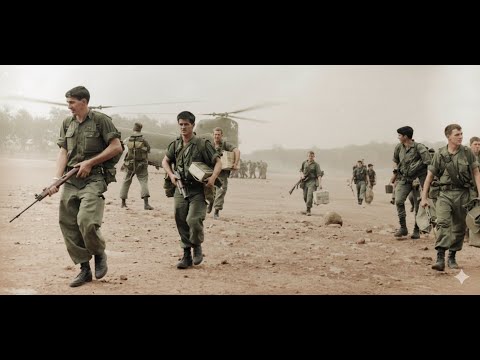
When his boots hit the red dirt of Phuoc Tuy province, and the smell of sweat, cordite, and monsoon rain became the only world he’d know, the illusion of preparation shattered. They told him Canungra was as close to Vietnam as you could get without actually stepping foot in a war zone. That might have been true in theory, but nothing in Queensland—not even the hardest parts of the jungle training center—could fully prepare him for the first breath of air he took stepping off the chopper.
The heat wasn’t just hotter, it was heavier, wetter, like wearing a soaked wool blanket around your chest. The humidity clung to your skin, your gear, your rifle. Everything felt damp. Then came the dust—that infamous iron-red Vietnamese dust. It coated your boots, your weapon, even your food if you weren’t careful. By lunchtime, it would bake into mud, and by evening, it would rise again in clouds.
Canungra had rough terrain, but this—this was a living, breathing battlefield. At Canungra, everything was controlled. You knew it was training. The instructors had blanks in their rifles. The explosions were staged. The leeches probably planted just to prove a point. But out here, the enemy didn’t wear high-vis vests, the traps weren’t rubber, and the silence—oh, the silence—wasn’t a drill. It meant danger. It meant Charlie was near.
The jungle in Phuoc Tuy was alive in a different way. It wasn’t just vegetation; it was a tactical nightmare. Triple-canopy trees blocked light. The ground below was soft, riddled with roots, crawling with ants and snakes. Sound barely traveled, but the VC moved like ghosts. At Canungra, you practiced identifying ambush zones. Here you walked through them, praying the man ahead didn’t step on a mine, or worse, that the man behind you didn’t.
The practical lessons kicked in fast. Digging a shell scrape before sunset became second nature. So did shaking your boots in the morning for scorpions. Navigation? It wasn’t just compass and map now. It was reading broken twigs, sensing bird silence, watching how vines had been pushed aside by someone not long ago. You stopped speaking unless necessary. You learned to communicate with glances, hand signals, breath.
Even the wildlife was different. In Canungra, snakes were rare. Here you saw vipers slither past gun barrels, monkeys screamed overhead, and mosquitoes swarmed in clouds. Dysentery and trench foot weren’t concepts—they were comrades. Most of all, the enemy was real. Canungra taught you to expect ambushes. Phuoc Tuy delivered them—fast, brutal, sudden. One second you’re checking a map, next you’re pinned down by AK-47 fire, trying to remember where your fire support is coming from, shouting for a medic while counting your last three magazines.
And yet, for all the shock and fear, something strange began to happen. The skills drilled into you in Canungra—move, cover, react, shoot, listen—they started to flow without thought. You were becoming what they trained you to be: a jungle soldier. But this wasn’t the end of the transformation; it was only the beginning. Vietnam wasn’t just a war of bullets—it was a war of heat, silence, doubt, and endurance.
The jungle was quiet that morning—too quiet. The kind of silence that made your skin itch, your grip tighten on the rifle, and your heart beat like a war drum inside your chest. It had been two weeks since deployment into Phuoc Tuy, and the routine was beginning to set in. Move, halt, listen, patrol, dig, sleep. But nothing could prepare a soldier for that first moment when training became survival, and the enemy turned from cardboard silhouettes into real men firing real bullets.
The section had been patrolling near a village suspected of harboring VC activity. The air was thick with humidity, the smell of wet earth and sweat hanging between the trees. The forward scout raised his fist—contact imminent. Everyone dropped low, eyes searching the foliage, fingers resting on triggers.
Then came the crack of an AK-47—short, sharp, unmistakable. A single shot echoed, followed by a staccato of return fire. The jungle erupted into chaos. What had been a calm patrol just seconds earlier was now a coordinated dance of fire and movement, practiced hundreds of times in Canungra, but now played out with live rounds, screaming voices, and the real possibility of death.
The enemy was close—too close. They were dug in, firing from cover. One digger was hit, a bullet tearing through his thigh. The section commander radioed for support while the medic crawled low, dragging the wounded man behind a fallen tree. Meanwhile, the rest of the team laid down suppressing fire, slowly flanking the VC position.
The noise was deafening. Rifles snapping, machine guns hammering, the occasional thump of a grenade launcher. The smell of cordite and blood hung in the air. You could hear the breath of the man beside you, the insects still chirping under the madness, and every so often a yell in Vietnamese from somewhere ahead.
And then, as quickly as it started, it stopped. The VC had broken contact, melting back into the jungle like ghosts. That was their way—hit fast, hit hard, then vanish. The diggers held their ground, securing the perimeter, checking on each other. They moved slowly forward, searching the site. Blood trails, empty shell casings, a few captured documents, and a torn sandal—small but valuable pieces of intelligence.
One of the veterans turned and looked at the younger soldier, eyes wide, hands still trembling. “Well,” he said grimly, “that’s your welcome to Vietnam.”
Later, during the debrief, the young soldier realized how everything from Canungra had clicked into place, almost without thinking. The drills, the movements, the reactions—they had all worked. But there was a difference now. The abstract had become real. The stakes were not points on a scorecard; they were flesh, blood, and silence.
That first contact was more than a fight—it was a transformation. From that point on, the jungle was no longer just terrain; it was a living battlefield. Every step forward would now be different. Every sound, every rustle, every decision meant life or death. And somewhere deep down, he understood: he had just become a soldier.
After the adrenaline faded from that first firefight, something else set in—the long, exhausting rhythm of jungle operations. For every bullet fired in Vietnam, there were days of slow movement, tense silence, endless patrolling, and crushing discomfort. Victory wasn’t always measured in enemy body count; it was measured in endurance, teamwork, and staying alive.
The lessons from Canungra had laid the foundation, but real adaptation only came in country, often the hard way. You learned fast—you had to. How to move without breaking a twig, how to tell fresh VC footprints from your own, how to read the jungle not just as terrain, but as a living map of clues and threats. Sweat became a constant companion. Uniforms rarely dried. Feet stayed soaked for days. The leeches were relentless, silent hitchhikers that filled with blood before you even noticed them.
But you stopped reacting. You had to. Flinching meant noise. Noise meant death. Every day blurred into the next. Up at dawn, patrol, observe, report, rest if you could, repeat. Sometimes you didn’t see the enemy for weeks, but he was always there—watching, listening. Booby traps took more lives than bullets, and every digger knew someone who’d stepped in the wrong place at the wrong time.
Yet within that hardship, something began to emerge—a quiet, almost invisible professionalism. The section started to move as one. Words were barely needed. You could tell your mate was tired just by the way he adjusted his pack. You knew how far you could push before someone snapped. You began to understand what it meant to trust someone—not just with your life, but with your silence.
By now, the jungle wasn’t just terrain; it was home—mud, leeches, and all. But what truly held a digger together in that green hell wasn’t training or even instinct. It was mateship—an unspoken code that had traveled from Gallipoli through Kokoda, and now rooted itself in the tangled undergrowth of Phuoc Tuy.
You didn’t fight for politics; you fought for the bloke next to you. You carried your mate’s gear when he was too buggered to walk. You stayed awake on watch an extra hour because he needed sleep. You didn’t let on when you were scared, because he was too. But every now and then, you’d exchange a glance—brief, knowing—and that was enough. No speeches, just trust, as real as your rifle.
Some days that bond was tested brutally. A misstep, a sudden explosion. One second he’s there, the next he’s not. You dive for cover, ears ringing, dirt in your eyes. And when it’s over, when the smoke clears, you crawl over to find him—hoping, always hoping. Sometimes he’s okay. Sometimes he’s gone. But you don’t leave him behind—ever.
At night, back at the patrol base, you’d hear laughter—real, broken, relieved laughter. Someone would brew up a tea ration, someone else would dig out a crushed tin of biscuits. The jokes were always dark, because what else could you do? Gallows humor was a survival tool. A digger lacing up his mate’s boot because the other had a wounded hand. Someone handing over the last cigarette without a word. The corporal walking the line at midnight, checking each man—not out of duty, but out of care.
These weren’t soldiers from a manual. These were brothers forged in mud, sweat, and silence. Not just trained together, but changed together. Mateship wasn’t taught; it was earned—one patrol, one fight, one impossible day at a time. Because in the jungle, you didn’t survive alone. You survived with your mates.
When a digger’s twelve-month tour finally ended, the moment he had longed for was real—rotation home. The same HMAS Sydney that brought him to war now waited to carry him back. The same flight decks, the same sea breeze—but he was not the same man. On paper, he had fulfilled his duty. He had served. He had survived. But something had changed deep inside, beyond words, beyond uniform. War doesn’t let you leave untouched.
The return to Australia was often quiet. No parades, no victory flags. Many diggers found their homecoming cold and confused. The war had become politically controversial; the country they fought for now wasn’t sure it had wanted them to fight at all. Some were met with indifference. Others with protest. And many found it easier to say nothing—to pack away their medals and memories and blend back into civilian life.
But inside, the war stayed. Memories of mates lost in rice paddies and ambushes, of the heat, the mud, the leeches, of the smell of burning cordite and the silence after gunfire. These weren’t the kind of stories you told easily over a beer. PTSD hadn’t yet entered the vocabulary, but its symptoms lived in the shadows of countless veterans.
And yet, they went on. The same grit that carried them through Phuoc Tuy helped many rebuild. Some returned to the bush—the only place that still made sense. Others became mentors, passing down hard-earned lessons. Many simply disappeared into the fabric of society—teachers, builders, drivers, dads—never speaking much of the man they used to be. But if you looked closely, you could still see the soldier beneath the skin: in the way they scanned a room, in the way they walked with quiet purpose, in the way they looked after their mates, even decades later.
From Canungra to Phuoc Tuy, the journey had forged them. What began as a training course had become a rite of passage. And while they might never wear a uniform again, they would always carry the jungle inside them. Because some wars don’t end when the shooting stops. Some wars walk home with you.
So the next time you pass an old man at the RSL, sitting quietly with his beer and his thoughts, remember—he might have been anyone. An apprentice mechanic. A university student. A farmhand. But he answered the call, survived the crucible, and came home carrying a silence that never quite left him. What would you say to him, if you knew the jungle still whispered in his ear?
Report this article
Select a reason for reporting:






