August 1943. The desert sun near Tunis was a merciless hammer, beating down on a line of 300 German soldiers with their hands raised in surrender. Among them stood 24-year-old Gfr. Franz Weber, a baker’s son from a small Bavarian village, his mind a storm of fear and propaganda. For two years, he had been told that capture meant torture, starvation, and a slow, agonizing death at the hands of Allied monsters. But as British troops moved down the column with clipboards and canteens, Franz noticed something impossible: they were laughing—not with cruelty, but with the tired camaraderie of men who just wanted the day to end. One soldier offered him water without being asked, a simple act of kindness that felt like a betrayal of everything he knew.
Next to him, Obergefreiter Klaus Richter, a 31-year-old former schoolteacher from Hamburg, whispered, “This is a trick. They’re fattening us up before something worse happens.” Franz wanted to agree, but the British soldiers didn’t look like monsters. They looked bored, like men doing paperwork they despised. When a medical officer gently helped 19-year-old Johan Fuks, a skeletal Austrian farm boy, sit in the shade and gave him medicine, Franz felt his certainty crack like sunbaked mud.
Three weeks later, aboard the HMS Duchess of York, Franz expected chains and rats. Instead, he found bunk beds, blankets, and working toilets. The British weren’t treating them like animals; they were treating them like a logistical problem. During the 18-day Atlantic crossing, Franz watched guards share their rations, separate fighting prisoners without violence, and even give Klaus a pencil and paper to write home. “They eat the same food we do,” Klaus noted, his voice hollow. “If this ship were German, would we feed British prisoners from our own supplies?” Franz knew the answer: German guards would eat real food while prisoners got scraps. That’s what superior people did. But these British guards shared like it was normal.
On September 28th, the ship docked at Halifax. Canadian civilian workers barely glanced at them—no hatred, no fear, just indifference. Franz had expected spitting crowds and thrown stones. Instead, he got apathy. Whatever came next, he knew nothing would be as expected. And maybe that was the most terrifying discovery of all.
The train slowed to a stop at Medicine Hat, Alberta. Through the window, Franz saw Camp 133 sprawling across 300 acres: twenty large barracks, a hospital with a red cross, recreation halls, even gardens with vegetables still growing. “This isn’t a prison camp,” Johan whispered. “It’s a small town.” Klaus’s hands trembled as he clutched his notebook. At intake, a Canadian sergeant with a clipboard rattled off privileges: 3,600 calories per day, Red Cross parcels, voluntary work at 20 cents a day. “Forced labor is prohibited under the Geneva Convention,” the sergeant said. Franz stumbled away, his mind reeling. They were prisoners—why would they be paid?
In Barrack 7, electric lights hung from the ceiling. Franz climbed onto a bunk with a real mattress and two wool blankets that smelled like soap. “Something is very wrong here,” Klaus said from the bunk below. “You don’t spend this much on prisoners unless you have so much abundance that feeding enemies doesn’t strain your system.” Franz understood: Germany had told them the Allies were weak, collapsing. But this camp proved those words were lies. Canada wasn’t starving; it had enough wealth to house enemy prisoners in comfort.
The next morning, breakfast was porridge with real milk, fried bread with jam, and real coffee. A Canadian officer explained their rights under the Geneva Convention: adequate food, shelter, medical care, and recreation. “You will not be tortured. You will not be executed.” Franz looked around at 400 German prisoners eating better than their families back home. Everything he believed was built on lies, and he hadn’t even been here one full day.
November 1943. Franz volunteered for farm labor, hoping to escape his thoughts. George Patterson, a Canadian farmer whose son was fighting in Italy, picked up ten prisoners in his truck. “Any of you boys know wheat?” Patterson asked. Klaus stepped forward, and Patterson nodded. “Good. You’re in charge. Rest of you do what he says.” No armed guards, no chains—just a thermos of coffee offered like they were hired hands. On the drive, Franz saw fields stretching to the horizon, farmhouses with electric lights, barns bigger than his village church. Patterson’s farm had three tractors. Three! His entire village in Bavaria had shared one broken-down tractor between eight farms.
At lunch, Patterson’s wife brought soup, thick sandwiches, and crisp apples. “You boys must miss home,” she said, showing them a photo of her son in uniform. “I hope wherever he is, if he’s captured, someone treats him with kindness.” Franz couldn’t eat. His throat had closed up. The world had turned upside down.
By the third week, Franz noticed the abundance everywhere. Patterson complained about supply shortages, but two brand-new tractors sat in reserve. “Back home, they told us Canada was starving,” Johan said quietly. “Does this look like starvation?” Klaus pulled out his notebook. “Patterson’s farm produces enough wheat to feed a thousand people for a year. And I’ve seen at least fifty farms like this. We were told Germany was the industrial heart of the world, but Germany never had abundance like this.” Franz thought of his mother’s last letter: food rations cut again, a neighbor collapsing from hunger, constant fear of bombs. Meanwhile, he was gaining weight as a prisoner of war.
Back at camp, Franz discovered a library with 15,000 books, a theater producing plays, and English classes taught by a retired schoolteacher who never mentioned the war. Klaus became fluent in six months and started translating Canadian newspapers for other prisoners. “It says here that German prisoners in Canada receive better medical care than some Canadian civilians,” Klaus read one night. “Canadian citizens are complaining that we’re treated too well. The enemy’s own people think their government is being too kind to us.”
December 24th, 1944. Christmas approached with a homesickness that felt like stones in his chest. Major Henderson announced special rations and a holiday meal. Franz expected little, but when he stepped into the dining hall, he stopped so suddenly that Johan bumped into him. White cloths covered every table. Real plates. The smell of roasting meat and fresh bread. Platters of roasted chicken, bowls of potatoes in real gravy, vegetables fresh instead of canned, and Christmas stollen with dried fruit and powdered sugar—just like his mother used to make. “This is more food than most German families will see this Christmas,” Klaus whispered.
Then Major Henderson announced Red Cross parcels. Franz heard his name and stumbled forward to collect a package with his mother’s handwriting. Inside: hand-knitted socks that still smelled like home, a small Bible, dried apples, and a letter dated September 4th. His mother wrote about food shortages, fear during air raids, his sister working 12-hour shifts, his father’s persistent cough. She prayed for his safety and believed in final victory. Franz sat holding the letter, looking at the roasted chicken. His mother was hungry. His father was sick. But he was about to eat a meal better than anything his family would have this Christmas.
Around him, men were crying quietly. “My village doesn’t have this much food,” Johan said, tears running into his beard. “People are eating turnips and potato peels, but we’re here eating chicken and real bread.” Klaus stared at his plate. “We were told the Allies were barbaric, that they hated Germans with a rage beyond reason. This isn’t hatred. I don’t know what this is, but it isn’t hatred.”
After the meal, German Christmas carols played from a scratchy record. Franz stood outside smoking a saved cigarette, watching the northern lights dance across the sky—green and blue ribbons of light like something alive. A young guard approached and looked up. “Beautiful, isn’t it? My grandfather used to say they were spirits dancing.” They stood in silence. Then the guard spoke again. “My brother’s a prisoner in Germany near Munich. I hope he’s having a Christmas like this. I hope whoever’s guarding him remembers he’s somebody’s brother.” He flicked ash into the snow. “War makes us forget that sometimes. Makes us forget the enemy is just people who happen to be born somewhere else.”
That was the moment. Not the food, not the decorations, not even the package from home. It was that guard’s simple statement. Franz had spent two years believing Germans were superior, that mercy was weakness. But if the enemy was inferior, why were they treating him like this? If they were barbaric, why were they following rules Germany ignored? That night, he tried to write home but tore up three pages. How could he tell his mother what he had experienced? How could he explain that everything they were told was lies without making her sacrifices meaningless? In the end, he wrote only: I am well. The food is adequate. I pray for peace and your safety.
January 1945. The camp split like wood under an axe. True believers kept Hitler’s portrait hidden and attacked anyone who questioned their loyalty. Klaus stood during an assembly and spoke words that made half the room explode: “The war is lost. Germany cannot win. The Soviet Union is advancing from the east. The Allies from the west. Our cities are burning. We are here safe and fed while our countrymen die.” Hans Werner, a former officer, jumped to his feet. “Defeatist lies! The Führer has secret weapons!” Klaus didn’t back down. “I was a teacher. I understand mathematics and industrial capacity. Just this one province of Canada grows more wheat than all of Bavaria. If Canada with 11 million people can do this, what can America do with 150 million? Germany has already lost.” The hall erupted into shouting. Guards rushed in to separate groups without violence, just forming lines between angry prisoners.
That night, someone painted “traitor” on Klaus’s bunk. Franz helped scrub it off, but the ghost of the letters remained. “They’ll do worse if you keep talking,” Franz said quietly. “I know,” Klaus replied. “But someone has to say the truth out loud.”
March arrived cold and gray. Franz received a letter that made the world tilt sideways. His father had been killed in an air raid, going to the market when the bombs fell. His mother had pneumonia and wasn’t eating. His sister worked 16 hours a day and came home too exhausted to speak. No food, no fuel, no medicine, no hope. Franz read the letter three times, then walked to the fence and stared at the prairie stretching to the horizon. Johan found him there. “I got similar news last month,” Johan said. “My village was in the path of the Soviet advance. I don’t know if my family is alive.” They stood together, two prisoners who had survived while their homes burned. “I keep thinking about that Christmas meal,” Franz said. “We were told captivity would be hell. But hell is back home. Hell is what we did to the world.”
April brought news that filtered through newspapers: Hitler was dead. Berlin had fallen. Germany had surrendered. The true believers denied it. “Lies! Allied propaganda!” Werner shouted. “He did die,” Klaus said quietly. “He killed himself in a bunker while Berlin burned.” Werner charged at Klaus, but Franz stepped between them, and so did Johan and a dozen others. The fight was over before it began. Guards increased watch rotations and medical staff visited certain barracks more often, checking for men who might try to kill themselves.
Franz started keeping a diary. On May 8th, he wrote: The war is over. We lost. I feel nothing. Klaus says we should feel liberated from lies, but liberation feels like falling. What do we return to?
June brought voluntary educational programs. Dr. Morrison, a professor from Calgary, taught about occupied Germany, democracy, reconstruction. “Germany will be divided into zones,” he explained. “There will be hunger, shortages, rubble. But there will also be opportunity to rebuild without the poison that led to this war.” A prisoner interrupted: “Why should we believe anything you say? You’re the enemy.” Dr. Morrison nodded. “Fair point. You shouldn’t believe me blindly. You should think critically about everything. That’s something you weren’t allowed to do under your previous government. That’s what freedom means.”
Franz stayed after class. “Why did you treat us so well? If the situation were reversed, we would not have done this for you.” Dr. Morrison met his eyes. “Yes, you wouldn’t have. That’s precisely why we did. Because we’re not you. The moment we become like our enemies, we’ve lost everything worth fighting for. Treating prisoners with dignity isn’t weakness. It’s proof that our cause was just.” Franz carried those words back to his barracks and wrote them in his diary.
September brought repatriation schedules. Klaus requested to stay in Canada. “Germany’s finished. I’m a teacher. What will I teach in ruins? I could start over here.” Franz was shocked. “You’d abandon Germany?” Klaus’s eyes were hard. “Germany abandoned me when it chose Hitler. When it chose war and genocide and madness. I’m not abandoning my country. My country abandoned itself. I’m choosing to survive.” Johan chose to return. “I have to know if my family survived. If there’s nothing there, I might come back.” Franz didn’t know what treason meant anymore. All the words—loyalty, duty, honor—had changed meaning.
By winter, Franz had made his decision. He would return to Germany, help rebuild, try to make something good from the ashes. But the man returning was not the same man who had been captured. That man had died somewhere between the Christmas feast and the letters from home. The new man believed in very little except that showing mercy was stronger than showing cruelty, and that sometimes you had to admit you were wrong, even when admitting it hurt worse than dying.
December 1945. Franz stood in the north barn at Patterson’s farm, watching snowfall through roof gaps. Patterson had left the keys in the truck’s ignition. “We could take it,” Franz said quietly. “Drive to Calgary. Disappear.” Klaus’s voice held interest. “And then what?” “And then stay. Make a life here.” Franz looked at the keys like they were a door to a different future. Klaus spoke finally. “I’m not going back, Franz. I’m staying in Canada, but I’m going to do it the right way. Apply through proper channels. But you should go back. You need to know what’s there. Your mother is waiting.” Franz thought about his mother’s last letter, her hope that he would come home. “You’re right. I have to know.” They shook hands. “If you change your mind,” Klaus said, “there are ways. People disappear during repatriation transfers. Records get lost.” Franz filed that information away.
January 1946. Franz stood in a processing line, waiting for departure. Johan left in group two. They embraced at the gate. “If you come back to Canada, write to me through the Red Cross,” Johan said. “Promise me something,” Franz said. “When you get home, whatever you find, don’t forget what we learned here. Don’t forget that enemies can be kind, that following rules isn’t weakness, that maybe we were wrong about everything.” “I won’t forget. I can’t forget even if I wanted to.” Franz watched until Johan disappeared from sight.
On February 12th, three days before his scheduled departure, a letter arrived. His mother had died in January. Pneumonia, malnutrition. She had survived the war but couldn’t survive the peace. Franz read the letter three times, then walked to the fence and stood there for two hours while the sun moved across the sky. When he returned to the barracks, George Patterson was waiting. “I heard,” Patterson said simply. “I’m sorry, son.” “She died waiting for me.” “She died knowing you survived. That matters.” Patterson handed him a piece of paper—an address in Calgary. “My brother runs a restaurant there. After you’re repatriated, if you ever want to come back, write to him. He’s helped other fellows get settled.” Franz stared at the paper. “Why would you help me?” “Because I met you. Because you work hard and don’t complain and treat people decent. Because my son came home last month and told me a German farmer helped him escape from a POW camp near Munich. That farmer probably saved his life. People are people, Franz. The war is over. Time to remember that.”
February 15th. The train pulled away from Medicine Hat, carrying Franz and 200 other prisoners east toward Halifax. In his pocket, he carried three pieces of paper: Patterson’s address, Klaus’s forwarding address in Calgary, and a letter from Johan to be delivered to the Red Cross in Hamburg. And a decision that was forming like ice on water—slow, inevitable, changing liquid into solid.
March 1946. The ship docked in Hamburg, and Franz walked into a wasteland of rubble and hollow-eyed scavengers. His village was gone—a bomb crater where the church had stood, twenty houses reduced to foundations. The neighbor who had written about his mother showed him a mound of earth with a cross made from burned beams. “She talked about you constantly,” the neighbor said. “She believed until the end you would come home.” Franz stood at the grave until dark, trying to pray but not knowing who to pray to.
He spent six weeks clearing rubble for occupation forces, chasing paperwork that led nowhere, watching former Nazis pretend they had always opposed Hitler. In May, he wrote to Patterson’s brother in Calgary. His immigration application was denied—former enemy combatants not eligible. So Franz took Klaus’s advice. During a chaotic transfer between zones, with records incomplete and administrators overwhelmed, Gefreiter Franz Weber disappeared. In August, using forged papers, he boarded a ship to Canada as Frank Weber, a displaced Austrian farmer.
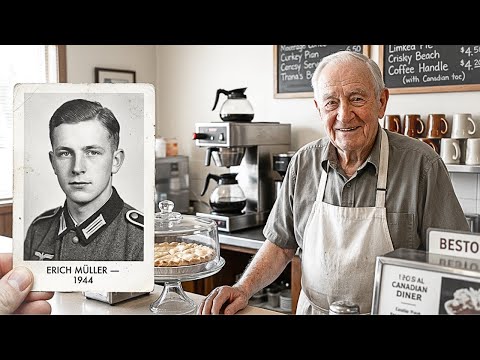
September 14th, 1980. Two RCMP officers walked into Frank’s Diner. “Your fingerprints don’t match your immigration papers,” Sergeant Morrison said. “They match a German POW named Franz Weber.” Frank set down his coffee. “My name is Franz Weber,” he said finally. “I was captured in Tunisia in 1943. I came back here because this country treated me better as an enemy than my own country treated me as a citizen.” The story hit newspapers within days. Testimonials poured in—from George Patterson, now ninety-five, from Dr. Morrison, from decades of neighbors. In December, Frank received citizenship through a special ministerial order. “Fron died in a bomb crater in Bavaria in 1946,” he told the judge. “Frank is who I became here.”
Frank Weber died on December 24th, 2003—exactly fifty-nine years after the Christmas meal that changed his life. In his diary, the last entry read: Changing your mind isn’t weakness. Admitting you were wrong isn’t betrayal. Sometimes the bravest thing you can do is choose to become different from what you were raised to be.
Today, Frank’s Diner still stands, a plaque beneath his photograph reading: POW, farmer, cook, citizen. Change is possible. Choose humanity.
What would you have done, standing in that surrender line, watching your entire worldview crumble with a single canteen of water?
Report this article
Select a reason for reporting:






