The air was thick with tension as the B-17 Flying Fortresses roared to life, their engines a deafening chorus against the cold English dawn. It was 1944, and the men of the Eighth Air Force were about to embark on a mission that would test their courage, skill, and luck in the unforgiving skies over Nazi Germany. This was not a Hollywood set; this was Target for Today, a documentary that captured the raw, unflinching reality of a daylight bombing raid.
In the briefing rooms, young pilots and gunners studied maps and photographs, their faces a mix of determination and anxiety. “Your target is the Focke-Wulf 190 plant at Anklam,” the intelligence officer announced. “If you destroy it, you’ll cripple nearly half of Germany’s fighter production.” The room fell silent. Every man knew the stakes. The Luftwaffe would throw everything at them to protect that factory.
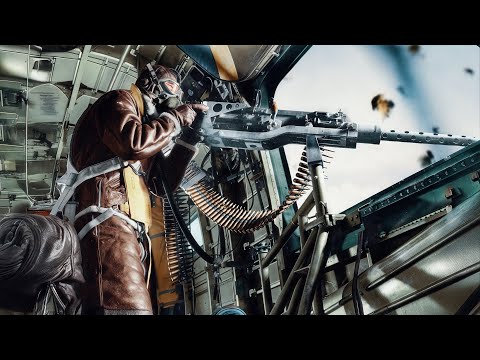
As the bombers lifted off, assembling into tight formations, the crewmen checked their guns and exchanged nervous banter. “I wonder where it’ll be today,” one gunner muttered. “They’ll be shooting at us,” another replied with a grim laugh. “Sometimes I don’t think those Jerries got proper respect for us.” The humor was a thin shield against the fear that coiled in every stomach.
Over the North Sea, the formation droned on, a vast armada of aluminum and steel. The weather was clear, but the threat of enemy fighters lurked beyond the horizon. “Enemy fighters at 7 o’clock high!” the call came. Suddenly, the sky was filled with FW 190s and ME 109s, their cannons blazing. “Scratch one heavy 109!” a gunner shouted as a German plane exploded in flames.
The bombers pressed on, their gunners firing in coordinated bursts. “They’re coming from all angles!” someone yelled. The air was a chaos of tracer fire and exploding shells. “Bomb bay doors open!” the pilot ordered. The moment of truth had arrived. “Bombs away!” The payloads fell, hurtling toward the factory below. “We got him! The plant is hit!” a bombardier confirmed.
But the mission was far from over. As the formation turned for home, the German fighters regrouped for another assault. “Here they come again!” The gunners, exhausted but resolute, kept firing. “I got one! He’s going down!” The battle continued, a deadly dance in the skies.
Back at base, the ground crews waited anxiously. “How many returned?” a mechanic asked. “Eighteen dispatched, seventeen returned,” came the grim reply. Some groups fared worse. “Twenty dispatched, ten returned.” The cost was high, but the damage to the enemy’s war machine was devastating.
As the surviving bombers touched down, the crews were immediately debriefed. “We saw 65 to 80 enemy aircraft,” a gunner reported. “They pressed home their attacks from 300 yards.” The intelligence officers noted every detail, piecing together the puzzle of the enemy’s tactics.
The strike photos, developed hours later, revealed the true impact. “Severe damage to the Focke-Wulf plant,” an analyst confirmed. “Almost every building destroyed or seriously affected.” General Arnold would later call it “the greatest example of precision bombing on record.”
But for the men who flew the mission, the memories would linger. The fear, the adrenaline, the loss of comrades—it was all part of the job. And as the sun set over the English countryside, the crews prepared for the next day’s briefing, knowing that the battle of Germany was far from over.
Yet the battle of Germany was not won by any single raid, no matter how devastating. “Every bomb that falls on a factory today is a bullet that never reaches the front tomorrow,” a briefing officer reminded the men, tapping his pointer against a wall map of occupied Europe. The crews nodded, though few needed convincing. They had seen the flak, the fighters, the burning ships at Gdynia. They understood the arithmetic of attrition.
In the following weeks, the weather over Europe turned foul, grounding the armada for days at a time. “Weather is the greatest single enemy of the Eighth Bomber Command,” the narrator had said, and the men felt it in their bones. Fog shrouded the English bases; cloud banks swallowed the continent. Crews drilled, repaired, and waited. Some played cards. Others wrote letters they might never send.
Then came the morning the skies cleared. The teletype machines chattered again, and the field order went out. This time the target was different—not a single factory, but a sprawling complex of oil refineries deep in the Reich. “Without fuel, the Luftwaffe is a tiger without teeth,” the intelligence officer declared.
The crews assembled at dawn, the same ritual of flying clothes and escape kits and final conferences around each airplane. But something had changed. The newer crews spoke of the raid on Anklam the way men speak of a legend. “They say the whole factory went up like a torch,” a young co-pilot whispered to his navigator. “They say General Arnold called it the greatest strike ever.”
At the 303rd, the briefing room was packed once more. The intelligence officer pulled the cloth from the target map, revealing the oil refinery at Merseburg—a maze of cracking towers and storage tanks. A low whistle ran through the room. “That’s a lot of smoke waiting to happen,” someone murmured.
The flak officer took the podium next, his voice flat and clinical. “Expect heavy, accurate fire over the target. The Germans have ringed this complex with more than a hundred heavy guns. Approach from the south, make your turn quickly, and do not linger on the bomb run.” He paused, then added, “And gentlemen—this time the Luftwaffe will be waiting in strength. They know what their oil means.”
The group commander rose for his few words, as he always did. He looked older now, the lines around his eyes deeper than they had been a month ago. “Men, the going’s going to be rough,” he said quietly. “But you’ve been through worse. Fly tight. Shoot straight. And bring each other home.”
Outside, the ground crews were already swarming over the Fortresses, topping off tanks and checking turrets. The smell of high-octane fuel hung in the cold air. A mechanic patted the nose of his bomber as if it were a living thing. “Just one more, girl,” he said. “Just one more.”
At the perimeter of the field, the first engines coughed, caught, and roared. The lead ship taxied into position, its propellers a blur against the gray sky. In the tower, the controller raised his flare gun. The crews strapped in, checked their oxygen, and waited for the green light.
The mission to Merseburg was about to begin—and with it, another chapter in the long, grinding battle of Germany.
The green flare arced into the sky, and the lead Fortress lumbered down the runway, its wheels lifting at last from the English soil. Behind it came the rest of the group, one after another, each bomber clawing for altitude in a ritual that had become as familiar as breathing. “Formation assembly at two thousand feet,” the pilot called over the intercom. “Keep it tight, boys. We don’t want to be caught alone up here.”
The climb to bombing altitude was a long, cold ordeal. The crews donned their oxygen masks and heavy flying suits as the temperature plummeted. Frost crept across the windows. “Minus thirty degrees outside,” the navigator reported, his voice muffled through the mask. “And it’ll get colder before we’re done.”
Over the North Sea, the formation droned eastward, a vast, precise geometry of aluminum and steel. The gunners swung their turrets slowly, scanning the horizon for the first sign of enemy fighters. “Keep your eyes peeled,” the tail gunner warned. “They’ll come out of the sun if they can.”
The first contact came not from fighters but from flak—a sudden, black bloom of smoke far ahead, then another, and another. “Looks like they’ve got our route figured out,” the co-pilot muttered. The bombardier, hunched over his sight, said nothing. His eyes were fixed on the target maps in his mind.
Then the fighters came. “Bandits at twelve o’clock high!” The call crackled through the intercom. A dozen FW 190s dove out of the sun, their cannons flashing. The Fortresses answered with a wall of fire. “Got one! He’s hit!” a gunner shouted. The German plane trailed smoke and fell away, but others pressed the attack.
The sky became a chaos of tracer fire and diving planes. A Fortress in the low squadron took a direct hit and spun toward the earth, flames streaming from its wing. “No chutes—no chutes!” someone cried. There was no time to mourn. The fighters were already coming around for another pass.
The bomb run approached, and the formation tightened. “Bomb bay doors open,” the pilot ordered. The bombardier stared through his sight, his hand steady on the controls. The flak was intense now, black puffs rocking the plane. “Steady—steady—” Then: “Bombs away!”
The payload fell toward the refinery below. From the cockpit, the crew watched the tanks erupt in geysers of flame and smoke. “We hit it!” the bombardier shouted. “Right on the aiming point!” But there was no time to celebrate. The fighters were back, and the long flight home had only just begun.
The return leg was a running battle. The fighters harried them across the North Sea, picking off stragglers and damaged ships. “Fighters at six o’clock low—where’s our cover?” a gunner screamed. The answer came in the form of silver specks diving from above: P-51 Mustangs, their props biting the air. “Here come the little friends!” someone shouted. The German pilots broke off, and the battered formation limped home.
At the base, the tower counted them in. “Twenty dispatched, fourteen returned,” the controller said, his voice flat. The ground crews met the survivors with silent nods and steady hands. A mechanic climbed onto the wing of a flak-scarred Fortress and ran his palm along the holes. “She brought them back,” he whispered. “That’s all that matters.”
In the interrogation hut, the crews gave their reports. “We saw the refinery go up,” a bombardier said. “Three tanks burning, maybe more.” The intelligence officers wrote it all down. Later, the strike photos would confirm it: the Merseburg complex had been gutted. But the cost was written in the empty chairs at the mess hall.
That night, the men of the Eighth Air Force ate their chow in near silence. Some wrote letters. Some stared at the walls. And somewhere in the operations block, the teletype machines began to chatter again. “Weather tomorrow: clear over the continent.” The battle of Germany would continue.
“Every mission brings us closer,” the group commander had said. “Closer to what, sir?” a young pilot had asked. The old man had looked at him for a long moment. “Closer to going home.” And so they flew, day after day, into the flak and the fighters, because the only way out was through.
What would you have done, strapped into that freezing turret with the sky full of enemy fighters—would you have kept firing, or would you have prayed for the wheels to touch down?
Report this article
Select a reason for reporting:






