The war was over. The suffering had just begun. In the spring of 1945, as the Nazi flag was torn down from the Reichstag and Hitler’s charred remains were buried in a shell crater, the German people faced a nightmare that no history book dares to fully tell. From the frozen gulags of Siberia to the burning streets of Dresden, from the mass suicides of Demmin to the systematic expulsions from the East, millions of civilians—women, children, the elderly—were about to endure a wave of retribution so brutal it would scar generations.
This is not a story of victory. It is a story of what happens when an entire nation is held collectively guilty, and the bill comes due in blood.
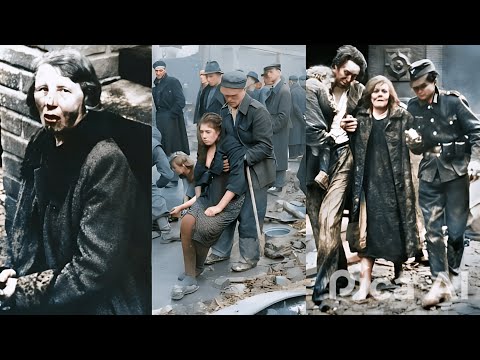
By early 1945, the Red Army had pushed relentlessly from the East, leaving a trail of vengeance that Soviet propaganda had carefully cultivated. “All Slavic peoples had to be eliminated,” Hitler had ordered his soldiers during Operation Barbarossa—and now, as the tide turned, that genocidal ambition returned with a fury that would consume the innocent and the guilty alike.
German cities lay in ruins. Berlin was a moonscape of rubble and corpses. In the chaos, Nazi leaders either fled, took their own lives, or deluded themselves until the very end. Hitler, holed up in his bunker, married Eva Braun and dictated a final testament that blamed everyone but himself. Goebbels poisoned his six children before taking his own life. Himmler, captured after trying to negotiate separately with the Allies, bit into a cyanide capsule.
But their deaths brought no relief to the millions of ordinary Germans now at the mercy of advancing Soviet troops—soldiers who had seen their own families slaughtered, their villages burned, their homeland devastated by a war of extermination the Nazis had waged on the Eastern Front.
“One in three women in Berlin suffered some kind of sexual assault,” experts estimate. The numbers vary wildly—from 20,000 to nearly a million across the occupied zones. Soviet officers often encouraged rather than restrained their men. The Red Army’s march through East Prussia, Pomerania, and Silesia was marked by mass rape, summary executions, and the burning of entire towns.
In the Pomeranian town of Demmin, the nightmare reached its most extreme form. On April 30, 1945—the same day Hitler killed himself in Berlin—Soviet tanks rolled into the city after the German defenders fled and blew the bridges behind them, trapping civilians. What followed was an orgy of violence, looting, and arson. Then came the suicides. Hundreds of women filled their pockets with rocks, tied their children’s hands to their own, and walked into the river. The final death toll from self-murder in Demmin alone is estimated between 700 and 1,000—a mass suicide unprecedented in modern history.
Yet Demmin was just one dot on a map of horror. Dresden had already been firebombed into oblivion in February, with 25,000 dead. Hamburg had been reduced to ashes in Operation Gomorrah, with 60,000 to 100,000 killed. Millions of Germans from the eastern territories were expelled westward, many dying of cold, starvation, or murder along the way. The ship Wilhelm Gustloff, packed with 9,000 refugees, was sunk by a Soviet submarine—the deadliest maritime disaster in history.
And for those who survived, the war’s end meant years of forced labor in Soviet camps, where prisoners starved, froze, and sometimes mutilated themselves to be deemed unfit for work and sent home. Of the 90,000 Germans captured at Stalingrad, only 5,000 ever saw their homeland again.
The Nuremberg Trials would expose the crimes of the Nazi leadership to the world—but they also created a convenient narrative: that the German people had been deceived, that only the top officials bore guilt. The reality was far more complicated. As Stalin pointed out, the soldiers who pulled the triggers and pushed Jews into gas chambers would walk free. And the civilians who had supported Hitler—or simply looked away—would now face the consequences of a war they had cheered.
In the end, Germany was divided, deindustrialized, and forced to pay reparations it could never afford. The Thousand-Year Reich had lasted twelve years and left behind a mountain of corpses, a shattered nation, and a people who would spend decades trying to forget—or atone for—what had been done in their name.
But the story of 1945 is not just about the fall of Berlin or the death of Hitler. It is about what happened to the millions of ordinary Germans caught between their own government’s madness and the righteous fury of those they had wronged. It is a story of suffering that does not excuse the crimes that came before it—but it is a story that must be told.
To understand the full weight of that suffering, one must return to the very beginning of the collapse—not in Berlin, but in the East, where the first German civilians to feel the wrath of retribution were the colonists Hitler had planted in conquered lands. In Poland, in the Baltic states, in the Sudetenland, ethnic Germans who had lived there for generations suddenly found themselves surrounded by populations that had endured years of occupation, enslavement, and massacre. The German state had killed around five to six million Polish citizens during the war. Now the bill was being presented to every German within reach, regardless of age or guilt.
Polish communist authorities began suppressing the German population west of the Bobr River, demanding a border on the western Neisse. The Allies, meeting at Potsdam in July and August 1945, signed an agreement recommending the “orderly transfer” of German populations back to their original country. In practice, order was the first thing to vanish. What followed was the largest forced migration in European history—up to fourteen million people driven from their homes.
The first exodus had begun in mid-1944, as spontaneous flight and organized evacuation merged into chaos. Kilometers-long queues of refugees pushed their carts through the snow, trying to stay ahead of the advancing Red Army. When Soviet troops caught up with them, the columns were attacked brutally—strafed by low-flying aircraft, crushed beneath tank treads, shelled without warning. An estimated 120,000 civilians were killed during the flight and evacuations. The main causes of death were cold, stress, and bombing.
In January 1945, the ship Wilhelm Gustloff left East Prussia packed with 9,000 civilians and military personnel. A Soviet submarine put three torpedoes into her hull. Nobody survived. It remains the largest loss of life in a single ship sinking in history. There were other ships, other sinkings, other thousands swallowed by the icy Baltic.
Many refugees tried to return home once the fighting ended. Before June 1, 1945, some 400,000 people crossed back over the Oder and Neisse rivers eastward—before Soviet and Polish communist authorities sealed the crossings. Another 800,000 entered Silesia through Czechoslovakia, hoping against hope to find their houses still standing. Most found strangers living in them, or rubble, or nothing at all.
Under the Potsdam agreement, by the end of 1945, 4.5 million Germans who had fled or been expelled were under the control of the Allied governments. From 1946 to 1950, another 4.5 million were brought to Germany in organized mass transports from Poland, Czechoslovakia, and Hungary. An additional 2.6 million released prisoners of war were listed as expellees. They arrived in a country that was itself a ruin—half its housing destroyed, its industry dismantled, its people starving.
For the men who had worn the German uniform, the reckoning was even more direct. Soviet authorities had made no secret of their intentions. As early as late 1943, Stalin had spoken of needing four million forced laborers for many years as reparations. By the summer of 1944, the figure had risen to five million for ten years. A general order in December 1944 decreed that all German men between seventeen and forty-five and all women between eighteen and thirty capable of work were to be taken to the USSR within two months.
By October 1945, the transport was complete. Around 100,000 were exempted—too ill, too old, or too young. The remainder were corralled in approximately sixty camps in Poland and eastern Germany before being shipped east. Some were sent to specific locations where important raw materials were at stake—for example to Jáchymov in Czechoslovakia, where they mined the uranium necessary for Stalin’s new nuclear industry.
Inside the Soviet Union, the prisoners were scattered across some 2,500 camps. German accounts of captivity speak of a hunger culture shared by the neighboring civilian populations—there simply was not enough food in a country whose productive capacity had been destroyed by the war. The accounts describe widespread dysentery, the hoarding of food, the taboos that remained about eating certain things even in the direst hunger, the ways food was stolen and traded within the camp, and the prisoners’ slow movement in everything they did.
Desperation produced its own grotesque logic. Once it became known that those unfit for work were being sent home, men began amputating fingers or inducing blindness. The most subtle method was ingesting excessive quantities of salt to induce edema—some men were repatriated as a result, but others died in the attempt.
At first, Stalin claimed the prisoners would be kept for as long as reconstruction required—a task he calculated would take fifteen years. In reality, the USSR released most of its Axis prisoners between May 1945 and the end of 1949, still considerably longer than most of the Allied powers. Most of those released were old, ill, or unfit for work. On June 6, 1945, it was decreed that future releases would require Politburo approval. By August, 412,000 Germans had been identified as qualified for release on the basis that they were unfit for work—but anyone suspected of anti-Soviet views was held back under a suitable pretext. The USSR wanted to maximize the labor potential of the remaining prisoners. Sergei Kruglov, head of the ministry responsible, put forward a plan to send home 150,000 men unfit for labor and increase the rations of the remaining prisoners by ten percent to improve productivity.
For the women left behind in Germany, the danger had never required a uniform. In Berlin alone, an estimated 1.5 million women and girls lived in the city by April 1945—many had lost their homes to the ceaseless bombing, their husbands to the front. Food and water were scarce, basic services cut. When the Soviets surrounded the city and the close-quarters fighting began, the defenders were not the elite troops of the Waffen SS but mostly depleted reserve divisions, elderly men of the national militia, and children from the Hitler Youth—including little girls with no fighting experience.
They were told to defend Berlin street by street, house by house, to repel the “big Russian beast” or die trying. Many did. The official casualties of the Battle of Berlin exceeded 900,000 Germans, Poles, and Soviets combined. And in the cellars and ruins behind the front, the other war—the one fought against women’s bodies—was being waged with the same ferocity.
The memory of that spring would never fade. In the years that followed, German women whispered of it in kitchens and church pews, their voices lowered as if the walls might judge them. Some bore children of the occupation—the so-called “Russenkinder”—and raised them in silence, never speaking of the fathers who had come with tanks and left with shame.
By 1949, two Germanys stood where one Reich had fallen. West Germany, rebuilt with American dollars and a guilty conscience, taught its children that the Nazis were monsters from another planet. East Germany, under Soviet shadow, taught a different lie: that its people had been victims of fascism, never its willing hands.
Both versions erased the same truth—that ordinary Germans had cheered, profited, and looked away. The rubble women who cleared bricks by hand, the expellees crammed into makeshift camps, the prisoners who came home skeletal and silent—they carried a suffering that could not be spoken, and a guilt that could not be confessed.
Was justice ever truly served—or was the suffering of the innocent simply the price of the guilty?
Report this article
Select a reason for reporting:






