October 12, 1944. The transport truck rumbled through the gates of Camp Butner, North Carolina, carrying 23 German women prisoners of war—captured during the final Allied push through France. They sat in silence, wearing tattered Wehrmacht uniforms stained with mud and fear. Among them, 24-year-old Greta Hoffmann clutched a photograph of her mother and sister, convinced that capture by Americans meant certain death. She had been told the enemy was barbaric.
But as the truck stopped outside simple wooden barracks—surrounded by wire fencing, not the hellish prison of her imagination—guards approached with lowered weapons. Their expressions were curious, not hostile. Captain William Reynolds, assigned to oversee the women’s section, watched the exhausted, frightened young women disembark. “These are not the hardened soldiers I fought in the Pacific,” he murmured to a young corporal, Thomas Miller, a farm boy from Georgia who recognized hunger in their eyes.
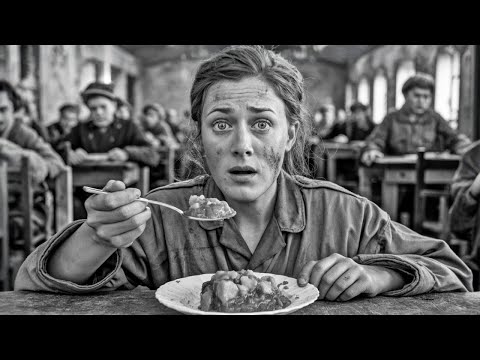
Processing was basic: name, rank, hometown. Nothing threatening. Greta’s confusion deepened. “Why aren’t they cruel?” she whispered to the translator, Mrs. Schneider, a German-American volunteer. The American soldiers had shared rations with them after capture. Medical officers treated their wounds with care. This camp looked nothing like the hellish prisons of Nazi propaganda.
That first night, they were led to clean barracks with real beds and blankets. Greta wrapped herself in rough wool, wondering what tomorrow would bring. She had not eaten a proper meal in three days.
The next morning, a bugle call startled them awake. They dressed quietly, helping each other with buttons and hair ribbons—maintaining dignity, even in captivity. An American guard, Sergeant Robert Chen, led them to the mess hall. The smell hit Greta like a physical blow: real coffee, eggs, and something sweet she couldn’t identify. Her stomach clenched with desperate hunger.
They were handed metal trays and served portions that seemed impossible: scrambled eggs, thick bread with real butter, bacon glistening with fat, and fruit—precious fruit that had vanished from German tables years ago. Behind Greta, 22-year-old Liesl Werner began to cry silently. Corporal James Washington, a heavy-set Black cook from Georgia, noticed her tears and placed two extra strips of bacon on her tray. His expression softened with pity.
Greta sat down slowly, staring at her tray. This was enemy food, American food—everything she had been taught to despise. Excess, waste, indulgence. But her hands trembled as she picked up her fork. The first bite of scrambled eggs tasted like nothing she could have imagined. For three days, each meal brought the same impossible abundance. The guards remained consistently, frustratingly kind—opening doors, offering assistance, speaking with patience rather than contempt.
On the fourth day, Sunday, October 15th, the routine changed. Corporal Washington stood behind a large pan filled with fruit swimming in golden syrup, topped with a lattice of baked dough. “This here is peach cobbler,” he announced proudly. “Made it myself this morning with peaches from Georgia. Figured you ladies might like something sweet.”
Through Mrs. Schneider, the translation hung in the air like an impossible promise. Real peaches—not ersatz preserves, but actual fruit baked with butter, sugar, and flour. Each woman received a generous portion, the warm cobbler steaming slightly. Greta carried hers back to the table with the reverence of a precious artifact.
20-year-old Anna Vogel tasted it first. Her eyes widened, then closed, and a sound escaped her throat—something between a gasp and a sob. The peach was soft, melting, sweet in a way that seemed impossible. This was not just food. This was abundance made manifest.
Greta watched Anna’s reaction, then took her own first bite. The spoon felt heavy, weighted with more than metal. This simple act felt like a betrayal of everything she had believed about the war, about Germany’s cause, about the enemy she had served against. The peach cobbler touched her tongue, and every rational thought vanished. Real sugar. Tender peaches that tasted like summer itself. Tears began to roll down her face.
Around the mess hall, the German women sat in various states of emotional breakdown. Some cried openly. Others froze with spoons halfway to their mouths. Liesl set her spoon down with a clatter. “This is propaganda,” she said in German, her voice tight. “They are trying to confuse us, to make us forget who we are.” But her eyes remained fixed on the remaining cobbler, and her hand trembled with the desire to take another bite.
Mrs. Schneider approached their table slowly. “It is not a trick,” she said softly in German. “This is simply how Americans eat. This is normal here. They do not understand that what is ordinary to them is impossible to you.”
Her words created a new kind of silence. If this was normal, then what did that mean about everything they had been told? Germany had sacrificed everything for the cause, accepted starvation as the price of victory. And here was America feeding even its prisoners with casual abundance.
That night in the barracks, the women could talk of nothing else. “My mother has not tasted real sugar in two years,” Anna whispered. “My little brothers do not remember what fresh fruit tastes like. And we, prisoners, enemies, ate peaches baked with butter and sugar as if it meant nothing.”
Greta thought about Corporal Washington, the cook who had smiled when he served them—no cruelty, no superiority, just the satisfaction of sharing food prepared with care. It reminded her of her own father, a baker in Dresden, who had taken the same pride in his work before the war reduced him to stretching flour with sawdust.
The unfairness of it hung in the air. They had served Germany faithfully, believed they were defending their homeland. Yet Germany had given them increasingly meager rations while asking for greater sacrifice. America, their supposed enemy, fed them better than their own country had in years.
Over the following days, the meals continued with impossible regularity. The women began to gain weight, their faces filling out. They were becoming healthier as prisoners than they had been as free women serving their country. The cognitive dissonance created a strange atmosphere in the barracks. Some women retreated into denial. Others began to openly question everything they had been told.
Corporal Washington had been cooking in the army for three years. He understood food as a language of care that transcended words. He had watched the German women’s reactions to his peach cobbler with a mixture of satisfaction and sadness. Satisfaction because good food should provoke that kind of response. Sadness because their shock revealed how much the war had stolen from them.
On Wednesday, he made apple pie—six of them, enough for generous slices for all. When the women entered the mess hall and saw the pies cooling, their reactions were more controlled but no less profound. Greta received her slice and paused before eating. She looked across the mess hall to where Corporal Washington stood, and in careful, heavily accented English she had been secretly practicing, she said, “Thank you.”
The words were simple, but they represented a bridge being built. Other women followed her example, offering halting English thanks or nodding with genuine gratitude. The invisible wall between captors and prisoners began to develop small cracks.
That evening, Washington received permission to speak with the women through Mrs. Schneider’s translation. “I wanted you to understand something,” he began. “The food I make for you is not special prison food. It is not propaganda. This is how we eat in America. My family back in Georgia—poor families—we eat like this. This is normal for us.”
The women’s faces showed their struggle to accept this reality. If even poor Americans ate with such abundance, what did that say about the war Germany had been fighting? Washington continued, “I grew up during hard times. I know what it is like to be hungry. But even then, America had food. The land is rich here. We grow more than we can eat. That is not evil. That is just the truth.”
Anna raised her hand tentatively. “Why do you share it with us? We are your enemies. We work to help kill American soldiers. Why waste this food on us?”
Washington was quiet for a long moment. “My grandmother was a slave,” he said finally. “She taught me that the measure of a person or a country is how they treat people who have no power. You are prisoners. You cannot fight back. If we treat you badly, it says nothing about you. It says everything about us. America is not perfect. But we try to believe that every person has dignity—even enemies, maybe especially enemies, because that is when it matters most.”
The women sat in silence. These were not the words of a propaganda officer. This was a Black man from the American South, telling them about his grandmother’s enslavement and his country’s ideals in the same breath. Something fundamental shifted inside Greta. She thought about her father’s bakery, about how Germany had always struggled to feed itself even before the war. What if the problem was not lack of resources? What if it was something else entirely—something she had never been allowed to question?
The weeks that followed brought subtle but profound changes. The women began attempting more English phrases. Greta volunteered for kitchen duties, watching how supplies arrived with reliable abundance. One afternoon, she worked alongside Private David Brenner, whose family had emigrated from Germany in the 1920s. “You seem surprised by everything in the kitchen,” he observed. “What did you expect to find here?”
“We were told America was weak, that your people were starving,” Greta admitted. “Now I do not know what to believe. Either you are all excellent actors, or we were lied to about fundamental truths.”
Brenner set down his peeling knife. “My parents left Germany because they saw what was coming. They tried to warn family members, but most did not believe them. Greta, Germany did not lose this war because America was stronger. Germany lost because you were fighting for something evil—something that required constant lies to maintain.”
The words hit Greta like physical blows, but she did not argue. She had been thinking similar thoughts in the quiet hours of night.
As November arrived, Captain Reynolds announced that Thursday would be Thanksgiving—a day of gratitude and feasting. It seemed almost obscene that America, already so abundant, would dedicate an entire day to celebrating having more than enough. The mess hall was decorated with paper turkeys and autumn leaves. Long tables were arranged so that American soldiers and German prisoners would sit together.
When the food arrived, the women experienced a new level of disbelief. Whole roasted turkeys, golden and glistening. Mashed potatoes in quantities that could have fed a regiment. Stuffing, sweet potatoes with marshmallows, green bean casserole, cranberry sauce. And pies—pumpkin, apple, pecan—each one a masterpiece of American plenty.
Greta sat between Private Brenner and Anna, staring at her plate. Around her, American soldiers ate with casual normalcy, as if meals like this were regular occurrences. Corporal Washington paused at her table. “This is my favorite holiday,” he said. “Because it reminds us that having enough is something to be grateful for—not something to hoard from others.”
As Greta took her first bite of turkey, moist and flavorful, she felt something break inside her. Not her spirit, but the shell of certainty that had surrounded her beliefs about the world. She had served Germany believing it was the victim of international conspiracy. But the evidence of American generosity was overwhelming.
The meal lasted for hours. Conversations deepened beyond polite small talk. Private Morrison from Iowa asked, “Do you want to go home when this is over?”
Anna answered first. “Home is gone. My city, Cologne—the letters say it is mostly rubble. My family—I do not know if they live. What is home when everything you knew is destroyed?”
Another woman, Margarete Stein, spoke up. “But also, home is destroyed in a different way. We thought we knew what Germany was. Now we learn about the camps, about the murders—things so terrible we cannot speak of them. How do we go back to a country that did such things?”
Captain Reynolds stopped at their table. “This is why we feed you well, why we treat you with respect—not because we have forgotten what Germany did, but because we refuse to become the monsters we are fighting against. When this war ends, we will need Germans who understand that there is another way to live.”
Greta felt tears sliding down her face. “We were taught that strength meant hardness, that compassion was weakness. But you show us every day that this is a lie.”
December brought the first snow. Greta had begun keeping a diary, tracing her journey from confusion to understanding. She wrote about the peach cobbler that had started everything, about Corporal Washington’s kindness, about the Thanksgiving feast. But she also wrote about the weight of her new understanding—the burden of recognizing that she had been complicit, however unknowingly, in something monstrous.
The German women had access to American newspapers now. They read with growing horror about the liberation of concentration camps, about the systematic murder of millions. Some women still insisted these reports were exaggerated. But most, like Greta, could no longer maintain such comfortable denial.
Anna stopped eating for two days after reading about Auschwitz. She sat in the mess hall staring at the abundant food, unable to reconcile American plenty with German horror. How could these two realities exist in the same world?
Dr. Patricia Morrison, the camp psychologist, was brought in to speak with the women. “What you are experiencing is called cognitive dissonance,” she explained. “It is the psychological distress that occurs when your beliefs are contradicted by undeniable evidence. Your minds are trying to reconcile what you were taught with what you are learning.”
Greta found comfort in having a name for the turmoil inside her. “How do we live with this knowledge?” she asked. “How do we accept that we served evil while believing we were serving good?”
Dr. Morrison’s answer was measured. “You start by recognizing that you were victims of a massive deception, even as you acknowledge some responsibility for not questioning more deeply. You were taught not to think critically, not to ask difficult questions. That was not an accident. Totalitarian systems require people to surrender their individual judgment.”
That evening, fifteen women gathered in the common room for a special session. Captain Reynolds insisted on being present, feeling it was his responsibility to hear whatever they needed to say. What emerged over three hours was a collective unburdening of guilt, shame, confusion, and grief. They spoke of their recruitment, their genuine belief that they were defending Germany. They described the gradual erosion of certainty, the small moments of doubt they had suppressed.
They talked about the peach cobbler—how something as simple as a dessert had cracked open their certainty. “It was not the food itself,” Greta said. “It was what the food represented. Generosity where we expected cruelty. Abundance where we expected deprivation. Humanity where we expected monsters.”
Christmas approached with the same generous spirit. The women had been at Camp Butner for two months now, and the transformation in their appearance was remarkable. They had gained healthy weight, their skin had cleared, their hair had regained shine. Proper nutrition had restored them physically even as their psychological journey remained turbulent.
Corporal Washington planned his Christmas menu for weeks. He wanted to create something that honored both American traditions and German memories. On Christmas Eve, he prepared sauerbraten using a recipe his grandmother had learned from German neighbors in Georgia, serving it alongside traditional American sides. When the German women entered the mess hall and smelled the familiar scent, several began crying before they even sat down.
Greta found Washington after the meal. “Thank you for remembering we are human,” she said in her improved English. “That we had lives and families and traditions before all of this. Thank you for not making us forget who we were even as we learn to become different.”
Washington nodded. “My grandmother used to say that healing requires remembering the good along with acknowledging the bad. You cannot build a new self on nothing but shame and denial. You have to know what is worth keeping from your past even as you reject what was evil.”
The Christmas celebration continued with singing—German and American songs. Private Morrison played harmonica while Sergeant Chen taught everyone a Chinese folk song. The mess hall became a space where different cultures met in recognition of shared humanity.
But the comfort of the evening could not erase the questions that haunted them. News from Europe worsened. The Battle of the Bulge had begun—Germany’s last desperate offensive. The women worried about brothers, fathers, cousins who might be dying in the snow while they sat in warm American barracks eating generous meals.
January 1945 brought bitter cold and deep introspection. Greta had been assigned to work in the camp’s administrative office. One afternoon, she discovered a folder containing photographs from newly liberated concentration camps. She knew she should not look, but could not stop herself. The images showed horrors beyond imagination—skeletal bodies, mass graves, survivors who looked more like ghosts than living humans. These were not enemy propaganda. These were official American military photographs.
Captain Reynolds found her twenty minutes later. He did not reprimand her. Instead, he sat down and spoke quietly. “This is what your country did. Not what you personally did. But what the government you served committed in your name. The kindness we show is not because we have forgotten or forgiven. It is because we refuse to become like those who committed these crimes.”
Greta looked up, tears streaming. “How can you stand to be kind to us? We do not deserve your mercy.”
“Maybe you do not,” Reynolds agreed. “But America was founded on the principle that every individual has dignity regardless of what their government does. You did not build these camps. You were a radio operator who believed she was defending her homeland. Should we punish you for crimes you did not commit?”
“But I served the system that committed them,” Greta said. “I wore the uniform. I believed the lies.”
“Yes,” Reynolds agreed. “And now you know the truth. And you have to decide what you do with that knowledge.”
February brought discussions about the future. The war in Europe was entering its final phase. Captain Reynolds called an assembly to explain that they would eventually be repatriated to Germany, but the timeline remained uncertain. “When you return, you will find a country that has been defeated and occupied, where food is scarce and denial will be widespread. You have had time to process the truth in relative safety. What will you do with it?”
Anna raised her hand. “Captain, what if some of us do not wish to return immediately?”
Reynolds considered carefully. “Legally, you are prisoners of war. I do not have authority to allow you to remain permanently. But America has historically been a nation of immigrants. People who demonstrate genuine commitment to democratic values might find opportunities here eventually.”
Margarete spoke for several women. “I do not know where I belong anymore. I am German, but Germany as I understood it no longer exists. Here in America, I have discovered parts of myself I did not know were there. Can I take those lessons back to Germany, or will returning erase everything I have learned?”
April brought spring flowers and devastating news. Hitler was dead. Berlin had fallen. Germany’s unconditional surrender was imminent. On May 8th, Victory in Europe Day, the compound gathered in the mess hall. There was no celebration among the German women. They sat quietly, faces reflecting complex emotions—defeat, relief, uncertainty.
Captain Reynolds addressed them. “You will be repatriated to Germany through displaced persons camps. Transportation will be arranged within four to six weeks.” He paused, his expression showing genuine emotion. “I want you to know that watching your transformation has been one of the most meaningful experiences of my military career. You came here as enemies. You leave as friends.”
Greta stood, her voice steady. “Captain Reynolds, Corporal Washington, all of the American soldiers who have shown us kindness we did not deserve—we came here expecting cruelty and found compassion. We came here believing lies and found truth. We came here as Nazis and discovered we could become something better. Whatever happens to us in Germany, we will carry these lessons with us.”
That evening, the women gathered in their barracks for a difficult conversation. Did they want to return to Germany? Anna spoke first. “I have no family left. My parents died in the bombing of Cologne. I have nothing to return to except rubble. Here, I have learned English, made friends, discovered work I find meaningful. Why should I choose devastation over possibility?”
Margarete offered a different perspective. “If all the Germans who learned these lessons stay in America, who will help rebuild Germany into something decent? Do we not have a responsibility to return, to teach what we have learned?”
The decision divided the women. Fourteen, including Greta and Anna, approached Captain Reynolds with an unprecedented request—they wished to explore options for remaining in the United States. Nine, including Margarete, chose immediate repatriation despite knowing the hardships they would face. They spoke of duty to help rebuild, responsibility to family members who might still live, and a belief that Germany needed people who understood democracy to guide its reconstruction.
Liesl and a handful of others remained trapped in denial, insisting until the end that the reports about concentration camps were exaggerated. Captain Reynolds watched them with sadness, knowing they had learned nothing from captivity except resentment.
The camp administration worked to find sponsors for the women who wished to stay. The Henderson family offered to sponsor Greta, providing housing while she sought employment. Dr. Morrison arranged for Anna to continue work at the camp hospital. The War Department, impressed by reports of their transformation, agreed to reclassify them as displaced persons with provisional status. They would have the opportunity to build lives in America while pursuing naturalization.
On June 15th, 1945, the day of departure arrived. The scene at Camp Butner was emotional and complex. The women who were leaving packed their few belongings, accepted care packages from Corporal Washington filled with food for their journey, and said goodbye to the Americans who had fundamentally changed their understanding of the world.
Greta embraced Margarete, both women crying openly. “Tell them,” Greta said in German. “Tell everyone in Germany what you learned here. Tell them that enemies can become friends, that strength does not require cruelty, that there is a better way to live.”
Margarete nodded. “And you remember where you came from. Do not forget you are German, even as you become American. We need Germans in America who understand both worlds, who can help build bridges between former enemies.”
The trucks arrived to transport the departing women to the port. Captain Reynolds stood at attention as they boarded, saluting them with the respect due to soldiers rather than prisoners. As the trucks pulled away, Greta looked back at the camp that had become her unlikely sanctuary. She thought of the peach cobbler that had started everything—the simple dessert that had cracked open her certainty and let the truth flood in.
She did not know what the future held. But she knew she would never again accept lies without question, never again mistake cruelty for strength, never again forget that every person—even an enemy—deserves dignity. The journey ahead would be difficult. But for the first time in years, she felt something she had almost forgotten: hope.
Twenty-five years later, in a kitchen in Charlotte, North Carolina, Greta Hoffmann Henderson slid a tray of peach cobbler from the oven. The recipe was Corporal Washington’s, shared before he retired in 1952—their friendship had outlasted the war that first divided them. Her daughter Margaret, named for the friend who chose to rebuild Germany, helped slice Georgia peaches at the counter.
“Mom, do you ever regret not going back?” Margaret asked. Greta considered it carefully. “I regret the years lost to lies. But this country gave me the chance to become someone better than I was.”
That evening, as guests tasted the cobbler, Greta watched their faces—the same pleasure she had seen in a mess hall decades ago. Food as a bridge between worlds. Abundance shared, not hoarded. Anna had become a doctor; Margarete, a teacher warning new generations against tyranny.
The story became a footnote in history books, but for those who lived it, it remained everything: proof that enemies are made, not born. So tell us—what small act of kindness might one day crack open a stranger’s certainty?
Report this article
Select a reason for reporting:






