He was too small, too young, and too poor to be a hero. Yet Audie Murphy became the most decorated American soldier of World War II—a man whose courage under fire was so extraordinary that Hollywood later made a movie about him, with Murphy playing himself. But the story behind the medals is darker and more complex than any film could capture.
Born in rural Texas in 1925, Murphy was the seventh of twelve children in a dirt-poor farming family. When his mother died in 1941, he was just sixteen, left to fend for himself. After Pearl Harbor, he tried to enlist in the Army, Navy, and Marines—and was rejected by all three. Underweight, under height, and underage, he was not deterred.
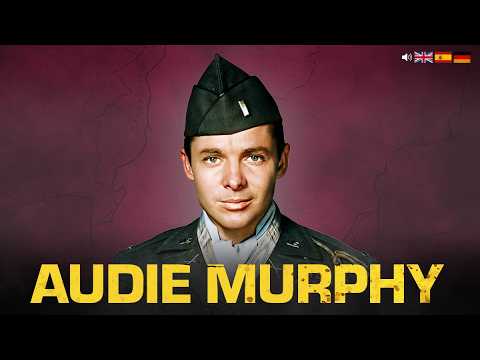
Finally, in June 1942, the Army accepted him. At just 5’5″ and 112 pounds, he earned the nickname “Baby” during training. But what he lacked in physical presence, he more than made up for in courage and skill.
Landing in North Africa in February 1943, Murphy joined Company B, 15th Infantry Regiment of the 3rd Infantry Division. He quickly came to the notice of his superiors as a quick-thinking soldier and a crack shot.
By July, he was in action in Sicily. By December, he was a sergeant. And in January 1944, he found himself at Anzio, where he would earn his first medal for gallantry.
On March 2, 1944, Murphy spotted twenty German tanks advancing toward his lines. He called in artillery fire, disabling the lead tank. That night, he led a patrol to finish it off, destroying the tank and earning the Bronze Star.
But it was in southern France, in August 1944, that Murphy’s legend truly began. Near the town of Ramatuelle, his platoon was pinned down by German machine gun fire. Murphy single-handedly charged the enemy position, killing or capturing the entire garrison. For this, he was awarded the Distinguished Service Cross.
Just days later, he would earn two Silver Stars in five days—an almost unheard-of achievement. And on October 26, 1944, near the village of Laroque, Murphy’s luck finally ran out. A sniper’s bullet shattered his hip, but not before he killed the sniper with a single shot to the head.
He spent two months recovering, but by January 1945, he was back with his men, now a second lieutenant. Little did he know that the greatest test of his courage was yet to come.
The 15th Infantry had been bloodied in the weeks since, and Company B was down to just forty men—exhausted veterans holding a thin line in the frozen woods outside a village called Holtzwihr. The ground was so hard they couldn’t dig in. Men stamped their feet to keep from freezing.
Murphy set up his command post in a drainage ditch along the road, armed with his carbine, binoculars, map, and field telephone. He’d chosen the spot himself—ten yards ahead of a tank destroyer, with a second one further up the road.
Then, at 2 p.m. on January 26, the rumble of engines broke the silence.
Six Jagdpanther tank destroyers emerged from the village, followed by some 250 infantrymen in white camouflage, advancing under a heavy artillery barrage.
Murphy grabbed his field telephone and called in artillery fire on the approaching enemy. Then the rear tank destroyer was hit. It began billowing smoke, its surviving crew bailing out and running for the rear.
The second destroyer fired continuously, but Murphy watched in dismay as its shells struck the Jagdpanthers’ frontal armor and ricocheted off. Moments later, the remaining tank destroyer reversed into the drainage ditch and became stuck, its main gun angled uselessly toward the sky.
Company B was alone.
Murphy ordered his men to fall back to their secondary line deeper in the woods. He stayed behind to cover their withdrawal with artillery fire.
Platoon Sergeant Elmer Brawley later described the scene: “Lieutenant Murphy stayed on at his CP under a pine tree on the edge of the woods and directed artillery fire by telephone upon the advancing tanks and infantrymen. The enemy tanks crashed through on both our flanks, firing persistently at the lieutenant and shattering branches of trees at his side with shell fragments.”
Murphy fired his carbine until his ammunition was exhausted. Then he moved ten yards to the rear and took cover behind the burning tank destroyer.
It was a hugely dangerous place to be—right in the heart of the German advance, in immediate danger of its own ammunition exploding.
Lieutenant Vincent Fenning, an artillery forward observer who had relocated to Company B’s line after his communications were knocked out, watched what happened next. “The Kraut infantry line, consisting of two full-strength companies of 125 men each, surged across the open meadow in a wide arc. As they advanced, they fired their machine pistols and rifles at Lieutenant Murphy. Then I saw Lieutenant Murphy do the bravest thing that I’ve ever seen any man do in combat.”
With the Germans only a hundred yards away and still moving up on him, Murphy climbed onto the slowly burning tank destroyer. He began firing its .50 caliber machine gun at the enemy.
There he was—completely exposed, silhouetted against the background of bare trees and snow, with a fire beneath him that threatened to blow the destroyer to bits. German 88mm shells, machine gun, machine pistol, and rifle fire crashed all around him.
Murphy stayed there, raining a shower of .50 rounds into the oncoming German infantry, killing and wounding many and driving the others to ground.
Fortune aided him too. Fearing either the imminent explosion of the tank destroyer or possibly that it might still be crewed, the German armor steered clear. Partially concealed by the smoke it was emitting, Murphy remained somewhat hidden.
For the next thirty minutes or so, he held off every German attempt to move toward his position—alternating between firing and calling in artillery strikes on enemy troops, all the time standing on something likely to explode at any moment.
In classic Murphy fashion, he would later write: “I’m conscious only that the smoke and the turret afford a good screen and that for the first time in three days my feet are warm.”
Unable to advance deep into the woods and dissuaded by the occasional bazooka round and Murphy’s fire, the German armor paused in the fields and waited for the infantry to come forward to clear the way.
From the German perspective, the devastating .50 caliber fire was now the major obstacle. All attention switched to that. Units crept up under fire to try to identify and outflank the position.
On two occasions, German tank rounds slammed into Murphy’s M10, engulfing it in clouds of smoke. Both times, miraculously, he reappeared and carried on firing.
Peering through the smoke of the burning Wolverine a few moments later, Murphy caught sight of movement just a few yards away. Swinging the .50 caliber around in the nick of time, he spotted a group of twelve German soldiers in the act of getting out of the ditch to rush his position.
He opened up on the group from a distance of just ten yards, killing them to a man.
That immediate threat was gone, but things were still desperate. Murphy once again called back for artillery support. On the other end of the line was a radio operator who asked how close the enemy was.
He received the legendary reply: “Just hold the phone and I’ll let you talk to one of the bastards.”
If it wasn’t already clear how perilous the situation was, Murphy’s next coordinates for the artillery were his own position. In a few moments, American shrapnel was mixing with German steel as it buzzed and clanged off the burning tank destroyer in a desperate attempt to halt the enemy attack.
Murphy’s luck held. Now drenched in blood from that sniper wound which had reopened, he fought on, hammering the hard-pressed Germans who finally, after more than an hour fighting against one man, began to falter.
PFC Abramsky, watching from the Company B lines, later said: “For an hour he held off the enemy force single-handed, fighting against impossible odds. When his last round of ammunition was spent, Lieutenant Murphy climbed painfully down from the top of the tank destroyer and made his way back to our position.”
Although his wound looked bad, he refused to wait for treatment. He reorganized the company and led them in an attack which swept the German force back into the woods they had come from. Only then did he stop for first aid—right on the field—but he wouldn’t take evacuation.
Abramsky added: “The fight that Lieutenant Murphy put up was the greatest display of guts and courage I’ve ever seen. There was only one in a million who would be willing to stand up on a burning vehicle loaded up with explosives and hold off 250 Krauts for an hour. And to do all that when he was wounded—he must have killed and wounded about a hundred of them.”
Shortly after climbing down and making his way rearward—all the while under fire and suffering a further wound in his right ankle—Murphy heard the ammunition blow on the tank destroyer. It would have killed him if he’d remained in the vicinity just a couple of minutes longer.
There is no underestimating it: Murphy’s actions, aided by the artillery, were responsible for halting the German attack—and, according to his commanding officer, for preventing the remnants of Company B from being surrounded and entirely destroyed.
In the following days, reports of his bravery flooded in. He was recommended for and rightly received the Medal of Honor—the highest award for gallantry available to a U.S. serviceman. It was presented to him on June 2, 1945, near Salzburg, Austria, by Lieutenant General Alexander Patch, who reportedly whispered to the equally shy Murphy, “I wonder if you’re as nervous as I am.” Murphy’s reply: “Yes, sir, I’m afraid I am.”
First Lieutenant Audie Leon Murphy returned to the U.S. in August 1945, just days before his 21st birthday. He was released from active duty the following month, eventually accepting an appointment as Captain in the National Guard in July 1950. When recommended for major, a special board had to be convened because he lacked sufficient academic qualifications—but after reviewing his staggering record, they confirmed the promotion. The most decorated American soldier of World War II probably did have the necessary qualifications.
After the war, Murphy became a national celebrity. Offers flooded in, and he embarked on an acting career spanning more than 40 feature films, mostly Westerns. His most famous role was as himself in the 1955 film To Hell and Back, based on his own autobiography—a film he didn’t like.
But his life was troubled off-screen. Haunted by memories of combat, he struggled profoundly with PTSD and reportedly slept for the rest of his life with a pistol under his pillow. Lost in a peacetime world, a physical wreck from his wartime service, and thrust into a Hollywood limelight he never enjoyed, he battled depression, scraped with the law, and suffered a severe gambling addiction he would never overcome.
Murphy was perhaps most at ease in the company of fellow veterans—men who’d shared the dangers, highs, and lows of warfare. On one Veterans Day in the 1950s, asked what the most memorable day of the war was for him, he gave a powerful response: “I was on a train going for a little rest on the Riviera… and I heard the announcement that the war in Europe was over. There’s nothing that could top that for me.” He added: “Those three years had seemed much longer than they really were, and I saw a lot of good men come and go—and a lot of them are still there.”
Despite the title of his autobiography, perhaps he never truly came back. On May 28, 1971, Audie Murphy and five others took off from DeKalb Airport in Atlanta, Georgia, aboard a twin-engine Aero Commander bound for Martinsville, Virginia. It never arrived. The aircraft, lost in fog, struck a mountain range, killing all six on board. Audie Leon Murphy was just 45 years old.
He was buried with full military honors at Arlington National Cemetery on Monday, June 7, 1971. At his earlier request, the gold lettering reserved exclusively for Medal of Honor recipients was omitted from his headstone. He preferred the plain inscription of an ordinary soldier.
What do you think—was Audie Murphy a hero made by war, or a man destroyed by it?
Report this article
Select a reason for reporting:






