In the spring of 1933, while the world watched Hitler consolidate his power, a teenage girl named Melita Maschmann made a secret decision that would define her life. She joined the League of German Girls (BDM), the female branch of the Hitler Youth—not out of fear, but out of a desperate longing for meaning. Her wealthy, conservative parents saw the Nazis as thugs. Melita saw a revolution. “I needed to break free from the narrow confines of my childhood and engage in something great and essential,” she later wrote in her memoirs. Like thousands of others, she craved purpose. The regime was only too happy to provide it.
That same year, more than 200,000 girls flocked to the BDM. They were drawn by promises of adventure: summer camps in the countryside, sports, horseback riding, and nights around a campfire. For girls from working-class families, it was a taste of freedom they had never known. For Melita and her friends, it felt like the happiest days of their lives. “We felt a sense of unprecedented freedom,” she recalled. But behind the laughter and camaraderie lurked a sinister design. The Nazis were not merely entertaining teenagers; they were molding them into loyal servants of a regime that despised women.
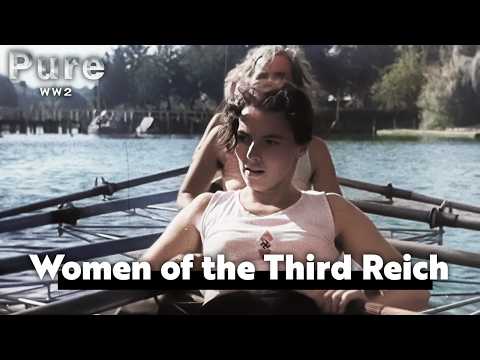
Hitler’s vision for women was brutally simple: Kinder, Küche, Kirche—children, kitchen, church. Women were barred from leadership, politics, and higher education. “You are a woman, you can never practice law or become a judge,” Annette Schucking, a brilliant law student, was told. Undeterred, she dreamed of fighting the system from within. But the regime had other plans. In 1935, the Nuremberg Laws stripped Jews of their rights, and the Nazis intensified their assault on anyone who dared to oppose them. Annette’s father’s friend, a Social Democrat parliamentarian, was arrested by the Gestapo and sent to a concentration camp. “I wanted to do something for human rights,” she thought. But the walls were closing in.
Meanwhile, the BDM’s curriculum shifted. In 1936, the organization declared a “Year of Home Training,” dedicating all activities to preparing girls for motherhood. They were taught to choose husbands based on racial purity, to keep their bodies clean, and to bear as many children as possible. “You must be a guardian of German blood,” they were told. Girls like Liesel Riedel, eager to climb the social ladder, embraced this role. She married Gustav Willhaus, a brutal SS officer, after undergoing a humiliating medical examination to prove her fertility. “She had to renounce her Catholic faith,” her daughter later revealed. “That’s when her family cut ties.” Liesel’s story was one of many. Women were being transformed into instruments of the state, their bodies and futures hijacked for the Führer’s cause.
But the regime’s control extended far beyond marriage and motherhood. In the name of racial purity, nurses like Pauline Kneissler were recruited for the T4 euthanasia program. “We were told that every living being has the right to a merciful death,” she later claimed. In reality, she and her colleagues gassed and injected thousands of disabled adults and children—the first mass murder of the Third Reich. “None of us objected,” she admitted. The seeds of genocide had been planted, and women were among its most willing gardeners.
As war loomed, the roles of women expanded yet again. They were needed to replace men in factories and fields, but also to participate in the colonization of occupied lands. Melita Maschmann, now a BDM leader, was sent to Poland. “We believed we were fulfilling a difficult and noble duty,” she wrote. In the Wartheland, she helped evict Polish and Jewish families from their homes. “I turned my back on them calmly,” she recalled. Other young women, like Lieselotte Meyer, a 19-year-old secretary in the Lida ghetto, wielded life-and-death power. “She had the authority to decide who lived and who died,” says historian Anna Greet. Lieselotte selected Jews for forced labor, issued work cards that meant survival, and attended mass executions without flinching. “She was an efficient administrator, ruthless enough to ignore the fate of the Jews,” Greet adds. “That makes her an accomplice.”
The war in the East unleashed a frenzy of violence. Annette Schucking, now a nurse, found herself in Ukraine, where she witnessed the aftermath of the Babi Yar massacre. “There are no more Jews in the city,” an officer told her. She wrote to her mother: “If you knew what is happening here, you couldn’t stay a day. But I don’t know how to leave.” Trapped among killers, she began documenting the atrocities in a secret diary. “I can smell blood on them,” she wrote. Her words would later serve as evidence of the horrors she could not stop.
By 1942, the “Final Solution” was in full swing. Women like Lieselotte Meyer continued to profit from the ghettos, even as the Jews of Lida were systematically murdered. “She spoke fondly of sledding,” one survivor recalled. “Those were the happiest days of her life.” The complicity of ordinary women—secretaries, nurses, camp guards—was not an anomaly. It was a cornerstone of the Nazi machine. As the war dragged on, their roles would only grow more monstrous. The story of women under the Third Reich is not one of passive victims, but of active participants, seduced by power and ideology. And the full extent of their crimes was yet to be revealed.
The spring of 1942 brought a new urgency to the Nazi enterprise. As the Wehrmacht pushed deeper into Soviet territory, the regime faced a growing paradox: it needed women to sustain the war effort, yet its ideology confined them to the home. “We were told our place was with our children,” recalled one former BDM member, “but suddenly they needed us everywhere.” The solution was a propaganda campaign that framed factory work and auxiliary military service as extensions of a woman’s natural duty. Posters showed smiling mothers in overalls, their children waving from the sidelines. The message was clear: to serve the Reich was to serve the family.
For Melita Maschmann, the shift was seamless. In the Wartheland, she had already overseen the expulsion of thousands of Poles and Jews. Now, as the war machine demanded more, she was tasked with organizing the recruitment of ethnic German women from the Baltic states and Romania. “We were building a new German order,” she wrote, “and women were its foundation.” She threw herself into the work with the same fervor that had once driven her to defy her parents. But the contradictions were becoming harder to ignore. In her diary, she noted the irony of training young women to be both mothers and laborers. “We ask them to give birth for the Führer and then leave their infants to work in munitions factories.” She never questioned the policy aloud.
Meanwhile, Annette Schucking’s secret documentation grew more detailed. In the small Ukrainian town of Zviahel, she had become a quiet witness to the machinery of genocide. Each morning, she watched as trucks arrived to collect Jews from the ghetto. The passengers were told they were being resettled. “They carried their suitcases with such hope,” she wrote. “I knew they would never return.” She began to memorize the names of the SS officers who oversaw the killings, scribbling them on scraps of paper and hiding them in the lining of her coat. “If I survive,” she told herself, “someone must know.”
But survival was far from certain. In June 1942, a wave of arrests swept through the region. The Gestapo had uncovered a network of Polish resistance fighters, and suspicion fell on anyone with ties to the West. Annette’s family background—her father’s leftist politics, her own thwarted legal career—made her a target. She was summoned to the local commandant’s office for questioning. “They asked why I had volunteered for service in the East,” she later recalled. “I told them I wanted to help the wounded. They didn’t believe me.” She was released, but the encounter left her shaken. That night, she burned several pages of her diary, keeping only the most cryptic notes.
In Lida, Lieselotte Meyer’s world was also changing. The ghetto was being liquidated. In September 1942, the remaining Jews were rounded up for deportation to Treblinka. Lieselotte, as always, was efficient. She helped organize the lists, ensuring that the “useful” workers were spared—for now. “She never showed any emotion,” recalled a Jewish survivor who worked in the administration. “She signed our death warrants with the same hand that signed our work permits.” When the transports left, Lieselotte returned to her villa, where she and Hermann Hanweg celebrated with champagne. The swimming pool built by Jewish laborers shimmered in the autumn sun.
Yet not all women were so hardened. In Berlin, a young secretary named Gerda Lang, who had joined the Nazi Party in 1937, found herself increasingly disturbed by the rumors she heard. Her boss, a mid-level official in the Reich Security Main Office, often spoke in euphemisms: “special treatment,” “resettlement,” “evacuation.” But Gerda had begun to piece together the truth. “One day I saw a transport list with the names of children,” she later testified. “I asked my supervisor what would happen to them. He told me not to ask questions.” She didn’t. Instead, she began to copy documents in secret, hiding them in her desk drawer. She was not brave enough to resist openly, but she wanted a record.
By early 1943, the tide of war had begun to turn. The defeat at Stalingrad sent shockwaves through the Reich. Women who had once celebrated the regime’s victories now whispered about the dead. The BDM’s cheerful songs seemed hollow. Melita Maschmann, back in Germany for a training course, noticed the change. “People were afraid,” she wrote. “Not of the enemy, but of each other.” She began to distance herself from the more fanatical members of the organization, though she never renounced her beliefs. The ideology had become a part of her, as natural as breathing.
In Ukraine, Annette Schucking received orders to transfer to a hospital in Lublin. The day before she left, she watched as the last Jews of Zviahel were marched to a nearby forest. She could hear the gunfire from her quarters. That night, she wrote her final entry in Zviahel: “They are all dead. I am still here. I don’t know which is worse.” She packed her diary into a small leather bag and boarded the train. The war was not over, and her role in it was far from finished.
Annette arrived in Lublin to find the city transformed into a nerve center of the Final Solution. The air itself seemed heavy with dread. She was assigned to a hospital that treated SS men, and each day she overheard fragments of conversations that confirmed her worst fears. “They spoke of the camps as if they were factories,” she later wrote. She continued her secret documentation, but the risk was immense. One wrong word could mean the Gestapo.
Back in Germany, Melita Maschmann’s disillusionment grew. The bombing raids had turned her hometown to rubble, and the endless propaganda felt hollow. “I began to see the faces of the children we had taught to worship a lie,” she admitted. Yet she never openly resisted. Like many, she clung to the belief that she had been part of something historic, even as the evidence of atrocity mounted.
Lieselotte Meyer fled westward as the Red Army advanced. She destroyed what records she could, but the memories of the ghetto lingered. In the chaos of defeat, she shed her uniform and blended into the refugee streams. “She never spoke of Lida again,” her daughter recalled. But the cups from the ghetto workshop remained on her shelf, silent witnesses to her crimes.
When the war ended, the world demanded accountability. Annette Schucking’s diary became crucial evidence in the Nuremberg trials. Melita Maschmann was interned and later wrote a memoir that shocked the nation with its honesty about her complicity. Pauline Kneissler was tried for her role in the T4 program, but many others vanished into ordinary life.
These women were not monsters in the traditional sense. They were mothers, secretaries, nurses—ordinary people who chose to serve an extraordinary evil. Their stories force us to confront a disturbing truth: the banality of complicity. How do we reconcile the smiling girl at the campfire with the woman who signed death warrants? What would you have done in their place?
Report this article
Select a reason for reporting:






