July 21, 1954, Geneva. Rain streaks down the marble columns of the Palais des Nations as diplomats sign away the fate of a nation. Outside, the world tilts quietly on its axis. Inside, the haze of cigarette smoke conceals the fragility of peace—a ceasefire born not of reconciliation, but of exhaustion. Vietnam is cleaved in two along the 17th parallel, a thin red line through jungles and rice paddies that will soon become a river of blood.
On the ground, chaos reigns. Families crowd the banks of the Ben Hai River, clutching children and bundles, their voices swallowed by loudspeakers shouting evacuation orders. “The border cuts through villages, even families,” a witness recalls. In the rain, a mother shouts across the river to her son as soldiers urge her onto a boat. His voice fades into the mist. For the first time in centuries, Vietnam is not a single country.
In Hanoi, red banners rise above shattered colonial villas. Propaganda loudspeakers promise land reform, literacy, and independence. In Saigon, the smell of gasoline and French perfume lingers. Each capital believes itself to be the true Vietnam, and each is already preparing for the next war. “Independence and socialism hand in hand,” the slogans read—but idealism comes at a cost.
The North moves swiftly to rebuild. Roads once bombed by French aircraft are cleared by peasants wielding shovels. Soviet and Chinese advisers arrive with notebooks and optimism. But the land reform campaign of 1955–1956 turns brutal. Landlords are denounced in village tribunals, thousands executed or imprisoned. Ho Chi Minh himself will later apologize for its excesses, but the damage is done. Yet the North emerges disciplined and unified, a state hardened for war.
In the South, President Ngo Dinh Diem faces a different battle. Saigon is a city of contradictions: rickshaws beside Cadillacs, Buddhist pagodas shadowed by cathedrals. Diem, a stern Catholic nationalist, dreams of a third force—neither colonial nor communist. Backed by the United States, he consolidates power with remarkable will. “Loyalty is won through spectacle as much as fear,” advises CIA agent Edward Lansdale. But Diem rules through family, not democracy. His brother controls the secret police; his sister-in-law lectures the nation on moral purity. Political rivals vanish. Buddhist leaders are watched.
By 1957, small ambushes begin in the Mekong Delta, dismissed as banditry. In reality, former Viet Minh cadres are reorganizing. They dig caches, whisper passwords, and prepare for a new insurgency. America’s shadow grows. To Washington, Vietnam is another domino in the Cold War. The Eisenhower administration pledges millions in aid and sends military advisers. Helicopters land at Tan Son Nhut airfield under the blazing southern sun. American optimism is high—but behind the aid is a growing fear that Diem cannot win hearts beyond the cities.
In a 1959 report, a US officer writes, “The enemy moves by night, invisible among his own people. We cannot fight what we cannot see.” Along jungle trails near the Cambodian border, units of the People’s Army begin infiltrating south. They carry rifles wrapped in cloth, guided by moonlight. Each footstep marks the start of a shadow war. In 1959, the first organized attacks strike ARVN outposts. Officially, the conflict does not yet exist. There are no declarations, no battle lines—only scattered gunfire swallowed by the jungle. But the silence after each burst tells what the reports do not: the war has already begun.
By the end of 1959, Vietnam is two nations bound by one grief. In the North, children recite songs about the day they will return to Saigon. In the South, American jeeps patrol highways lined with bomb craters from a war that officially ended five years ago. At night, from both sides of the Ben Hai River, villagers hear distant drums. The monsoon rain blurs the border lights. Somewhere in that darkness, history turns its page. The paper signed in Geneva has begun to burn.
Beneath the jungle canopy, a thin column of men moves silently. Their boots sink into wet earth. Mosquitoes hum like static. Each soldier carries a rifle, a bag of rice, and a dream to reunite a divided homeland. Above them, bamboo creaks under rain. These are the first units of the People’s Army of Vietnam to infiltrate southward, following what will soon be known as the Ho Chi Minh Trail—a lifeline carved through mountains and monsoon.
Officially, there is no war. But in the dark, Vietnam is already bleeding again. In Hanoi, planners from the General Staff study maps by candlelight. Route 559, named for its creation in May 1959, becomes their answer to a divided land. It snakes through the Truong Son Mountains, crossing into Laos and Cambodia, invisible to foreign reconnaissance. Young volunteers, many barely twenty, build bridges from vines, dig tunnels by hand, and haul supplies on bicycles overloaded with ammunition.
Every meter of the trail is contested by nature itself—leeches, landslides, and endless rain. But these paths will one day carry divisions of men, trucks, and artillery. For now, they carry only whispers.
In the South, scattered uprisings grow bolder. Small bands of former Viet Minh attack police posts and seize weapons. Their slogans are cautious at first: “Defend the people’s land.” But by 1960, the movement has a name—the National Liberation Front. To Washington, the new acronym becomes familiar: Viet Cong.
Diem’s grip tightens in Saigon. President Ngo Dinh Diem surveys his capital from the Independence Palace. He sees himself as the last bulwark of anti-communism in Southeast Asia—austere, incorruptible, destined. But beyond the palace walls, resentment simmers. His Strategic Hamlet Program uproots millions of villagers into fortified compounds, allegedly to isolate the insurgents. Barbed wire replaces rice fields. Soldiers search homes, arrest men without charge, and burn thatched huts to force compliance.
“They say they protect us, but they cage us like prisoners,” villagers whisper. In 1960, discontent erupts into the Binh Xuyen rebellion, led by paratroopers furious with Diem’s autocracy. The coup fails, but it shakes the regime’s confidence. Diem’s brother Nhu tightens surveillance. Torture becomes common in prisons like Phu Loi and Poulo Condore.
Meanwhile, the Viet Cong expand from dozens to thousands of fighters. They establish shadow governments in the Mekong Delta, collecting taxes and enforcing justice. By 1962, more than 80 percent of rural South Vietnam lies beyond Saigon’s control. After sunset, the villages belong to the revolution.
America steps deeper. Washington’s fear intensifies as the Cold War spreads. In Laos, communists advance. In Cuba, Fidel Castro rises to power. President John F. Kennedy, young and idealistic, sees Vietnam as a test of American resolve. He sends Special Forces—the Green Berets—to advise and train South Vietnamese troops. US personnel jump from helicopters into rice paddies wearing jungle fatigues under the relentless sun.
What began as a handful of advisers swells to over 16,000 by 1963. At first, the Americans are confident. They bring radios, helicopters, and tactical manuals. But the enemy is elusive. Ambushes appear and vanish like ghosts. An ARVN officer confides to an American captain: “They fight for their land. We fight for our pay.”
In Washington, optimism fades into frustration. Despite billions of dollars in aid, Diem’s regime fails to win loyalty. US intelligence reports warn that military victories cannot substitute for political legitimacy. The war comes to the villages. In the Mekong Delta, a farmer named Nguyen Van watches his village burn after a government sweep. His brother is accused of aiding the Viet Cong. He joins the resistance—not out of ideology, but revenge. Stories like his multiply across the countryside.
The Viet Cong’s tactics are simple yet devastating: ambushes, assassinations, propaganda at night. They blend with the people, fighting not for territory but for time. A village may be liberated by day and occupied by night. American advisers note the paradox: “We win every battle, but we’re losing the war.”
By 1962, the countryside becomes a labyrinth of traps and whispers. Bamboo spikes hidden in puddles. Grenades tied to trip wires. Radios broadcasting patriotic songs. Helicopters thunder overhead, spraying jungle with Agent Orange—a chemical defoliant meant to reveal enemy trails and instead poisoning generations. The sky darkens.
In January 1963, the Battle of Ap Bac erupts in the Mekong Delta. A small Viet Cong force, barely 300 men, faces a thousand South Vietnamese troops supported by American advisers, armored vehicles, and helicopters. The battle lasts a single day, but changes everything.
The Viet Cong shoot down five helicopters, destroy armored carriers, and hold their ground. American officers are stunned. US adviser Lieutenant Colonel John Paul Vann cables Saigon: “We have been beaten by a much weaker enemy.” News spreads quickly. For the first time, the myth of inevitable victory cracks. The jungle, once thought conquered, swallows confidence whole.
While the jungle burns, Saigon rots from within. Diem’s Catholic favoritism alienates the Buddhist majority. In Hue, police shoot protesters demanding religious equality. On June 11, 1963, the world watches in horror as monk Thich Quang Duc sits cross-legged in a Saigon intersection, pours gasoline over himself, and strikes a match. Flames consume him, yet his body remains motionless. The photograph—his calm amid fire—circles the globe, more powerful than any bullet. Diem’s regime collapses morally in that moment.
Washington’s patience evaporates. Behind closed doors, US officials discuss what they once denied: regime change. On November 1, 1963, South Vietnamese generals with quiet American approval move against Diem. Tanks surround the presidential palace. Gunfire echoes through Saigon streets. Within hours, Diem and his brother are captured while fleeing through Cholon. They are executed in the back of an armored vehicle. The man who once declared himself the savior of Vietnam dies, betrayed by his own army.
The streets fall silent. The smell of gunpowder lingers as crowds gather around the palace gates, uncertain whether to mourn or rejoice. In Washington, Kennedy receives the news somberly. Three weeks later, he too will be assassinated in Dallas. Two leaders fall within the same month—one in Saigon, one in Texas—and the path ahead darkens for both nations.
By the close of 1963, South Vietnam is leaderless, the North emboldened. The Ho Chi Minh Trail hums with steady movement. Men and supplies pour south like an unbroken tide. American advisers now command troops in all but name. The seeds of insurgency have taken root. The next war—the one the world will remember—is no longer a question of if, but when.
And somewhere deep in the jungle, a Viet Cong radio operator tunes in to the Voice of America broadcast and smiles faintly. The Americans are coming.
August 2, 1964. Gulf of Tonkin. Night swallows the sea off Vietnam’s northern coast. On board the US destroyer USS Maddox, radar screens flicker with ghostly blips. The ship’s captain squints into darkness thick with monsoon rain. Suddenly—alarm bells. Enemy torpedo boats inbound. Gunners swing their mounts. Tracers light up the storm. For twenty chaotic minutes, the Maddox fires into the void. No one ever confirms if an attack truly occurred. Yet within forty-eight hours, those echoes in the rain will pull America into a full-scale war.
In Washington, President Lyndon B. Johnson faces cameras with grave determination. He declares that North Vietnamese patrol boats have launched deliberate attacks upon US ships. Congress responds with overwhelming unity, passing the Gulf of Tonkin Resolution—granting the president authority to take “all necessary measures to repel aggression” in Southeast Asia. Few in Congress realize they have just handed Johnson a blank check for war.
Behind the political language lies strategy. The Pentagon already has contingency plans—bombing lists, troop deployments, logistics networks—drawn up months earlier. Tonkin simply provides the spark. By late 1964, US aircraft strike North Vietnamese targets for the first time. American bases expand across the South: Da Nang, Pleiku, Cam Ranh, Bien Hoa. Engineers carve airfields from red earth. Supply ships unload tanks under the glare of floodlights. The quiet advisory mission is over. The United States is now at war in Vietnam.
March 8, 1965. Da Nang Air Base. A curtain of sea mist drifts over the beach as 3,500 US Marines step onto Vietnamese soil—the first official combat troops. The Stars and Stripes flutter beside South Vietnam’s yellow flag. Onlookers cheer. Women offer garlands of flowers. Photographers crowd for shots of smiling soldiers. To many Americans back home, it feels like the start of a noble rescue—saving a small democracy from communist aggression.
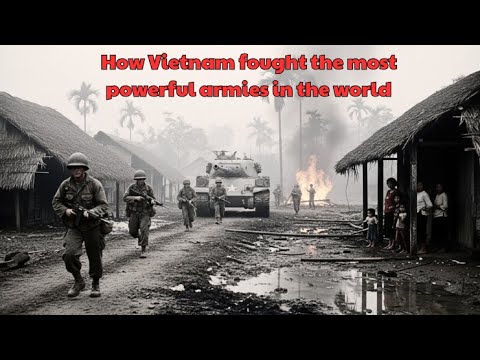
But beneath the ceremony, the air smells of mud, diesel, and foreboding. The Marines quickly learn Vietnam is not a war of fronts, but of fog. There are no fixed lines, no enemy uniforms. Villagers plant rice by day and bury mines by night. The Marines are told they’re here to defend Da Nang. Yet within weeks, they’re drawn into sweeps through nearby villages—operations with names like Starlight and Piranha.
Operation Starlight in August 1965—the first major US offensive—ends in tactical success. Six hundred Viet Cong dead. American casualties under fifty. Commanders hail it as proof of US superiority. But for every body counted, a dozen new recruits join the resistance. In the villages, grief is fertile soil.
By 1967, the war had become a furnace. Operation Rolling Thunder dropped over 864,000 tons of bombs on the North—more than all US air raids in Korea—yet the Ho Chi Minh Trail only grew wider, rebuilt each night by women with torches. “America is trying to kill an idea with explosives,” a journalist wrote, “but ideas don’t bleed.”
In Hanoi, Ho Chi Minh’s beard had turned white. Asked how long the war would last, he replied simply: “As long as it takes.”
As 1967 drew to a close, North Vietnamese commanders whispered a single code word—Tong Tien Cong, the General Offensive. What no one yet knew, not Johnson in Washington nor Westmoreland in Saigon, was that the storm gathering in the jungles would soon erupt into the Tet Offensive—the moment that would turn the world’s perception of the war upside down.
The air war had failed to break the North. The ground war had failed to pacify the South. And the illusion of control was about to shatter under the weight of history.
What do you think finally shattered America’s faith in the war—the Tet Offensive, or the lies that preceded it?
Report this article
Select a reason for reporting:






