The spring of 1944 carried a grim promise across the free world. In the crowded coastal towns of southern England, the greatest amphibious armada in human history was quietly gathering strength. But behind the official newsreels and triumphant headlines, a handful of combat photographers wielded their 16mm cameras to capture the raw, unvarnished truth of Operation Overlord.
Their footage—meticulously restored and colorized—reveals the immense logistical nightmare and the striking human element of the invasion. From untested sailors learning to navigate flat-bottomed landing craft in Chesapeake Bay to the tense, agonizing days spent waiting aboard transports in the English Channel, every frame tells a story of courage and fear.
As the massive fleet finally moved out into the channel, stretching from one end of the horizon to the other, the reality of their destination set in. They were heading into the teeth of the German defenses, toward beaches littered with mined obstacles built by forced labor. Survival depended entirely on the protective steel of their landing craft and the courage of the men beside them.
“It was a tremendous sight to see ships from one end of the horizon to the other,” one photographer recalled. “But even so, we thought this was just another exercise.”
It wasn’t until they continued into the night that they knew it was real. The air was thick with tension, the sea alive with the hum of engines and the distant crack of gunfire. Each man aboard knew that the next time they stepped ashore, it would be on an enemy beach.
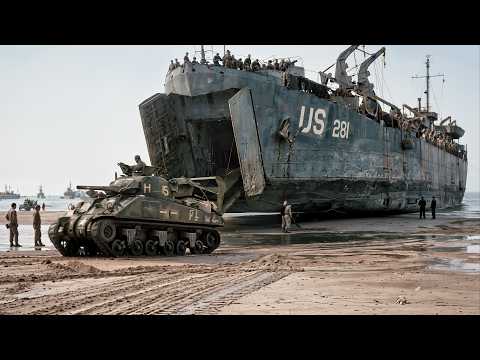
In the crowded ports of embarkation, troops prepared themselves for their greatest battle. A Coast Guard officer briefed his men, and all along the coast, sailors received their final instructions. The slow LSTs, loaded with heavy equipment, and the transports, packed with men, moved out into the channel. Fast warships screened the mighty invasion fleet from enemy raiders.
At 15:30, a Coast Guard flotilla of LCIs left, loaded with engineers, medical corpsmen, and infantry. D-Day was approaching, and the ships were in their assigned positions. Some, like the Coast Guard-manned transport Chase, were on their fourth invasion in European waters.
“The only planes overhead are friendly,” a voice noted, a rare comfort in a sky that could soon fill with enemy fire.
Below decks, officers studied maps that marked the invasion beachheads on the coast of Normandy. Some landing barges were stopped by concrete obstacles built far out in the water by the enemy. Offshore, the larger landing craft approached the beachhead slowly, their ramps ready to drop.
Aboard the LCIs, the troops prepared to land. The beach was still empty, but the crossfire of German guns raked the shore. Out of enemy firing range, the LSTs waited to move in until the beaches were cleared.
The arrival of motorized equipment marked the end of the first phase of the landing. The LCIs, their first loads of men now on the beaches, went out to the transports to ferry more troops inshore. Still waiting beyond gun range, the LSTs unloaded supplies onto smaller LCTs. Heavier equipment was transferred to giant rhino ferries—flat-bottomed barges that would land it ashore.
And reinforcements arrived, thousands of men. Defeated and disarmed, the first German soldiers captured in France waited until someone had time to evacuate them. Out in the channel, the rescue boats of the Coast Guard looked for survivors and aided damaged vessels. Hospital ships waited for the wounded.
Another Coast Guard-manned LCI, badly crippled, could not reach the shore, and its wounded were removed. The beach was firmly in Allied hands now, and the vast extent of the operation was visible. Silent evidence of the fierce battle was apparent everywhere.
But in a few days, many of the damaged ships would be afloat again. Now more and more troops moved inland to push the enemy back. And the LSTs landed their cargoes on the beach. Barges built especially for the Normandy operations were left on the shore to be unloaded.
During the daytime, there were only Allied planes in the air. But at night, German bombers harassed the beachhead and dropped mines offshore. Out of sunken blockships, artificial harbors had been built. Until a port was won from the enemy, these had to handle all Allied shipping.
Bad weather came after the fighting on the beaches was over. A heavy storm left a trail of damaged ships. Once again, the landing barges moved out into the channel—this time, loaded with German prisoners. In England, prisoners boarded a Coast Guard transport. And ships which had carried thousands of American soldiers overseas now returned westward with a different cargo: men who were beaten and captured in Normandy.
But the story of D-Day is not just one of ships and soldiers. It is also the story of the men who documented it all—the combat photographers who risked their lives to capture the truth. Their footage, often shot under fire, provides a window into a world on the brink.
As one photographer later reflected, “I was given a shovel to defend myself, and it proved to be a valuable instrument.” A grim joke, perhaps, but one that underscores the absurdity and danger of their task.
Their journey took them from the training grounds of England to the bloody beaches of Normandy, and eventually into the heart of a liberated Paris. Along the way, they encountered legendary figures—Ernest Hemingway, Ernie Pyle, Robert Capa—and witnessed history unfold frame by frame.
But the cost was high. Some of their comrades never returned. “This is Bill Stringer,” a photographer noted, pointing to a friend in a photograph. “He was killed trying to get into Paris.”
The images they brought back are more than just a record of war; they are a testament to the resilience of the human spirit. And as the film rolls on, we are reminded that the fight for freedom is never truly over.
Their journey took them from the training grounds of England to the bloody beaches of Normandy, and eventually into the heart of a liberated Paris. Along the way, they encountered legendary figures—Ernest Hemingway, Ernie Pyle, Robert Capa—and witnessed history unfold frame by frame. But the cost was high. Some of their comrades never returned.
“This is Bill Stringer,” a photographer noted, pointing to a friend in a photograph. “He was killed trying to get into Paris.”
The images they brought back are more than just a record of war; they are a testament to the resilience of the human spirit. And as the film rolls on, we are reminded that the fight for freedom is never truly over.
In the weeks that followed the breakout from Normandy, the correspondents pressed deeper into France. They passed through villages where the dust of tank treads still hung in the air and the smell of cordite clung to the hedgerows. At Mont Saint-Michel, the tide receded to reveal an island fortress untouched by the fighting, and there the photographers found a brief respite.
Ernest Hemingway sat at a table outside the Poulard Hotel, his broad shoulders hunched over a notebook, while Madame Poulard’s famous omelets sizzled in the kitchen behind him. “A lot of the correspondents gathered here to fight the war from this point,” the narrator recalled, a wry smile in his voice.
They traded champagne for cigarettes with the locals and swapped stories of near misses. Bob Capa, ever restless, was already planning his next move—always pushing closer to the front, always seeking the shot that would define the war.
Paris, when it finally came, was a city drunk on liberation. The correspondents had been barred from entering with General Leclerc’s Second French Armored Division, but they followed close behind, cameras ready. The streets were a blur of tricolor flags and tear-streaked faces. Snipers still lurked on rooftops, and the crack of rifle fire echoed down the Champs-Élysées even as de Gaulle strode forward, unflinching.
“If you stuck your head out a window, you were bound to lose it,” the photographer remembered. “But de Gaulle just stood his ground.”
The images from that day are chaotic, jubilant, and terrifying all at once. Crowds pressed against the sides of jeeps, reaching up to touch the soldiers who had freed them. Women in summer dresses threw flowers from balconies. And in the shadows, the ugly work of retribution began—collaborators dragged into the street, beaten by mobs, their fates sealed in the delirium of victory.
From the top of the Eiffel Tower, the photographer looked down on a city that had escaped destruction. The Seine wound through the heart of Paris like a dark ribbon, the bridges still intact, the opera house still standing. But the railroads were shattered, the food supplies were running out, and winter was coming.
There was no time to linger. The war moved on, and the correspondents moved with it—into Belgium, into the Ardennes, where the trees were turning gold and the air was sharp with the first bite of cold. They passed through Houffalize, a town that would soon be erased from the map by the German counteroffensive, and into Bastogne, where the roads were muddy and the soldiers’ faces were drawn with fatigue.
“I was in Bastogne just a few days before the breakthrough,” the photographer said. “I was fortunate enough to get out of there not knowing about the attack.”
They pressed on toward Germany, through the Siegfried Line’s dragon’s teeth and into Aachen, where mortar shells arced overhead and the streets were empty of civilians. The enemy held the center of the city, and the reserves waited a block behind the front line, ready to be called in.
It was there, in the rubble of a German town, that the photographer captured the faces of children on their way to school, their hands pressed over their ears as Allied guns thundered in the distance. “Children everywhere look cute,” he observed, “even in the middle of a war.”
The footage would eventually carry him home, to the cemeteries above the Normandy beaches and the bombed-out shell of Berlin. But the images he brought back—of ships stretching to the horizon, of men wading through surf under fire, of Parisians weeping in the streets—would outlast them all.
Years later, the photographer sat in a darkened room as the colorized footage flickered across the screen. The faces of friends long gone—Ernie Pyle, Bob Capa, Bill Stringer—swam into view, young and alive and unaware of what awaited them.
“The pictures have lasted,” he said quietly. “They’re beginning to fade, I’m afraid.” But the images of the armada stretching to the horizon, of men walking slowly and cautiously through the surf, of de Gaulle standing firm as bullets flew—those would never truly fade.
He had carried a shovel to defend himself and a camera to bear witness. In the end, the camera proved the more powerful weapon. The footage was more than a record of battle; it was a warning and a prayer.
“The atomic bomb is here to stay,” one scientist had said. “The question is, are we?” The photographer let the film run to its final frame, the screen going dark, the silence heavy with all those young faces frozen in time.
What would you have risked everything to capture—and would you have had the courage to press the shutter?
Report this article
Select a reason for reporting:






