December 16, 1944. The Ardennes Forest, Belgium. A thick, freezing fog choked the ancient pines, and an unnerving silence hung over the 85-mile stretch of the front line. The American soldiers stationed there called it the ghost front—a quiet sector where exhausted units could rest and green replacements could cut their teeth. But the silence was a lie. Beneath the frozen ground, an apocalyptic nightmare was gathering. Over 300,000 German soldiers, 1,900 artillery guns, and nearly 1,000 tanks were silently moving into position, their tracks wrapped in blankets to muffle the grinding steel. And directly in their crosshairs were the shivering, hopelessly green troops of the 106th Infantry Division, completely unaware that their own high command had sentenced them to death.
At 5:30 a.m., the silence shattered. A synchronized barrage of German artillery lit the sky with a violent orange glow, ripping through the trees and showering the panicked American rookies with razor-sharp splinters. In their frozen foxholes, the young men of the Golden Lions division pressed themselves into the mud, screaming prayers that no one could hear. They had been promised they were safe. They had been told the German army was broken. But as the shells pounded their positions for 90 agonizing minutes, the terrible reality crashed down upon them.
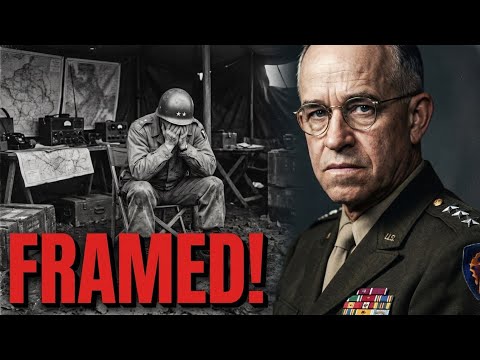
Several miles behind the lines, in the freezing town of St. Vith, Major General Alan Jones jolted awake to the thunderous roar. As commander of the 106th, he felt a cold wave of terror wash over him. He rushed to his command center, expecting to coordinate a defense. Instead, he walked into a blinding fog of chaos. Telephone lines had been vaporized, and German commandos in American uniforms had cut radio wires and switched road signs. Jones was suddenly and systematically blinded. He was the commander of over 15,000 men, but he had no idea what was happening to the majority of his soldiers.
Frantic radio reports confirmed his worst nightmares. Out of the heavy fog, massive silhouettes emerged—German Tiger tanks, nearly indestructible, leading a brutal armored assault directly against the greenest troops in the American military. The German columns were not attacking the center of his regiments; they were slicing through the massive, undefended gaps between American positions, driving deep into the rear and drawing a tightening steel noose around the 422nd and 423rd Infantry Regiments. By the afternoon of December 16th, two entire regiments—over 7,000 young men—were almost completely surrounded.
For General Jones, managing this localized catastrophe was a psychological nightmare. But it was exacerbated by the baffling response from his superiors. Above him was Major General Troy Middleton, commander of the 8th Corps, and ultimately General Omar Bradley, the megastar tactician commanding the 12th Army Group. When the German onslaught began, Bradley’s comfortable headquarters in Luxembourg City reacted with catastrophic arrogance. Bradley and his intelligence officers refused to believe Hitler was launching a massive counteroffensive. They convinced themselves it was a minor spoiling attack. And because they misunderstood the scale of the disaster, they issued paralyzing orders: hold the line at all costs.
Jones desperately tried to communicate the gravity of his situation to Middleton. He needed permission to withdraw his 7,000 men westward, to pull them out of the closing trap and consolidate a defensible line around St. Vith. But Middleton, caught in the suffocating web of Bradley’s directives, refused to authorize a retreat. He told Jones to hold the line and vaguely promised that armored reinforcements were rushing to the sector. It was a fatal miscommunication driven entirely by systemic arrogance at the top. The megastars were managing a different war than the one being fought in the mud. Bradley was unwilling to admit that his calculation to leave the Ardennes undefended had resulted in a catastrophic intelligence failure. Meanwhile, his rigid refusal to accept reality forced Middleton to deny Jones the tactical flexibility he needed to save his men.
As darkness fell on December 17th, the temperature plummeted toward zero and the snow began to fall violently, grounding any possibility of Allied air support. In his freezing headquarters, General Jones was physically deteriorating. He had not slept in nearly 48 hours. He was drinking excessive black coffee and smoking a continuous chain of cigarettes, his hands visibly trembling as he stared at the map. The red arrows representing German Panzer divisions had completely encircled the blue symbols of the 422nd and 423rd. The promised armored relief had failed to break through. The radio signals from his trapped soldiers were becoming increasingly frantic, increasingly desperate, and rapidly fading into silence. Through the static, young captains pleaded for ammunition they did not have, begged for food they could not receive, and reported the terrifying mechanical squealing of German tank treads closing in from every direction.
General Jones was a father himself, and his own son was serving somewhere in Europe. As he listened to the terrified voices of the teenagers he was commanded to lead, he realized with horrifying clarity that the trap had permanently snapped shut. Because the glamorous megastars of the Allied High Command had refused to admit they were wrong, 7,000 young Americans were now completely out of time, out of ammunition, and facing a horrific fate in the frozen forests of the Ardennes.
By the morning of December 18th, the situation inside the Schnee Eifel salient had degraded from a tactical nightmare into a large-scale human tragedy. For the roughly 7,000 young soldiers of the 422nd and 423rd Infantry Regiments, the concept of fighting a structured war no longer existed. They were completely encircled by overwhelming German forces, trapped in a frozen, shrinking pocket that was under continuous, merciless artillery fire. The temperature hovered near zero, and the exhausted men dug into the frozen mud, huddling together in their light summer combat jackets simply to survive the lethal cold.
Their logistical situation was practically nonexistent. The isolated regiments had consumed almost all of their combat rations and were desperately melting snow in their helmets just to have drinking water. Most critically, their ammunition had completely evaporated. American military doctrine relied on overwhelming firepower and massive supply chains, but these green troops were functioning with nothing more than the handful of bullets they carried in their standard-issue webbing. When German infantry probed the American perimeter, the young teenagers could barely afford to return fire. They watched helplessly as German tanks maneuvered freely across the snowy ridges, completely untouchable because the Americans possessed almost zero anti-tank weapons.
Back in St. Vith, General Jones was frantically trying to manage the unmanageable. He clung to the optimistic promises from his superiors—that Combat Command B of the 7th Armored Division was aggressively driving toward the Schnee Eifel to smash through the German encirclement. Relying on these assurances, Jones relayed hopeful messages to his regimental commanders via scattered, poor radio signals. He ordered them to hold their positions, assuring them that heavy American tanks and salvation were only a few miles away. But the promises of the high command were built on a foundation of severe tactical delusion. The relief force bravely attempted to break through, but they immediately ran into a massive, impenetrable wall of elite German Panzers and heavy anti-tank fire. The American tanks were quickly bogged down on the treacherous forest roads and suffered catastrophic casualties. The relief force was stopped in its tracks, miles from the desperate men of the 106th.
As December 18th turned into December 19th, the crushing reality of their abandonment became agonizingly clear to the commanders inside the pocket. Colonel George Descheneaux of the 422nd and Colonel Charles Cavender of the 423rd faced two impossible choices. They could attempt a suicidal breakout, ordering their freezing, starving, disorganized infantrymen to charge through miles of dense forest fortified by German machine guns and dominated by Tiger tanks. The high command, still disconnected from reality, had actually suggested they attack and destroy the German Panzer divisions—a suggestion that bordered on military lunacy. Their second option was infinitely more agonizing for a professional officer: recognize that further combat would accomplish zero strategic value. It would not delay the German offensive or degrade the enemy’s fighting capacity. It would solely result in the total annihilation of 7,000 young American boys who had been abandoned by the system sworn to protect them.
In a last desperate attempt, the regimental commanders requested aerial supply drops of ammunition and food. But the violent winter weather grounded the Allied air forces. Not a single parachute fell from the sky. Out of artillery rounds, out of medical supplies, and surrounded by a heavily fortified enemy preparing a final extermination assault, Colonel Descheneaux and Colonel Cavender made the heaviest decision of their lives. They ordered their soldiers to destroy their own weapons. Weeping, exhausted American teenagers smashed their beloved M1 Garand rifles against the frozen pine trees, scattering the shattered wooden stocks into the snow. They poured dirt into the barrels of their machine guns and smashed their radios with heavy rocks. Then, in small terrified groups, they began to raise whatever white fabric they could find—first-aid bandages, torn undershirts, anything to signal surrender. More than 7,000 American soldiers walked out of the freezing woods with their hands raised, marching into a brutal captivity that would kill hundreds of them before the war ended. It was, and remains, the most catastrophic mass surrender of United States forces in the entire history of the European theater.
The news slowly filtered back to the chaotic division headquarters in St. Vith. When General Jones finally realized that his communication networks were permanently dead, when the reality crashed down upon him that two entire regiments of his young soldiers had been erased from the battlefield, the psychological and physical burden became intolerable. He was a commander whose fundamental duty was to protect the men under his authority. He had pleaded with the high command to withdraw them while there was still time. He had accurately predicted the disaster, but because he was forced to obey the delayed, delusional orders of men sitting comfortably in warm chateaus miles away, thousands of his soldiers were marching into frozen German prison camps. The sheer, monumental guilt and suffocating stress physically destroyed his body. As the German offensive pressed toward his own frail headquarters, General Jones began to experience severe, excruciating pain radiating across his chest. He struggled to breathe, his face turning a sickly ashen gray. His staff officers watched in horror as the 50-year-old division commander collapsed under the crushing weight of the disaster. He was suffering a massive myocardial infarction—a severe, life-threatening heart attack induced entirely by the profound stress of an impossible command.
General Jones was immediately evacuated from the front lines, placed onto a medical transport, and rushed to a secure military hospital far behind the shattered lines. He was physically removed from the battlefield, technically surviving the violent assault that had decimated his beloved division, but his military career, his emotional stability, and his professional reputation were completely shattered. He had been placed into an impossible tactical situation by the overarching arrogance of the highest-ranking generals in Europe, and his body had broken alongside his division. And as General Jones lay recovering in a distant hospital bed, grappling with the agonizing ghosts of 7,000 surrendered soldiers, the massive political machinery of the Allied High Command began to aggressively move into motion.
The senior military leaders, including the celebrated megastar General Omar Bradley, immediately recognized the political danger the destruction of the 106th Division posed to their carefully cultivated reputations. A massive disaster had occurred—one caused almost entirely by strategic arrogance and catastrophic intelligence failures at the very top. But the rigid, protective system of the High Command never blamed itself. The system needed a scapegoat to carry the blame.
The perfect tragic candidate was already lying broken and silent in a military hospital bed: Major General Alan Jones and his utterly green infantry division. A sanitized version of the battle began to circulate through the upper echelons. The senior generals quietly suggested that the inexperienced young men of the Golden Lions had simply panicked. They insinuated that the green troops had cowardly abandoned their positions and surrendered without a fight. The official records conveniently ignored the fact that these shivering teenagers had been deliberately placed into an impossible salient, starved of ammunition, and explicitly ordered by Middleton and Bradley to hold their ground until they were entirely surrounded.
For General Jones, the institutional betrayal was total and devastating. Still recovering from his near-fatal heart attack, he was quietly shuffled into the anonymous bureaucratic shadows of the military apparatus and never given another combat command. Jones was heartbroken—not just for the destruction of his own reputation, but for the agonizing fate of the young men he had been unable to save. Adding to his personal nightmare, he would later receive the devastating news that his own son, an officer serving on a different front, had been killed in action. Jones carried the heavy, suffocating silence of the Schnee Eifel to his grave—an honorable man crushed by the undeniable arrogance and systemic rigidity of the very men he served.
But the most profound tragedy of the cover-up belonged strictly to the 7,000 young American boys who had been forced to march into the freezing darkness of German captivity. The military establishment framed their surrender as a cowardly capitulation rather than a desperate, inevitable tactical necessity forced upon them by their superiors. Their immense suffering was quietly swept under the historical rug. These thousands of teenagers were herded into freezing, overcrowded boxcars and transported deep into the collapsing heart of the Third Reich. They spent the final, brutal months of the war rotting in horrific, disease-ridden Stalags, systematically starved, denied medical care, and forced into brutal slave labor. Hundreds of them died from extreme malnutrition, severe pneumonia, and untreated wounds—freezing to death on wooden bunks while the Allied armies gloriously marched toward Berlin. Their agonizing sacrifice was rarely mentioned in triumphant postwar documentaries or the glossy memoirs written by the megastars of the high command. They were an embarrassing footnote, an unpleasant statistical anomaly that contradicted the glorious narrative of the flawless American military machine.
Years later, when General Omar Bradley released his heavily celebrated memoirs, outlining his brilliant strategic vision and his deep paternal love for the common American soldier, he maintained the sanitized version of the Ardennes disaster. He successfully protected his historic legacy, eventually ascending to the prestigious rank of a five-star General of the Army and serving as the first Chairman of the Joint Chiefs of Staff. He died as an absolute American icon, revered as a tactical genius who had never made a singular profound mistake during his entire illustrious tenure in Europe.
But the uncomfortable truth of the Ghost Front remains incredibly clear to anyone willing to look beneath the polished bronze medals and the carefully written official histories. The destruction of the 106th Infantry Division was entirely preventable. It was not a failure of courage by the terrified, freezing teenagers in the snowy foxholes. It was not a failure of leadership by Major General Alan Jones, who desperately begged for the tactical permission to save the lives of the soldiers under his command. It was a spectacular, catastrophic failure of extreme arrogance by the highest-ranking military officers in the world. It is the dark, frequently unspoken reality of massive global warfare. The shiny historic reputations of the brilliant megastars who command armies from the comfort of warm chateaus are very often purchased directly with the unnecessary blood and profound suffering of the men they consider statistically expendable. General Bradley gambled with the lives of 15,000 green soldiers simply because he was entirely convinced of his own infallibility. When he inevitably lost that horrific gamble, the massive military system actively protected him—ensuring that General Alan Jones and 7,000 forgotten prisoners of war paid the ultimate agonizing price for a disaster they had absolutely zero power to prevent. And that is the true, utterly terrifying nature of the high command.
So here is the question that history demands we ask: when the system protects its legends at the expense of its pawns, who truly bears the guilt—the general who gambled, or the institution that buried the truth? Share your thoughts below.
Report this article
Select a reason for reporting:






