The order crackled over the radio, frantic and clear: pull back. Go to ground. Wait for air support. Do not engage. The American generals watching their screens saw a dozen tiny blue dots—Australian SAS operators—sitting almost on top of a massive Iraqi armored column retreating down Highway 15. By every page of Pentagon doctrine, those men were already dead. But the Australians didn’t retreat. They attacked.
What happened next became one of the most audacious tactical decisions of the entire Iraq campaign—a decision that would leave the most powerful air force on earth circling an empty battlefield, asking if there was anything left to destroy.
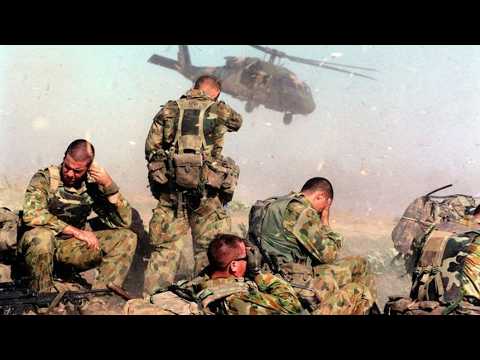
The patrol commander looked at the retreating column. He looked at his vehicles—open-topped Land Rovers, no armor, no doors, nothing between his men and enemy fire but sunburn and sheer audacity. He looked at the Javelin anti-tank missiles strapped to the rear. And he made a call that would have ended the career of any American officer who dared suggest it.
He decided to attack.
Not from a prepared position. Not from behind cover. From the vehicles themselves, at speed, bouncing across open desert parallel to the highway, firing guided missiles from the back of trucks never designed to be missile platforms.
The Javelin is a sophisticated weapon—fire and forget, tandem warhead, climbs high before diving onto the thin top armor of a tank. The manual says nothing about launching it from a vehicle doing 80 km/h over sand dunes while tracer rounds whip past your ears. The reason the manual says nothing is that nobody at Raytheon ever imagined anyone would be mad enough to try.
The Australians tried. And they did it again and again.
Vehicle after vehicle raced along the flank of the Iraqi column like a pack of wild dogs harassing a herd of cattle. Each truck peeled off just long enough for the operator to lock on and fire before the driver floored it and swerved back into the dust cloud. The Iraqis had no idea what was happening. Their anti-aircraft guns pointed at the sky. Their tank turrets traversed slowly, searching for a threat they couldn’t identify. And every few seconds another explosion ripped through another vehicle.
The Javelin warhead punched down through the thin top armor with a white-hot jet of molten copper that turned the interior into an inferno.
But the ambush on Highway 15 was only the opening act of a much larger embarrassment for coalition command.
To understand why the Australians did what they did, you have to understand how the SASR operates—something that sets them apart from almost every other special operations unit in the western alliance. The Australian Special Air Service Regiment traces its lineage to the original British SAS of the Second World War, the desert raiders who drove jeeps behind Rommel’s lines and shot up airfields before vanishing back into the sand.
That heritage is not mess hall nostalgia. It is baked into how these soldiers think about warfare.
When the SASR deploys into a desert environment, they don’t operate like American special forces, who embed with local partners, or like British SAS squadrons, who have gravitated toward urban counterterrorism. The Australians go back to basics. They load their vehicles with fuel, water, ammunition, and communications gear. They drive deep into denied territory and stay there for weeks, moving at night, hiding during the day, watching, reporting, and striking when the opportunity presents itself.
Their vehicles are their homes, their weapons platforms, and their escape routes all in one. The long-range patrol vehicle—open-topped, no armor—tells you everything about the gap in philosophy between the Australians and their American allies. The American approach is to wrap the soldier in a cocoon of technology. The Australian approach is to accept the exposure and compensate with aggression, speed, and the willingness to do things the enemy considers impossible.
This is precisely why the engagement on Highway 15 unfolded the way it did. When the order came to pull back, the SASR patrol commander had two choices: obey and let the Iraqi column escape, or trust his men, his vehicles, and the principle that says you do not wait for someone else to solve your problem. You solve it yourself with whatever you have at hand.
He chose the second option—and what followed made the most expensive air force in human history look like it had overslept.
The mechanics of the engagement deserve close attention, because they reveal just how far outside normal doctrine the Australians had gone. The LRPV patrol split into smaller elements of two or three vehicles each and began running parallel to the highway at high speed—far enough from the road to avoid effective fire from Iraqi small arms, close enough to bring the Javelins into play.
The desert in that part of Iraq is not smooth sand like a beach. It is hard-packed gravel and compacted dirt, broken by shallow wadis and low ridgelines. The kind of terrain that destroys suspension, but rewards a driver who can read the ground and use every fold and dip as momentary cover. The SASR drivers had trained for exactly this on the red dirt tracks of the Outback, where hitting a hidden rock at 100 km/h in a fully loaded vehicle is not a hypothetical—it is something that happens regularly.
Each attack run followed a rough pattern. The lead vehicle accelerated toward a firing position where the Javelin operator had a clear line of sight. The driver held the vehicle as steady as possible while the operator locked the infrared seeker onto the thermal signature of an Iraqi vehicle. The moment the missile left the tube, the driver swerved hard and accelerated away, putting distance and dust between his vehicle and any return fire.
The entire engagement window—approach, launch, evasion—lasted only seconds. By the time Iraqi gunners swung their weapons toward the launch point, the Australian vehicle was already gone, lost in the dust, repositioning for another run.
The effect on the column was immediate and catastrophic. Vehicle after vehicle began to burn. The Javelin warheads defeated the top armor with ease, punching through the thin plating on roofs and engine decks that even the heaviest tanks leave relatively unprotected. The psychological damage was arguably worse than the physical destruction. The Iraqis could hear engines somewhere in the dust. They could see the brief flash of a missile launch, but they could not find a target to shoot back at.
Their anti-aircraft guns, designed to track aircraft at thousands of meters, were useless against small vehicles darting across the desert floor at ground level. Their tank turrets, built for engagements at two or three kilometers, could not traverse fast enough to track a Land Rover doing 80 across broken ground. The column began to come apart as drivers panicked. Some accelerated to escape. Others swerved off the highway into the open desert. Others simply stopped and abandoned their vehicles.
And here is where this story turns from a battlefield account into something much more uncomfortable for the Americans. The air support the SASR had been ordered to wait for finally arrived. A-10 Thunderbolt attack aircraft and F-16 Fighting Falcons—the sharp end of American tactical air power, aircraft specifically designed and optimized for the destruction of armored columns in open terrain.
The A-10 in particular is one of the most feared ground attack platforms ever built. A flying gun wrapped around a 30-mm Gatling cannon that can shred a main battle tank with a single burst. These pilots had trained for years for exactly this scenario: a retreating enemy column caught in the open with no air cover. This was supposed to be their moment—the textbook demonstration of American air power at its absolute best.
Instead, the pilots arrived over Highway 15 and found a scene that defied everything they expected. Below them stretched kilometers of burning, shattered, abandoned Iraqi vehicles. Columns of black smoke rising into the sky—the unmistakable signature of total destruction. But there were no targets left. Everything that could be destroyed had been destroyed. Every crew that could be driven out had already fled into the desert.
The A-10 pilots circled, searching for something to shoot at. The F-16 pilots ran their sensors across the battlefield looking for surviving thermal signatures. They found nothing.
The radio traffic from that moment became something of a legend among coalition forces who served in the Western Desert Campaign. The American pilots, professionals who prided themselves on being the most lethal force on any battlefield, were reduced to asking the SASR ground controllers if there was anything left for them to do. The response from the Australian patrol, delivered in the flat, laconic tone SASR operators are known for, was essentially that the situation was under control—and that the aircraft were welcome to have a look around, but would probably find the cupboard rather bare.
The broader context of the Australian special forces deployment in western Iraq is essential to understanding why Highway 15 was not a one-off act of recklessness, but a logical result of deliberate operational thinking. The SASR task group was given an enormous area of responsibility in the vast, empty quarter west of Baghdad—a region coalition planners considered strategically vital because it contained the road networks and desert tracks Saddam Hussein’s regime could use to move weapons, reinforcements, or mobile Scud missile launchers toward Israel or Jordan.
The memory of the 1991 Gulf War, when Iraqi Scud attacks on Israel nearly shattered the coalition by threatening to draw the Israelis into the conflict, weighed heavy on the planning for the 2003 invasion. The Western Desert was identified as the most likely launch area for any Scud strike. The Australians received this mission partly because of their proven record in long-range desert operations—and partly because nobody else wanted it.
The Western Desert was a logistical nightmare: hundreds of kilometers from the nearest friendly base, with no roads, no water, no infrastructure, and no quick reaction force available if something went wrong. American special operations units preferred to work closer to their support networks, with helicopter extraction on short notice and air support just minutes away. The SASR had none of that.
But that isolation was never a weakness. It was precisely the opposite. Because when you know that no one is coming to help, you make different decisions. You plan more carefully. You conserve resources more ruthlessly. You think three moves ahead instead of one. And when the moment comes to fight, you fight with an intensity that comes from knowing this is everything you have and there is no reserve.
The vehicles were proof of this mindset. The LRPVs were not factory-fresh hardware shipped from a depot in Alabama. They were machines modified, adapted, and jury-rigged by the operators themselves over years of training. Every vehicle was slightly different, configured to suit the preferences of its crew. Some carried extra fuel for extended range. Some carried additional water. Some had improvised weapon mounts and communications antennas that would make a procurement officer furious—but worked perfectly in the field, because the men who built them were the men who used them.
This is the same instinct that led a 1940s digger to fix a Bren gun with a piece of fencing wire. The same contempt for official procedure that led a Tobruk rat to brew tea during a Luftwaffe bombing raid. Translated forward sixty years, that instinct led an SASR operator to modify his Javelin mount so it could traverse faster during a high-speed engagement—and led his patrol commander to ignore an American order and make his own call.
Consider what would have happened if the order had been obeyed. The patrol would have gone to ground while the Iraqi column continued its retreat. The air support request would have entered the queue at the combined air operations center, competing with dozens of others. By the time the A-10s arrived, the column might have dispersed or reached cover. The opportunity would have been lost—the kind of fleeting tactical window that opens and closes in minutes, not hours. Instead, the Australians acted in the moment with the weapons they had, using techniques they had invented themselves. The entire engagement, from first missile launch to last burning vehicle, took less time than it would have taken for the air support request to work its way through the coalition’s targeting bureaucracy.
The reaction within the coalition tells you everything. British special forces officers, sharing a regimental heritage with the SASR, were reportedly amused and unsurprised. American special operations officers were more ambivalent—impressed by the result, but uncomfortable with what it implied. Because if the Australians could destroy an armored column without air support, what did that say about the entire architecture of American combined arms doctrine, built up over decades at a cost of trillions?
Iraqi survivors later captured described total confusion. Explosions coming from nowhere. Vehicles burning one after another with no warning. The terrifying sound of engines in the dust they could hear but never see. Several prisoners asked their interrogators whether the Australians were using some kind of new weapon, unable to believe the destruction had been caused by man-portable missiles fired from the back of what looked like oversized Jeeps. The answer was that the Australians were not using a new weapon. They were using an existing weapon in a way its designers never intended and its manual explicitly prohibited.
The refusal to accept that a tool can only serve its designated purpose—the instinct to look at a piece of equipment and see not what it was designed to do, but what it could be forced to do in the hands of someone with enough skill, enough nerve, and enough disregard for the instruction manual—that is an instinct as old as the Australian military itself.
In the years since, Highway 15 has been studied at military academies and special operations schools around the world. It appears in case studies on asymmetric warfare, on the use of precision-guided munitions in non-standard roles, and on tactical initiative at the lowest levels of command. The Australian Defence Force has been characteristically quiet about it. The engagement has never received the public attention that American operations like Fallujah attracted—partly because the Australian government has always been cautious about publicizing special forces operations, and partly because the engagement does not fit neatly into any conventional narrative. It was not a desperate last stand. It was not a daring rescue. It was a spontaneous decision made in the dust and heat by a handful of men who saw a problem and fixed it with whatever was lying around and a cheerful disregard for people who said it could not be done.
The American pilots who arrived too late went home with a story most of their colleagues refused to believe. The idea that a dozen Australians in open trucks could do the job of an entire squadron of attack aircraft was too absurd, too threatening to the institutional self-image of the United States Air Force to be accepted without resistance. But the satellite imagery did not lie. The burning vehicles were real. The destroyed column was real. And the Australians were very real.
The geopolitical consequences reached far beyond one highway. The SASR task group’s performance cemented Australia’s reputation as a coalition partner whose special forces could operate independently at a level matched by very few other nations. It opened doors for military cooperation with the United States and the United Kingdom, and gave Canberra diplomatic leverage far exceeding what a nation of twenty-odd million people would normally command. The success of the mobile Javelin tactic also reshaped Australian procurement, driving investment in long-range patrol vehicles and precision-guided munitions for special forces—and reinforcing the institutional commitment to unconventional thinking that had made the engagement possible in the first place.
In a military world increasingly dominated by drones, cyber warfare, and artificial intelligence, what the SASR did in the Iraqi desert served as a blunt reminder that the most effective weapon in any arsenal is still a trained, motivated human being willing to think for himself.
For the SASR operators, the engagement was discussed the way Australian soldiers have always discussed their most intense experiences—with understatement, dark humor, and a flat refusal to make it sound more dramatic than it was. In their telling, they were not heroes who defied the odds. They were blokes who did their job using the skills they had trained in and the weapons they had been given. And if the Americans wanted to make a fuss about it, that was the Americans’ business.
The insistence that extraordinary actions are just ordinary work done under slightly unusual circumstances—the refusal to accept the hero label, because heroes are people who do things for glory, and these men did what they did because it needed doing and nobody else was around to do it—that is the digger tradition at its rawest and most honest.
And perhaps that is the part of this story that stings the most for the American military establishment. Not that the Australians succeeded where doctrine said they should have failed. Not that the jets arrived to an empty battlefield. But that the men who pulled it off did not think it was a big deal. They packed up their gear, checked their vehicles for damage, ate their rations, and prepared to do it all again the next morning.
For the Pentagon, Highway 15 was a strategic earthquake. For the SASR, it was just another day at work.
So here is the question worth asking: when the next war arrives, with its drones and algorithms and doctrine written by committees—will the side that wins be the one with the most technology, or the one with a few sunburned operators willing to ignore the manual and brew tea on the wreckage? Let me know what you think in the comments below.
Report this article
Select a reason for reporting:






