The icy air at 30,000 feet should have been silent, but Lieutenant Klaus Fischer’s world was a deafening roar of engine and adrenaline. His Bf 109 cut through the thin, frigid sky over occupied France, the metal of his cockpit frosted with his own frozen breath. Then he saw it: a sleek, impossible shape gliding ahead, bearing the unmistakable roundels of the Royal Air Force. But something was wrong. It was too smooth, too simple—and it had no gun turrets. No defensive spikes. Just a clean, wooden hull.
Fischer keyed his radio, a smirk tugging at his lips. “Werner, do you see that? It’s one of those wooden toys the Tommies are flying now. The Mosquito.” A laugh crackled back. This would be easy. A bomber made of furniture scraps and glue, facing two of Germany’s finest metal predators. He armed his cannons, the four 20mm muzzles hungry for a kill.
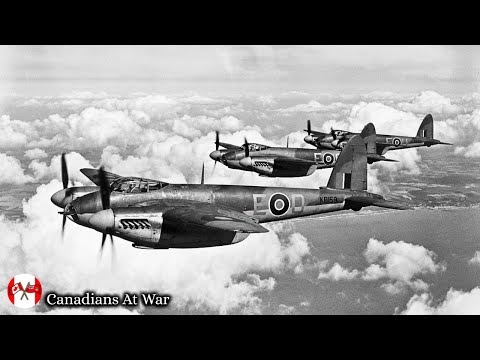
The war had been raging for nearly four years, and the Luftwaffe still ruled the skies. British bombers fell in droves—over 3,000 lost between 1940 and 1942 alone. They were slow, heavy, and easy prey for the fast, agile Bf 109s. The odds were brutal: for every German fighter lost, three or four Allied bombers exploded or spiraled to earth. The RAF desperately needed something new, something that could fly deep into enemy territory and come back.
Most experts said it was impossible. You needed armor, turrets, and a strong metal frame to survive. But a British company, de Havilland, proposed something insane: a bomber made of wood. Light, fast, and unarmed—pure speed as its only defense. “Let the enemy chase it if they can,” they argued. The Air Ministry was skeptical, but desperation won out. The Mosquito was born.
German intelligence laughed when they saw the first reconnaissance photos. “A wooden plane? Britain is running out of materials!” Berlin radio mocked it as a desperate joke, a child’s toy built from scrap. Pilots were told the Mosquito would shatter like matchsticks at the first hit. Fischer pushed his throttle forward, the distance shrinking: 5,000 yards, 4,000, 3,000. The Mosquito flew straight and level, oblivious. He smiled behind his oxygen mask. This would be a slaughter.
But the story of the Mosquito began five years earlier, in a quiet office in Hatfield, England. Geoffrey de Havilland Jr. sat across from skeptical Air Ministry officials, pitching his radical idea: a bomber with no armor, no guns, just two powerful engines and a streamlined wooden frame. “Speed is the best defense,” he insisted. They dismissed him, but he kept coming back. Finally, with war looming in 1939, they gave him a chance.
The Mosquito was a marvel of engineering—a sandwich of Canadian birch and balsa wood, glued with Ecuadorian resin, shaped in giant molds. It was incredibly strong yet feather-light. Powered by two Rolls-Royce Merlin engines, the same that made the Spitfire famous, it had double the power. The first prototype flew in November 1940, and test pilots returned grinning. “It handles like a sports car with wings,” they said. But critics remained. Air Marshal Arthur Harris was dubious, and other officers called wood a relic of a past war.
German propaganda had a field day. “British aircraft built in furniture factories!” they sneered. When intelligence reports showed workshops resembling carpentry shops, with craftsmen using traditional tools, the mockery only grew. “The British Empire is crumbling,” one broadcast declared. But the Mosquito was about to prove them all wrong.
By mid-1941, the first operational squadrons formed. Pilots were stunned by its beauty and speed. In level flight, it could hit 380 mph—and with emergency boost, over 400 mph. That was faster than any German fighter at altitude. Production ramped up, with furniture and piano factories churning out wooden components. Canadian and British forests provided the wood, South American balsa, and tropical resin. It was a global effort to build something the enemy thought was primitive.
Squadron Leader Reggie Reynolds was among the first to fly it in combat. “It felt alive in my hands,” he later said. Wing Commander Hughie Edwards led early deep-penetration raids, returning with stories of outrunning German fighters that couldn’t believe their eyes. A wooden bomber leaving metal fighters in the dust.
But the Mosquito crews faced unique challenges. They flew alone or in small groups, racing over enemy territory at 380-400 mph, often above 30,000 feet where the air was thin and the cold brutal. Frost formed on the windscreen, engines roared so loud that crewmen could barely hear each other. They carried no defensive guns—no turrets, no gunners. If a German fighter got close enough to fire, their only hope was speed. A single burst from a 20mm cannon could mean death.
German fighter pilots were confident. Intelligence told them the Mosquito was made of plywood and balsa—materials for a bookshelf. “A few cannon shells will smash it to splinters,” they were assured. Early reports even claimed successful shoot-downs, and Luftwaffe pilots celebrated, adding Mosquito silhouettes to their kill markings.
Then the truth began to leak out, confusing and infuriating. On May 31, 1942, four Mosquitos attacked Cologne in broad daylight, bombed accurately, and turned for home. Bf 109s scrambled, climbed hard, and dove to intercept. They closed in, guns ready—then the Mosquitos accelerated. 415 mph. The Bf 109s maxed out at 398 mph. The wooden bombers vanished into the western sky, all four returning without a scratch.
The pattern repeated all summer and fall. Mosquitos photographed German sites, outran flak, bombed precise targets, and escaped before fighters could arrive. They appeared over German cities at night, one plane triggering air raid sirens and forcing thousands into shelters, then disappearing before night fighters could find them. German frustration turned to rage. New tactics emerged: high-altitude ambushes, diving attacks, coordinated wolf-pack formations. Yet the wooden planes kept slipping away.
The Luftwaffe remained convinced of one thing: if they could just get close enough, if their shells hit the wooden airframe, the Mosquito would shatter. Wood couldn’t withstand 20mm explosive rounds. One solid hit and the RAF would lose its precious wooden wonder. They needed just one chance—one mistake, one engine failure, one lucky shot.
In March 1943, north of France, Squadron Leader James Marks sat in the left seat of his Mosquito, hands steady on the yoke. Beside him, Sergeant Philip Hayes hunched over the navigation table. They had just bombed a railway junction from 28,000 feet, black smoke rising below. Mission accomplished. Time to go home.
Then Hayes looked out the canopy and froze. Two shapes were diving from above, growing larger by the second. Bf 109s. They were in a perfect diving attack, trading altitude for speed. Hayes did quick mental math. “They’ll be in firing range in 30 seconds,” he said, voice tense. The German leader dove past 400 mph, then 410, then 420. For the first time in months, a Luftwaffe pilot was actually gaining.
At 300 yards, he opened fire. 20mm cannons roared, 13mm machine guns spat armor-piercing rounds. Tracers reached for the Mosquito like fingers of death. Marks saw the flashes, then felt the impacts. Thud, thud, thud. Shells and bullets struck the wooden fuselage and left wing. Direct hits, multiple impacts. The German pilot expected the plywood frame to explode into splinters, the wing to tear off, the fuel tanks to ignite. None of that happened.
The Mosquito flew on. The wooden construction absorbed the cannon shells in a way metal never could. Where aluminum would tear and crack, the birch-balsa sandwich absorbed the shock, dispersing energy locally. Wood splintered and cracked exactly where hit, but the damage didn’t spread. The frame held. Some shells passed through the wooden skin without exploding properly, leaving clean holes. The Mosquito shuddered but stayed in one piece, engines roaring, wings steady.
Marks pushed both throttles to the firewall. The Merlins screamed, delivering 3,000 horsepower. The airspeed indicator climbed: 410 mph, 418, 425. The German fighters, having spent their energy in the dive, couldn’t keep up. In seconds, the gap widened again. Marks watched in his mirror as the two black shapes fell back, becoming dots, then vanishing. They had taken hits—holes in the fuselage, wood splinters on the cockpit floor—but they were alive and heading home at over 400 mph.
The wooden toy had survived its test. But not all Mosquitos were toothless. By mid-1943, the fighter-bomber variant entered service, and German pilots were about to discover a new nightmare. The FB.6 carried four 20mm Hispano cannons in the nose, plus four machine guns. When Luftwaffe pilots expecting a defenseless bomber encountered these versions, the hunters became the prey.
In June 1943 off the Dutch coast, Leutnant Ernst Hartmann, a 15-kill ace in an Fw 190, spotted what looked like a standard Mosquito heading home. He dove to attack, closing to 600 yards, then 500, then 400. He prepared to fire. Then the Mosquito turned—not away, but toward him. Suddenly he was staring into four massive cannon muzzles. Wing Commander Bob Braham, flying a Mosquito FB, had been waiting for this. At 350 yards, he pressed the trigger. Four 20mm cannons erupted, firing 600 rounds per minute. The combined firepower was devastating. Tracers reached out like orange fingers of death. Hartmann had no time to evade. Shells tore through his Fw 190’s engine cowling, one exploded inside the cockpit, another ripped the wing root. The fighter shuddered violently, parts flying off. Controls dead, smoke filling the cockpit, Hartmann pulled the ejector handle and bailed out, his parachute opening just as his fighter exploded below.
From a joke in a furniture factory to the deadliest adversary in just three seconds.
When Marks and Hayes landed back in England, ground crews rushed to inspect the damage. They found cannon shell holes punched through the wooden fuselage, machine gun bullet holes scattered across the left wing. Splinters and cracks radiated like spiderwebs from impact points, but the wooden frame held. Structural strength remained. One crew chief ran his hand over a hole and shook his head in amazement. A metal plane with this damage would have lost parts, torn whole sections away. The wooden Mosquito looked wounded but unbroken.
Marks climbed out, legs shaking from adrenaline. He told intelligence officers what happened—how the Germans had cornered them, fired at close range, how shells hit but the plane kept flying. The report went up the chain and eventually reached Luftwaffe intelligence through spy networks and radio intercepts. By summer 1943, German combat reports forced a complete reassessment of the Mosquito. Intelligence officers collected stacks of pilot testimonies. One fighter pilot after another described the same frustrating experience: they cornered the wooden plane, fired, saw hits, then watched it simply fly away—damaged but not destroyed, still faster than anything Germany could put in the air.
A July 1943 intelligence document stated clearly: the British Mosquito could no longer be considered a weak wooden aircraft. Combat experience proved it had exceptional toughness and speed superiority over all current German fighters above 25,000 feet. The document recommended that German pilots avoid engaging Mosquitos unless they had a significant altitude advantage and could gain substantial speed in a dive. Otherwise, forget it. Let them go.
German pilots read these new reports with growing unease. One fighter pilot after another suffered the same shock: they hit the wooden plane with cannon fire, saw shells strike home, then watched in disbelief as the Mosquito flew on and pulled away. The plane they were told would shatter like kindling was proving tougher and faster than anything in their arsenal.
Despite its advantages, Mosquito crews faced a real danger. The wooden construction that resisted battle damage so brilliantly had one terrible weakness: it burned. Wood plus aviation fuel plus incendiary shells meant fire. Fast, intense, unstoppable fire. Of the 7,781 Mosquitos built during the war, 254 were shot down by enemy fire. Crew survival rates from burning aircraft were very low. Once fire took hold in the wooden airframe, crews had seconds to bail out before the cockpit was engulfed.
Lieutenant Tommy Brom was shot down over Hamburg in August 1943 when German night fighters hit his fuel tanks with incendiary rounds. He later described how his Mosquito became a torch within seconds. The wood ignited so fast he barely had time to open the canopy. He and his navigator jumped from 15,000 feet, parachutes barely opening before the burning wreckage plunged to earth. They survived but spent the rest of the war as POWs.
German losses to Mosquitos mounted steadily. The fighter-bomber versions carried four 20mm cannons plus four machine guns. When Luftwaffe pilots expecting a lone bomber encountered these armed versions, the results were catastrophic. Between 1943 and 1945, Mosquito fighter-bombers destroyed over 600 German aircraft. Mosquito night fighters shot down another 600 German bombers over England, hunting them in the darkness with radar and cannon fire. German bomber crews lived a real nightmare in the night sky. Mosquito night fighters, equipped with radar, stalked them in pitch darkness, appearing without warning and unleashing devastating bursts of cannon fire. Crews had been told the Mosquito was an unarmed bomber. No one warned them about the fighter versions with enough firepower to destroy a metal bomber in one burst.
Despite the violence, there were moments of unexpected respect between enemies. A damaged Mosquito made an emergency landing in Denmark after being hit by flak. The Luftwaffe pilot who had been chasing it, Leutnant Hans Bürger, landed nearby and met the British crew after their capture. According to witnesses, Bürger told the prisoners he had respected their aircraft before that day. But after chasing them for twenty minutes and barely keeping up despite every advantage, he now respected the engineers and builders even more. It took a special kind of genius to build something so perfect from wood and glue.
The RAF expanded Mosquito operations significantly through late 1943 and 1944. Specialized squadrons carried out precision raids that heavy bombers couldn’t attempt. They struck Gestapo headquarters. They destroyed factories making V2 rocket parts. They even bombed German government buildings in Berlin itself, flying in daylight, hitting their targets, and escaping before fighters could respond. The Luftwaffe had no effective way to counter these wooden planes that seemed to go wherever they wanted.
Wait, quick pause here. If you’re listening to this now, help me prove something wrong. My mom told me I’d never even reach a thousand subscribers, but I believe stories like this deserve to be told. And look where we are now—dreaming of 100,000 subscribers. Help me show her these videos matter. Please subscribe to my channel, “Canadians at War,” and let’s keep breathing life into stories that were never meant to stay silent. And now, let’s continue.
The numbers told a story that shocked military planners on both sides. By 1944, Mosquitos were flying more combat missions than any other British bomber except the massive four-engine Lancaster. Yet the Mosquito loss rate remained far lower than anything else in the sky. Only 2.1% of Mosquito sorties ended with the aircraft lost to enemy action. Heavy bombers like the Lancaster and Halifax suffered 5.2% losses per mission. That meant the Mosquito delivered more bombs per aircraft lost—a critical measure of effectiveness. Every Mosquito that returned to base could fly again the next day. Every heavy bomber shot down took ten trained crew with it and cost the equivalent of a small factory to replace.
The Mosquito’s success forced fundamental changes in how air forces thought about bomber design. For decades, military doctrine said bombers needed heavy armor to survive. They needed gun turrets bristling with defensive weapons. They needed to fly in large formations so their combined firepower could fend off enemy fighters. The Mosquito proved all of that wrong. Speed could protect you better than armor. Agility could save you better than guns. A single fast plane could do what 50 slow bombers attempted. It was revolutionary thinking. Air forces around the world took notice and began redesigning their aircraft based on these lessons. Speed over armor became a viable strategy. Precision over carpet bombing became possible. And the idea that one basic airframe could serve multiple roles—bomber one day, fighter the next—changed how military planners thought about building air forces.
Germany was forced to divert precious resources to counter the Mosquito threat. New high-altitude fighters were developed, including the Ta 152 and improved Bf 109 variants, all designed specifically to intercept the wooden planes that kept embarrassing the Luftwaffe. Radar-equipped night fighters, which had been hunting British heavy bombers, were reassigned to Mosquito interception missions. This meant fewer night fighters to protect German cities from the main bombing campaign. German documents from December 1943 show that Adolf Hitler personally demanded solutions to what he called “the Mosquito problem.” These wooden planes were photographing secret V-weapon launch sites. They were disrupting German propaganda by bombing Berlin during Hitler’s radio speeches, forcing him to stop broadcasting while air raid sirens wailed. They were humiliating the Luftwaffe in front of the German people, proving that British aircraft could reach anywhere, anytime, without being stopped.
The statistics made the Mosquito’s impact clear. These wooden planes dropped 26,867 tons of bombs during the war while losing only 254 aircraft to enemy action. They flew 39,795 operational sorties into enemy airspace. In air combat, Mosquito fighter-bombers achieved kill ratios exceeding 10 to 1, destroying over 600 German bombers and 600 fighters while losing relatively few of their own. These were the numbers that made military historians revise their understanding of what aircraft design could achieve.
The Mosquito’s success had a powerful effect on Allied morale. Crews flying heavy four-engine bombers knew their chances of surviving a full 30-mission tour were less than 50%. Many didn’t survive their first five missions. But Mosquito crews had much better odds. Pilots and navigators volunteered specifically for Mosquito squadrons because they knew the wooden plane gave them a real chance of coming home alive. Newspapers celebrated the Mosquito as the “Wooden Wonder.” They wrote stories about how British furniture makers and craftsmen were defeating German industrial power. Propaganda focused heavily on the fact that centuries-old woodworking skills had been used to build weapons that outperformed the most advanced metal aircraft Germany could produce.
Many Mosquitos were built in Canada, where de Havilland Canada produced 1,134 of them. Canadian squadrons flew them extensively in combat. No. 410 Squadron RCAF became one of the highest-scoring Mosquito units of the entire war, destroying over 100 German aircraft. The wooden Mosquito became a symbol of Canadian industrial capability and military effectiveness. Proof that Canada could design, build, and fight with the best equipment in the world.
Geoffrey de Havilland Jr., the designer’s son who flew the first Mosquito prototype and championed the wooden plane when everyone doubted it, didn’t live to see the full extent of his creation’s success. On September 27, 1946, just one year after the war ended, he was testing a new experimental jet called the DH 108 over the Thames Estuary in England. The sleek jet was pushing the boundaries of speed, exploring what aircraft could do in the new jet age. At high altitude and speed beyond any propeller plane, the aircraft suddenly disintegrated in the air. High-speed aerodynamic forces tore the experimental plane apart. De Havilland’s body was found among the wreckage washed ashore days later. He was 36 years old.
But the wooden Mosquito he believed in so fiercely outlived him for years. It served in air forces around the world into the 1950s, long after jet aircraft replaced propeller planes in front-line service. Wing Commander Bob Braham, the pilot who shot down Ernst Hartmann off the Dutch coast, became the most successful Mosquito pilot of the war, flying the night fighter version and hunting German bombers in the darkness over England and occupied Europe. He shot down 29 enemy aircraft, most while flying radar-equipped Mosquitos with four cannons. Braham received more decorations than almost any other RAF pilot. His chest was covered with ribbon bars recognizing his courage and skill. He later said the Mosquito gave him a confidence no other aircraft could provide. He knew that if things got dangerous, if everything went wrong, he could simply push the throttle forward and escape. That speed gave him the freedom to take risks he would never have dared in slower aircraft. That escape capability saved his life many times.
But his luck ran out on June 25, 1944. While flying a mission over Denmark, flak damage to his Mosquito was so severe he couldn’t maintain altitude. He crash-landed in a field and spent the rest of the war as a prisoner in German camps. He was finally liberated when Allied forces arrived in 1945.
German pilot Franz Stiegler, who encountered Mosquitos several times and survived the war with 28 confirmed victories, spent decades after 1945 reflecting on his experiences. In a 1985 interview, 40 years after the war ended, he spoke honestly about the Mosquito. He admitted that German pilots had been arrogant about the wooden plane at first. Wood seemed primitive and backward, especially compared to the modern metal fighters Germany was producing. But combat taught them humility very quickly. That wooden plane, built in furniture factories by craftsmen using traditional woodworking techniques, was better designed than the metal fighters designed by Germany’s best engineers. The British understood something fundamental that the Germans missed. The best material for any job isn’t always the most modern or advanced. Sometimes the best material is the one that does the job most effectively, even if that material is old and simple.
February 18, 1944, saw one of the most famous Mosquito missions of the entire war. Squadron Leader Tony Wickham led 19 Mosquitos in a daring raid known as Operation Jericho. The target was Amiens prison in occupied France, where the Gestapo held members of the French Resistance awaiting execution. The mission was to breach the prison walls with precision bombing, allowing the prisoners to escape in the chaos. The Mosquitos flew at rooftop height in broad daylight, racing over the French countryside at 300 mph. They approached the prison and dropped their bombs with astonishing accuracy. The walls exploded outward. German guards scattered in every direction. In the confusion, over 250 prisoners escaped into the countryside. Many joined Resistance groups to continue the fight. Wickham’s Mosquito was hit by debris from the explosions and crashed. Wickham survived but spent the rest of the war in a German POW camp. After his release in 1945, he said the Mosquito could do what no other bomber in the world could do. It could hit a single building without destroying the entire town around it. That precision made missions like Amiens possible.
Sergeant Major Hergert served as a crew member on a German Junkers 88 bomber during a mission over northern Germany in March 1945. The war was nearing its end, but Germany kept sending bombers at night hoping to slow the Allied advance. Hergert’s bomber was flying through the darkness when a Mosquito night fighter spotted it on radar. The Mosquito’s radar operator, Flight Officer Peter Evans, guided his pilot, Lieutenant James Harrison, to within 200 yards of the German bomber. Hergert never saw the wooden plane, never heard it approach. Suddenly, the night was filled with cannon fire. Bright orange flashes in the darkness, explosive shells tearing through his bomber’s wing. The wing separated from the fuselage and the bomber began spinning toward the ground. Hergert managed to bail out, his parachute opening at the last moment. He was one of only two crew members who survived. When he was later told that a British wooden plane had shot him down, he thought someone was joking. Wooden? Impossible. But it was true.
Thirty-three years later, in 1978, Hergert attended a veterans’ reunion where he met former enemies to remember the war. He met Peter Evans, the radar operator from the Mosquito that destroyed his bomber. The two men shook hands and talked about that night. Hergert described the experience of not seeing death coming, just sudden fire and his aircraft disintegrating around him.
Lieutenant Jane Brod was part of the Air Transport Auxiliary, a group of civilian pilots who ferried aircraft from factories to military squadrons during the war. Women weren’t allowed to fly combat missions, but they could transport planes, and Brod delivered over 200 Mosquitos during her service. She remembered that male pilots were sometimes surprised when she climbed out of the cockpit after landing. They expected a man, but the Mosquito didn’t care about gender. It responded to skill and training, not whether the pilot was male or female. Brod said the plane was wonderful to fly, responsive to the controls, forgiving of small mistakes. She loved every flight and considered the Mosquito the best aircraft she ever flew.
After the war ended in 1945, Air Marshal Sir Arthur Harris sat down to write his assessment of the plane that won the air campaign over Europe. Harris was the man who had commanded all of British Bomber Command, the man who had initially dismissed the Mosquito as a foolish idea. Now, with years of combat data before him, he wrote words that completely reversed his earlier skepticism. He described the Mosquito as the greatest multi-role combat aircraft of the entire war. It could perform every role asked of it—fighter, bomber, reconnaissance—and performed each role better than aircraft designed specifically for single purposes. The wooden plane proved that smart design and innovative thinking could overcome conventional wisdom every time.
Memorials and museums preserve the Mosquito’s legacy today. The de Havilland Aircraft Museum in Hertfordshire, England, holds several Mosquitos, including the prototype that first flew in 1940. Visitors can walk around these wooden planes and see up close how furniture-making techniques created a weapon that dominated the skies. A memorial at RAF Marham honors the squadrons that flew Mosquitos on dangerous missions over occupied Europe. The memorial lists the names of crews who never returned, carved in stone so their sacrifices won’t be forgotten. In Amiens, France, the prison attacked by Mosquitos in 1944 maintains a memorial to Operation Jericho and the wooden plane that gave French Resistance fighters a chance to escape and survive. The Canadian Warplane Heritage Museum keeps one of only three airworthy Mosquitos in the world. When this wooden warrior flies at air shows, thousands gather to watch and hear the distinctive sound of the two Merlin engines that once terrified German pilots across Europe.
The Mosquito influenced how aircraft were designed for decades after the war ended. Military planners learned crucial lessons that shaped the jet age. The use of unconventional materials in aircraft construction traces back to this wooden wonder. Modern military aircraft use carbon fiber, fiberglass, and other composite materials instead of metal in many components. These materials were chosen for their engineering properties, not because they look modern or advanced. The Mosquito taught designers to choose materials that achieve the best performance, even if those materials seem unfamiliar or old-fashioned.
In Britain and Canada, the Mosquito represents wartime ingenuity and determination. It symbolizes how ordinary people—furniture makers, piano builders, woodworkers—contributed to victory using skills passed down through generations. When materials were scarce and factories were being bombed, British and Canadian workers built weapons from wood that defeated a major industrial power. National pride in the Mosquito remains strong even after 80 years. In Germany, military historians and former Luftwaffe pilots speak of the Mosquito with respect and admiration. General Adolf Galland, who commanded all German fighter forces during the war, wrote after 1945 that the Mosquito was the most successful twin-engine combat aircraft ever built. Germany had nothing to match it. The fact that it was made of wood—something German propaganda mocked relentlessly—proved British genius. The British turned what was considered a weakness into an overwhelming strength.
By 2024, only three airworthy Mosquitos remain from the nearly 8,000 built. These rare wooden planes appear at air shows where tens of thousands gather to watch them fly. The sound of their Merlin engines, echoing across airfields, brings together veterans from both sides of the war. Former enemies, now elderly men, shake hands and share memories of the plane that changed aerial warfare forever. They speak with respect about the wooden aircraft that some mocked and others feared.
The Mosquito’s story teaches us that assumptions in war can be fatal. The Luftwaffe assumed wood meant weakness. They assumed unarmed meant vulnerable. They assumed British desperation meant poor design. Every one of those assumptions proved catastrophically wrong. The wooden plane they laughed at became the plane they couldn’t catch, couldn’t destroy, couldn’t match. In war, success doesn’t belong to those with the most modern materials or the largest factories. Success belongs to those who think differently, who challenge what everyone believes, who turn limitations into advantages. The Mosquito was built by furniture makers from wood in the age of metal aircraft. And it was magnificent. They laughed at the wooden plane. Then they couldn’t catch it. Then they couldn’t shoot it down. Then they couldn’t build anything better. In the end, no one was laughing anymore. They were running for their lives.
Fischer never forgot that March afternoon. He never fired the shot. His finger hovered, then fell away from the trigger as the Mosquito banked gently and simply pulled ahead, its twin Merlins singing a note his own engine could not answer. He returned to base that evening and told Werner the truth: “We were not the hunters. We were the audience.”
Years later, long after the guns fell silent, an old man in a garden in Bavaria watched a documentary about the wooden plane. He smiled at the mocking newsreels, at the laughter of 1943. “We laughed,” he said quietly to no one. “Then we learned. Then we ran.”
So here is the question the Mosquito leaves us: when the world tells you your idea is too simple, too old, too foolish to work—will you build it anyway, out of wood and glue and stubborn belief, and let the laughter fade behind you?
Report this article
Select a reason for reporting:






