In the glittering world of classic Hollywood, where spotlights chased away shadows and fame seemed the ultimate prize, a darker narrative lurked beneath the surface. Whispers of satanic rituals, occult pacts, and unholy alliances clung to some of the most beloved stars of the silver screen. From Marilyn Monroe’s mysterious death to Elvis Presley’s obsession with the esoteric, these stories blur the line between rumor and reality, leaving us to wonder: did these icons truly dabble in the dark arts, or were they merely victims of sensationalism?
Take Jayne Mansfield, the blonde bombshell whose life ended in a horrific car crash in 1967. Her connection to Anton LaVey, founder of the Church of Satan, fueled rumors that she was a high priestess in his inner circle. Some claimed she participated in blood rituals and that LaVey cursed her lawyer and lover, Sam Brody, shortly before the fatal accident. Was it a coincidence, or the fulfillment of a dark covenant?
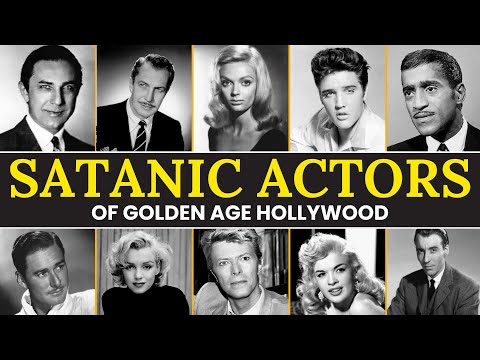
Elvis Presley, the King of Rock and Roll, grew up singing gospel hymns, yet rumors persist that he harbored a secret fascination with the occult. His personal library allegedly contained books on numerology, Hermetic philosophy, and even the works of Aleister Crowley, the infamous occultist. Some insiders whispered that Elvis believed he was guided by the spirit of his stillborn twin, Jesse Garon, and performed ritual prayers to protect his voice. His tragic death in 1977 sparked conspiracy theories that he had struck a deal with dark forces, paying the ultimate price for his meteoric rise.
James Dean, the rebel without a cause, lived fast and died young, but not before his passion for speed and the unknown led to speculation about a darker influence. His Porsche 550 Spyder, nicknamed “Little Bastard,” was said to be cursed, and after his fatal crash, the car’s wreckage seemed to bring misfortune to anyone who touched it. Some claimed Dean’s dabbling in séances or Ouija boards opened a gateway to malevolent entities, sealing his fate. Was his death at 24 just a tragic accident, or the result of a Faustian bargain for stardom?
Errol Flynn, the swashbuckling hero of the screen, was equally notorious off-screen for his hedonistic lifestyle. His yacht parties were legendary, attended by Hollywood starlets and eccentric artists, and allegedly featured black candles, strange symbols, and midnight rituals. Flynn’s rebellion against social norms and his interest in forbidden knowledge—from alchemy to ceremonial magic—fueled beliefs that he consorted with dark powers. Even his death in 1959 was shrouded in mystery, with some suggesting he paid the final price for his indulgences.
Sammy Davis Jr., the multi-talented Rat Pack member, was rumored to have briefly joined Anton LaVey’s Church of Satan in the late 1960s. Stories circulated about him attending rituals with black candles and cryptic incantations, though friends dismissed it as a phase. Yet his sudden distancing from LaVey left many wondering if he had witnessed something that forced him to retreat. Marilyn Monroe, the ultimate Hollywood icon, was said by some to be a victim of dark forces—chosen for stardom by a shadowy elite in exchange for compliance. Her mysterious death in 1962 and her connections to powerful figures like JFK only deepened the speculation.
Vincent Price, the master of horror, was known for his cultured demeanor and extensive art collection, but rumors hinted at a collection of books on Satanism and the occult. His lectures on the cultural significance of witch trials raised eyebrows, and some crew members claimed his dressing room was filled with arcane symbols. Barbara Steele, the queen of gothic horror, was said to have a deep interest in real witchcraft, studying Crowley and European folklore. On set, she reportedly entered trance-like states and carried protective charms, adding to her enigmatic aura.
Christopher Lee, the towering presence who defined Count Dracula for a generation, carried an air of menace that seemed to extend beyond the screen. His personal library, vast and filled with volumes on demonology and the occult, was no secret to those who knew him. Lee often warned fans and interviewers about the dangers of dabbling in black magic, his voice carrying a gravity that suggested firsthand knowledge. Some whispered that his interest was born from direct experience, perhaps linked to European elites who practiced esoteric rites. He supposedly witnessed a summoning ritual once, and the memory never left him.
Bela Lugosi, the original Dracula, was said to have held séances in his Hollywood home, seeking contact with the other side. His collection of ancient grimoires and magical texts was rumored to be extensive, used to lend authenticity to his performances. As his career declined and his personal life spiraled into addiction and financial ruin, some claimed he had invoked forces he could not control, leading to a spiral of misfortune. He was buried in one of his Dracula capes, a detail that only deepened the myth that the man and the monster had become inseparable.
David Bowie, ever the chameleon, was rumored to have developed a deep fear of black magic during the 1970s. His then-wife Angie told of an incident in Los Angeles where Bowie became convinced that evil forces had taken over their swimming pool. A white witch was summoned to perform a cleansing ritual, complete with incantations, salt, and symbolic gestures. Bowie watched in terror and fascination, allegedly seeing strange shapes in the water. His fears were partly fueled by heavy drug use, but his interest in occult symbols and literature added another layer to the enigma of a man who constantly reinvented himself.
These stories, whether born of coincidence, paranoia, or genuine encounters with the unknown, continue to haunt the legacy of Hollywood’s golden age. The line between performance and reality blurs when the spotlight fades, and the question remains: were these icons merely playing with fire for the thrill of it, or did some of them get burned?
Yet the most unsettling tales often emerged not from the stars themselves, but from those who worked closest to them—makeup artists, set designers, and personal assistants who swore they had glimpsed something unnatural behind the glamour. A former studio grip, speaking decades later under a pseudonym, recalled an incident on the set of a 1950s thriller involving Vincent Price. According to his account, Price arrived early one morning carrying a small leather-bound book, its pages yellowed and brittle, and spent nearly an hour alone in his dressing room, murmuring in a language the grip could not identify. When the door finally opened, the room was said to be thick with the smell of incense and something else—something metallic and faintly sweet, like old blood.
“He looked at me and smiled,” the grip remembered, “and said, ‘Don’t worry, my boy. The curtain hasn’t risen yet.'” Whether it was a theatrical jest or a genuine warning, the grip claimed he never again set foot in that dressing room alone.
Similar accounts swirled around Barbara Steele, whose on-set behavior reportedly unnerved even hardened technicians. A costume assistant on one of her gothic productions described finding Steele at three in the morning in an empty soundstage, barefoot and draped in a black shawl, tracing a circle on the floor with chalk. “She didn’t seem surprised to see me,” the assistant said. “She just put a finger to her lips and told me the circle wasn’t for me—it was to keep something out.” The assistant quit the following week, citing recurring nightmares.
Even more chilling were the stories that followed Christopher Lee off the set and into his private life. A family friend once confided that Lee kept a specific room in his London home permanently locked, its windows sealed and its door fitted with an old iron lock unlike any other in the house. When asked about it, Lee reportedly grew quiet and changed the subject. The friend later learned from a housekeeper that the room contained nothing but a single chair, a mirror facing the wall, and a circle of salt that was renewed every Sunday. “He never explained it,” the friend said. “But he never let anyone near it either.”
These fragments—a locked room, a chalk circle, a whispered warning—rarely amounted to proof of anything. Skeptics pointed out that actors were, by nature, dramatic people who enjoyed cultivating mystique. A reputation for dabbling in the occult, after all, only deepened the allure of a horror star. Yet the sheer consistency of the accounts, told by people with little to gain and much to lose, suggested that something more than mere performance was at play. The golden age of Hollywood was, in many ways, a golden age of secrets—and the darkest secrets, it seemed, were always kept in plain sight.
As the 1960s gave way to the 1970s, a new generation of stars inherited both the spotlight and the whispering shadows that came with it. Some sought to escape the rumors; others embraced them openly, treating the occult as just another costume to be worn and discarded. But the old stories refused to die, passed from set to set like a curse that could not be lifted. The question was no longer whether the stars had dabbled in the dark arts—it was whether the dark arts had ever truly let them go.
The answer, if it exists at all, may lie buried in the archives of a town most have never heard of. In the late 1980s, a retired studio publicist named Margaret Holloway gave a single interview to a local radio station, her voice frail but steady. She claimed that during her years handling press for several of the stars now shrouded in rumor, she had been entrusted with a small box of documents she was told never to open. “I kept it for forty years,” she said. “I never looked inside. I was too afraid of what I’d find.”
When Holloway died in 1991, the box was reportedly discovered among her belongings and promptly vanished before any historian could examine it. No inventory, no photographs, no confirmation that it had ever existed—only her word, and the quiet insistence of a few who knew her that she was not a woman given to invention.
Perhaps that is the true nature of these legends. They survive not because they are proven, but because they are unprovable—each missing page, each locked room, each whispered warning becomes another thread in a tapestry that grows richer with every retelling. The stars themselves are long gone, but the stories have taken on a life of their own, fed by our hunger for meaning behind the inexplicable.
And so the golden age of Hollywood remains exactly what it always was: a glittering surface stretched over a fathomless dark. Whether demons danced in those shadows or only the reflections of our own fears, we may never know for certain.
But tell us—what do you believe? Did these icons truly bargain with forces beyond our understanding, or have we simply conjured the darkness ourselves?
Report this article
Select a reason for reporting:






