In the suffocating heat of the Vietnamese jungle, a legend was born—one that would haunt the Viet Cong long after the guns fell silent. They called them Ma Rung, the phantoms. A force so silent, so lethal, that the enemy refused to believe they were human. This is not the story of a massive army, but of just 100 Australians who struck more paralyzing terror into the hearts of the Viet Cong than 10,000 heavily armed US Marines combined.
How did a tiny group of SAS operators turn the hunter into the hunted? Moving through the bush like shadows, they left behind nothing but a trail of silent kills and a legend that still haunts the veterans of the North. The Americans brought the noise. The Australians brought the nightmare.
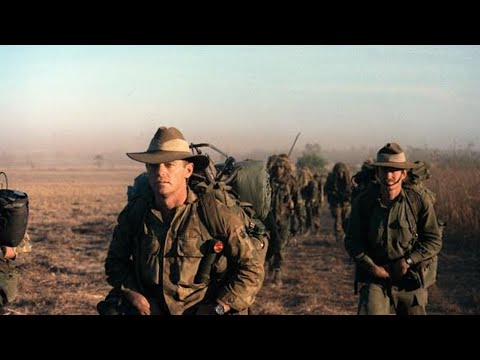
In the thick tropical heat of Phuoc Tuy province, an American patrol might as well have been marching through the jungle with a flashing neon sign strapped to their helmets. The enemy always knew they were coming. But the Australians had a different approach—one that was as simple as it was scandalous.
They smelled like the jungle itself. For two full weeks before venturing beyond the wire, every member of the patrol completely abandoned all forms of hygiene. They rejected soap, threw away their razors, and allowed their natural body oils to saturate their tattered uniforms. They stopped brushing their teeth. They stopped washing their hands. They let the accumulated filth of the Australian bush camp seep into every pore of their skin until their own comrades could barely stand to sit next to them at the mess table.
This was not a lack of discipline, but a calculated transformation into a predator that the jungle would accept as one of its own. To complete this biological camouflage, they went to lengths that many considered absolutely scandalous. They intentionally drenched their gear and skin in nuoc mam, the fermented rotting fish sauce that was a staple of every Vietnamese village kitchen, and rubbed handfuls of jungle mud, crushed leaves, and local spices into their pores until their bodies produced an odor so foul that it would make a dumpster behind a Saigon fish market smell like a French perfume counter.
By the time they stepped into the deep brush, they did not just blend into the foliage. They became an organic, indistinguishable part of the jungle’s own rotting ecosystem. A Viet Cong scout could be standing a mere three feet away, and his nose would tell him he was smelling nothing more dangerous than a patch of decaying vegetation or a local farmer returning from the rice paddies.
But the science behind the stinking protocol was about to reveal a truth that the Pentagon never wanted to hear. The tropical humidity of Vietnam acted as a scent amplifier of terrifying efficiency, carrying chemical molecules through the stagnant moisture-saturated air with a reach that no laboratory could replicate. Military researchers would later confirm that a single drop of Western aftershave lotion could create a detectable scent corridor stretching over 400 yards in the right atmospheric conditions.
The Viet Cong scouts who operated in these forests were not ordinary soldiers. Many of them had grown up hunting wild game in the triple-canopy wilderness since childhood, and they possessed an olfactory sensitivity to foreign chemicals that rivaled a bloodhound’s ability to track a fugitive through the swamps of Louisiana. Captured guerrilla fighters confirmed during interrogation that they could routinely detect the approach of an American patrol by smell alone, often 15 to 20 minutes before any visual or acoustic contact was made.
Against such natural detection systems, the standard-issue bottle of army insect repellent was not just a comfort item. It was a homing beacon that guided enemy ambushes with devastating pinpoint accuracy. And yet, the most devastating part of this equation was what it revealed about the fundamental clash of philosophy between the two allied forces.
The Americans were trying to bring civilization into the jungle. They hauled in portable showers, stocked their forward bases with branded hygiene products, and insisted on maintaining the grooming standards of a peacetime garrison, even in the most hostile terrain on the planet. Every bar of soap, every tube of shaving cream, every aerosol can of insect repellent represented a philosophical choice that the generals in Washington never questioned. Comfort over survival, familiarity over adaptation, the illusion of normality over the brutal reality of the bush.
The Australians understood something that no amount of Pentagon spending could buy. They understood that the jungle was not a battlefield to be conquered with technology. It was a living, breathing organism that would betray any foreign body it detected within its ecosystem. The SAS men chose the opposite path from their American allies. They chose to become the jungle, to dissolve the boundary between soldier and swamp, between hunter and habitat. And in doing so, they became invisible to the enemy’s most ancient and most reliable detection system—the human nose.
It was a victory of adaptation over arrogance. And it was only the first of many lessons that the world’s most powerful military was too proud to learn.
If the stench of the forest phantoms was a nightmare for the enemy, their absolute mastery of silence was a total impossibility in the world of 20th-century combat. The Australians treated sound the way a demolition expert treats nitroglycerin—with obsessive, fanatical, almost religious respect for its terrifying power to cause instant, irreversible catastrophe. One careless clink of metal against metal. One dry twig snapping under a boot. One involuntary cough suppressed half a second too late—and five men would cease to exist in a storm of AK-47 fire from an enemy they never even saw.
In the suffocating green darkness of the Vietnamese triple canopy, sound was not just a tactical consideration. It was the difference between walking back through the wire at Nui Dat and vanishing forever into the anonymous mud of a foreign jungle. The standard American approach to the same problem could not have been more dramatically different. The doctrine of search and destroy relied on overwhelming volume—both in terms of firepower and sheer acoustic presence.
A typical American infantry company on the move generated a noise signature that a trained Viet Cong listener could detect from over a kilometer away. The clanking of aluminum canteens bouncing against steel ammunition pouches. The rhythmic thudding of heavy jungle boots on packed laterite earth. The metallic rattle of M16 rifles knocking against flak jackets with every step. The constant crackle of multiple PRC-25 radio handsets broadcasting on open frequencies. And above all, the unmistakable sound of 200 young men from Ohio, Texas, and California talking, arguing, cursing the heat, and complaining about the chow—voices that carried through the canopy like a live broadcast from Armed Forces Radio Saigon.
This was not a failure of discipline. It was the logical, unavoidable consequence of a doctrine that valued speed, aggression, and overwhelming firepower over the ancient patient arts of stealth and concealment. But the Australians had built their entire operational philosophy around a single, obsessive question: how do you make a man disappear?
Every single piece of equipment carried by an Australian SAS patrol was subjected to a ritualistic pre-mission inspection that bordered on the pathological. The process began 72 hours before departure and consumed more time than the actual weapons cleaning. Metal dog tags were taped together with thick black electrical tape so they could not produce even the faintest metallic clink during a midnight stalk through enemy-held bamboo. Standard-issue metal buckles on webbing and harnesses were removed entirely and replaced with silent fabric ties. Rifle magazines were loaded one round short of full capacity to prevent the compressed spring from producing a telltale rattle. Weapons were carried with the safety catch engaged and the sling wrapped tight against the body to eliminate any possibility of the barrel tapping against a canteen during a sudden change of direction.
Even the most mundane items in the patrol kit were subjected to this fanatical acoustic audit. The medical kit was completely unpacked and reassembled so that individual bandages, morphine syrettes, and surgical instruments could not shift or rub against each other inside the pouch. Water canteens were wrapped in strips of cloth to dampen any sloshing sound from partially filled containers. Compass cases were padded with strips of cut rubber. Grenades were secured to the webbing with additional tape to prevent the safety spoons from vibrating against the body of the munition.
One veteran SAS operator later revealed that his patrol leader once sent a man back from the departure point because his bootlace eyelets were producing a barely perceptible squeak that could only be heard in total silence from a distance of two feet. That level of obsession would have been considered clinical madness in any other army on the planet. But in the Australian SAS, it was the basic minimum standard for staying alive.
Yet the true mastery lay not in the silencing of equipment, but in the extraordinary science of the human footstep itself. The movement of these Australian phantoms through the jungle was a cold-blooded and precise discipline of kinetic invisibility that remains unmatched by any special operations force to this day. While irregular infantrymen might crash through the undergrowth like a startled water buffalo, breaking dry twigs and rustling dead leaves with every careless stride, the Ma Rung operators utilized a specialized heel-to-toe roll that allowed a 200-pound man loaded with 25 kilograms of combat equipment to move with the acoustic signature of a falling leaf.
The technique required the lead scout to lower his forward foot in an excruciatingly slow, controlled arc—making contact first with the outer edge of the heel, then gradually transferring his full body weight along the length of the sole while simultaneously feeling through the thin rubber of his modified jungle boot for any dry twig, loose pebble, or brittle bamboo shard that might produce a snap. If the toe detected an obstacle, the foot was lifted with agonizing slowness and repositioned without ever completing the step. A single careless footfall, a single crack of dried wood echoing through the silent canopy, could betray the entire patrol’s position and trigger a contact that would mean the permanent end of five men’s stories.
The result was a pace of movement that would have driven an American battalion commander to the absolute edge of professional despair. A five-man SAS patrol moving through dense secondary growth might cover as little as 100 yards in a full hour of continuous movement. One hundred yards. An American infantry platoon could cover the same distance in under two minutes at a standard tactical walk. But the Australians were not interested in speed, because speed in the Vietnamese jungle was just another word for noise. And noise was just another word for a body bag on the next helicopter back to Saigon.
That glacial, maddening, patience-destroying pace bought something infinitely more valuable than rapid ground coverage. It bought total acoustic invisibility—the ability to pass through an enemy-controlled landscape like a ripple of warm air, leaving behind no sound, no trace, and no indication that a human being had ever been present.
The Viet Cong learned to dread the silence more than the gunfire. A sentry would report an uneventful night, only to find his comrades dead 300 meters away—killed by a force that had slipped through his line like a shadow across a wall. They had not failed. The Australians had simply erased themselves from every spectrum of detection.
Then came the directive that broke the enemy’s will. In 1969, an SAS patrol recovered a captured document ordering all Viet Cong units to avoid contact with the Australians at all costs. “They fight like jungle guerrillas,” the directive admitted—an extraordinary confession from the world’s foremost practitioners of guerrilla war.
One hundred men had beaten the Viet Cong at their own game. The Ma Rung had become a legend written in silence and shadow, a ghost story the enemy told themselves in the dark.
But the question that still haunts history remains: if a method destroys the men who practice it, was it truly victory—or just a different way of feeding humans to the engine of war? What do you think—were the phantoms heroes, or casualties of a war that never truly ended?
Report this article
Select a reason for reporting:






