In 1945, every air force on Earth had reached the same verdict: the propeller was finished. Speed was survival, and anything spinning a blade through the air was already obsolete. Britain had the Meteor. Germany had the Me 262. The United States had the P-80. The Navy had jets on order and a procurement roadmap that ended piston combat aircraft on a fixed date.
Yet one design office in El Segundo, California, delivered a piston attack aircraft anyway. The man who drew it had no engineering degree—his formal education ended with high school. He had been hired as a draftsman in 1926 and laid off within a year. His name was Ed Heinemann. Twenty-one years later, on March 10, 1966, one of his airplanes landed on a runway under fire in the A Shau Valley. The aircraft nobody wanted had become the one aircraft nobody could replace.
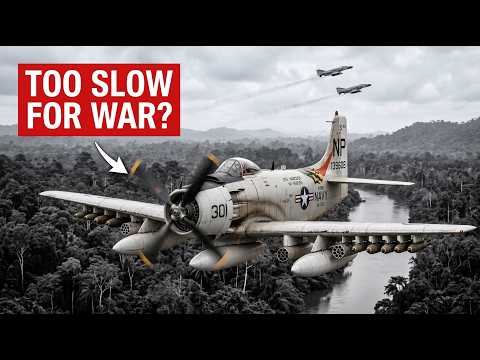
The decision that produced it was taken before anyone drew a line. In 1943, the Navy’s Bureau of Aeronautics concluded it was carrying one aircraft type too many. Dive bombing and torpedo bombing had been separate trades with separate airframes and separate crews. The Dauntless, the Helldiver, and the Avenger were all to be replaced by a single machine that could do both jobs with one man aboard.
The reasoning was arithmetic, not doctrine. A carrier deck is a fixed area, and every attack aircraft parked on it is a fighter that cannot be. Fleet commanders wanted more fighters. The attack aircraft was being compressed before it existed.
Sitting beside that requirement was a procurement roadmap with a date printed on it. Jet engines had stopped being laboratory equipment. The roadmap showed piston combat aircraft ending, and it showed the year. Men who had spent fifteen years building radial engine airplanes sat in rooms where their entire discipline was handed a closing date and a successor. Not a law of physics—a schedule.
The engineer who would answer the requirement did not argue with it. He said later that his team expected roughly five years of service out of whatever they produced. He was not building a monument. He was filling a gap until the jets arrived. Five years.
The Navy already knew what it wanted to stop building. It did not yet know what to build. Douglas already held the contract that was supposed to answer the requirement, and the contract was failing. The BTD-1 Destroyer had grown out of an earlier two-seat design, had lost its defensive turrets, had gained fuel and armor in their place, and had arrived heavier and slower than the aircraft it was meant to improve on. Twenty-six were built. Twenty-eight had been delivered by the Japanese surrender. Not one of them saw combat.
Martin was answering the same requirement in the opposite direction with the AM Mauler. Bigger airframe, bigger engine, more of everything. That answer was orthodox and defensible. Weight was the price of strength, and strength was the price of hitting a moving deck at night with ordnance still on the racks. Any engineer who chose brute size in 1944 could point to a decade of wreckage proving the alternative.
Douglas’s chief engineer went to Washington and argued against his own company. He asked the Bureau of Aeronautics to cancel the Destroyer outright. That is a rarer act than it sounds. A wartime production contract is payroll, space, tooling, and a company’s standing with the only customer that matters. Handing it back meant telling the Navy that Douglas had spent public money on an aircraft not worth finishing, and then asking to be trusted with more of it.
The aircraft on the ramp was the evidence against him, and the evidence for him at the same time. It had been paid for, delivered, and flown, and it was going nowhere. He gave the contract back. He had until the following morning to replace it.
The name attached to the replacement was not a famous one in 1944, and the career behind it did not read like the resume of a chief engineer. Edward Heinemann was born in Saginaw, Michigan, on March 14, 1908, and raised in Los Angeles. His formal education stopped at high school. He learned drafting and mechanics out of library books and correspondence courses, joined Douglas as a draftsman at eighteen and was laid off within the year. He worked at International Aircraft, then Moreland, then Northrop, and returned to Douglas when Douglas absorbed Northrop. In 1936, at twenty-eight, he became chief engineer.
There was one reason the Navy listened to him in a hotel room instead of throwing him out of it, and that reason had a serial number. He had designed the SBD Dauntless, a dive bomber lighter than its intended successor, still in production after it was supposed to be obsolete, and responsible for sinking four Japanese carriers in a single morning at Midway. The man now proposing to solve a weight problem by subtraction had already won an argument about subtraction once in the most public way available.
The night itself rests on his own account, and the sources place it in June or July of 1944. He was summoned to Washington with two members of his staff. Leo Devlin ran the weight computations. Gene Root ran the aerodynamics. They spent the day arguing the Destroyer’s case in front of the Bureau and lost it, and then they went back to the hotel and started again from nothing.
By 3:00 in the morning, there were dimension drawings on the table. One seat, one large radial engine, a structure conceived around lifting an enormous external load off a deck rather than around carrying it internally. Devlin’s columns and Root’s curves had been turned into an airplane that existed only as paper and would have to be defended in daylight. By noon the next day, Douglas had authorization to kill the Destroyer and build twenty-five pre-production examples of the thing on the paper.
The prototypes were formally ordered on July 6, 1944. The Bureau attached a condition that was closer to a dare than a schedule: nine months to first flight.
He had already decided what he would sell in order to buy them. Every airplane is an argument about what to give up, and this one was unusually explicit about it because somebody had done the arithmetic. A study circulated shortly after design work began put an exchange rate on weight. For every 100 pounds removed from the aircraft, the takeoff run shortened by 8 feet, the combat radius extended by 22 miles, and the rate of climb improved by 18 feet per minute. 100 pounds bought 22 miles.
That figure changed the nature of the work. It meant that weight was not an engineering nuisance to be tolerated, but a currency to be spent—and that every fitting, bracket, and length of pipe in the aircraft had a price expressed in miles. The design office began stripping the airplane line by line, and the receipts survived.
The fuel system gave up 270 pounds through simplification. The internal bomb bay gave up 200 pounds by being deleted entirely. The fuselage dive brake gave up 70. An older, heavier tail wheel design was replaced and gave up 100 more. Item by item across the whole airframe, the total passed 1,800 pounds.
Each of those numbers was a decision with a consequence attached, and the consequences were not small. Deleting the internal bomb bay meant that every bomb, rocket, and fuel tank the aircraft ever carried would hang in the airstream in the open for the entire life of the type. That is drag permanently on every sortie ever flown. It also meant the fuselage could be built as a simple continuous structure instead of a box wrapped around a hole, which is stronger and lighter and cheaper to make.
Simplifying the fuel system meant fewer components, fewer failure points, and less plumbing to maintain on a pitching deck. And it also meant accepting a specific and unglamorous truth about what happens when a fuel line is hit at low altitude. Choosing the older tail wheel meant taking a known quantity over a lighter unknown in a program with nine months on the clock and no margin for a component that needed inventing.
Martin’s engineers were solving the same problem by adding a bigger engine to a bigger airframe. That was not stupidity. It was the mainstream position, and it had the advantage of not requiring anyone to be clever under deadline.
What the subtraction actually purchased is the whole story, and it was not speed. Removing weight from an airframe with a fixed engine buys three things: shorter takeoff, more payload, and endurance. It buys the ability to leave a deck with an absurd amount of ordnance underneath. It buys the ability to stay airborne long after the fuel state of everything around it has become a problem. Hours bought by the pound.
Against fighters, that is a losing trade, and everyone involved understood as much. An aircraft that trades speed for endurance is an aircraft that cannot run away. In a war fought against other airplanes, it is a target with a long attendance record. Against the ground, it is the only trade that matters. An aircraft that can stay is an aircraft that can be called and waited for and relied upon by men who cannot leave.
That war was not what the Navy had specified in 1943, and nobody in the design office was planning for it. Not a weight problem. A bet on which war was coming.
The first XBT2D-1, Bureau number 09085, flew from on March 18, 1945, with Douglas test pilot LaVerne Brown at the controls. It flew inside the deadline. No significant flaws surfaced. The numbers justified the arithmetic. Empty weight came in at 10,093 pounds against a Destroyer that had been heavier and slower with the same job to do. Maximum speed was 375 mph at 13,600 feet, which was competitive with piston attack aircraft, unremarkable beside the Mauler’s brute force answer, and irrelevant beside the jets already flying faster than either.
The program then collided with the calendar. A letter of intent for 548 aircraft was signed on May 5, 1945. After the Japanese surrender, the order fell to 377, then it fell to 277. An aircraft conceived to fight the Pacific war arrived in a peacetime budget, and the plant at El Segundo—which would eventually build 3,180 of them across eleven variants—spent its first postwar year watching orders evaporate.
Service trials produced their own verdict. Aircraft sent to the Pacific Fleet for evaluation suffered main undercarriage and wing skin failures, most of them when landing weights and sink rates were high. The structure was not yet strong enough for the way the Navy actually flew. The second prototype went to the NACA facility at Moffett Field for full-scale wind tunnel work that ran into 1947. The airplane that had been drawn in one night spent the next two years being argued with by physics.
It worked. The Navy had already begun designing the jet that would replace it. In May 1953, an article appeared in Naval Aviation News under the title “Aluminum Armor Protects ADs.” Marine Skyraiders flying low-level close support in Korea had been taking unacceptable losses. The response was a package of external aluminum plate between a quarter and half an inch thick fitted to the underside and sides of the fuselage. The package weighed 618 pounds. The Navy reported that it had little effect on performance or handling. Roughly a third of the weight the design office had spent two years removing was bolted back on by the customer in public, in print, thirteen years before Vietnam.
Korea is where the airplane found the job it had not been designed for. The first Skyraiders went into action from the deck of USS Valley Forge on July 3, 1950. Fifteen external hard points and 8,000 pounds of ordnance meant a single-engine aircraft could deliver a heavier load than a four-engine B-17 of the previous war. Ten hours of endurance meant it could remain over a target area while the jets sharing the deck measured their time on station in minutes. It also meant it was in range of everything on the ground for the entire duration.
101 Skyraiders were lost in combat in Korea, and the total climbed to 128 when operational losses were counted. The pilots gave it a name that was meant as an insult. They called it the Spad, after the French fighters of 1917—the Société pour l’Aviation et ses Dérivés—an airplane a generation out of date. They kept the name.
By the time American carriers were operating off Vietnam, the airplane was two decades old and still doing work nothing else could do. Navy Skyraiders shot down a MiG-17 with cannon fire on June 20, 1965, and a second on October 9, 1966, which remains one of the stranger entries in the record of jet-age air combat. On March 10, 1966, a United States Air Force major named Bernard Fisher, leading a flight supporting a Special Forces camp being overrun, watched his wingman crash and landed on the camp’s cratered airstrip. He landed his two-seat A-1E on the same strip under mortar and machine gun fire, loaded the downed pilot into the empty right seat, and took off again. He was awarded the Medal of Honor. That was what hours bought by the pound looked like on the ground.
The institutional reaction was not admiration. Tactical Air Command regarded propeller aircraft and the air commando units that flew them as a lesser class of flying and staffed the early Skyraider squadrons accordingly, largely from transport and tanker pilots rather than frontline fighter crews. Everything they praised it for was a description of how long it stayed. So was everything that killed it.
The collapse arrived in four stages, and each one had a different cause. The first stage was tactical. Close air support and rescue escort are flown low and slow by definition, because a target being hit fifty yards from friendly troops has to be identified by eye. That places the aircraft inside the envelope of every automatic weapon on the ground for as long as it remains useful. The 602nd Squadron, which pioneered the rescue escort mission, lost thirty-five aircraft and twenty pilots killed or missing between June 1965 and December 1966. By the time it was inactivated in December 1970, those figures stood at seventy-seven aircraft and thirty-eight pilots.
The second stage was mechanical. The cockpit had been laid out in 1944 for an airplane expected to serve five years, and it had no ejection seat. A pilot leaving a damaged Skyraider climbed out over the side. In 1967, after three years of combat in Southeast Asia, the aircraft were retrofitted with the Stanley Yankee extraction system, which used rockets to pull a pilot clear of the cockpit and deploy his parachute in under two seconds. It was an admission written in hardware. The airplane was now being flown in conditions its own designers had never modeled.
On September 1, 1968, Lieutenant Colonel William A. Jones III pulled that handle over North Vietnam with his cockpit on fire. The canopy went. The rocket, damaged by the fire, did not. He stayed in the burning aircraft, finished locating the survivor he had been sent to find, and flew home badly burned. He was awarded the Medal of Honor.
The third stage was industrial, and it was the one nobody could fix. Production had ended in February 1957. There was no line, no tooling in place, and no possibility of replacement. Every airframe lost was permanently subtracted from a fixed and shrinking inventory. The 6th Special Operations Squadron, formed in February 1968 with twenty aircraft and twenty-five pilots, lost twelve pilots in eighteen months of existence. One squadron at Nakhon Phanom began a tour year with thirty-two Skyraiders and ended it with thirteen.
The fourth stage arrived on a shoulder. In the spring offensive of 1972, North Vietnamese troops brought forward the SA-7 Strela 2, a shoulder-fired infrared missile that homed on exactly the kind of large, hot, slow-moving radial engine the airplane had been built around. Several went down in a matter of weeks, including losses during the rescue attempt for a downed navigator that spring. By late 1972, the Air Force had run out of flyable Skyraiders altogether and deployed two squadrons of A-7 jets to Korat to take over the work.
Hours bought by the pound were also minutes spent inside the gun sight. A comparative study of Air Force fixed-wing losses in Southeast Asia, completed in 1977, put a figure on it. Over North Vietnam, the Skyraider was lost at a rate of 7.2 aircraft per thousand sorties. The Super Sabre lost 4.5, the Thunderchief lost 3.3, the Phantom lost 1.7. No American aircraft in the theater was killed more often.
The same study contained the other half of the sentence. Measured as aircraft lost per aircraft actually hit, the Skyraider was the most survivable machine in the war by more than double the rate of the fast jets. It was hit constantly because it stayed. It brought its pilot back more reliably than anything else because of how it had been built. The trade had not failed. It had simply been paid.
The Navy let it go first. On February 20, 1968, an A-1H from VA-25 flew close air support for the Marines at Khe Sanh and became the last Skyraider to fly a carrier-based attack mission. The squadron had operated the type for twenty-one years and was the last tactical propeller squadron in the fleet. It transitioned to jets that October. The official language was procedural. Aircraft were released from US Navy service and transferred. What actually happened was that an out-of-production airframe with no successor was handed down twice—from the Navy to the Air Force, and from the Air Force to an ally. Each time to fly a mission the newer aircraft could not perform with an inventory that could not be replenished.
The men who flew it were passed along in a similar spirit. Tactical Air Command declined to take returning Skyraider pilots into its ranks between 1970 and 1972 despite the fact that each of them had three to five hundred hours of combat close air support, which was more than anyone else in the service possessed. Air Training Command took them instead. Its commander, Lieutenant General William McBride, sent word that returning Skyraider pilots would get the base and the aircraft of their choice, and by the accounts of the men involved, every one of them did. A few years later, with command changed, Tactical Air Command went looking for the pilots with all that close air support experience and had to ask where they had gone.
The designer’s own position was stranger and quieter. From late 1951 he had been working on the A-4 Skyhawk, an aircraft specified from the outset to replace the piston attack airplane he had drawn in a hotel room. The Navy set a maximum weight of 30,000 pounds. He told them he would deliver the required range and payload in an airframe under half that, and he did. The men who built the Skyraider also built the machine intended to end it and applied precisely the same method to both. He left Douglas in 1960. Seven years later the company left as well.
Douglas had overcommitted itself on the DC-8 and DC-9 and could not deliver them on schedule. By the summer of 1966, it was forecasting a loss of nearly $30 million for the year. By November, its cash position was severe enough that creditors insisted on a solvent partner. McDonnell put in more than $68 million in new funds, and on April 28, 1967, the merger closed. At the time of signing, Douglas Aircraft was estimated to be less than a year from bankruptcy. The name came off the building while the airplane was in the middle of the war that made it famous.
The Skyraiders went to the Republic of Vietnam Air Force. More than 350 were transferred over the course of the conflict, and by the end of 1965, six squadrons were flying them. Their pilots were not rotated home after twelve months. Many accumulated thousands of combat hours in the type and became the most experienced Skyraider operators alive. The last American aircraft were handed over in November 1972. By 1974, sixty-one were in storage. In 1975, eleven were flown out to Thailand as the country collapsed. More than forty were captured on the ground.
The final Skyraider shot down in the war fell over Laos on September 22, 1972. It was the same airframe that had carried Jones through the fire in 1968, repaired and returned to service. Its pilot was extracted and recovered. One of the surviving aircraft was restored decades later and put on display in 2022, painted in the markings of that airplane. It is a museum piece now in a hall in Ohio with nothing under the wings. The airplane outlived the company. The argument outlived them both.
The ledger is short and it is not in dispute. He replaced a failing program with a new design in a single night. He put a prototype in the air inside nine months. He built an aircraft that carried more ordnance than a four-engined heavy bomber of the previous war and stayed airborne for ten hours doing it. He built a machine that flew the first American naval strike of the Vietnam War and the last propeller-driven combat sortie in United States Air Force history. Across more than 90,000 Air Force sorties in nine years, most of the airmen recovered from North Vietnam came home under its escort.
Against that, his own company specified the aircraft’s replacement in 1951. Production ended in 1957. He left in 1960. The company ceased to exist in 1967. 104 Air Force Skyraider pilots and 40 Navy pilots are named on the wall in Washington. The type sustained the highest loss rate over North Vietnam of any American aircraft of the war. The Air Force ran out of flyable examples and passed the remainder to an ally with two years left. Tactical Air Command would not take his pilots home.
He was right that weight buys time and that time spent over a man on the ground is worth more than speed carrying you past him. He was wrong about the clock. He expected five years and never designed for nine years of a war fought at treetop height against everything with a rifle.
The argument did not end with the airplane. In September 1966, the Air Force Chief of Staff, General John P. McConnell, ordered the development of a dedicated close air support aircraft, and a formal requirements directive followed that December. When a detailed specification was finally written in 1969, its author built it out of interviews with Skyraider pilots then flying in Vietnam. Long loiter, low speed handling, heavy cannon, extreme survivability. The A-10 is, in the most literal sense, the Skyraider’s after-action report turned into a machine.
On April 3, 2026, over Iran, an A-10 supporting the search and rescue of a downed F-15E crew was hit by ground fire and destroyed. The pilot ejected and was recovered. Reporting from the operation gives his call sign as Sandy, which is the same call sign the Skyraiders carried on rescue escort sixty years earlier. In the same budget year, Congress had to legislate a floor of 103 airframes to stop the Air Force retiring the type, using arguments that would have been familiar in 1957.
The A-1E that landed in the valley, serial number 52-132649, sits behind glass at Wright-Patterson, disarmed and stationary, while the same trade is being negotiated again over a different airplane. Whether that trade was worth its price is a question this channel will not settle. A like and a subscription keep the research going, and the comment section is the right place to argue the ledger either way. The airplane was never selling speed. It was selling the minute somebody else needed, which is the one commodity nobody has yet found a way to buy cheaply.
The museum hall in Ohio is quiet now. The Skyraider hangs there with nothing under the wings, and the trade it made is still being argued in budget hearings a world away.
Ed Heinemann never designed for the war that found his airplane. He designed for five years and got nine, and the difference was paid in the names on the wall.
But the men who flew it kept the name Spad, and the men who were rescued by it kept something else—a debt they never stopped trying to repay.
The ledger closed long ago. The argument never did.
So here is the question worth your comment: if you could buy back the minute somebody else needed, how much would you be willing to pay for it?
Report this article
Select a reason for reporting:






