In the spring of 1942, the world map was being redrawn in blood. The Imperial Japanese war machine had swept through Southeast Asia with terrifying speed, crushing the supposedly impregnable fortress of Singapore and shattering American forces in the Philippines. For Australia, the war was no longer a distant European conflict—it was a screaming siren on the northern horizon. The Japanese South Seas Force, a veteran juggernaut hardened by a thousand victories, had set its sights on Port Moresby, the last shield protecting the Australian mainland. If the Japanese seized its airfields, they could sever the vital supply lines between the United States and Australia, and launch devastating air raids on Australian cities. The nation faced the real possibility of surrender or brutal occupation.
Japan’s initial plan was a seaborne invasion, but the Battle of the Coral Sea in May 1942 thwarted their naval ambitions. Deprived of the sea route, the Imperial High Command turned to a plan of desperate audacity: a land assault across the spine of the formidable Owen Stanley Range, via a narrow, primitive foot track known as the Kokoda Trail. What began as a tactical pivot soon evolved into a stalemate of the Pacific—a war of absolute survival where the environment was as much an enemy as the opposing soldiers.
On one side stood the elite Nankai Shitai, veterans of China and Malaya. On the other, a small group of Australian militia—many of them teenagers who had never fired a shot in anger. As the first Japanese boots touched the northern shores of Papua New Guinea, the opening chords of a bloody symphony began. The Kokoda campaign was not just another battle; it was an existential struggle for the soul of a nation. It marked the beginning of a hellish odyssey through some of the most unforgiving terrain on Earth, where the thin line between victory and total annihilation would be drawn in the mud of the jungle.
To understand the Kokoda Trail is to understand a landscape designed by nature to break the human spirit. Stretching 96 kilometers across the jagged spine of the Owen Stanley Range, the trail was not a road, but a treacherous, winding ribbon of mud and roots. The mountains did not roll; they soared in vertical upheavals, with slopes often exceeding 45 degrees. For every kilometer gained in distance, a soldier often had to climb or descend hundreds of meters in elevation. It was a world of false crests—a man would struggle to the top of a peak only to find another steeper ridge looming out of the mist.
The most haunting characteristic of the Kokoda jungle was its oppressive emerald gloom. The canopy was so dense and the ancient trees so vast that it was famously described as a place where the sun never touches the ground. Even at high noon, the forest floor remained in a state of perpetual damp twilight. This lack of sunlight meant the ground never dried. The trail was a river of viscous, stinking mud, often knee-deep, which acted like a vacuum, sucking the boots off the feet of exhausted men. When the daily tropical deluges arrived—shattering downpours that could drop inches of rain in an hour—the trail became a death trap of landslides and roaring torrents.
In this claustrophobic environment, the primary enemy was often invisible. The air was a thick, stagnant soup of humidity that made breathing a chore and caused every scratch to fester into a tropical ulcer. Death came silently from the environment long before the first bullet was fired. Malaria-carrying mosquitoes swarmed in the shadows, while scrub typhus and dysentery ravaged the guts of the soldiers. Men became hollow-eyed walking ghosts, their uniforms rotting off their bodies in the constant moisture. The logistical scale of the misery was unprecedented—because the terrain was too steep for vehicles and too dense for pack animals, everything—every bullet, every tin of bully beef, every medicinal tablet—had to be carried on a human back.
The silence of the forest was deceptive. It was a sensory deprivation chamber where the smell of decaying vegetation and the constant rhythmic dripping of water created a psychological pressure that drove men to the brink of madness. For the young Australians of the 39th Battalion, many of whom had grown up in the dry open plains of the south, the Owen Stanley Range was a nightmare beyond comprehension. They were not just fighting a war against the Imperial Japanese Army; they were fighting a primeval wilderness that sought to swallow them whole. This was the Green Labyrinth—a vertical battlefield where the darkness was absolute, the mud was relentless, and the very air felt like a weight pressing down on their chests. To survive the trail was a miracle. To fight on it was an act of supreme endurance.
As the Japanese vanguard began their relentless push inland, the task of stopping them fell to a unit that many in the high command had written off: the 39th Infantry Battalion. They were not the elite, battle-hardened AIF veterans who were still returning from the Middle East. Instead, they were a militia unit—young men, some barely 18, often referred to as “chocolate soldiers” because it was joked they would melt under the heat of battle. Lacking proper jungle camouflage, equipped with First World War-era bolt-action rifles, and wearing heavy woolen uniforms ill-suited for the tropics, they were the thin, ragged line between a triumphant Japanese Empire and the city of Port Moresby.
However, these chocolate soldiers did not melt. Facing an enemy that outnumbered them five to one and possessed superior experience in jungle tactics, the 39th realized that a conventional static defense was a death sentence. To survive, they had to adapt instantly, reinventing themselves as masters of guerrilla warfare. They learned to use the suffocating darkness of the Owen Stanleys to their advantage, turning the Green Labyrinth into a series of lethal traps. Their strategy was one of calculated delay. They utilized hit-and-run tactics that drove the Japanese commanders to distraction. An Australian section would wait in total silence behind a curtain of ferns until the Japanese scouts were only meters away. They would unleash a devastating burst of fire, then vanish into the mist before the Japanese could fix their position.
At places like Deniki and Alola, the 39th fought desperate rear-guard actions, contesting every ridge and every bend in the trail. They would hold a position until the very last moment, forcing the Japanese to deploy for a full-scale attack, only to find the Australian trenches empty when they finally charged. These tactics were physically and mentally grueling. The Australians were constantly wet, shivering from the high-altitude cold, and starving as supply lines failed. Yet they understood that every hour they held a ridge was an hour closer to the arrival of the veteran reinforcements. They weren’t just fighting for ground; they were trading space for time. They cut Japanese communication lines, ambushed supply porters, and created an atmosphere of constant paranoia for the Nankai Shitai veterans who found that the easy march to Port Moresby had turned into a bloody crawl.
By the time the battle-hardened regulars finally began to arrive, the 39th Battalion was a shadow of its former self. Men were skeletal, covered in sores, and shivering with fever. But they had done the impossible. Through sheer grit and the ingenious use of the terrain, these inexperienced boys had blunted the momentum of the Imperial Japanese Army. They had proven that the jungle did not belong to the invader, but to those who were willing to endure its horrors to protect their home. They were no longer chocolate soldiers. They were the ragged, bloody heroes of Kokoda.
By late August 1942, the Kokoda campaign reached its fever pitch at a small mountain clearing known as Isurava. This was the strategic choke point of the entire Owen Stanley Range. For the Japanese, Isurava represented the final hurdle. As their soldiers crested the ridges surrounding the area, they reached a psychological peak. Through the gaps in the mountain mist, they could finally see the distant flickering lights of Port Moresby and the shimmering blue of the Coral Sea. They were so close they could almost taste victory. To the Japanese command, the objective was within a single final thrust. They saw the goal, but they would soon discover they would never reach it.
The Battle of Isurava, from August 26th to 31st, was a clash of titans. The exhausted militia of the 39th Battalion were finally joined by the veteran 2/14th Battalion, men who had fought the Vichy French in Syria. These two units—one inexperienced but defiant, the other professional and grim—stood shoulder-to-shoulder in the mud. The Japanese unleashed a human wave doctrine, hurling thousands of fresh troops against the Australian perimeter in a desperate bid to break through before their own supplies ran out. The fighting was primeval. In the thick fog and pouring rain, the battle dissolved into a series of frantic close-quarters brawls.
It was here that the legend of Private Bruce Kingsbury was born. As the Japanese threatened to overrun the 2/14th headquarters, Kingsbury grabbed a Bren gun and charged headlong into a hail of enemy fire. He swept the Japanese positions with lead, clearing a path and inspiring a counterattack that saved the battalion’s position. Though he was killed moments later by a sniper’s bullet, his valor earned him the first Victoria Cross ever awarded on Australian territory. His sacrifice became the heartbeat of the resistance.
Despite the individual heroics, the sheer weight of Japanese numbers eventually forced a withdrawal. However, this was a pyrrhic victory for the Imperial Japanese Army. While the Australians fell back, they did so in an orderly fashion, continuing to inflict staggering casualties. The Japanese had expended their last reserves of energy and ammunition to take Isurava. They stood on the ridges staring at the lights of Moresby, but they were a spent force. They had reached the high-water mark of their invasion. Isurava proved to the Japanese that the Australians would not break. The lights of Moresby remained a taunting mirage, forever out of reach. The Australian defense had turned a tactical retreat into a strategic triumph, ensuring that while the Japanese might hold the ground at Isurava, they had lost the war for the trail.
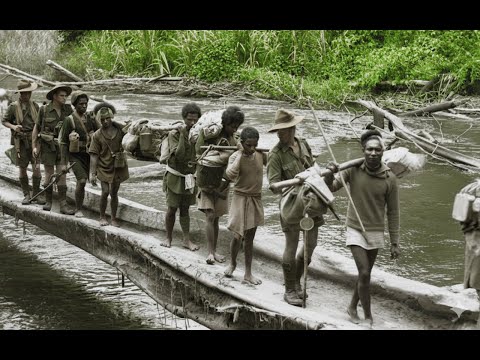
The arrival of the 7th Division, veterans of North Africa, brought fresh firepower and cold professional determination to the trail. Yet even their iron discipline would have faltered without a miraculous logistical lifeline provided by the indigenous people of Papua New Guinea—the Fuzzy Wuzzy Angels. These local porters carried the war on their shoulders, hauling ammunition and food up vertical, muddy slopes that would exhaust an unburdened man. With incredible tenderness and legendary stamina, they carried wounded Australians on makeshift stretchers across the most treacherous sections of the range, navigating pitch-black trails at night so the injured were never dropped.
To a wounded soldier, the sight of a Fuzzy Wuzzy Angel meant the difference between life and death. This bond humanized the struggle and gave the Australians a moral and logistical advantage the Japanese, who often treated local populations with brutality, could never replicate. With this support system in place, the strategic initiative shifted. The Australians prepared to move from a delaying defense to a decisive counteroffensive.
The Japanese had overextended their reach. Every meter they pushed toward Port Moresby made their supply lines longer and more vulnerable to RAAF air strikes. The turning of the tide was not a single moment, but a grinding change in momentum. The Australians began to realize the Japanese were no longer invincible jungle warriors. They were hungry, they were sick, and they were beginning to fear the dark. As the first Australian patrols pushed back north, the hunters became the hunted.
By September 1942, the strategic momentum had undergone a violent shift. The Australians were no longer merely trying to survive. They were hunting. At Templeton’s Crossing, the fighting became blind combat in thick mountain mist and drenching rain, visibility often reduced to less than five meters. Small groups of soldiers crawled through the undergrowth, feeling for the roots of trees until they were close enough to lob grenades into Japanese foxholes. Section by section, the diggers utilized fire and movement—one group providing suppressing fire while another scrambled up near-vertical slopes to flush the enemy out with Owen guns and grenades.
The art of the counterattack on the Kokoda Trail was not about grand sweeping movements of tanks or massive artillery barrages. It was a war of inches. It was won by the corporal who found a way around a machine gun nest, the scout who tracked the enemy through the mud, and the platoon that refused to stop climbing. By the time the Australians cleared the heights of the Eora Ridge, the Japanese juggernaut was in full retreat. The invincible enemy was being dismantled one ridge at a time.
By late October 1942, the Imperial Japanese dream of a South Pacific Empire was not just dying—it was decomposing. As the Australians relentlessly pushed northward, they discovered the true extent of the Japanese catastrophe. The trail was no longer a battlefield; it was a corridor of horror, littered with abandoned equipment and the unburied remains of a starving army. Japanese logistics had undergone a total and irreversible collapse. For weeks, soldiers had subsisted on grass, roots, and even wood. Cases of cannibalism were reported—a grim testament to the absolute desperation of men abandoned by their high command.
The symbolic end of this tragic campaign was marked by the fate of Major General Tomitaro Horii. A brilliant and respected leader, Horii had led his men to the very threshold of Port Moresby. But as the Australian counteroffensive intensified and his troops were pushed back toward the northern coast, Horii found himself trapped by the rain-swollen Kumusi River. In a final desperate attempt to reach the Japanese base at Buna, he and his staff tried to cross the raging torrent on a flimsy makeshift raft. The river, engorged by the tropical deluge of the Owen Stanleys, proved more formidable than any army. The raft was seized by the current and flipped. In a moment of tragic irony, the man who had nearly conquered Papua was swept away by its wild waters. Horii drowned in the dark, turbulent river, his death serving as a perfect metaphor for the entire Japanese campaign—a venture overwhelmed by a landscape it could not control and an enemy it could not break.
When the Australians finally reached the northern plains of Buna and Gona, the Kokoda Trail was officially cleared. The Japanese had suffered over 6,000 casualties, the vast majority not from bullets but from the brutal combination of starvation and disease. The invincibility of the Japanese soldier was a myth buried in the mud of the Owen Stanleys. The collapse was total—military, physical, and spiritual. The rising sun had set over the ridges of Papua, leaving behind a trail of blood that would haunt the memory of the Japanese military for generations.
The guns eventually fell silent along the ridges of the Owen Stanley Range, but the echoes of the Kokoda campaign would resonate through the Australian consciousness forever. More than just a military victory, Kokoda became a foundational pillar of Australian national identity. It was the first time the nation’s soil was directly threatened by a foreign power, and the first time an Australian force, largely on its own, halted the advance of a seemingly invincible empire. This was the victory that saved a nation. And in the crucible of that green hell, a new understanding of the Australian spirit was forged.
At the heart of this legacy is the concept of mateship. On the trail, mateship was not about casual friendship. It was the grim, unspoken contract that no man would be left behind. It was seen in the way exhausted soldiers shared their last dry cigarette or their final tin of rations. It was seen in the way a healthy soldier would shoulder the pack of a comrade shivering with fever. Most poignantly, it was embodied by the Fuzzy Wuzzy Angels, whose devotion to the wounded Australians created a bond of mutual respect that transcended race and culture. At Kokoda, mateship was the engine of survival.
The campaign also fundamentally changed Australia’s place in the world. It marked the moment the nation stepped out from the shadow of the British Empire. When the chocolate soldiers of the 39th Battalion stood their ground, they proved that Australian resolve was not dependent on imperial guidance. The victory at Kokoda gave Australia a sense of strategic maturity and a fierce pride in its own martial capabilities. It demonstrated that a medium-sized power, when pushed to the brink of extinction, could innovate, adapt, and overcome the most professional military force in the Pacific.
Today, the Kokoda Trail is no longer a battlefield of blood, but a site of pilgrimage. Every year, thousands of Australians travel to Papua New Guinea to walk those 96 kilometers of mud and mountain. They do so to pay homage to the ragged, bloody heroes and to test their own limits against the terrain. They walk to remember that their freedom was bought at a staggering price in places with names like Isurava, Brigade Hill, and Deniki. The legacy of Kokoda is a reminder that even in the darkest, most claustrophobic corners of the earth, where the sun never touches the ground, the human spirit can shine with blinding intensity.
It is a story of endurance, sacrifice, and an unbreakable bond between brothers in arms. Kokoda remains the soul of the Australian military, a testament to a time when a generation of young men looked into the abyss of the jungle and, instead of flinching, marched forward together until the way home was safe. The trail is silent now, but the footsteps of the brave still echo through the mist—and the question remains: what would you have done, standing in that emerald gloom with the world watching and nowhere to retreat?
Report this article
Select a reason for reporting:






