Walter McKenzie stood at the rail of the USS Borie, watching 16 men burn alive in the black North Atlantic. One sailor jumped clear, hair on fire, screaming for three seconds before the weight of his soaked uniform pulled him under. McKenzie was 29, an oil rig driller from Louisiana, and he had zero submarine kills on his record. But in that moment, as another merchant ship burned and the convoy’s sonar lost contact with a German U-boat, something shifted in him.
He turned away from the flames and walked to where 600 feet of hemp rope lay coiled on the deck. His hands were shaking—not from fear, but from three depth-charge concussions that had blown out his eardrums and left him hearing the ocean differently. He grabbed the rope and started tying knots.
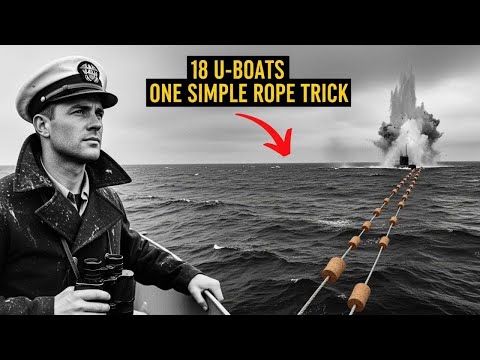
Lieutenant Harrow climbed down from the bridge, blood running from a gash over his eye. “What are you doing, McKenzie?” he asked. “Building sonar that works,” McKenzie said. He threaded cork blocks onto the rope at 50-foot intervals and lashed a depth charge to the bottom as ballast. The assembly looked like a vertical fishing net. Harrow frowned. “That’s not Navy procedure.” “Navy procedure gets ships sunk,” McKenzie replied.
Before the war, McKenzie had worked on Gulf oil platforms, using weighted ropes to detect drill-bit vibrations. He knew that a rope hung through all water layers, indifferent to thermal gradients that scattered sonar pulses. When a U-boat moved, its pressure wave would hit the rope, and the cork floats would bob in a readable pattern. The Navy had sonar—electronic, modern, and useless against a submarine hiding in a thermal layer. But a rope didn’t care about temperature.
Now, with oil fires lighting the night and corpses floating past the hull, McKenzie wasn’t asking permission. He and Harrow heaved the assembly overboard. The rope hissed out, cork blocks hitting the water at intervals. McKenzie held the bitter end in his left hand and waited. “Now what?” Harrow asked. “Now we listen,” McKenzie said.
He walked forward toward the bridge, rope trailing behind him. Lieutenant Commander Pierce turned when McKenzie climbed the ladder. “What is that, petty officer?” he asked. “Better sonar, sir,” McKenzie said. Pierce’s eyes narrowed. “We have sonar. It’s being operated by trained technicians with years of—” “Lost contact three times tonight,” McKenzie interrupted. “My line won’t lose it.” Pierce stared. “Your line is 600 feet of rope with cork floats tied to it.” “Yes, sir.”
McKenzie’s left hand tightened. He felt it—a faint vibration, too regular to be ocean current, too directional to be random wave action. Three pulses. Pause. Two pulses. Pause. Steady low-frequency hum. Something large and mechanical was moving through the water, 400 feet down and closing on the convoy’s port flank. “I think it just did, sir,” he said. “Contact bearing 320, depth approximately 400 feet. Closing.”
Pierce stared for two full seconds. Then he barked at the helmsman: “Come right to heading 010. All ahead full.” He grabbed the sound-powered phone. “Depth charge crew. Standby. Pattern Charlie. Set depth for 400 feet.” He turned back to McKenzie, face hard. “If you’re wrong about this, you’re on report for insubordination.” “If I’m wrong, we’re all dead anyway, sir,” McKenzie replied.
USS Borie heeled into the turn, engines hammering up to flank speed. McKenzie’s rope trailed behind in the boiling wake, cork floats bouncing. He felt the vibration pattern change—strengthen. Three of the cork floats bobbed hard in sequence, then settled. “He’s tracking us, sir. Bearing now 350, depth 380. He’s rising for a shot.” In the sonar shack, the operator shouted: “Contact bearing 352, range 600 yards!” Pierce spun to look at the sonar repeater. The bearing matched McKenzie’s estimate within two degrees. His face went pale. “How in God’s name did you—” He stopped himself, grabbed the phone. “Fire depth charges! Pattern Charlie! Drop!”
Six charges rolled off the stern racks. They hit the water and sank, fuses ticking. Five seconds passed. Ten. Then the ocean erupted in six columns of white water that climbed 100 feet into the air. The shockwave rattled the destroyer’s stern. McKenzie’s rope went taut, then suddenly slack. For ten seconds, nothing. Then debris began surfacing—oil, wood planks, a life jacket, a boot with part of a leg still in it. The sonar operator’s voice crackled: “Contact lost. Breaking up. Debris field on surface.”
Pierce turned slowly to McKenzie. “That’s a kill,” he said quietly. “That’s a confirmed U-boat kill.” He paused. “What the hell did you just do?” “I listened to the water the way it actually moves, sir,” McKenzie said. “Not the way the equipment manual says it should.”
Word spread through the convoy before dawn. By 0400, three other destroyer escorts were requesting rope assemblies. By noon, twelve ships had lines deployed. The convoy looked like a deep-sea fishing fleet, dragging long lines for giants. U-boat command noticed. Intercepted German radio traffic at 14:30 carried an urgent message: “Americans deploying unknown detection method. Multiple boats report unexpected depth charge accuracy. Request immediate tactical analysis.” Naval Intelligence in Wilhelmshaven opened a new file. They labeled it Xylen-Falle—the rope trap. They thought it was some kind of acoustic mine variant. They were wrong. It was simpler and more dangerous than that.
By March 17th, five U-boats had been sunk in 60 hours of convoy operations. HX229 lost no additional merchant ships after McKenzie deployed his first rope assembly. The mathematics were brutal and simple: before the rope, 17 ships sunk, zero U-boats destroyed. After the rope, zero ships sunk, five U-boats destroyed. When Admiralty in London received the casualty report, they sent an immediate priority signal: “Describe detection method in detail. Implement Atlantic-wide immediately.”
But McKenzie had problems. Hemp rope lasted 48 hours in salt water before it weakened and started to rot. Cork floats waterlogged after 72 hours and sank. Depth charge weights were in short supply. And the Germans were adapting. At 2200 on March 17th, Allied Signals Intelligence intercepted a transmission from U-boat fleet headquarters to all Atlantic boats: “Americans have deployed new acoustic detection device. Exact mechanism unknown. All commanders are ordered to commence extreme depth operations, descend below 600 feet when pursued. If unable to escape, surface and engage.” The U-boats would dive deeper, below his rope’s effective range, or surface with deck guns and shoot the cork floats before diving.
McKenzie had won round one. Round two was starting, and now the enemy knew the trick existed. Lieutenant Commander Pierce found him on deck at midnight, standing at the rail where his rope trailed invisible into the black water. “Admiralty wants you in London,” Pierce said. “Train the whole Atlantic fleet in this method.” “Can’t leave,” McKenzie said without looking up. “If I go teach while they adapt, they’ll figure out the counter before we can scale the defense.” He turned to face Pierce. “I need more rope—different rope. Parachute shroud lines, stronger, lighter, doesn’t rot fast. And I need 50 more depth charges for ballast weights.” “You’ll have whatever you need,” Pierce said. “Whatever it takes.” He paused. “You know they’re going to figure out how to beat this eventually.” McKenzie nodded slowly. “They already are, sir. That’s why I’m changing the design tomorrow.” Pierce waited. “Tomorrow,” McKenzie said, “I’m going to teach them how to sink themselves.”
At 0345 on March 18th, a torpedo struck SS John Morton amidships and turned her into a burning steel coffin in under ninety seconds. Fuel oil tanks ruptured. Fire shot eighty feet into the air. Twenty-three men were trapped below decks behind a jammed hatch while flaming oil poured through the passage. McKenzie stood at Borie’s rail six hundred yards away and watched men die he could not reach.
One sailor climbed the foremast to escape the fire on deck. Flames followed him up the rigging, crawling through tarred rope and paint. He climbed higher—thirty feet, fifty, eighty. His uniform burned, hair on fire, skin blackening. He jumped from the cross tree, a black shape falling through orange light. Ninety feet. He hit the water head first. Neck folded sideways. The body did not surface.
Depth charges went off too late. The U-boat was already gone, sitting cold and quiet below a thermal layer where neither sonar nor rope could touch it. Rope had killed five submarines. Rope had not saved twenty-three men.
Lieutenant Commander Pierce came up beside him, soot streaking his skin. “Your ropes stopped working,” he said. No accusation in his voice, just fact. “They figured it out.” “They stopped moving,” McKenzie said. “Sit on the bottom. Zero displacement. Rope feels nothing. Sonar feels nothing.” “Fix it,” Pierce said. “Or more ships burn.”
By 0700 the convoy commodore had McKenzie in the chart room. German radio traffic intercepted overnight lay on the table, the translation short and brutal: “American detection method mechanical vibration. Counter protocol: extreme depth, minimum speed. Full stop near attack point. Engage only from drift.” The commodore tapped the page. “Your trick lasted three days, petty officer. Now we’re back where we started.”
“Not exactly, sir,” McKenzie said. His hands had stopped shaking. “We know what scares them now.” “What’s that?” Pierce asked. “Missing a sure kill,” McKenzie said. “They can’t resist crippled ships. We give them one.” The commodore stared at him. “You want to hang bait?” “Yes, sir. Fake engine failure. One ship falls behind at dusk. Looks helpless. U-boat has to move for a shot. When he moves, rope feels him. We box him with depth charges.”
“Which ship?” the commodore asked. “SS William Clark,” McKenzie said. “New hull. Fast enough to run once we spring it. Empty enough to lose if we miscalculate.” “If we miscalculate,” Pierce said, “everyone on that ship dies.” “Same as John Morton,” McKenzie said. “Difference is this time we’re waiting.”
At 1845, SS William Clark began broadcasting engine trouble in the clear. Broken reduction gear, inability to maintain speed, convoy continuing without her. Every German operator in the North Atlantic heard the cry. Every U-boat captain drew his pencil across a chart and adjusted course. The convoy steamed on into the dusk. William Clark drifted alone.
McKenzie went with her. He brought six hundred feet of hemp rope, cork floats at fifty-foot intervals, and thirty depth charges that nobody thought would be used as ballast when they came aboard. He hung the line off the stern. The last cork lay thirty yards behind the rudder, bobbing in the dark swells like a single eye looking straight down into black water. McKenzie wrapped the bitter end twice around his left hand and waited.
The night was moonless, overcast, quiet in the way only mid-ocean could be. No harbor lights, no land—just black water and a ship pretending to be helpless. The engineer throttled the engines down to a cough every ten minutes, enough to keep the propellers turning lazily, enough to look sick on a periscope.
At 2132, McKenzie felt the first touch. A faint tick along the rope, like someone had flicked it with a finger four hundred feet down. Then another. Then three in quick succession. Three corks bobbed in order and settled. “Heavy mass, slow speed, deep closing contact,” he said, soft, to no one.
The vibration pattern built slowly. This U-boat captain was careful—two knots, maybe less, bearing 190 then 185 as he corrected his approach. Depth about 450 feet, climbing one cork interval at a time, hunting blind under a thermal layer, listening with his hydrophones. McKenzie flashed his lamp to the bridge. Three short bursts, one long. Captain Brennan answered with a single tight flash and left his engines at death rattle. William Clark drifted in the swell, playing dead.
At 2203, a thin rod broke the surface two hundred yards off the port quarter. Periscope. No wake, just a silver needle cutting the black. It held steady. The German commander turned slowly, studying the merchant ship, counting masts, measuring stack smoke, checking for destroyer silhouettes on the horizon. He saw nothing but one lonely freighter rolling in the swell.
McKenzie could feel the submarine rise that last sixty feet through the rope. The pressure wave changed pitch. The corks at 200 and 250 feet bobbed together. The U-boat leveled at firing depth—too shallow now to hide behind thermal tricks. To fire torpedoes, he had to move. Moving gave him away.
The periscope vanished as the boat turned its bow. McKenzie watched the water. Nothing to see, everything to feel. The vibration shifted angle. Torpedo run-up. Depth. Final corrections. He knew what was coming before the captain on the bridge did. “Stand by,” McKenzie called. “Port side spread.”
Two white streaks appeared in the water ten seconds later, running fast and straight at William Clark’s port bow. Brennan spun the wheel. The freighter’s engines came to life with a roar that shattered the illusion of helplessness. The bow swung slowly—too slowly for any crewman’s comfort. Men on deck watched their deaths slide past. Both torpedoes passed fifty feet ahead of the stem and kept going into empty ocean.
“Engines flank!” Brennan shouted. William Clark leapt ahead at twelve knots, faster than any submerged U-boat could match. McKenzie felt the panic through the rope. The U-boat dove hard, nose down, screws hammering water. Corks at 250, 300, 350 feet bounced wildly. The captain was running for safety depth straight along his original escape doctrine. Go deep. Go south. Go quiet.
Eight miles south, USS Goff’s sonar picked up the contact. McKenzie’s rope had already plotted it. “Bearing zero-four-zero from Goff now,” he called. “Depth 580 feet. Speed six knots.” Too deep for periscope. Too fast for drift. “Target in the box,” Goff’s captain said. He ordered Pattern Charlie—twenty depth charges over the estimated track, staggered from 550 to 650 feet.
The first explosions reached William Clark as dull, distant thumps. McKenzie heard them in the steel under his boots and in the line around his hand. The rope went suddenly slack, then taut, then dead. Oil surfaced four minutes later—thick black streaks, wooden planks, a broken ladder, a single boot with the laces still tied.
“How many now?” Brennan asked quietly. “Six,” McKenzie said. He watched the corpse roll with the swell. “Doesn’t bring back the twenty-three.”
By dawn, German radio channels were full of confusion and anger. Orders went out before noon: no more attacks on isolated freighters without confirmation. No more greed—only safe shots. “Bait’s done,” McKenzie told Pierce when he got back to Borie. “They’ll never bite like that again.” “Then what?” Pierce asked. “We make them chase ghosts,” McKenzie said.
Two days later, HX229 split in gray morning light. Three merchants and two escorts swung northwest into empty ocean, transmitting their position in the clear every four hours. Eight U-boats adjusted course toward the talking ships—and sailed into a ring of twelve destroyers waiting in a twenty-mile circle. By midnight, two more U-boats were gone, cracked open by hedgehog mortars and depth charges.
Convoy HX229 reached Britain without losing another ship. In London, they wanted diagrams, procedure, training syllabi. Admiral Horton sat across from McKenzie. “Can we teach this to every escort in the Atlantic?” “No, sir,” McKenzie said. “Because the moment we turn it into a manual, the Germans turn it into a counter-manual.” Horton studied him a long time, then nodded once. “You’ll have a free hand. You will not put any of it on paper.”
Four days later McKenzie was back at sea as HX230 pushed into gray Atlantic swell—new line this time, parachute shroud spliced into nylon, sealed glass floats instead of cork. The Germans had never seen this version. Fifty yards off Borie’s port quarter, one of the new glass floats bobbed once, then again, then three times in a perfect unnatural rhythm. “Contact,” McKenzie said.
Eighteen U-boats in eight months. Seven hundred seventy German submariners. Four thousand Allied sailors who reached port alive. The mathematics never added up—but the war ended, the submarines stopped, and the ropes were coiled and stored and eventually thrown away when nobody remembered why they mattered.
So here’s the question for you: if a single improvised idea could save thousands of lives but could never be written down, would you trust the next generation to reinvent it—or would you break the silence and risk the enemy learning the trick?
Report this article
Select a reason for reporting:






