It was a gamble born of desperation—a tiny jet trainer, barely armed, sent into the teeth of guerrilla warfare. The pilots who flew it were mocked, their aircraft nicknamed the “Super Tweet.” Yet within months, this forgotten machine would outperform the most advanced fighters in the sky, saving hundreds of lives while earning almost no recognition.
In the dense jungles of Vietnam, where the rules of engagement were written in blood and improvisation, the A-37 Dragonfly would carve out a legend that history nearly erased.
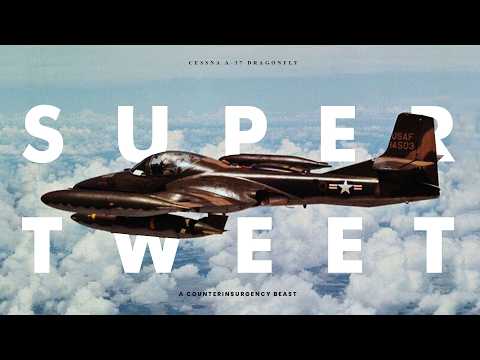
The 1960s were a time of upheaval. Across Southeast Asia, Africa, and Latin America, small militias armed with modern weapons were challenging superpowers. Traditional air forces, built for massive conventional wars, found themselves unprepared for the shadowy conflicts of counterinsurgency. The need for a dedicated aircraft—small, agile, and deadly—became urgent.
Enter Cessna’s T-37 Tweet. Originally designed as a primary jet trainer, it was lightweight, reliable, and easy to maintain. Its slow landing speed and forgiving handling made it perfect for training novice pilots. But its rugged airframe and twin engines hinted at something more.
In 1963, the U.S. Air Force awarded Cessna a contract to convert two T-37s into prototypes for a counterinsurgency aircraft. The result was the YAT-37D: reinforced wings with pylons for bombs and rockets, a 7.62mm minigun in the nose, and upgraded engines. It was a transformation that would turn a docile trainer into a fierce war machine.
By 1966, the need for such an aircraft had only grown. The aging A-1 Skyraiders were wearing out, and the Air Force needed a cheap, effective platform for close air support. The A-37A was rushed into combat under the code name “Combat Dragon.”
In August 1967, the first 25 A-37As arrived at Bien Hoa Air Base, South Vietnam. The pilots—many of them fresh from other aircraft—had no formal transition course. They were taught the basics, strapped in, and sent into battle. The aircraft were unarmored, unpressurized, and painted in a strange light blue experimental scheme. The seasoned Phantom pilots laughed, calling them “Mattel Marauders.”
But the laughter didn’t last. The Dragonfly proved devastatingly effective. With a combat radius of 400 nautical miles and the ability to carry nearly 3,000 pounds of ordnance, it could loiter over the battlefield for hours, striking with pinpoint accuracy. Its slow speed made it a difficult target for anti-aircraft gunners, and its agility allowed it to weave through valleys and skim treetops.
“Thank God, now I have someone who can actually hit the damn target,” a forward air controller radioed after an A-37 destroyed an enemy position that had stymied Phantom crews.
In its first three months, Combat Dragon flew over 3,000 sorties without a single combat loss. The Dragonfly was not just surviving—it was thriving. And yet, the recognition never came.
Maintenance crews adored it too. Two hours of upkeep per flight hour—among the lowest of any combat aircraft in the theater. The ground teams joked that the Dragonfly was the only jet in Vietnam you could fix with a hammer and a prayer. Its access panels were so numerous and simple that an engine swap could be done in half an hour under ideal conditions.
But the war was changing. By 1968, the A-37B arrived with larger fuel tanks, upgraded J85-GE-17A engines, self-sealing fuel cells, and armor plating around the cockpit. External payload jumped from 2,700 to 5,800 pounds. Some crews swore they carried over 6,000—nearly the aircraft’s empty weight. It was a bomb truck the size of a trainer.
The missions grew wilder. Pilots flew so low that ground crews found branches and leaves stuck in the airframe after landing. Captain Bob Chappelear once clipped a tree on departure, shearing its top and rupturing a napalm canister that sprayed gel across the fuselage. The wing bent 25 degrees. Somehow, he brought it home.
Night missions became routine. Major Richard Martell recalled being called for a desperate close-air-support run. Two A-37s descended from 6,000 feet to ground level, strafed and bombed enemy positions, then came back for a second pass with conventional bombs. They killed an estimated 200 enemy fighters and saved the Special Forces base.
And yet, the squadron’s extraordinary loss rate—or lack thereof—went unnoticed. John Bradley, later chief of the Air Force Reserve, flipped through a copy of Stars and Stripes and saw a front-page story praising a Phantom unit for 600 sorties in a month. “Man, we just did 1,200,” he muttered.
The Dragonfly never operated over North Vietnam, but it fought ferociously in the South. In one infamous incident on April 28, 1975, North Vietnamese forces captured several A-37s and used them in bombing raids. By 1974, an Air Force report noted the Super Tweet had flown 68,471 sorties and undoubtedly saved countless friendly troops.
After the war, South Vietnam’s air force kept 95 airframes flying until spare parts ran out. They were sold off or scrapped. In the U.S., the aircraft was reassigned to the Air National Guard and Reserve, its specialized role deemed unnecessary. Newer designs like the A-10 Warthog could handle counterinsurgency if needed.
Its final combat use came in Panama during Operation Just Cause. Twenty-four OA-37s from the 24th Tactical Air Support Squadron flew around-the-clock, targeting enemy positions with rockets and working alongside A-7D Corsairs. It was a fitting farewell for both airframes.
On March 1, 1991, the 24th Tactical Air Support Squadron was deactivated—ending regular U.S. Air Force operations of the OA-37. In total, 577 Dragonflies were built. Small, powerful, and armed to the teeth, it was a Cessna triumph that never got its due.
But the story of the Dragonfly didn’t end when the last OA-37 rolled to a stop at Howard Air Force Base in Panama. In the decades that followed, the aircraft found new life in the hands of foreign operators who recognized what the U.S. Air Force had been so eager to forget.
Across Latin America, the A-37 became a workhorse for air forces that couldn’t afford modern fighters. Guatemala, Honduras, El Salvador, Colombia, Peru, and Ecuador all operated the type. In the skies over Central America, the Dragonfly proved its mettle once again—not against sophisticated air defenses, but against insurgent columns and supply routes buried deep in triple-canopy jungle.
Colombian crews, in particular, pushed the aircraft to its limits. During the long war against the FARC and other guerrilla groups, A-37s flew thousands of counterinsurgency sorties. The aircraft’s ability to dive steeply, release its payload with precision, and escape before ground fire could find it made it a favorite among pilots who had little else at their disposal.
Perhaps the most remarkable second act came in a place the Dragonfly’s designers never imagined: the hands of the Salvadoran Air Force. During El Salvador’s brutal civil war in the 1980s, A-37s flew relentless missions against guerrilla positions, often at extreme low altitude. The aircraft became so feared that rebel commanders reportedly offered bounties for captured Dragonfly pilots.
But the cost was high. Several A-37s were lost to shoulder-fired missiles and anti-aircraft fire. The aircraft that had once been deemed too slow and too vulnerable for modern combat was proving that its survival depended entirely on how it was used—and who was flying it.
In the 1990s, the Dragonfly began to fade from front-line service. Airframes aged, spare parts grew scarce, and newer light attack aircraft like the Embraer Super Tucano promised greater capability. Yet even as the type was retired, its legacy lingered in the minds of the pilots who had flown it.
“It was a simple aircraft that did a simple job,” one retired A-37 pilot recalled. “But it did it better than anything else in the sky.”
Today, only a handful of A-37s remain airworthy. Most sit in museums or on static display, their faded paint and worn cockpits a quiet testament to a forgotten war. In the United States, the aircraft that once saved countless lives is remembered mostly by the men who flew it—and by the historians who stumble upon its remarkable record.
And yet, the Dragonfly’s story carries a lesson that military planners still struggle to learn. Advanced technology and overwhelming firepower do not guarantee victory in the shadowy conflicts of the modern world. Sometimes, the most effective weapon is the one that is simple, reliable, and flown by men who understand that survival is not about speed or sophistication—it is about getting close enough to make every shot count.
The A-37 Dragonfly was never glamorous. It never appeared on the cover of aviation magazines or received the accolades heaped upon the Phantom and the Thunderchief. But in the jungles of Vietnam and the mountains of Latin America, it proved something that no amount of high-tech wizardry could disprove: that a small aircraft, flown with skill and courage, can change the course of a battle.
And perhaps that is the greatest tribute of all—that a machine built to teach young pilots how to fly ended up teaching the world how to fight.
As the sun sets over the tarmac at Davis-Monthan Air Force Base in Arizona, a row of retired A-37s sits silently in the desert heat. Their engines are cold, their guns long removed. But if you look closely, you can still see the patches where armor was bolted on, the scars of tree branches and shrapnel, the faint outlines of kill marks painted by ground crews.
These aircraft are not just relics. They are reminders of a time when ingenuity mattered more than budget, when a trainer could become a warrior, and when the men who flew the most humble machine in the sky became the unsung heroes of a forgotten war.
The Dragonfly never got the parade it deserved. But for the soldiers it saved and the pilots who loved it, that was never the point.
“We didn’t fly it for glory,” one veteran said. “We flew it because it worked.”
And in the end, that is the only epitaph that matters.
Decades later, a young Air Force historian named Elena Marsh stumbled upon a dusty box of Combat Dragon after-action reports in the archives at Maxwell Air Force Base. She had been researching the Phantom for a dissertation, but the numbers in those faded pages stopped her cold. Sixty-eight thousand sorties. Two hours of maintenance per flight hour. A loss rate so low it seemed like a clerical error.
She cross-referenced the records with pilot interviews, maintenance logs, and even old Stars and Stripes clippings. The story that emerged was not one of glory, but of quiet, relentless effectiveness—a machine that did its job so well that no one bothered to notice.
Elena published her findings in a small military history journal. The article was picked up by a veteran’s newsletter, then a podcast, then a documentary filmmaker who had never heard of the Super Tweet. Suddenly, the pilots who had been forgotten began receiving letters from strangers thanking them for their service.
“It’s about damn time,” Bob Chappelear reportedly said, laughing, when a young filmmaker called to interview him. He was eighty-seven years old and still had the piece of tree branch he’d pulled from his wing that day in 1968.
At the Davis-Monthan boneyard, a small ceremony was held. A plaque was dedicated to the A-37 Dragonfly and the men who flew it. No generals spoke. No bands played. Just a handful of aging pilots, their families, and a row of silent, sun-bleached aircraft.
One of them, a former crew chief named Charlie Kraisak, ran his hand along the wing of the last OA-37 he’d ever worked on. “She wasn’t pretty,” he said. “But she always came home.”
The Dragonfly never became a legend in its own time. But in the stories passed down from pilot to pilot, from mechanic to historian, it found something better: a place in the memory of those who understood that the most important victories are often the ones no one writes about.
And somewhere, in the quiet of an archive or the hum of a museum, a young researcher might still pull a file from a box and discover the Super Tweet for the first time—and wonder how such a small aircraft could have done so much, for so little, for so long.
What forgotten machine from military history do you think deserves its own story told?
Report this article
Select a reason for reporting:






