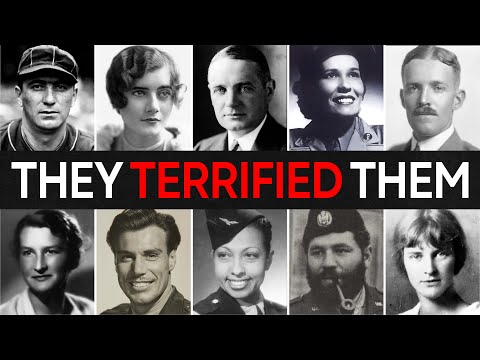
They weren’t soldiers. Not in the way the Nazis expected. A limping woman with a wooden leg. A baseball catcher with a license to kill. A prince who conquered an island without firing a shot. These weren’t myths. They were American spies. And the Reich feared them more than entire battalions.
Some vanished into cities. Others dropped from the sky. All of them rewrote the rules of war. This isn’t history as it’s taught. It’s the war beneath the war. And once you know their names, you’ll never see World War II the same way again.
Virginia Hall limped through the streets of Lyon, her wooden leg tapping a steady rhythm on the cobblestones. The Gestapo called her “the most dangerous Allied agent in France,” but they never caught her. She organized the Heckler network, turning farmers into saboteurs and priests into radio operators. Bridges exploded. Trains derailed. German troops vanished into the forests and didn’t come back. She once radioed London: “Cuthbert is giving me trouble.” The reply: “If Cuthbert is troublesome, have him eliminated.” They didn’t know Cuthbert was her prosthetic leg.
Klaus Barbie, the Butcher of Lyon, hunted her relentlessly. He said it with the urgency of a man being outwitted by a woman with one leg and no patience for fascists. They never caught her. And just when they started figuring out who she was, they had to start worrying about someone else entirely.
William “Wild Bill” Donovan walked into rooms like he owned them, mostly because he did. A Medal of Honor on one lapel, a plan to destabilize Europe in the other. He didn’t sneak into enemy lines. He built the people who did. Before Donovan, the United States didn’t have a centralized intelligence service. After Donovan, the CIA was inevitable.
His code name was 109. The Germans knew it. They didn’t care about code names. They cared that everywhere Donovan’s agents landed, a resistance movement followed. Factories exploded. Rail lines collapsed. Communications went dark. The Jedburgh teams he dispatched became the stuff of legend. Allied agents parachuting into occupied Europe to arm and coordinate local resistance fighters. The Nazis called them terrorists. Donovan called them proof that democracy knows how to get dirty.
But behind every architect is an operator. Someone in the field, someone who takes the grand plan and puts a knife to its throat. And in Switzerland, one such operator was doing just that, quietly, politely, with devastating precision.
Alan Dulles operated out of Bern, a neutral zone that looked like peace but felt like espionage. His official title: OSS station chief. Unofficially, he was the man who read your secrets before you even mailed them. The Gestapo didn’t just fear him. They feared what he might already know. They were right to.
Dulles didn’t chase information. He attracted it. Defectors found him. Double agents volunteered. He didn’t bribe, he listened. His greatest asset was silence. He let men talk themselves into treason. His biggest catch: Fritz Kolbe, a high-ranking official in the German Foreign Office. Kolbe handed over more than 1,600 documents, including Hitler’s own military cables. Dulles read them like bedtime stories. Then he weaponized them.
In 1945, while Berlin still deluded itself into thinking the Reich could survive, Dulles quietly negotiated the surrender of German forces in Italy. Operation Sunrise. No parades, just signatures. Thousands of lives spared without a single shot fired. The Nazis tried to poison the well and burn him. They couldn’t. They tried to flip his sources. They failed. They even tried to assassinate him, but couldn’t find him. Dulles wasn’t invisible. He was ungraspable. A ghost with perfect manners.
But ghosts don’t just haunt rooms. They leave doors open. And through one of those doors would crawl a young man born in Germany, Jewish, furious, and ready to bring hell to the Alps.
Frederick Mayer was dropped into a glacier at night. No applause, no backup, just ice, wind, and silence. A few months earlier he’d been living in Brooklyn. Now he was behind enemy lines in Austria wearing a Nazi uniform and pretending to fix power lines.
He was a German Jew, one of the lucky ones who had escaped. And now he was back, walking calmly through the heart of Hitler’s empire, armed with nothing but fake papers and a talent for disappearing in plain sight. His mission was absurd: infiltrate the fortified Tirol region, confirm whether Hitler’s rumored Alpine Redoubt fortress actually existed, and track German supply routes through the Brenner Pass.
He did all of it. He posed as a French electrician, then as a wounded German officer. He bribed hospital staff, manipulated local officials, and sent intelligence back to Allied command from a boarding house down the street from the Gestapo. When he was finally captured, tortured, and interrogated, Mayer didn’t break. He bargained.
In the final days of the war, he walked into the office of Franz Hofer, the Nazi governor of Tirol, and negotiated the peaceful surrender of Innsbruck — while technically still a prisoner. One man, no army. Just courage, deception, and timing.
And while Mayer played the long game with nerves of steel, another American was already inside Hitler’s capital, right under his nose. No disguises, no mountains — just a red scarf, a stack of books, and an execution order signed by the Führer himself.
There was nothing suspicious about Mildred Harnack. A soft-spoken American literature professor in Berlin, walking the Tiergarten, quoting Goethe, grading essays. She looked like a footnote in someone else’s history. That’s exactly how she survived — until she didn’t.
Born in Wisconsin, Mildred moved to Germany for love and stayed for the chaos. When the Nazis came to power, she didn’t run. She translated it, understood it, and then slowly, quietly began to help dismantle it. She opened doors to resistance, to treason, to something human inside a city turning machine.
She became a key figure in the Red Orchestra, a Soviet-aligned intelligence ring made up of artists, teachers, and bureaucrats who saw what was coming and couldn’t sit still. She recruited Germans to resist their own government, wrote and distributed anti-Nazi pamphlets, and passed economic and military data to the Allies. Some of her reports made it all the way to Moscow and Washington — including early warnings about Operation Barbarossa.
Hitler wasn’t amused. When Mildred was arrested, her trial was a show. Her first sentence — six years in prison — wasn’t harsh enough. So Hitler intervened personally and ordered a retrial. The second time, they sentenced her to death. She was executed by guillotine in 1943.
But fear doesn’t end with execution. It festers. Mildred proved that rebellion didn’t require guns, only words. And the Nazis, obsessed with control, feared that kind of quiet most. While her body was buried, her story wasn’t — because miles away in the shadowed valleys of France, a different kind of resistance was gathering. Louder. Armed. And led by a man who didn’t bother to hide in shadows at all.
Peter Ortiz didn’t look like a spy. He looked like a problem. A former French Foreign Legionnaire and decorated Marine officer, Ortiz was the kind of man who walked into Nazi territory wearing his uniform on purpose. Not as a bluff — as a message. I’m not hiding. Come get me.
And the Gestapo tried. They even put a bounty on his head, one normally reserved for generals. It didn’t help. Ortiz operated in the Haute-Savoie region like a wildfire. Impossible to pin down, impossible to ignore. Where most spies slipped through occupied Europe quietly, Ortiz moved like a soldier on parade.
As part of the Union II mission, Ortiz parachuted into France to arm, organize, and train Maquis fighters. His teams raided German convoys, ambushed patrols, and stole classified files. When the Nazis retaliated with executions and reprisals, Ortiz did something unthinkable. He surrendered himself to save an entire village. Not because he was caught — because he chose to.
His presence alone was a morale weapon. To the resistance, he was proof that America was with them. Boots on the ground. To the Nazis, he was a disruption with a death wish. He survived prison, escaped, returned, and then did it all again. His courage was irrational. That was the point. Rational fear couldn’t match irrational defiance.
And defiance comes in many forms. Ortiz carried guns and sabotage plans, but others carried silence, calculations, and a soft-spoken smile. Because the next American the Nazis would come to fear once stood behind home plate, catching curveballs. Then one day, he caught wind of a bomb plot.
Moe Berg spent his early life catching baseballs and speaking languages most scouts couldn’t pronounce. Princeton graduate. Major league catcher. Seven languages, maybe more. He looked like a trivia question. He was actually a contingency plan for the end of the world.
By the time the war reached its most paranoid phase, Berg wasn’t throwing out runners. He was throwing out futures. The OSS recruited him not for muscle or charm, but for judgment. Cold, final judgment. His assignment was simple in wording and terrifying in implication: attend scientific conferences in neutral Europe, get close to Germany’s top physicists, and decide whether one of them needed to die.
The name on everyone’s lips was Werner Heisenberg — the man who might be building Hitler an atomic bomb. Berg moved through academic circles like a ghost with a notebook. Zurich. Italy. Quiet dinners. Polite questions. He listened more than he spoke. He watched chalkboards. He counted pauses. And all the while, he carried a pistol with explicit authorization. If he concluded the Nazis were close to a nuclear breakthrough, he was to pull the trigger.
No trial. No confirmation. History would just turn. He never fired. That decision mattered. Berg reported that the German atomic program was years behind — fractured by politics, starved of resources, sabotaged by its own arrogance. That single conclusion redirected Allied priorities. Instead of racing to stop a German bomb that wasn’t coming, the Allies focused everything on building their own.
The Manhattan Project accelerated. The war’s end took a sharper shape. The Nazis never knew how close they came. That was the point. Berg didn’t make headlines. He made silence. And sometimes silence is the loudest weapon.
But silence wasn’t always enough. Sometimes the war required noise. Rumors. Lies. Carefully crafted words designed to rot an army from the inside. And that’s where the next American did her best work.
Barbara Lauwers didn’t carry a gun. She carried a typewriter. And to the Nazis, that was somehow worse. Stationed in Rome with the OSS Morale Operations branch, Lauwers understood something most generals didn’t. Armies don’t collapse from bullets alone. They collapse from doubt, from homesickness, from the slow, creeping suspicion that everything you’ve been told is a lie.
She spoke fluent German. She understood German psychology. And she knew exactly where to press. Her masterpiece was Operation Sauerkraut — which sounds harmless until you realize what it did. Lauwers used German prisoners of war volunteers to sneak back across enemy lines carrying black propaganda. Fake orders. Fake newsletters. Fake personal letters. Documents designed to look official enough to trust and poisonous enough to believe.
One leaflet claimed German soldiers’ wives were joining a league of lonely war women, spending time with men who avoided the front. It sounds juvenile. It worked. Morale plummeted. Discipline cracked. Entire units became distracted, angry, and unreliable. In one documented case, over 600 Axis-aligned Czech soldiers deserted in a single day.
The Nazis couldn’t counter it with force. You can shoot a saboteur. You can’t shoot a rumor once it’s inside your head. Lauwers turned certainty into suspicion, orders into questions, loyalty into loneliness — and the German command never fully understood why their troops were unraveling from the inside out.
But psychological warfare only works if someone’s listening on the other end. In North Africa, that role belonged to William Eddy, a professor who dismantled empires with a calm voice and a map. He built the Twelve Apostles Network, mapping coastal defenses across Morocco and Algeria. When Allied forces landed in Operation Torch, they weren’t guessing — they knew which beaches were lightly defended and which commanders would fold.
Through the crack that North Africa opened, James Jesus Angleton stepped into Italy. At 25, he flipped German agents like coins and sent them spinning back toward Berlin with pockets full of misinformation. Over 1,000 Axis agents were captured under his watch. Dozens became double agents who didn’t even realize they’d switched sides.
Others won with survival. Jack Taylor, a dentist turned OSS operative, was captured and sent to Mauthausen — and memorized everything. His hidden evidence helped sentence 58 Nazi war criminals to death. Henry Hyde built the Penny Farthing network: 8,000 sub-agents across France, feeding Allied command exact blueprints and timing.
George Musulin carved a runway out of a mountainside by hand, rescuing over 500 downed airmen without losing a single one. Betty Pack cracked a Vichy embassy safe with lockpicks and charm, handing the Allies naval codes that changed the odds in North Africa. Arthur Goldberg turned striking rail workers into a weapon — trains didn’t run, and no one knew why.
Serge Obolensky, a 53-year-old Russian prince, parachuted into Sardinia and bluffed 270,000 Italian troops into surrender without firing a shot. And Josephine Baker carried secrets in her sheet music, crossing borders under the spotlight, applauded at every stop.
These weren’t soldiers. They were the war beneath the war.
So here’s the question: if history tried to bury these names, how many more are still waiting in the shadows — and which one do you want us to dig up next?
Report this article
Select a reason for reporting:






