On the morning of October 14, 1902, deep beneath the hills of western Pennsylvania, a pickaxe struck something that should not have been there. The crew was 180 feet underground, cutting the floor of a coal mine heading to lay track. The pick went into the clay and did not come back. There was nothing beneath it.
When the mine foreman, Elias Hartzell, lowered himself down on a rope with a safety lamp, he found a chamber with smooth walls, no tool marks, no timber props, and no gas. And inside it, lying end to end, was a machine. It was 58 feet long, made of something like iron, with fluted cones at each end and three toothed rings around its middle. Not one tooth was worn. There was not a single spot of rust. Everyone who touched it said the same thing: it was cold, colder than the air of the mine.
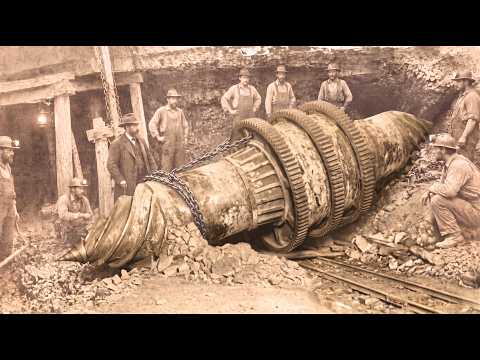
The coal above the chamber was undisturbed. The machine was there before the coal. Within nine days, the company sealed the heading. The ledger fell silent with a single line. But a boy, an old man, and an inspector did not.
This is where the story begins. Before we can understand what was found, we need to understand the seam itself—and the people who gave it its name.
The Allegheny River runs south through the hills of western Pennsylvania and meets the Monongahela at Pittsburgh. On its eastern bank, forty miles upriver, stands a town called Kittanning. The name is not English. In the Lenape language, it means the place by the great river. In the middle of the eighteenth century, this was a Lenape town. It had more than thirty houses along the bank, cornfields spread behind them, and canoes drawn up along the shore.
On the morning of September 8, 1756, a colonial force of 300 men under Colonel John Armstrong set the town on fire. House by house, it burned. The town’s war leader, the man the colonists called Captain Jacobs, died inside his own house. Today, a town square and a county courthouse stand where it stood. The town was rebuilt. The name stayed.
And a century later, when Pennsylvania’s first geologists began to classify the coal beds of the region, they gave that name to one of the most valuable seams they found—the Kittanning coal, the lower Kittanning seam. In Armstrong County, it ran three to four feet thick, and it was the bed most heavily mined in the county. By 1880, when Pennsylvania’s second geological survey published its report on Armstrong County, there was hardly a valley on its maps where that name did not appear.
The seam itself is far older than humankind. Geologists date the Kittanning coal to the Pennsylvanian period, roughly 310 million years ago. This was a warm, shallow swamp. Then plants died, sank beneath the mud, were pressed down, and turned into black stone. Beneath the coal lies a bed of pale gray fire clay, and beneath that the Vanport limestone. Each layer laid down on the one before it, unbroken, in order. To a miner, that order was as dependable as a clock.
Around 1900, the Rochester and Pittsburgh Coal and Iron Company bought up farmland in the valley of Cowanshannock Creek, twelve miles east of Kittanning, and built a company town from nothing: Yatesboro. There were rows of identical frame houses, a company store, a boiler house that made the mine’s electricity, and a loading tipple beside the railroad. The miners came from Italy, from the northern counties of the Kingdom of Hungary, from Wales, and from Pennsylvania’s own farms. The coal went north by rail into New York State. One of the company’s best customers was Eastman Kodak in Rochester.
Underground, the work looked nothing like the town above it. The lower Kittanning was so thin that most days the men worked on their knees or lying on their sides. The coal came out along the headings in small cars hauled by mules. Air was driven through the mine by a great fan on the surface and steered underground by wooden doors. At every door sat a boy all day in the dark, opening it when a car came through and closing it behind. They were called trapper boys. Most of them were twelve or thirteen years old.
The headings followed the dip of the seam, and every new heading was given a number and a direction. Three north, five west, six east. Cutting down the floor of a heading was ordinary work. A foot or two of fire clay was taken out beneath the coal to make room for the track. The clay was soft. Beneath it, according to the geologists’ maps, there should have been nothing but more clay and then limestone.
By 1902, several mines were working at Yatesboro. This story takes place in mine number two. And that year, mine number two had a mine foreman. The first record is his ledger. His name was Elias Hartzell. He was born in Somerset County in 1856, which made him forty-six in 1902. He had gone underground at twelve as a trapper boy, worked as a miner, and as a fire boss. And in 1885, when Pennsylvania’s new bituminous mine law required every foreman to hold a certificate, he passed the examination on his first attempt. The people who knew him described him as quiet, exact, and not fond of jokes.
Hartzell kept a daily report book. It was a bound ruled book of several hundred pages, and every morning it carried the same headings: heading number, advance in feet, condition of the roof, gas reading, injuries. He kept it not in pencil but in ink, with every figure set flush to the right. According to the accounts, in eleven years he had not crossed out a single line.
On the morning of October 14, 1902, a crew of four working the new heading called 6 East was taking up the fire clay beneath the coal to deepen the track bed. A little after nine, one of the men drove his pick into the clay, and the handle slid out of his hand. The pick fell. The sound came late. The crew stopped work, and a trapper boy was sent running along the heading to fetch the foreman.
By the time Hartzell arrived, the hole had been opened wide enough for a man. He went down first on a rope with a safety lamp. The entry in his report book was written that afternoon, and the thing every person who has studied this story points to happens in the very first lines. The handwriting changes. The letters grow larger. The pen presses harder into the paper. The figures are no longer set to the right. The entry begins like this: “6 East floor 9 ft below the coal. Opening not cut by hand. Walls true. Chamber 71 ft x 24 ft. Roof 22 ft. Iron machine inside 58 ft end to end.” And then a sentence that has no business in the official book of a certified mine foreman: “I have no trade name for it.”
Hartzell had taken his measurements with a chain tape, but the rest of the entry is stranger still. Beneath the measurements, he wrote down the machine’s compass bearing. North 71° west. Why would a mine foreman record the bearing of a machine? At the time, no one asked.
We know what Hartzell saw down there from the rest of that entry, and from what he told his family years later. The rope dropped nine feet through the clay. The floor was dry. The flame of his lamp stood straight. There was no gas. The air did not move, and it was noticeably colder than the rest of the mine. There was not a single pick mark on the walls, not a drill hole, not one timber prop. In Hartzell’s words, the surface was like the inside of a glazed crock.
The chamber had been opened in the fire clay directly beneath the coal seam. Its roof was the bottom of the seam. That is the kind of detail a miner understands. The coal ran over the chamber unbroken. There was no crack, no roof fall, and no filled shaft. Which means no one had dug down from above, opened this chamber, set the machine inside, and closed it over. Or if they had, it was closed over by a swamp 300 million years old.
Hartzell raised the lamp and walked to the machine. The cone at the western end was more than twice his height, and five deep flutes wound down it like the thread of a screw to a sharp point. He put his hand into one of the flutes. The metal was smooth. There was no casting seam, no hammer mark, no rivet, and no maker’s plate anywhere on it. In his book, he wrote only this: “as if just finished.”
At the toothed rings, he stopped. In the lamplight, he counted the teeth of the nearest ring, one at a time. 180 teeth, each one as wide as a hand. The edges were sharp, the faces bright. Not one of them had ever ground against another tooth. Whatever this machine did, it had never done it.
Above, at the mouth of the hole, two men of the crew are named in the book: a Welsh miner named Owen Pritchard and a loader named Jeppi Amato. Pritchard is said to have remarked that when the foreman came back up, his face was white. Amato refused to go down. The last line of the entry reads: “Nobody to touch it. Awaiting instruction from general office. Do not leave it unwatched.”
The name of the boy who ran for the foreman is not in the book, but he would become the longest-lived witness this story has. His name was Andrew Costelnik. Everyone called him Andy. He was born in 1889 in the Szepes region, then part of the Northern Kingdom of Hungary, and came to Yatesboro with his family in 1898. In the autumn of 1902, he was thirteen years old, and he sat at the ventilation door at the mouth of 6 East.
The second record is the object itself, and the most detailed witness to it is the boy who looked down into that hole.
Andy Castelnik died in 1979 in Rural Valley at the age of ninety. Five years earlier, in 1974, his granddaughter Helen recorded him on a cassette recorder. The tape stayed with the family. A transcript was later given to a local historical society.
Most of the recording is about childhood—the mules, the company store, the cold of the winters in the company houses. But halfway through the forty-minute tape, Helen asks him about 6 East, and the old man’s voice changes.
By his account, after the foreman came up, two more men went down that afternoon, and Andy was allowed halfway down the rope to hold a lamp from below. Seventy-two years later, he was still describing what he saw, piece by piece.
The western end of the machine looked like an ear of corn, he said, only twisted, turning as it narrowed. The body was straight and thick, like a boiler, but solid. Around the middle, ringing the body like a crown, stood square bars, upright, twenty-four of them. Hartzell’s book gives the same number.
Behind the bars, side by side, were three toothed wheels. To Andy, the largest was bigger than the window in the church. Hartzell’s figure is sixteen feet. The eastern end could not be seen, or only half of it. The second cone was still inside the east wall of the chamber, as if the wall had set around it.
There is one detail Andy comes back to again and again on that tape. The iron did not sweat. In a mine, every cold surface sweats. Cars, rails, and pick handles are always wet in the morning. On this machine, there was not one drop. When he held the lamp close, the light came back off the surface, but the warmth did not. It was cold, he says on the tape, like water at the bottom of a well, but dry.
Hartzell had measured the same thing. In the next day’s entry, there are two figures taken with the pocket thermometer he carried. The mine air stood at 54° Fahrenheit. The surface of the machine read 44. Ten degrees in a closed chamber underground, in air that did not move.
But the most important line Hartzell wrote the next day was not a temperature. He had stretched a cord from one end of the machine to the other and taken the axis with his compass. North 71° west. He wrote it again at the bottom of the entry, this time underlined, and beside it he added a small note: toward Kittanning.
Seen from Yatesboro, the town of Kittanning and the Allegheny River do lie in that direction. The western cone was pointed at the town that gave the seam its name.
At the river, the book records one more attempt. On October 16th, while they waited for an answer by telegraph, Hartzell and two men tried to break the eastern end of the machine free of the wall. A twenty-ton screw jack was set beneath the body down in the clay. The jack handle was turned until it snapped. The machine did not move.
One man set a steel pinch bar against the rim of a toothed ring and threw his whole weight on it. The bar slipped. There was not a scratch on the rim. The point of the steel had gone blunt. Hartzell recorded the attempt in two lines. The second reads: “Harder than our iron, not our iron.” Then he posted a watchman at the hole and ordered that no one try again.
A telegram had gone to the company on the evening of October 14. The answer came the next day, and it was one word: wait. For nine days no work was done in 6 East. A watchman sat at the hole day and night, and Pritchard and Amato were moved to another heading on the far side of the mine.
And on the morning of October 23, a man arrived from the general office in Rochester. His name was Lucius Treadway. The book does not give his title. He appears only as Mr. Treadway of the General Office. Two men came with him, and their names were never written down. The three went down together and stayed about two hours.
That afternoon, at the very bottom of the October 14 entry, a single line was added in a different ink. The hand is not Hartzell’s. “6 East heading closed per order of general office. Men transferred. No further entry.”
The following week, a brick wall went up over the hole and across the mouth of the heading. The kind of wall miners call a stopping, built to cut off the air. On the mine map, 6 East became a dead end, and the machine was left where it lay beneath the coal. It was not removed. A thing fifty-eight feet long at that depth could not be removed.
So what did the company say it was? There is an explanation. And in fairness, it deserves to be taken seriously. A month after Treadway’s visit, in November 1902, a letter to one of the company’s inspectors in Armstrong County, which survives today only as a summary, classifies the find in a single phrase: “an abandoned tunnel machine belonging to some former boring attempt.”
Said out loud, it sounds reasonable. The nineteenth century was full of dreams of boring through rock by machine. In 1851, a boring machine designed by Charles Wilson for the Hoosac Tunnel in Massachusetts cut just ten feet into the mountain and was abandoned. In 1880, the machine of the British engineer Frederick Beaumont began a tunnel beneath the English Channel. And when the project was halted, the machines were left where they stood.
In Pennsylvania itself in the 1850s, railroad companies made attempt after attempt at tunnels along the Allegheny Valley. Companies failed, equipment was abandoned where it stood, and partnerships dissolved without leaving a record behind. In that world, it was not unusual for a machine underground to be forgotten.
There is also an explanation for why the company moved so quickly and so quietly, and it requires no conspiracy at all. 1902 was a year of tension across the Pennsylvania coal fields. Since May, 147,000 miners in the anthracite region to the east had been on strike. That strike ended with President Roosevelt’s intervention on October 23rd, 1902—the very day Treadway stepped off the train at Yatesboro.
There was no strike in the bituminous mines of the west, but every company feared every rumor. Word that something strange had been found underground was enough for a shift to refuse to go down. Among the Welsh and Italian crews, signs of ill luck in a mine were taken seriously. Closing one heading was cheaper than a town afraid of the ground beneath it.
This explanation may be correct, but it does not explain the following. An abandoned tunnel machine has a tunnel. This chamber had no entrance. It was closed beneath a seam of coal no one had touched. Wilson’s machine went ten feet and left its bore behind it. Beaumont stopped at the end of the tunnel it had cut. The machine in 6 East had no path cut ahead of it or behind it, only the chamber.
An abandoned machine has a maker, and a maker leaves marks: a foundry stamp, a patent number, a bolt. This machine had none of them. There was no wear on its teeth, no rust in its flutes, and no seam of any kind along its body. And in 1902, nowhere on Earth had anyone built a boring machine fifty-eight feet long with toothed rings sixteen feet across. Tunnel machines of that size would not exist for another half century.
The explanation is reasonable. The machine is not.
And there was something the company did not know. The first people of this land had spoken of the ones who left it behind long before the machine was ever found.
The third record comes from a voice—or more precisely, from a voice handed down generation to generation for two centuries. The Lenape described themselves as one of the oldest peoples of this land. Neighboring nations called them, with respect, the grandfathers. Europeans called them the Delaware, after a river. Through the eighteenth century, Lenape communities were pushed west from the Atlantic coast to the Susquehanna to the Allegheny, onto the Ohio and finally to Canada and to Oklahoma.
Kittanning was one of the stops on that road. At every stop, the Lenape carried something with them. They could not carry the land. They carried the story.
One of those stories was first written down by a missionary named John Heckewelder, a minister of the Moravian Church. He lived among Lenape communities from 1762 to 1810, spoke their language, and stayed in their towns in Pennsylvania and Ohio. In 1819, the American Philosophical Society in Philadelphia published his account of the nations who had once lived in Pennsylvania.
Its opening chapter is a migration story told to him by Lenape elders. In that story, the Lenape came from the west a very long time ago. When they reached a great river, they found a powerful nation living on its eastern side. The Lenape called them the Allegewi or the Tallegewi. Heckewelder’s description is brief and exact. These people were remarkably tall and stout. Among them were people of a much larger size than the tallest of the Lenape, and they had built regular fortifications of earth. The Lenape, with their allies to the north, the Mengwe, fought a long war against them. In the end, the Allegewi were defeated and withdrew south down the river, and they never came back.
Heckewelder believed the Allegheny River and the Allegheny Mountains took their name from these people. Linguists today trace the word to a different route. But Heckewelder himself writes that in 1789, near Lake Erie, he saw great earthen walls that his native guides pointed out to him as the defenses of a people who had been destroyed.
There is no machine in Heckewelder’s book. But the story does not end there.
The story of Moravian Town is part of that same road. In 1782 at Gnadenhütten in Ohio, ninety-six Lenape men, women, and children of the Moravian mission were killed by Pennsylvania militia. The survivors fled north. In 1792, they founded a new town on the banks of the Thames River in Upper Canada under the protection of the British crown. In 1813, during the Battle of the Thames, American soldiers burned that town, too. The community rebuilt on the opposite bank and carried its stories with it.
A name can be misfiled in a county ledger. It cannot be misfiled in the mouth of a living person. The stories the Lenape carried were told in the same order for 150 years inside a community that was burned and moved again and again.
In the summer of 1907, a twenty-five-year-old anthropologist named Mark Raymond Harrington traveled to Moravian Town on the Thames River in Ontario. A Lenape community had lived there since 1792. Its ancestors were the people of the Moravian towns where Heckewelder had preached. Harrington was collecting material on Lenape material culture and ceremony. He would publish his findings the next year in the journal American Anthropologist and continue working among the Lenape communities of Oklahoma until 1910.
The most important record Harrington made in Oklahoma is the Lenape Big House ceremony. Every autumn near Dewey, a ceremony of twelve nights was held in a long wooden house. Carved faces painted half red and half black were set on the center post and the wall posts. Through the ceremony, the elders stood one by one and told aloud what they had dreamed and what they had seen. For the Lenape, to remember was not to open a book. It was to speak in turn in a place in front of others.
In one of Harrington’s field notebooks from Moravian Town, there is a page that never entered any published text. It is dated July 1907. The speaker is an elder of about eighty, identified in the notebook only by his baptismal name, Nathaniel. Nathaniel had been asked about the tall people. He told what he had heard from his grandmother’s father.
They did not build their walls by carrying earth in baskets, he said. They opened the hills from the inside. They had a thing that went through the ground, he said, the way a worm goes through an apple. The thing had two mouths, he said, one for going, one for coming back. Around its waist, like a crown, stood upright sticks, and three wheels with teeth like the teeth of a jaw.
When the Lenape and the Mengwe drove them out, he said, they could not take it with them because it was larger than they were. They put it to sleep facing the water, he said, at the place by the great river, under the black stone. “And we were told never to dig under the black stone in that place,” he said, “because it is still cold.”
At the foot of the page, in Harrington’s own hand, is a question Nathaniel asked him at the end of their conversation. The old man wanted to know whether the mines in Pennsylvania were still working. And then one more question. Have the miners reached the black stone by the great river?
Harrington notes that he did not understand the question. He does not record his answer. In the margin, in pencil, Harrington left two notes. The first is a single word written in his quick field hand: Kittan—the great river. The second ends with a question mark: Black stone equals coal?
The page does not say where Nathaniel placed the town by the great river. But in the Lenape language, the place by the great river has a name: Kittanning.
Now place these two records side by side.
On one side, an entry dated October 14th, 1902, written by a certified mine foreman in a company report book. A machine fifty-eight feet from end to end. A fluted cone at each end. Twenty-four upright square bars ringing its body. Three toothed rings side by side. One hundred eighty teeth on the nearest. Its axis north 71° west, toward Kittanning. Its surface ten degrees colder than the air of the mine, beneath the coal. After 1902, that book went into the company’s safe. It was never published.
On the other side, a page from a young anthropologist’s field notebook kept in Ontario, dated July 1907. A thing that went through the ground. Two mouths. Upright sticks around its waist like a crown. Three wheels with teeth. Facing the water. At the place by the great river, under the black stone. Still cold.
Harrington never visited Yatesboro. Moravian Town is more than three hundred miles from Yatesboro, with an international border between them. Hartzell’s book was locked in a company safe. Treadway’s instruction was that the men were never to speak of it again. And in the autumn of 1902, Nathaniel, a man close to eighty, was at his home on the banks of the Thames.
Harrington is known to have worked through an interpreter at Moravian Town because the language of the community was Munsee, the northern branch of Lenape. So Nathaniel’s words reach us translated twice. First from Munsee into English, spoken aloud in a kitchen on the Thames, and then from Harrington’s pencil onto paper. Translation flattens detail. It loses numbers, and it simplifies images.
But some things survive translation. Two mouths. A crown around the waist. Three-toothed wheels. Facing the water. Cold. Those are not ornaments on a story. That is what a description is made of. They are the figures in Hartzell’s book spoken in the language of an elder instead of a foreman.
None of this is a conclusion—just two records. Two records that never saw each other.
One more record stands between them, and the thing that made it knew no story at all. A compass.
When Hartzell’s bearing, north 71° west, is drawn from Yatesboro across the Second Geological Survey map of 1880, the line crosses Cowanshannock Creek twice, passes south of Rural Valley, and twelve miles on reaches the eastern bank of the Allegheny. The point where it meets the river lies within a few hundred yards of what is now the town square of Kittanning—the site of the Lenape town in 1756.
A foreman’s compass and an elder’s words pointed the same way. Toward the water. Toward the place by the great river.
And on Andy Costelnik’s 1974 tape, there is something Helen never asked about. After he describes the machine, the old man goes quiet for a while. Then, almost to himself, he adds one thing.
While he held the lamp, he put his hand on the iron. The foreman put his hand on it, too. Both of them at the same moment pulled their hands away, and the foreman said something a grown man does not say to a child. “This wasn’t made for us, Andy. It wasn’t waiting for us.”
That sentence is not in Hartzell’s book. It is not the kind of sentence a certified foreman writes in an official record. But in the entry for October 15, beside the two figures from his thermometer, Hartzell wrote one word: cold.
And the last word Nathaniel spoke is the same.
The brick stopping at 6 East stayed closed for twenty-one years. Then someone opened it.
The fourth record came twenty-one years later, from the hand of a state official. In 1903, Pennsylvania brought the inspection of its mines under a single roof and created the Department of Mines. Every bituminous district had an inspector. The inspector’s job was simple to describe: gas, roof, and air. The three things that kill men underground.
In 1923, the district inspector responsible for the mines of Armstrong and Indiana counties was a man named Clement Rule, born in Indiana County in 1882. He was forty-one. His father had been a miner. He had gone underground himself at fourteen and studied mine engineering at night school.
In February 1923, a fire boss working a newly opened heading in mine number two noticed the flame of his safety lamp growing taller—which means gas in the air. The gas miners call fire damp. Over the next two days, the source of the gas was traced along the return airway to an old brick stopping: 6 East.
The law was clear. A feeder of gas from an unknown source had to be examined on site by the inspector. On February 19th, 1923, Rule came to the stopping with a fire boss named Thomas Gascill and two bricklayers. The bricklayers took the wall down one brick at a time.
The report Rule wrote over the next three weeks is dated March 9th, 1923. It begins in the same place as the first record. It does not end there.
The hole was there. The chamber was there. The machine was there. Rule measured it end to end and got fifty-eight feet, which was Hartzell’s figure. He measured the three-toothed rings and got sixteen feet, which was Hartzell’s figure. Again he counted the bars of the collar: twenty-four. Rule had never seen Hartzell’s book.
But on the west wall of the chamber, level with the tip of the machine, he found a mark someone had left long before. An upright line in white mine paint, and beside it a pair of initials and a date: E.H. October 14th, 1902. A foreman’s starting point for a measurement.
The western tip of the machine was four feet two inches beyond that line. Rule measured it twice. Then, without comment, he wrote both figures in his report side by side.
The eastern end of the chamber had changed as well. In 1902, half of the second cone had been inside the wall. In 1923, the cone stood entirely clear. In the wall, where it had been, was a smooth cone-shaped hollow. Its surface, in Rule’s words, was like the inside of a mold.
But the longest section of the report is not about the machine. In front of the tip of the western cone, where the 1902 entry describes a solid wall, in 1923 there was an opening—round, seventeen feet across by Rule’s measurement. Its walls were as smooth as those of the chamber, but brighter, like the inside of a glazed jug. He writes: “It is the same comparison Hartzell had used for the chamber itself twenty-one years before.” Rule had no way of knowing that.
The bore ran north 71° west, climbing gently as it went. The gas was coming from here. Rule and Gascill walked into it for 340 feet, holding their lamps a foot above the floor. Then the bore was closed completely by rock and clay fallen from the roof. There was no getting past the fall.
There is one more detail in Rule’s report that no inspector would miss. The spoil. When a heading is driven, every ton of rock and clay that comes out of it goes somewhere. It goes into cars, onto the dumps on the surface, or back into old workings. Those red dog piles, as the miners called them, could be seen from anywhere in Yatesboro. A bore seventeen feet across and 340 feet long means more than 77,000 cubic feet of rock. That is thousands of carloads. And it would have had to come out of the mine somewhere. There was not one piece of spoil in that bore. None in the chamber. Not even a drift of sand or dust along the foot of the walls. Rule puts it this way: “Not dug. As if pressed.” Around the bore, the beds of clay and sandstone in the walls curved as though they had been bent into a ring, pushed aside.
In his report, Rule offers no guess as to who opened this bore or when. He writes only this: “Old workings of unknown origin. No marks of any tool. I make no explanation.” And beneath it: resealed with double brick stopping, 17 ft.
The machine’s toothed rings were sixteen.
On the last page of the report, outside the official form, is one more paragraph written by hand. Rule writes that before he left, he went back to the machine one last time. He put his hand on a toothed ring. He had no thermometer with him, but he uses Hartzell’s word. Cold.
Rule’s report had exactly one practical consequence for the company, and that consequence is still on a map today. On the map of mine number two drawn in 1924, the area around 6 East is marked by a hatched rectangle. On every side of it, a strip of coal 300 feet wide was left untouched—what miners call a barrier pillar. A wall of solid coal left standing between two workings, or between a mine and a danger. From the western edge of the hatched area, a single dashed line runs northwest. Above the line are four words: “Old workings, not explored.”
The dashed line runs all the way to the edge of the map. The edge of the map lies toward Kittanning.
A year later, at his own request, Rule transferred to the anthracite region in the east. He died in 1959. According to his family, he never spoke of Yatesboro again.
When the fire boss Thomas Gascill retired in 1957, the Indiana Evening Gazette ran a short piece about him. Asked for the strangest day of his thirty-four years underground, Gascill gave one answer: “23. Yatesboro number two.” When the reporter pressed him for more, Gascill declined and added only one sentence. “That tunnel wasn’t dug. It was pressed.”
This fourth record is not a repeat of the first. It brings a new measurement: four feet two inches. It brings a new structure: a bore seventeen feet across. And it brings a new direction: west, toward the great river.
The fifth record comes from outside Pennsylvania—not from the memory of the Lenape, but from the memory of their old allies.
In Heckewelder’s account, the Lenape did not defeat the tall people alone. They fought beside their allies to the north, the Mengwe. Mengwe was the Lenape name for the Haudenosaunee, the Iroquois Confederacy. If that war was ever fought, the other side would have remembered it too.
They did.
In 1827, in the village of Lewiston, New York, a Tuscarora writer named David Cusick wrote and printed in English the ancient history of his own people. It is one of the first histories written by the Haudenosaunee themselves. In Cusick’s account, long ago, an enemy came from the west. Their bodies were covered in stone. Arrows turned away from them. They destroyed towns one after another. In the end, the Holder of the Heavens drew them into a narrow valley and buried them under rock.
In Cusick’s book, these enemies are called by the name Iroquois tradition still uses: the Stone Coats.
In 1883, a linguist named Jeremiah Curtin collected Seneca stories on the Cattaraugus Reservation in New York for the Smithsonian’s Bureau of American Ethnology. Those stories were published in 1918 in the Bureau’s Thirty-Second Annual Report, edited by J. N. B. Hewitt.
In the stories Curtin recorded, the bodies of the Stone Coats are cold. Fire does not warm them to the touch. They are not cold like stone, but like winter water. And when they are beaten, they are not buried. They are left at the bottom of a valley, under the rocks.
In one Seneca story, a Stone Coat shows a hunter where the game is by pointing a finger, and wherever the finger points, the ground opens. In another, the Stone Coats are so heavy that they do not swim across rivers. They walk across along the bottom.
These are not decorations on a war story. They describe weight and direction and ground that opens.
There is no machine in these stories. But here are two separate peoples—the Lenape and the Seneca—in two separate traditions, recorded in two different languages in two different centuries, telling the two sides of the same war. An enemy from the west. A surface arrows could not enter. And the cold.
One more structure connects them. In the late 1840s, Ephraim George Squier mapped the ancient earthworks of western New York for the Smithsonian and published them in 1851. On Seneca land, he recorded dozens of enclosures and ditches. Seneca guides told him that some of them had been built not by their own ancestors but by those who came before. Nearly the same words Heckewelder had heard on the shore of Lake Erie in 1789.
The sixth and last record is not really a record. It is a gap. Three gaps, in fact.
The first gap is Hartzell’s book. At the end of the company’s long history, the records of the Rochester and Pittsburgh Coal Company went to the special collections of Indiana University of Pennsylvania. There, the foreman’s report books for mine number two survive almost complete—from 1891 to 1931—except for one volume in the catalog. Beside the volume covering October 1902 to January 1903 is a single word: wanting.
That volume surfaced in 1988 at an estate auction in Kittanning. It was offered with the belongings of Hartzell’s grandson. The sale catalog printed two photographs of the October 14 page and a transcript of the entry. The text we know today comes from that catalog. As lot 214, the book sold for $1,150 to a bidder on the telephone. No name was recorded. The book has not been seen since.
The photograph of the October 14th page in that catalog is the source of every transcript in circulation. In it, the line where the handwriting changes is plain to see. The entry for the day before is written in small, slanting, even letters. The first line of October 14 is nearly twice their size, and in several places the pen has gone through the paper. The line added after Treadway’s visit, shown in a separate photograph, is written not in blue-black, but in violet—the copying ink used in company offices at the time.
The second gap is Harrington’s page. Harrington’s field notes are held in the archive of the Smithsonian’s National Museum of the American Indian. That single page from the Moravian Town notebook escaped researchers for decades because it was in the wrong folder. A cataloger read the marginal note Kittan as the Kittatinny Ridge in New Jersey and filed the page among the New Jersey Lenape material. Both names come from the Lenape language. Both describe a place beside something great. One a river, the other a mountain. One misread word had moved the page three hundred miles east.
The page was not noticed until 2004, when a graduate student working on Lenape place names in New Jersey found it. The student thought it odd that a page dated in Ontario was sitting in the Kittatinny file, read it, and reported to the archive that it had been misfiled. According to the archive’s records, the page is in the same folder today. The catalog correction is pending.
The third gap is Rule’s report. In the 1923 annual report of the Department of Mines, under Armstrong County, there is one line for mine number two: Old workings encountered, sealed. Rule’s full report went into the files of the district office in Kittanning. On March 17th, 1936, in the St. Patrick’s Day flood, the Allegheny came up into the streets of Kittanning. The district office basement filled to the ceiling. The files could not be saved.
The report we have today comes from a carbon copy Rule kept at home. His daughter donated it to the Historical and Genealogical Society of Indiana County in 1961. The last page of the copy carries the handwritten paragraph as well—left out of the official report, but never thrown away.
None of this was a cover-up. A volume ended up at a country auction. A page was filed under the wrong state. And a file went into the river. Nobody hid anything. Nobody followed up.
There is a version of this story in which everything resolves into comfortable categories, and it deserves to be told fairly.
First, the geology. A few dozen feet below the lower Kittanning lies the Vanport limestone. Limestone dissolves in water. In Armstrong County, cavities opened in that limestone by groundwater over thousands of years are known. The walls of such a cavity can be worn smooth by water. A solution cavity under a miner’s lamp can look as though it was cut by hand.
Second, the machine. The Allegheny Valley Railroad reached Kittanning in 1856. Over the next half century, countless tunnels, shafts, and trial openings were driven in the valley, some by companies that failed and whose records were lost. Pieces of some engineering experiment could have been lowered down an old shaft that later collapsed—the shell of a steam boiler, a mill gear, a boring head. By lamplight and frightened, men might easily see them as one thing.
Third, the sources. We know Hartzell’s book today only from an auction catalog. The book itself has not been seen since 1988. Lost ledgers are perfect ground for forged ones. Andy Costelnik was recorded seventy-two years after the event. By then he would have heard every story Yatesboro ever told about 6 East. Rule’s four feet two inches can be explained by a sagging tape, a different starting point, a simple error.
Fourth, the tradition. Most historians today read Heckewelder’s Allegewi story as a migration narrative. In the nineteenth century, some writers tried to turn it into the legend of a vanished nation of mound-builders, and that error was corrected in 1894 by Cyrus Thomas of the Smithsonian, whose survey showed that America’s earthworks and mounds were built by the ancestors of the native nations living today. Lenape material has been forged before. The Walam Olum, published by Rafinesque in 1836, is now regarded as a fabrication. And Harrington’s page is the word of a single elder, passed through an interpreter, found almost a century later. Kittan could be any place beside any great river.
Fifth, the bore. In the nineteenth century, the hills of western Pennsylvania were dotted with hundreds of small country banks—pits opened by farmers to dig their own winter coal. Almost none of them were ever recorded. A country bank, a natural fissure, an old shaft that caved in over time, can look like part of a tunnel in the dark. And clay does not need a machine to look pressed. One hundred eighty feet of rock above it will do that with its own weight.
Every one of these is reasonable, and none of them assumes bad faith. No institution hid anything here. The book went to auction, the page went into the wrong folder, and the report went into the river. Not suppressed—simply not followed up.
But there is one thing this version does not explain. A solution cavity, an old boiler, a lost ledger, an old man’s memory, a translator’s error, a sagging tape, a country bank. Seven separate explanations for six separate records. Each one could be true on its own.
But a foreman, a boy, an inspector, and an elder on the Thames—none of whom ever met—did not have to describe the same five things. Two mouths. A crown of upright bars around the waist. Three toothed wheels. Facing the water. Cold.
That is not a weakness in the story. It is the story.
The Yatesboro mines closed one after another in the 1930s. In 1947, the Rochester and Pittsburgh company sold off seventeen of its company towns, houses and all. When the pumps in mine number two stopped, the groundwater slowly filled the headings. Today, the double brick stopping at 6 East lies 180 feet down, underwater. Mine water seeps into Cowanshannock Creek and stains its stones orange. Above the valley, there are farms again—corn, hay, and pasture running down to the creek.
Beginning in 2011, Pennsylvania’s Department of Environmental Protection, working with Penn State, began scanning the state’s old mine maps and putting them online. Hundreds of thousands of maps no one had looked at in decades appeared on ordinary screens for the first time. Among them is the 1924 map of mine number two. The hatched rectangle is still there. The 300-foot barrier pillar is still there. And the dashed line running northwest, with its four words, still runs to the edge of the map.
Anyone can look at it. Almost no one does.
In the lower right corner are the initials of the engineer who approved the drawing and a date: April 12th, 1924—thirteen months after Rule’s report.
Yatesboro itself still stands. Most of the two-story frame houses the company built in rows belong to the grandchildren of the mining families who bought them in 1947. Where the company store stood, there is now a parking lot. The brick footings of the boiler house can still be made out in the weeds. No one left in town remembers 6 East, but some of the older residents say their grandfathers would never go into one corner of number two. And when they asked why, they got no answer.
In Kittanning, near the river, stands a state historical marker for the raid of 1756. It names the Lenape town. It does not mention a machine.
And the Lenape are not a people of the past. Today the Delaware Tribe of Indians, centered in Bartlesville, Oklahoma; the Delaware Nation, centered in Anadarko, Oklahoma; and the Delaware Nation at Moravian Town on the Thames in Ontario are living communities. The language is being taught. The stories are still being told. Nathaniel’s great-great-grandchildren may know the story he told Harrington far more completely than Harrington’s page does.
Hartzell died in Kittanning in 1931. Andy Costelnik’s cassette sits in a shoe box in Helen’s house.
In the autumn of 1902, a pick went into the fire clay and did not come back. A foreman went down on a rope, put his hand on a piece of iron, and could not find a trade name for it. Twenty-one years later, an inspector put his hand on the same iron and used the same word. And long before either man was born, the grandmother’s father of an elder on the Thames had already described it—that they put it to sleep, that it faced the water, that it was still cold.
Hartzell’s compass pointed west. Rule’s bore ran west. Nathaniel’s story ended in the west, at the place by the great river.
If your family worked the mines of Armstrong County, or if a grandparent ever told you what lies under the black stone by the great river, write it in the comments below. Some pieces of this story have survived no other way.
Because four feet two inches is not a long way to move. But it is not nothing for twenty-one years.
And if something was put to sleep facing the water—who can say where it will want to go when it wakes?
Report this article
Select a reason for reporting:






