In the autumn of 1902, 180 feet below the surface of western Pennsylvania, a pickaxe struck clay and never came back. The void beneath was not natural—its walls were smooth, unmarked by water or tool. Inside lay a machine 58 feet long, its metal cold as well water, its teeth unworn, its surface rustless. The Lenape, the people who gave the coal seam its name, already knew what it was. They said it was left behind.
Within nine days, the company sealed the heading. The ledger fell silent with a single line. But a boy, an old man, and an inspector did not. This is where the story begins—and where the questions only deepen.
The Allegheny River runs south through the hills of western Pennsylvania, meeting the Monongahela at Pittsburgh. Forty miles upriver stands Kittanning—a name that in the Lenape language means “the place by the great river.” In the mid-18th century, this was a Lenape town of more than thirty houses, cornfields stretching behind them, canoes drawn up along the shore.
On the morning of September 8, 1756, a colonial force of 300 men under Colonel John Armstrong set the town on fire. House by house, it burned. The town’s war leader, known to the colonists as Captain Jacobs, died inside his own house. Today, a town square and a county courthouse stand where it stood. The town was rebuilt. The name stayed.
A century later, when Pennsylvania’s first geologists classified the region’s coal beds, they gave that name to one of the most valuable seams they found: the Kittanning coal. In Armstrong County, it ran three to four feet thick—the bed most heavily mined in the county. By 1880, there was hardly a valley on the maps where that name did not appear.
The seam itself is far older than humankind. Geologists date the Kittanning coal to the Pennsylvanian period, roughly 310 million years ago—a warm, shallow swamp where plants died, sank beneath the mud, and turned to black stone. Beneath the coal lies a bed of pale gray fire clay, and beneath that the Vanport limestone. Each layer laid down on the one before it, unbroken, in order. To a miner, that order was as dependable as a clock.
Around 1900, the Rochester and Pittsburgh Coal and Iron Company bought up farmland in the valley of Cowanshannock Creek, twelve miles east of Kittanning, and built a company town from nothing: Yatesboro. Rows of identical frame houses, a company store, a boiler house that made the mine’s electricity, a loading tipple beside the railroad. Miners came from Italy, from the northern counties of the Kingdom of Hungary, from Wales, and from Pennsylvania’s own farms. The coal went north by rail into New York State. One of the company’s best customers was Eastman Kodak in Rochester.
Underground, the work looked nothing like the town above it. The lower Kittanning was so thin that most days the men worked on their knees or lying on their sides. Coal came out along the headings in small cars hauled by mules. Air was driven through the mine by a great fan on the surface and steered underground by wooden doors. At every door sat a boy all day in the dark, opening it when a car came through and closing it behind. They were called trapper boys. Most were twelve or thirteen years old.
The headings followed the dip of the seam, and every new heading was given a number and a direction. Three north, five west, six east. Cutting down the floor of a heading was ordinary work—a foot or two of fire clay taken out beneath the coal to make room for the track. The clay was soft. Beneath it, according to the geologists’ maps, there should have been nothing but more clay and then limestone.
By 1902, several mines were working at Yatesboro. This story takes place in Mine Number Two. And that year, Mine Number Two had a mine foreman. The first record is his ledger. His name was Elias Hartzell.
He was born in Somerset County in 1856, which made him forty-six in 1902. He had gone underground at twelve as a trapper boy, worked as a miner, and as a fire boss. In 1885, when Pennsylvania’s new bituminous mine law required every foreman to hold a certificate, he passed the examination on his first attempt. People who knew him described him as quiet, exact, and not fond of jokes.
Hartzell kept a daily report book—a bound, ruled book of several hundred pages. Every morning it carried the same headings: heading number, advance in feet, condition of the roof, gas reading, injuries. He kept it not in pencil but in ink, with every figure set flush to the right. According to the accounts, in eleven years he had not crossed out a single line.
On the morning of October 14, 1902, a crew of four working the new heading called Six East was taking up the fire clay beneath the coal to deepen the track bed. A little after nine, one of the men drove his pick into the clay, and the handle slid out of his hand. The pick fell. The sound came late.
The crew stopped work. A trapper boy was sent running along the heading to fetch the foreman. By the time Hartzell arrived, the hole had been opened wide enough for a man. He went down first on a rope with a safety lamp.
The entry in his report book was written that afternoon, and the thing every person who has studied this story points to happens in the very first lines. The handwriting changes. The letters grow larger. The pen presses harder into the paper. The figures are no longer set to the right.
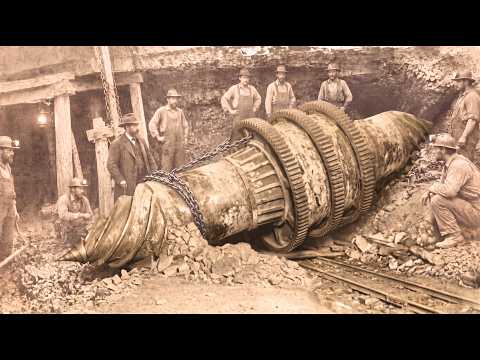
The entry begins like this: Six East floor 9 ft below the coal. Opening not cut by hand. Walls true. Chamber 71 ft x 24 ft. Roof 22 ft. Iron machine inside 58 ft end to end. And then a sentence that has no business in the official book of a certified mine foreman: I have no trade name for it.
Hartzell had taken his measurements with a chain tape, but the rest of the entry is stranger still. Beneath the measurements, he wrote down the machine’s compass bearing. North 71° west. Why would a mine foreman record the bearing of a machine? At the time, no one asked.
We know what Hartzell saw down there from the rest of that entry, and from what he told his family years later. The rope dropped nine feet through the clay. The floor was dry. The flame of his lamp stood straight. There was no gas. The air did not move, and it was noticeably colder than the rest of the mine. There was not a single pick mark on the walls, not a drill hole, not one timber prop. In Hartzell’s words, the surface was like the inside of a glazed crock.
The chamber had been opened in the fire clay directly beneath the coal seam. Its roof was the bottom of the seam. That is the kind of detail a miner understands. The coal ran over the chamber unbroken. There was no crack, no roof fall, no filled shaft. Which means no one had dug down from above, opened this chamber, set the machine inside, and closed it over. Or if they had, it was closed over by a swamp 300 million years old.
Hartzell raised the lamp and walked to the machine. The cone at the western end was more than twice his height, and five deep flutes wound down it like the thread of a screw to a sharp point. He put his hand into one of the flutes. The metal was smooth. There was no casting seam, no hammer mark, no rivet, no maker’s plate anywhere on it. In his book, he wrote only this: as if just finished.
At the toothed rings, he stopped. In the lamplight, he counted the teeth of the nearest ring, one at a time. 180 teeth, each one as wide as a hand. The edges were sharp, the faces bright. Not one of them had ever ground against another tooth. Whatever this machine did, it had never done it.
Above, at the mouth of the hole, two men of the crew are named in the book: a Welsh miner named Owen Pritchard and a loader named Jeppi Amato. Pritchard is said to have remarked that when the foreman came back up, his face was white. Amato refused to go down.
The last line of the entry reads: “Nobody to touch it.” Awaiting instruction from general office. Do not leave it unwatched.
The name of the boy who ran for the foreman is not in the book, but he would become the longest-lived witness this story has. His name was Andrew Costelnik. Everyone called him Andy. He was born in 1889 in the Szepes region, then part of the Northern Kingdom of Hungary, and came to Yatesboro with his family in 1898. In the autumn of 1902, he was thirteen years old, and he sat at the ventilation door at the mouth of Six East.
The second record is the object itself, and the most detailed witness to it is the boy who looked down into that hole. Andy Costelnik died in 1979 in Rural Valley at the age of ninety. Five years earlier, in 1974, his granddaughter Helen recorded him on a cassette recorder. The tape stayed with the family. A transcript was later given to a local historical society.
Most of the recording is about childhood—the mules, the company store, the cold of the winters in the company houses. But halfway through the forty-minute tape, Helen asks him about Six East, and the old man’s voice changes.
By his account, after the foreman came up, two more men went down that afternoon, and Andy was allowed halfway down the rope to hold a lamp from below. Seventy-two years later, he was still describing what he saw, piece by piece.
The western end of the machine looked like an ear of corn, he said, only twisted, turning as it narrowed. The body was straight and thick, like a boiler, but solid. Around the middle, ringing the body like a crown, stood square bars, upright, twenty-four of them. Hartzell’s book gives the same number. It gives their dimensions, too: each bar two feet tall, four inches square, the gaps between them equal. Out of a miner’s habit, Hartzell had measured the space between two bars at three different points and found the same figure all three times. Under the three numbers written side by side, he added one word: same.
Behind the bars, side by side, were three toothed wheels. To Andy, the largest was bigger than the window in the church. Hartzell’s figure is sixteen feet. The eastern end could not be seen, or only half of it. The second cone was still inside the east wall of the chamber, as if the wall had set around it.
There is one detail Andy comes back to again and again on that tape. The iron did not sweat. In a mine, every cold surface sweats. Cars, rails, pick handles are always wet in the morning, and the men wipe their hands on their trousers before they take hold of anything. On this machine, there was not one drop. When he held the lamp close, the light came back off the surface, but the warmth did not. It was cold, he says on the tape, like water at the bottom of a well, but dry.
Hartzell had measured the same thing. In the next day’s entry, there are two figures taken with the pocket thermometer he carried. The mine air stood at 54° Fahrenheit. The surface of the machine read 44—ten degrees colder in a closed chamber underground, in air that did not move.
But the most important line Hartzell wrote the next day was not a temperature. He had stretched a cord from one end of the machine to the other and taken the axis with his compass. North 71° west. He wrote it again at the bottom of the entry, this time underlined, and beside it he added a small note: toward Kittanning.
Seen from Yatesboro, the town of Kittanning and the Allegheny River do lie in that direction. The western cone was pointed at the town that gave the seam its name. At the river. The book records one more attempt. On October 16, while they waited for an answer by telegraph, Hartzell and two men tried to break the eastern end of the machine free of the wall. A twenty-ton screw jack was set beneath the body down in the clay. The jack handle was turned until it snapped. The machine did not move. One man set a steel pinch bar against the rim of a toothed ring and threw his whole weight on it. The bar slipped. There was not a scratch on the rim. The point of the steel had gone blunt.
Hartzell recorded the attempt in two lines. The second reads: “Harder than our iron, not our iron.” Then he posted a watchman at the hole and ordered that no one try again.
A telegram had gone to the company on the evening of October 14. The answer came the next day, and it was one word: wait. For nine days, no work was done in Six East. A watchman sat at the hole day and night, and Pritchard and Amato were moved to another heading on the far side of the mine.
And on the morning of October 23, a man arrived from the general office in Rochester. His name was Lucius Treadway. The book does not give his title. He appears only as Mr. Treadway of the General Office. Two men came with him, and their names were never written down. The three went down together and stayed about two hours.
That afternoon, at the very bottom of the October 14 entry, a single line was added in a different ink. The hand is not Hartzell’s. Six East heading closed per order of general office. Men transferred. No further entry.
The following week, a brick wall went up over the hole and across the mouth of the heading—the kind of wall miners call a stopping, built to cut off the air. On the mine map, Six East became a dead end, and the machine was left where it lay beneath the coal. It was not removed. A thing fifty-eight feet long at that depth could not be removed.
So what did the company say it was? There is an explanation, and in fairness, it deserves to be taken seriously. A month after Treadway’s visit, in November 1902, a letter to one of the company’s inspectors in Armstrong County—which survives today only as a summary—classifies the find in a single phrase: an abandoned tunnel machine belonging to some former boring attempt.
Said out loud, it sounds reasonable. The nineteenth century was full of dreams of boring through rock by machine. In 1851, a boring machine designed by Charles Wilson for the Hoosac Tunnel in Massachusetts cut just ten feet into the mountain and was abandoned. In 1880, the machine of the British engineer Frederick Beaumont began a tunnel beneath the English Channel, and when the project was halted, the machines were left where they stood. In Pennsylvania itself in the 1850s, railroad companies made attempt after attempt at tunnels along the Allegheny Valley. Companies failed, equipment was abandoned where it stood, and partnerships dissolved without leaving a record behind. In that world, it was not unusual for a machine underground to be forgotten.
There is also an explanation for why the company moved so quickly and so quietly, and it requires no conspiracy at all. 1902 was a year of tension across the Pennsylvania coal fields. Since May, 147,000 miners in the anthracite region to the east had been on strike. That strike ended with President Roosevelt’s intervention on October 23, 1902—the very day Treadway stepped off the train at Yatesboro. There was no strike in the bituminous mines of the west, but every company feared every rumor. Word that something strange had been found underground was enough for a shift to refuse to go down. Among the Welsh and Italian crews, signs of ill luck in a mine were taken seriously. Closing one heading was cheaper than a town afraid of the ground beneath it.
This explanation may be correct, but it does not explain the following. An abandoned tunnel machine has a tunnel. This chamber had no entrance. It was closed beneath a seam of coal no one had touched. Wilson’s machine went ten feet and left its bore behind it. Beaumont stopped at the end of the tunnel it had cut. The machine in Six East had no path cut ahead of it or behind it—only the chamber.
An abandoned machine has a maker, and a maker leaves marks: a foundry stamp, a patent number, a bolt. This machine had none of them. There was no wear on its teeth, no rust in its flutes, no seam of any kind along its body. And in 1902, nowhere on Earth had anyone built a boring machine fifty-eight feet long with toothed rings sixteen feet across. Tunnel machines of that size would not exist for another half century.
The explanation is reasonable. The machine is not.
And there was something the company did not know. The first people of this land had spoken of the ones who left it behind long before the machine was ever found.
In July 1907, an anthropologist named Mark Raymond Harrington sat in a kitchen on the Thames River in Ontario and heard an elder named Nathaniel describe a thing that went through the ground the way a worm goes through an apple. Two mouths, one for going and one for coming back. A crown of upright sticks around its waist. Three wheels with teeth. Put to sleep facing the water, under the black stone, still cold.
Harrington never visited Yatesboro. Hartzell’s book was locked in a company safe. Yet a foreman’s compass, an inspector’s bore, and an elder’s words all pointed the same way: north 71° west, toward Kittanning, toward the river.
In 1923, Inspector Clement Rule measured the machine at fifty-eight feet and found Hartzell’s painted mark still on the wall. He sealed the bore with double brick and wrote: I make no explanation.
Today the stopping lies 180 feet down, underwater. The dashed line on the 1924 map still runs northwest, to the edge, toward the great river.
“It wasn’t made for us,” Hartzell told the boy. “It wasn’t waiting for us.”
But if something was put to sleep facing the water—who can say where it will want to go when it wakes? What did your grandfathers say about the cold corner of Mine Number Two?
Report this article
Select a reason for reporting:






