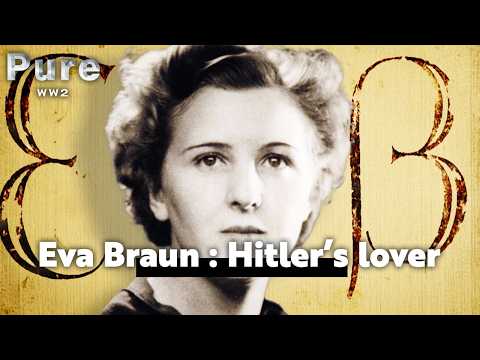
She was the woman who shared Hitler’s bed, yet the world barely knew she existed. For over a decade, Eva Braun lived in the shadows of the Obersalzberg, a golden cage that was never truly golden. By 1940, the 27-year-old had long accepted her fate as the Führer’s secret lover, a woman who could only love a monster in the dark.
But behind the carefully staged idyll of the Berghof, a darker truth festered. Eva Braun was deeply unhappy, her life a prison of her own making. Twice she had tried to take her own life—once with a pistol, once with sleeping pills—desperate cries for help that finally forced Hitler to pay her more attention. Yet even as war engulfed Europe, she remained a ghost in his world, known only to a select few.
The Obersalzberg was a stage, and Eva its willing actress. She played the lady of the house, addressed as “gnädiges Fräulein” by the staff, who secretly called her “the boss.” While Hitler planned his blitzkrieg against France, Eva captured it all on her 16mm camera—Christmas parties, birthday celebrations, and the fake warmth of a family life that never truly existed. “How was that possible?” one of Hitler’s secretaries later asked. “A ruthless warmonger and fanatical mass murderer enjoyed lighting Christmas tree candles.”
But the facade was cracking. As the war escalated, Eva’s world shrank. She partied in Munich when Hitler was away, filmed her terriers playing in the snow, and waited for phone calls that always came but never lasted long. “She always waited eagerly for them,” her cousin Gertraud recalled. “If he wouldn’t have called, she would have been very sad.”
By 1943, the tide had turned. Stalingrad had fallen, and Hitler aged visibly, his Parkinson’s disease beginning to show. Eva, now 31, became more important to him than ever. Goebbels noted in his diary: “The Führer praises the quiet, intelligent, and down-to-earth character of Eva Braun. She will be a valuable support for him.” Yet she remained hidden, a secret mistress in a world that demanded total loyalty.
When her sister Gretl married SS officer Hermann Fegelein in June 1944, Eva orchestrated the wedding to be “as beautiful as if it were my own.” She wasn’t in the photos, but she didn’t need to be—she was the power behind the throne, the woman who had learned to wield her influence in silence.
But the end was coming. After the July 20th assassination attempt on Hitler, Eva suffered a nervous breakdown. The dictator sent her his shredded uniform as a macabre souvenir—a sign of how much she meant to him. “He basically acted like every normal man in his relations with her,” her biographer observed.
As the Allies advanced, Eva retreated to Obersalzberg, swimming in the icy lakes and ignoring the war until the radio brought news of Paris’s liberation. “She got more and more serious then,” Gertraud remembered. “I think she was woken up by the news one day and then started planning her future path through life—or to death.”
On October 26, 1944, at just 32 years old, Eva Braun dictated her last will and testament. She left everything to her family, but her true intent was clear: she would die with Hitler. “She wanted to die with him,” her biographer said. “If he would have stayed in Eastern Prussia, she may have taken her own life.”
In early March 1945, Eva made her final trip to Berlin. She said goodbye to her family and friends in Munich, knowing she would never return. The wedding in the bunker was a spontaneous decision—Hitler’s final gift to the woman who had waited in the shadows for 13 years.
But their union would not even last 48 hours.
In the claustrophobic depths of the Führerbunker, Eva Braun became Eva Hitler. The ceremony was brief, a macabre farce conducted amid the thunder of Soviet artillery. Hitler, his left hand trembling, dictated his political testament while Eva signed her name with a practiced flourish. For thirteen years she had waited for this moment, and now it had come—not in a cathedral, but in a concrete tomb.
The newlyweds celebrated with champagne and a few loyal aides, but the toast was to death, not life. Eva wore a black dress, her hair freshly set, as if attending her own funeral. She distributed her jewelry to the secretaries, a quiet act of finality that spoke louder than any words.
When the time came, she walked with Hitler into the small study. The door closed. A single shot rang out. The smell of bitter almonds—potassium cyanide—seeped into the corridor. Eva Braun, the woman who had lived in the shadows, died in them.
Their bodies were carried up the stairs to the garden, where a shell crater served as an impromptu pyre. Petrol was poured, a match struck. The flames consumed what was left of the dictator and his mistress, reducing them to ash and bone fragments. The Soviets would find the remains days later, but the world would not learn the full truth for decades.
For Eva’s family, the news came as both a shock and a grim vindication. Her father, Friedrich, had always believed his daughter would never choose a bad man. Her sister Ilsa, who had once been warned by Eva never to criticize the Führer, now faced a different reality. In the chaos of defeat, the Braun family destroyed letters, photographs, and any evidence that might tarnish their name—or theirs.
But Eva had left her mark. Her albums, hidden away and discovered by chance after the war, revealed a side of Hitler that the world had never seen: the relaxed host, the affectionate partner, the man who lit Christmas candles and patted his lover’s shoulder. These images, carefully staged by Eva herself, were her final act of defiance—a claim to a life that history would try to erase.
In the end, Eva Braun was neither a hero nor a villain. She was a woman who loved a monster and paid the ultimate price. Her story, long buried in the rubble of Berlin, serves as a chilling reminder of how easily ordinary people can be seduced by power—and how far they will go to belong.
But the story did not end in that garden. It continued in the silence that followed—in the destroyed letters, the hidden albums, the testimonies that contradicted one another. Eva Braun had spent her life being seen only when she chose to be seen, and in death she proved just as elusive.
The Soviets, the first to reach the bunker, found charred remains and a mystery. They would spend years trying to confirm what had happened, interrogating servants, secretaries, and guards. The accounts varied wildly. Some claimed Eva had been shot; others insisted she had taken poison. Even her death became a story told by others, never quite her own.
Her cousin Gertraud, who had swum with her in the cold lakes of Obersalzberg and watched her hum American songs just to provoke Hitler, learned the truth from a radio broadcast. She had sent letters to the Berghof address and received nothing. For months she believed Eva was still alive, still waiting somewhere in the mountains. “I heard it on the news that they said Hitler died a hero’s death,” she recalled. “And I still didn’t know about Eva.”
When the announcement finally came—that the Führer had married his longtime companion and that she had died at his side—Gertraud understood something the world could not. “I got the impression that she somehow wanted to let her family know that she had married after all.”
For the Braun family, the marriage was both a wound and a strange consolation. Their daughter had lived as a mistress, a role that had shamed them in the early years. Now, in the final hours of the Reich, she had become a wife. “She led the life of a mistress,” Gertraud reflected. “The family wasn’t happy about it. But in the end, she became a married woman.”
Yet the price of that respectability was annihilation. Eva had married a sick, aging man—a murderer, a criminal—and her final act was to die with him. “Her last consequence was dying with him,” Gertraud said, her voice carrying the weight of decades.
In Munich, Ilsa Braun read the same newspapers as everyone else. She had once been warned by her sister never to criticize the Führer, or she would not be saved from a concentration camp. Now the war was over, and the Braun name was tied to the most infamous man in history. Ilsa, who had worked as a secretary for Albert Speer, retreated into obscurity. The family destroyed what they could.
But Eva’s albums survived. Discovered by chance after 1945, they revealed a world that seemed impossible to reconcile with the horror of the Holocaust. There was Hitler with children on his lap, Hitler laughing at a tea party, Hitler patting Eva’s shoulder with something that looked almost like tenderness. These images were Eva’s legacy—not of love, but of complicity.
Historians would debate for decades what she knew. She had lived in Munich, where Jewish neighbors disappeared and synagogues burned. She had heard the radio broadcasts, read the newspapers, watched the war unfold from the safety of the Berghof. “Of course, those people weren’t just spectators,” one historian noted. “They were privy to many things that happened.”
Eva had once forbidden her sister to mention politics. She had claimed she could not ask the Führer for favors for her family. She had staged idyllic scenes of children and dogs while Jewish children were being killed in the death camps. The question was never whether she knew, but how much she allowed herself to know.
In the end, Eva Braun remained what she had always been: a woman who chose the shadows, who loved a monster, and who died by his side. Her story is not one of redemption, but of a warning—a reminder that ordinary people can be seduced by power, that love can be twisted into complicity, and that the most dangerous monsters are often the ones who seem most human.
The evidence, such as it is, survives in fragments: a few feet of color film, a handful of photographs, a will dictated in a bombed-out city. Everything else—the letters, the diaries, the private words—was burned or buried by those who had reason to forget.
Eva Braun never wrote her own story. She left that to the men who guarded her, the sister who feared her, the cousin who swam beside her and still could not say what she had truly seen. “I may still believe it because I want it to be true,” Gertraud said of the relationship. “The thought of this man touching her is unbearable.”
Perhaps that is the final truth of Eva Braun: she remains unknowable because we need her to be. A monster’s mistress or a monster’s victim, a calculating opportunist or a lonely woman in a gilded cage—she can be whatever the century requires her to be.
But the albums are real. The films are real. Somewhere in them, a young woman laughs on a mountainside while the world below begins to burn. She chose not to look. That choice is her epitaph.
What do you think—was Eva Braun a victim of her own devotion, or a willing accomplice who simply refused to see? Tell us in the comments.
Report this article
Select a reason for reporting:






