The average lifespan after activating the flamethrower was 2 to 4 minutes. Of the 380 operators sent to Iwo Jima, only 18 left the island alive. Many survivors carried severe burns, auditory trauma, and nervous breakdowns. They were called the best and worst weapon the US Marines had—and their story is far more horrifying than it seems.
The Japanese developed a specific obsession with eliminating flamethrower operators. They knew it was one of the few weapons that could destroy their underground fortifications. Any soldier who spotted an operator was ordered to prioritize him, even under crossfire. They set traps, feigned retreats, and used hidden tunnels to flank and kill operators at point-blank range. But this is only one detail that explains the real situation.
The strategic importance of Iwo Jima was colossal. Located between the Mariana Islands and Japan, the tiny volcanic island—just over 20 square kilometers—served as a critical radar and fighter base for the Japanese. American B-29 bombers flying from the Marianas passed directly over it, making the island a deadly threat to every mission. Capturing it would give the Allies an intermediate air base, a vital emergency landing strip, and a launchpad for closer attacks on the Japanese mainland.
But the Japanese high command anticipated the offensive. General Tadamichi Kuribayashi, a veteran commander, knew victory was impossible. His mission was not to win, but to inflict maximum losses. He transformed the island into a deadly labyrinth of tunnels—nearly 20 kilometers of them—carved into porous volcanic rock. Bunkers, ammunition depots, command rooms, and hidden artillery positions interconnected beneath the surface. Every meter of ground was a killing field.
On the morning of February 19, 1945, the American operation began with a massive bombardment. For days, Iwo Jima was pounded by tons of explosives. When the first Marines touched ground, they expected rubble and disorganized resistance. Instead, they found black volcanic sand that sank underfoot, bogging down vehicles and making cover nearly impossible. The scene was eerily quiet for almost an hour. No shots were fired.
Then the trap sprang. At the exact moment the beaches were crowded with American troops, Kuribayashi authorized the attack. A coordinated downpour of machine gun, mortar, and artillery fire erupted from hidden positions. It was as if the island itself had come to life. Soldiers were trapped in the open, easy targets for Japanese precision fire. Even so, the Marines did not retreat. Meter by meter, under intense fire, they began to push inland.
Only after that initial advance did the Americans begin to understand what they were dealing with. The Japanese defenses were not destroyed—they were hidden. Behind the barren landscape lay a hostile labyrinth where every opening could hide a shooter or a grenade launcher. To deal with that, it would take more than courage. It would take fire, a lot of fire.
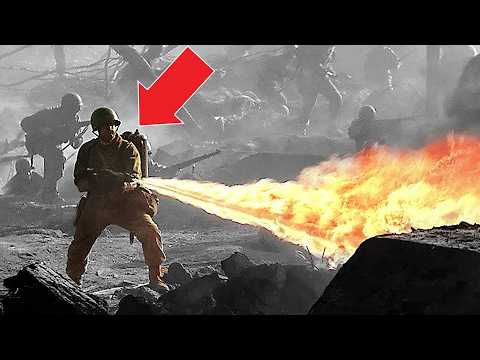
The M2 flamethrower produced a distinctive sound—a mix of whistling and a continuous roar, like an old jet engine. The Japanese learned to recognize that sound at a distance. Even without spotting the operator, they would fire in his direction with machine guns, mortars, or improvised grenades. Merely hearing the jet of fire was enough for a dozen camouflaged positions to turn toward the target. The operator’s silhouette was unmistakable—barrel-shaped fuel tanks on his back made him clumsy and slow, easy prey in the open.
Few imagine the logistical drama of operating this weapon. The thickened gasoline, mixed with napalm type B, adhered to practically any surface—skin included—and burned for up to 10 seconds at 1200°C. Refill drums had to be carried on foot by assistants, often under enemy fire. There was no safe quick reload system. The operator needed to find cover, remove the equipment, connect hoses, manually refill the three tanks, and only then resume combat. This could take between 3 and 5 minutes—time enough for any front line to have moved or collapsed.
On Iwo Jima, it was not enough to destroy a bunker to defeat it. Many positions that seemed neutralized came back to life when the Marines advanced. Japanese troops hidden in tunnels reappeared from the rear, opening fire from locations already considered safe. It was like fighting an invisible enemy that moved under the earth. The Americans could not define a clear front line. Everything was chaos, confusing, lethal.
Among the greatest obstacles were the casemates—reinforced concrete structures, well camouflaged, with machine guns pointed at every possible angle. Many were so well hidden that one passed by them without noticing until the bullets began to fly. Destroying those positions was a risky mission. Soldiers had to advance under constant fire, often crawling between rocks and craters until they got close enough to throw explosives. Even then, the result was uncertain. The casemates had curved or zigzag interiors which limited the effect of explosions. It was not uncommon for the Japanese to survive and resume firing minutes later.
That was when flamethrowers proved vital. They allowed attacking the interior of those shelters without the need for direct entry. The liquid flames penetrated the corridors and eliminated resistance almost immediately. The operators of those weapons, however, ran extreme danger. They carried fuel on their backs and were the enemy’s preferred targets. Contrary to what many think, flamethrower operators were not conventional volunteers. They were selected by physical strength, endurance, agility, and psychological criteria. They trained with real equipment, including withstanding the extreme heat radiated by the jet itself, which could heat the operator’s body up to 70°C even at a short distance from the discharge.
But no training could prepare someone for what they would face on Iwo Jima, where the black sandy terrain absorbed and reflected even more heat, drastically increasing thermal stress. In Iwo Jima, flamethrowers became almost indispensable, but those who operated them bore a mortal burden.
The M2 was a heavy and rudimentary device. It featured two reservoirs filled with a thick flammable mixture of gasoline and a central cylinder of compressed nitrogen whose function was to force the flammable liquid out. This mixture was expelled through a metal hose equipped with an ignition mechanism—electrical or chemical—responsible for igniting the jet. Despite its visual and psychological impact, the flamethrower had severe limitations. Its effective range was short, about 18 meters, and the total firing time was a mere 7 seconds. There was no room for waste. Each burst had to be short, precise, and lethal. It was necessary to get dangerously close to the target, open fire for a few seconds, and withdraw. All of this under extreme risk.
The effect of a flamethrower was so devastating that enemy soldiers did everything to prevent its approach. It was enough to see the flames coming out for all the defenders to focus on the operator. With a bulky, heavy backpack on his back, carrying more than 30 kilograms of flammable fuel, he became the most sought-after target on the battlefield. To protect him, the rest of the troop provided cover with suppressive fire. It was a race against time—distract the Japanese shooters long enough for the operator to complete his mission and escape alive. But in an environment surrounded by fortified positions and hidden tunnels, success was as uncertain as survival itself.
Testimonies from captured Japanese soldiers revealed something shocking. There was a deep emotional aspect to the hatred against flamethrower operators. They were seen not only as a threat, but as living demons. The samurai code of honor, adapted for imperial propaganda, preached that fair combat was fought with sword or shot, and that incinerating a man was an offense to the fighting spirit. A document found after the battle carried the phrase: “A man who brings fire on his back burns the soul of the sacred land. He must die first, even if he takes us with him.”
This fanaticism resulted in targeted suicide attacks. Several operators died from bayonets, hand grenades thrown with meter precision, and even foot kamikaze soldiers with explosives on their bodies running toward the flamethrower.
A few veteran operators developed their own strategies to increase their chances of survival. One was to remain in absolute silence until a few meters from the enemy position and fire without warning. Another was to work in pairs—while one fired the flamethrower, the other shot with a submachine gun or covering rifle. In rare cases, operators hid the flamethrower with camouflage tarps or positioned it sideways to disguise the silhouette. But these strategies had limited effectiveness given the level of preparation of the Japanese defenders.
Iwo Jima’s unique geography turned the flamethrower into an even more dangerous weapon for the operator himself. The island’s volcanic sand reached high temperatures under the sun, making movement with 30 kilograms on the back a constant thermal ordeal. The metal equipment heated to the point of causing burns even without contact with fire. Furthermore, jets of flame projected into caves created micro-explosions of hot air which could ricochet off rock walls, returning toward the operator like an infernal breath. There were documented cases of soldiers who fainted from the heatwave and were burned to death by the residual jet escaping from the barrel.
Among the numerous dangers faced by the Marines on Iwo Jima, there was one that surpassed even the fear of death: being captured alive. And for the soldiers who carried flamethrowers on their backs, that possibility came with a fate almost always more cruel. These men were not seen as ordinary combatants. In the enemy’s eyes, they were symbols of total destruction. Surrender was rarely an option. At best, a captured operator could expect a quick execution. But more commonly, there was something prolonged—a merciless revenge for the terror his weapon spread.
A well-known account from the battle speaks of a Marine whose flamethrower failed at the worst possible moment, right in front of a cave. Two Japanese soldiers surprised him, dragged him inside, and disappeared. The platoon could still hear his screams coming from inside the rock for two days. Unable to save him or even relieve his pain, all they could do was listen.
And that was only one facet of the horror. The weapon itself was a constant risk for whoever carried it. One mistake, a gust of wind in the wrong direction, or a failure in the ignition system, and the operator could be swallowed by the flames he was supposed to control. In addition, there was the psychological impact. Firing a flamethrower meant seeing, hearing, and even smelling the devastating results of your action, all up close.
In many cases, the survivors were treated by field medical teams lacking adequate resources. Because napalm stuck to the skin, the standard procedure was to remove the affected tissue with a scalpel—without anesthesia, since the patient was frequently in shock or unconscious. Third-degree burns required amputations. According to records from the Navy Medical Corps, flamethrower operators were five times more likely to require amputations than any other combatant on Iwo Jima.
Some of the few survivors gave interviews in the following decades. One of them, veteran Jack Hurst, stated in 1972: “I still dream of the smell. It’s not just burned flesh. It’s something that sticks to the soul. I see the flames coming out of the tip, and I know exactly what I’m doing with it. They screamed, and I saw. There’s no way to forget.” Another, known only as Sergeant Wallace, confessed that he avoided lighting campfires until the end of his life—the mere sound of gas being released would cause him to panic.
Despite everything, flamethrower operators were decisive for the American victory at Iwo Jima. It is estimated that more than 30% of direct Japanese deaths were caused by flamethrowers, either by fire or by structural collapse after incineration. However, their memory remained on the margins. In official ceremonies, they were rarely honored directly. The image of the liberating soldier preferred the Marine with the flag, not the man with fire on his back.
It was only from the 2000s onward that veterans associations began to highlight the vital and sacrificial role of these men. In 1995, on the 50th anniversary of the battle, a small group erected an unofficial plaque in their memory. It read: “Those who carried hell on their backs and released it with their hands—may they never be forgotten.”
So the question remains: when we remember the heroes of Iwo Jima, should we not also honor the men who carried hell itself into battle—and paid for it with their bodies and souls? What do you think—were they victims, weapons, or something far more complicated?
Report this article
Select a reason for reporting:






