Dr. Maya Freeman had seen thousands of historical photographs, but something about this one made her breath catch. The sepia-toned portrait from 1900 showed a Black family—a father in a dark wool suit, a mother in lace, four children arranged with rigid formality. But it was the youngest child, a little girl in a white dress, whose hand froze Maya’s heart. Three fingers extended upward, the index and middle crossed tightly over the thumb. A gesture too precise for a child’s fidgeting. Too deliberate for a random pose.
Maya zoomed in on the high-resolution scan, her pulse quickening. “That’s not an accident,” she whispered to the empty archive room. “That’s a signal.”
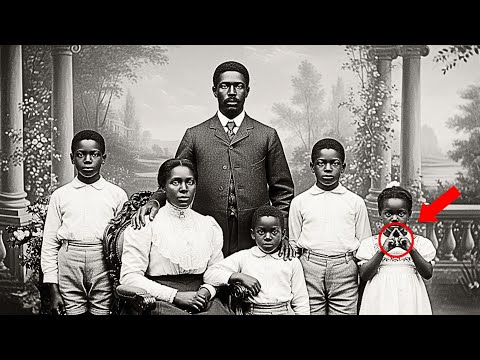
The photograph sat in a climate-controlled drawer at the Smithsonian National Museum of African American History and Culture, cataloged but forgotten. Maya, a cultural historian specializing in post-Reconstruction Black communities, had pulled it for a routine digitization project. Now she couldn’t look away. The family’s guarded dignity, the mother’s exhaustion, the boys’ unnerving seriousness—all of it pointed to a story beyond the frame. But the girl’s hand was the key.
Maya spent five days barely sleeping, surrounded by maps of Mississippi from 1900, census records, and histories of Reconstruction’s violent collapse. She searched academic databases for documented hand signals used by enslaved people and their descendants. Nothing matched. On the sixth morning, she emailed the image to Dr. Elliot Richardson, a historian at Howard University who had spent 45 years studying covert resistance networks. His response arrived within two hours, marked urgent: “This changes everything I thought I knew. Call me immediately.”
Her hands shook as she dialed. Elliot’s voice trembled with excitement. “Where did you find this photograph?” She told him. He paused, then said, “The Underground Railroad didn’t end in 1865. That’s the sanitized version we teach. After Reconstruction collapsed in 1877, the South became a killing ground. Black families needed protection networks just as desperately as during slavery—maybe more, because now they were supposedly free but had no federal protection.”
Maya stared at the little girl. “And the hand signal?”
“That’s called the ‘reload signal.’ It meant a family was connected, prepared, and ready to help or receive help. It was deliberately taught to children. Because children could move through communities without attracting suspicion. If parents were killed or arrested, the children needed a way to identify safe families who would protect them.”
Chills ran down Maya’s spine. The little girl in the white dress had been prepared for her parents’ possible death. “I need to find out what happened to this family,” Maya said.
The photograph bore a faint stamp on the reverse: Sterling and Son’s Photography, Natchez, Mississippi. Maya tracked the studio to James Sterling, whose great-granddaughter, Vanessa, lived in Chicago. Three days later, Maya sat in Vanessa’s living room as she opened a wooden trunk that hadn’t been touched in decades. Inside were hundreds of glass plate negatives and three leather-bound journals. “My great-grandfather documented every family who came to the studio,” Vanessa said. “Dates, names, sometimes notes about why they needed portraits made.”
She flipped to September 14, 1900: Coleman family, six portraits, express order, 3-day rush, special arrangement.
“Special arrangement?” Maya asked.
“My great-grandfather’s studio wasn’t just a business. It was a safe place, a checkpoint. Families who needed help knew they could come to him.” Vanessa’s eyes met Maya’s. “He documented people who were about to disappear by choice—to survive. This photograph was evidence they existed before they vanished into a new life somewhere safer.”
Maya’s heart raced. The Coleman family, six people, one little girl making a signal that would outlive them all. She had found the beginning of the story. Now she needed to find the end.
Two days later, Maya stood in a conservation lab at the Art Institute of Chicago as a specialist named Robert positioned the glass plate negative under a high-resolution scanner. The resulting image was stunningly clear—every texture of fabric, every strand of hair, every line in the subjects’ faces rendered in remarkable detail. Robert zoomed in on the little girl’s hand. “That’s definitely intentional,” he confirmed. “See how her fingers are positioned with tension? She held that gesture deliberately for the entire exposure. That would have been difficult for a child this young.”
Then Robert pointed to another detail. “Look at the mother’s left hand resting in her lap. See this ring on her middle finger? It has an engraving.” Maya leaned closer. The ring bore a tiny symbol: three interlocking circles forming a triangle. “I don’t know what that means,” Maya said, “but it’s connected somehow.”
Back at Vanessa’s home, they examined the journals more carefully. Maya discovered that certain families had small symbols marked next to their names—stars, circles, triangles. The Coleman family entry had three interlocking circles drawn in the margin. “He was marking network families,” Maya realized. “Different symbols meant different things. Maybe levels of involvement or types of assistance needed.”
Vanessa flipped through more pages. “Look at this. August 1900, one month before the Colemans. A Reverend Patterson visited, discussed arrangements for autumn departures. Twelve families confirmed.”
“Twelve families preparing to leave Mississippi,” Maya said. “The Colemans were part of a larger exodus. But why? What happened in Natchez in 1900 that made families run?”
She pulled out her laptop and searched historical records. Within minutes, she found it: newspaper articles from the Natchez Democrat, August through October 1900. A wave of racial violence following a disputed land claim. Three Black landowners lynched. Churches burned. Families terrorized. The September 14th portrait was taken at the height of the violence. “They were documenting themselves before they disappeared,” Maya said. “This photograph was evidence of their existence, their dignity, preserved before they had to erase themselves to survive.”
Vanessa touched the journal gently. “And my great-grandfather helped them do it.”
Maya immersed herself in Natchez records from late 1900. The violence wasn’t random—it targeted Black families who had acquired land, established businesses, or gained any measure of economic independence since emancipation. The Colemans, she learned from property records, owned forty acres of farmland outside Natchez, purchased in 1892. The father, Isaac Coleman, had been born enslaved in 1861, freed as an infant, and somehow saved enough money to buy land. She found Isaac’s name in an 1899 agricultural report as one of the few Black farmers successfully growing cotton and vegetables for market. Success that bred resentment among white landowners accustomed to Black subservience.
Then in October 1900, a notice in the Natchez Democrat: Coleman property, 40 acres, forfeited for unpaid taxes. A legal theft disguised as bureaucracy. But by then, the Colemans were gone.
Maya contacted Dr. Richardson again, sharing everything. “If they left Mississippi in late 1900, they would have headed north,” Elliot explained. “Chicago, Detroit, Cleveland—cities where Black communities were establishing themselves, where factory work was available, where they might disappear into growing populations.”
She searched 1910 census records for northern cities, looking for Isaac Coleman and his family. The name was too common, appearing hundreds of times. She needed more specific identifiers. She remembered the children—the three boys and the little girl. Estimating their ages from the photograph, she searched for Black families in northern cities with four children matching those age ranges. The work was painstaking, taking days of cross-referencing city directories, church records, and school enrollment lists.
Finally, in a 1910 census record from Detroit, Michigan, she found them. Isaac Coleman, age 49, laborer. His wife Esther, age 44. Children: Thomas, 22; Benjamin, 20; Samuel, 17; and Ruth, 14. The ages fit perfectly. The Colemans had made it. They survived.
But Maya noticed something else in the census record. Under year of immigration to Michigan, it listed 1900. Under place of birth for all family members: Mississippi. And in the margin, in the census taker’s handwriting, a small notation: Family declined to provide prior address. They had buried their past deliberately, erasing Natchez from their story, protecting themselves even a decade later and hundreds of miles away.
Maya stared at Ruth’s name—the little girl in the white dress, who made the reload signal with her small hand, who carried a code meant to save her life. She was determined to find out what happened to Ruth Coleman.
Tracking Ruth Coleman through 114 years proved extraordinarily difficult. Maya started with Detroit records from 1910 onward, searching for a Black woman born in Mississippi around 1895 or 1896. She found Ruth’s name in 1918 Detroit school records—graduating from Cass Technical High School, one of the few Black students in her class. Then the trail went cold for several years.
Until Maya discovered a marriage certificate from 1921. Ruth Coleman, married to William Harris, a postal worker. The surname change complicated the search, but Maya persisted. She tracked Ruth Harris through city directories, living on Detroit’s east side. No occupation listed in the 1920s and 1930s—likely working at home, raising children, taking in laundry, or doing domestic work that left no official record.
Then Maya found something unexpected. Ruth’s name appeared in the archives of the Second Baptist Church of Detroit, one of the oldest Black churches in the city and a historic station on the original Underground Railroad. Ruth served as a Sunday school teacher from 1925 to 1964.
Maya contacted the church, speaking with the current historian, an elderly deacon named Frank Morrison. When she explained her research, his response surprised her. “Mrs. Harris,” he said immediately. “Oh, I remember Sister Ruth. She taught my Sunday school class when I was a boy in the 1950s. Quiet woman, very dignified, but warm with children. She died in 1987—lived to be 91 years old.”
“Did she ever talk about Mississippi, about her childhood?”
“Never. Not once. A lot of the older folks who came up from the South during that era didn’t speak about it. Too much pain, too many memories they wanted to leave buried.”
Maya’s heart raced. “Did she have children?”
“Three daughters and a son. The youngest daughter, Grace, still lives here in Detroit. Works as a nurse at Henry Ford Hospital. I can give you her number if you’d like.”
That evening, Maya called Grace Harris Thompson, Ruth’s daughter, now 72 years old. Grace was cautious at first—another historian asking about the past. But when Maya mentioned the photograph and described the hand signal, Grace’s voice broke. “I need to see that picture,” she said. “Can you send it to me right now?”
Maya emailed the high-resolution scan. Ten minutes passed. Then her phone rang. Grace was crying. “That’s my mother. That little girl is my mother. I’ve never seen a photograph of her as a child. She always said they didn’t have any pictures from before they came to Detroit. She said they were lost.”
“They weren’t lost,” Maya said gently. “They were hidden. Protected.”
“The hand signal,” Grace whispered. “My mother did that once. I was maybe eight years old and we were at church. An old woman came up to her—someone visiting from down south—and they looked at each other and my mother made that exact gesture with her hand. The woman started crying and they hugged like they were family, but I’d never seen her before. When I asked my mother about it later, she just said, ‘That’s how we used to say hello in the old days, baby.'”
Grace agreed to meet Maya in Detroit. They sat in Grace’s living room, surrounded by photographs of Ruth’s life—her wedding picture from 1921, images of her teaching Sunday school, family gatherings from the 1940s through the 1980s. But nothing from before 1910. Nothing from Mississippi.
“My mother was a woman of silences,” Grace explained. “She loved us fiercely, but there were rooms inside her we were never allowed to enter. Whenever we asked about her childhood, she’d say, ‘That was another life, baby. This is the life that matters now.'”
Grace brought out a wooden box she inherited when Ruth died. “After she passed, I found this hidden in the back of her closet. I never knew what to make of it.” Inside the box: a small leather-bound Bible from 1892, worn and annotated in careful handwriting. A cotton handkerchief embroidered with the initials EC—Esther Coleman, Ruth’s mother. Three buttons hand-carved from wood. And a folded piece of paper, yellowed with age.
Maya carefully unfolded it. A hand-drawn map, crude but detailed, showing roads, rivers, and landmarks. Notations in pencil marked distances. 12 mi to Jackson. Safe house, barn with red door. Avoid main road after dark.
“This is an escape route,” Maya said, her voice hushed. “This is how your family fled Mississippi.”
Grace stared at the map, seeing her mother’s history made tangible. “She carried this her whole life. Never showed anyone, never spoke about it, but she kept it.”
Then Maya noticed something else in the box—a small piece of folded cloth. When she opened it, she found a child’s white dress, yellowed with time, with embroidered flowers along the hem. Grace’s hand trembled as she touched it. “The dress from the photograph.”
“Your mother kept it,” Maya said. “She kept the evidence.”
Grace lifted the dress to the light, and for a moment the room held its breath. “She kept the evidence,” Maya repeated softly, “because evidence is how you prove you existed.” Grace nodded, tears sliding freely now. “My mother spent her whole life making sure we never needed to disappear. That was her answer to the signal.”
Maya returned to the Smithsonian and requested the catalog be updated. No longer unknown family, circa 1900—now it read: Isaac and Esther Coleman family, Natchez, Mississippi, September 1900. Child making reload signal is Ruth Coleman, later Ruth Harris, 1896–1987.
The exhibition opened in February 2025. Grace stood before her mother’s photograph and raised three fingers, index and middle crossed over the thumb. The room went still. Then, one by one, the descendants answered.
What other silent codes are still waiting in old photographs for someone to finally look closely?
Report this article
Select a reason for reporting:






