The Turkish command had a problem they couldn’t solve with artillery, reinforcements, or frontal assault. Somewhere in the Anzac lines, in a loophole barely 30 centimeters wide, a single rifleman was killing their soldiers at a rate that was altering the arithmetic of the entire sector. They called it the spot of death.
By mid-summer 1915, the shooter had already passed 50 confirmed kills and was climbing. His name was William Edward Sing—Billy to the Australians, the murderer to the officers who logged his kills. He was 29 years old, a trooper in the 5th Light Horse Regiment, 5’6″, quiet, and half Chinese in an army that officially barred non-Europeans from enlisting.
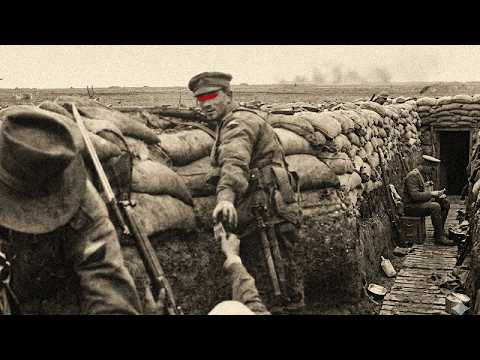
Born in 1886 near Clermont, Queensland, to a Chinese father and an Anglo-Australian mother, Billy grew up on a property where shooting was a daily skill. By his teens, he was winning marksmanship competitions across Queensland with a calm that unnerved the men beside him. When war broke out in 1914, the recruiting officer looked at his face, looked at the form, and wrote British subject where racial background was required. The army got a rifleman whose skill with a .303 would prove more valuable than any regulation.
Sing landed at Gallipoli on April 25, 1915. Within weeks, he’d found his role at Chatham’s Post, overlooking Turkish trenches on Bolton’s Ridge. His spotter, Trooper Tom Sheehan, sat beside him with a periscope, calling targets and confirming hits. They worked a daily routine that was methodical, patient, and lethally efficient. Sheehan would scan for movement—a head above a parapet, a soldier crossing a gap—call the range, and Sing would fire once. One round, one target. Then both men pulled back before the Turks could triangulate the shot. The entire engagement lasted seconds.
At ranges between 30 and 300 meters, Sing didn’t need a telescopic sight. He was shooting with open iron sights on a standard-issue SMLE, hitting targets that appeared for two or three seconds and then vanished. By mid-June, the count had passed 50. By August, it was over 100. The Turks knew they were losing men to sniper fire—every army on Gallipoli was—but the concentration of casualties in a single area, the consistency, pointed to something beyond routine harassing fire. Units opposite Chatham’s Post took disproportionate losses. Replacements lasted days, sometimes hours.
The Ottoman command identified the problem and decided to solve it the only way that made tactical sense. They sent their best sniper to kill the Australian. The man the Australians came to know as Abdul the Terrible arrived on the Turkish line sometime in mid-1915 tasked with a single objective: find the shooter at Chatham’s Post and eliminate him.
Abdul went to work immediately. He began picking off Australian soldiers in positions that had been safe for weeks, firing from concealed angles the Australians hadn’t identified. Within days, the word went around the trenches: there was a Turkish sniper on the ridge who didn’t miss. He was hunting Billy Sing.
The duel lasted several days. Both men understood the rules. The first to reveal his position would be the one who took a bullet. Sing couldn’t fire freely because Abdul was watching for his muzzle flash. Abdul couldn’t scan openly because Sing’s spotter was watching for his. It was a war of patience fought in centimeters—the width of a loophole, the angle of a periscope, the fraction of a second between a flash and a shot.
And then, Abdul found the periscope. The bullet came through the observation slit and hit Sheehan, wounding him badly enough to be pulled off the line. Sing was now alone, facing a marksman who had just proven he could put a bullet through a gap the width of a man’s fist from hundreds of meters away. But Abdul had also done the one thing a sniper in a static duel cannot afford to do. He’d fired from a position Singh could now narrow down by the angle of entry.
Singh didn’t rush. He knew Abdul’s general area from the angle of the shot that had hit Sheehan. He scanned that section of the Turkish line centimeter by centimeter, waiting for Abdul to fire again. The wait lasted more than a day.
According to the diary of Ion Idriess, a trooper serving with the Light Horse who later became one of Australia’s most widely read authors, when Abdul finally shot at another target, he exposed himself for a fraction of a second. Singh caught the muzzle flash. One shot from the Lee-Enfield. Abdul the Terrible dropped behind his parapet and didn’t fire again. Idriess wrote that Singh waited and waited, and then he got him.
The elimination of Abdul removed the only serious counter-sniper threat the Turks managed to deploy against Singh during the entire campaign. After the duel, he resumed his routine at Chatham’s Post, and the kill count continued to climb through the summer and autumn of 1915. By September, the total had passed 120. By the time the Anzac forces evacuated in December, his official count stood at 150 confirmed kills. The unofficial estimates ranged between 200 and 300. Either figure made him the deadliest sniper of the entire Gallipoli campaign on any side.
His commanding officer, Major Stephen Middleton, recommended Singh for the Victoria Cross, describing him as the most dangerous sniper on the peninsula—a phrase that carried specific tactical meaning, because Middleton was quantifying the operational impact of one soldier on the enemy’s ability to function in an entire sector. The VC was not awarded. Singh received the Distinguished Conduct Medal instead. No official explanation was given for why the recommendation was downgraded. Whether his Chinese heritage played a role is a question the official record doesn’t answer.
Gallipoli wasn’t the end of Billy Sing’s war. When the peninsula was evacuated and the AIF redeployed to France in 1916, Sing went with his unit to the Western Front. The fighting there was a different war entirely—industrialized, mechanized, fought across distances and with weapons that made Gallipoli look like a skirmish by comparison. The cramped ridgelines and 30-meter no-man’s-lands were replaced by open fields swept by machine gunfire and artillery barrages that lasted days.
Sing fought at Pozières in July 1916, one of the bloodiest engagements in Australian military history, where the 1st Division took 6,800 casualties in twelve days fighting for a ruined village on a ridge above the Somme. He continued serving through the Somme campaign and into 1917 and 1918, but his health was breaking down. He’d been wounded at least twice. The sustained physical strain of years of frontline service—the cold, the wet, the concussive effects of constant shelling, the mental toll of a job that required him to watch men through a rifle sight and kill them one at a time—had degraded his eyesight and his steadiness. The sniper who’d shot with iron sights at Gallipoli couldn’t perform at the same level on the Western Front. He was still a soldier, still in the line, but the edge that had made him the deadliest shooter on the peninsula was gone.
Sing returned to Australia in 1918. He was 32 years old, physically worn out, and carrying injuries that would affect him for the rest of his life. The country he came back to had a program for returned soldiers—the soldier settlement scheme, which provided land grants to veterans so they could establish farms and rebuild their lives after the war. Thousands of returned men received blocks of land across Queensland, New South Wales, and Victoria. Sing applied. He was denied.
The precise reason was never officially documented in a way that survived, but the timing and the pattern were consistent with what happened to non-white veterans across the country in the years after the war. The same racial restrictions that had almost kept him out of the army in 1914 followed him home. A man who had killed 150 enemy soldiers in defense of Australia, who had been recommended for the Victoria Cross, who had fought on two continents over four years, couldn’t get a block of land from the government he’d served.
He tried prospecting for gold in Queensland. That failed. He drifted into casual laboring work around Brisbane, taking whatever jobs were available—fencing, farm work, odd jobs that paid by the day. He never married. He never accumulated savings or property. The man who had been the most lethal individual weapon on the Gallipoli Peninsula lived in boarding houses and rented rooms, moving between addresses in the poorer parts of Brisbane, surviving on a war pension that barely covered rent. The Distinguished Conduct Medal sat in a drawer. Nobody asked to see it.
The country forgot him. No journalist sought him out for an interview. No historian recorded his account of the duel with Abdul the Terrible or the eight months at Chatham’s Post. Meanwhile, Ion Idriess—the trooper whose diary had captured fragments of Sing’s method—became one of the best-selling Australian authors of the twentieth century, with more than forty titles to his name. The man whose daily work Idriess had documented in those diaries was living in poverty 1,500 kilometers away in Brisbane, and nobody made the connection.
Billy Sing passed away on May 19, 1943, in a boarding house in Brisbane. He was 57 years old. He was alone. No family was present, no former comrades, no representatives of the army he’d served. The cause was listed as heart-related illness compounded by the accumulated effects of his war injuries. No Australian newspaper published an obituary. No military organization issued a statement. No RSL branch sent a representative to the funeral.
The most prolific sniper in the history of the Gallipoli campaign was buried in an unmarked grave at Lutwyche Cemetery in Brisbane. The headstone was blank. No name, no rank, no service number, no mention of Gallipoli or the Western Front or the 150 men he’d killed in defense of a country that couldn’t find room for him when the war ended. The grave stayed unmarked for 52 years.
It wasn’t until 1995, eighty years after Gallipoli and fifty-two years after Sing’s passing, that researchers identified the burial site and a proper headstone was finally placed on the grave. In 2015, on the centenary of the landings, the town of Clermont in Queensland—the town where Sing had grown up, where he’d learned to shoot on his father’s property, where he’d won the competitions that gave him the eye and the patience that would later kill 150 men on a Turkish hillside—erected a memorial statue in his honor. The memorial came 100 years after the campaign it commemorated.
What Billy Sing did at Gallipoli was a job. He sat in a hole in a sandbagged wall 30 centimeters wide and did the same thing every day for eight months. He watched, he waited, and he fired one round at a time. The cumulative effect was strategic. One rifleman with a bolt-action Lee-Enfield suppressed Turkish movement across a section of front that neither artillery nor infantry assault had been able to control. The Turks sent their best man to stop him. Sing killed that man and went back to work.
And when the war was over, the country that had needed him to kill couldn’t find him a piece of land to farm. He didn’t complain about it. There’s no record of Sing writing letters to politicians, petitioning the Repatriation Department, or making public statements about his treatment. He took the work that was available, lived in the rooms he could afford, and faded out of the story that Australia told itself about its soldiers. The larrikin digger myth had room for a white stockman from the bush who cracked jokes and called officers by their first names. It didn’t have room for a quiet half-Chinese shooter from Clermont who did his work in silence and then went home to nothing.
The army had been happy to overlook his ancestry when it needed a man who could shoot. The country was less generous when the shooting stopped. It took 52 years to put his name on his grave. What does it say about a nation that its heroes are only remembered when it’s convenient—and what would you have done differently?
Report this article
Select a reason for reporting:






