By mid-April 1945, the war in Europe was decided. The Western Allies had crossed the Rhine, and the Soviets massed 2.5 million men and 6,000 tanks for the final assault on Berlin. Hitler, clinging to power, directed his last reserves eastward in a futile attempt to stop the Soviet juggernaut. The battle for the capital of the Third Reich would be a fight to the death.
On April 16, the Soviets launched the Berlin Operation. Their plan: cross the Oder and Neisse rivers, encircle the city, and capture it. Two fronts, led by Marshals Zhukov and Konev, vied for the honor of taking Berlin—Stalin’s chosen symbol of Nazi defeat.
The defenders, outnumbered and outgunned, dug in along the Oder-Neisse line with about a million men of mixed quality. The key obstacle was the Seelow Heights, 60 km east of Berlin. There, Zhukov’s First Belorussian Front would endure four days of intense fighting, costing 66,000 Soviet casualties before the route to Berlin was open.
Inside the city, chaos reigned. Berlin was a shell of its former self, relentlessly bombed and swollen with refugees. The Nazi leadership prepared makeshift defenses, leaving civilians to fend for themselves. The city was divided into defensive zones, with the central Z Zone as the last bastion. But these defenses were largely ad hoc—trams filled with rubble and anti-tank ditches proved minor inconveniences to the overwhelming Soviet forces.
The soldiers manning them were often old men and young boys, along with a scattering of exhausted veteran units. Yet Berlin was not an easy target. Canals, waterways, and wide streets surrounded by high buildings turned the city into a death trap for tanks. The Soviets, however, were adept at urban combat. Their tactic: pulverize buildings with heavy artillery before advancing street by street.
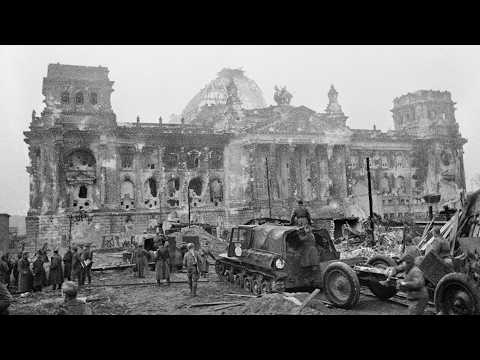
The Z Zone, bounded by the Landwehr Canal and the Spree River, contained key buildings: Gestapo headquarters, Göring’s Air Ministry, the Reich Chancellery, and Hitler’s Führerbunker. But the ultimate prize was the Reichstag. Though not in use since the 1933 fire, Soviet propaganda had turned it into the heart of the fascist state. Stalin demanded the Soviet flag fly over it as a sign of victory.
To capture the Reichstag, the Soviets first had to take the Moltke Bridge. On April 28, men of the 150th Rifle Division lined up along the Spree. The bridge was mined and barricaded, overlooked by German defenses in the Interior Ministry and diplomatic quarter. The first assault was repulsed with heavy losses, but the Soviets were soon ready to try again.
The next attempt, led by Stalin II heavy tanks, ended in disaster. Huge explosions rocked the bridge as the leading tanks disintegrated. Unknown to the attackers, the Moltke Bridge was under fire from the Zoo Flak Tower—a massive reinforced concrete structure armed with 128-mm anti-aircraft guns. The Germans had partially blown the bridge, but a narrow strip remained. Under heavy artillery cover, Soviet tanks finally forced a passage. By the evening of April 29, the Interior Ministry and diplomatic quarter were largely in Soviet hands, and the Reichstag was in sight.
The fight for the Interior Ministry was brutal, room by room. Success came down to a single window on the ground floor corner, through which thousands of Soviet troops passed until dawn. Meanwhile, a group of Fallschirmjäger remnants appeared from the Lehrter Station and rushed through Soviet positions to rejoin the fight around the Reichstag—their fate unknown.
By the early morning of April 30, Soviet troops occupied most of the Interior Ministry and diplomatic quarter, but the Kroll Opera House and the edge of the Tiergarten were still in German hands. The approach to the Reichstag was bottlenecked by a water barrier and covered by trenches, anti-tank guns, and machine-gun nests in the building’s bricked-up windows. Inside, a garrison of 300 men prepared to sell their lives dearly.
One of the attackers, Vladimir Pereverzev, wrote to his wife: “So far, I am alive and healthy. Only I’m slightly drunk the whole time. But, this is necessary to keep up your courage. I’m just 500 m from the Reichstag. We have already crossed the Spree and in a few days the Fritz’s and the Hans’s will be kaput.”
Not all Germans were eager to fight. Young conscript Günther Debski, assigned to a penal battalion, was ordered to defend the south side of the Reichstag. When his officer ordered him to carry a white flag to the Russians, Debski thought him a fool. Moments later, the officer was mortally wounded, and Debski and his comrade retreated out of sight.
At 4:30 a.m. on April 30, the Soviets made their first move across the 280 meters of open ground in front of the Reichstag. Smoke and brick dust covered their advance, but German fire was too strong. A second attempt at 11:30 was also driven back, partly by the Zoo Flak Tower. A third assault at 2:30 p.m. finally reached the water obstacle, knocking out several key positions.
By then, Soviet field artillery had been brought up and began hammering the Reichstag from point-blank range. Desperate, the German commander called for armored support. Several StuG IIIs and a King Tiger from the SS Nordland division arrived. Inside the King Tiger, Commander Georg Diers recalled: “The Reichstag building was already badly bombed. The plenary hall burned out. At the front of the building, we looked over to the Kroll Opera building and saw a large number of T-34s sitting to our right, about 30 of them. Their gun barrels pointing at the Reichstag building, at us. After a thorough briefing of the crew, we dared to race around the corner and open fire on this large number. With a success.” But one King Tiger could not change the outcome.
Stalin himself demanded the Reichstag be captured and a red banner flown by May 1. A mistaken report of a banner on the roof at 2:30 p.m. on April 30 only increased the pressure. With time running out, an all-out attack was launched. Most sources agree that men of the 756 Rifle Regiment entered the building through the main ground floor entrance at about 6:00 p.m. Staff Sergeant Ilya Syanov, one of the first inside, said: “Initially, we got into a long hallway. It turned out that the entire enormous building was in motion. Somewhere steps were heard rumbling. Somewhere people were shouting German. It was not immediately possible to take stock of the situation. One thing was clear. There were a lot of Germans in the building and we would have to do some fighting.”
The fight inside was a labyrinth of small and large rooms, long hallways, and wide staircases. The building was on fire in multiple places. The Soviets gained control of the ground floor, forcing the Germans to the upper floors and basement. Artillery shelled the upper floor while German guns targeted the ground floor. The battle raged through the night and into the next morning. A Soviet banner was likely raised above the main entrance sometime during the night, but the fighting continued until May 2, when the last defenders, out of ammunition and surrounded, surrendered. The fight inside the Reichstag had lasted over 30 hours.
By the time the last shots were fired, the defenders of Berlin emerged from basements and buildings into a shattered, dust-filled city, surrendering to the victors. On the roof of the Reichstag, photographer Yevgeny Khaldei took the iconic image of the red banner—a staged photo, likely taken on May 2. It was later edited to remove one of the two watches worn by the man in the photograph, a small detail alluding to the looting and darker episodes that would follow.
The cost had been staggering: 80,000 to 100,000 Soviet and 100,000 German troops killed, along with perhaps 20,000 civilians. In the days that followed, the world saw the first images of the destruction. The Reichstag became a mecca for Soviet soldiers, who carved their names into its walls. The story of Berlin, however, did not end there. Within months, the city would become the center of the Cold War, and it would remain so for five decades.
But the Reichstag was not yet entirely silent. Even as Khaldei arranged his flag-bearers on the roof, deep beneath the burning plenary hall, the basement levels still held pockets of resistance. Soviet sappers moved cautiously through the smoke-filled corridors, clearing each vaulted cellar with grenades and submachine-gun bursts. The air was thick with the smell of cordite and charred wood.
Among the Soviet troops was a young Kazakh sniper named Akhmet, who had followed his unit all the way from Stalingrad. He later described the scene to a war correspondent: “We came down the stairs and it was dark like a grave. Then a German shouted something and a burst of fire came up the stairwell. We threw grenades and waited. After that, there was only the sound of water dripping from broken pipes.”
The last Germans in the basement—a mix of SS men and Volkssturm—were eventually cornered in a storage room. According to Soviet accounts, they refused to surrender until a Soviet officer, himself wounded, crawled forward and shouted in broken German that the Führer was dead and Berlin had fallen. A long silence followed. Then a rifle clattered to the floor.
Outside, the city was entering its strangest hours. The guns had largely fallen silent in the center, but fighting still flickered in the Tiergarten and around the Zoo Flak Tower. Soviet infantry, exhausted and dust-caked, sat on the steps of the Reichstag smoking captured German cigarettes. Some posed for photographs. Others simply stared at the ruins.
For the civilians emerging from cellars, the first hours of peace were disorienting. Berliners shuffled through the streets in a daze, many clutching whatever possessions they had managed to save. The writer Erich Kästner, who had remained in the city throughout the war, recorded in his diary: “We walk through the streets like sleepwalkers. The city is a corpse. And yet, strangely, the birds are singing.”
The Soviet command, meanwhile, moved quickly to assert control. NKVD units fanned out across the city, setting up checkpoints and beginning the grim work of registering the population. The Red Army had won the greatest prize of the war, but the political battle for Berlin was only just beginning.
On the afternoon of May 2, General Helmuth Weidling, commander of the Berlin defense, was brought to Soviet headquarters. He had surrendered the city that morning, and now he sat across from General Vasily Chuikov, the man who had defended Stalingrad. The two men exchanged few words. Weidling asked permission to address his remaining troops, to urge them to lay down their arms. Chuikov agreed.
The broadcast went out over the city’s remaining loudspeakers. Weidling’s voice, tired and flat, echoed through the ruined streets. “The fight for Berlin is over. The Führer is dead. All further resistance is pointless.” For many Germans, it was the first confirmation that Hitler was gone. Some wept. Others simply turned away.
But in the bunker beneath the Reich Chancellery, the last act had already played out. On April 30, as Soviet troops closed in, Hitler and Eva Braun had taken their lives. Their bodies were carried up to the garden, doused with petrol, and burned in a shallow crater. The charred remains were found by Soviet soldiers days later, but the identification would take weeks to confirm.
For Stalin, the capture of the Reichstag was a triumph to be savored. The banner over the building—real or staged—became an instant icon of Soviet power. But the Soviet leader was already looking ahead. The Red Army’s presence in Berlin would become the foundation of a new empire in Eastern Europe, and the city itself would be divided into occupation zones within weeks.
In the streets, the first signs of a new order were appearing. Soviet soldiers distributed food from field kitchens, and military commandants began appointing local administrators. The swastika was torn down from public buildings, replaced by red flags. The war in Europe was ending, but the struggle for the future of Germany—and of Berlin—was already underway.
The fighting had barely stopped when the first Soviet soldiers began carving their names into the Reichstag’s scorched walls. “We had seen so much death,” one veteran recalled. “But here, at last, we could write something that would last.”
Elsewhere in the city, the dead lay where they had fallen. Soviet and German bodies were often piled together, and burial details worked through the night. For the survivors, the silence after the guns was almost harder to bear than the noise.
On May 8, Germany surrendered unconditionally. The war in Europe was over. But Berlin lay in ruins, and the city’s future was already being decided by the victors.
Today, the Reichstag’s walls still bear the scars of Soviet graffiti, preserved as a memorial. The birds still sing in the Tiergarten. And the question remains: what does victory truly look like when the cost is so immense?
Report this article
Select a reason for reporting:






