They fought for a sun that would never set, convinced of their own divine invincibility. Yet on battlefields from the jungles of Guadalcanal to the frozen plains of Khalkhin Gol, the soldiers of Imperial Japan came face to face with enemies who shattered their worldview. The question isn’t whether they feared their adversaries—it’s who they feared the most, and why that fear was born from a toxic mix of contempt, propaganda, and brutal, eye-opening combat.
But to understand the Japanese perspective, you must first step into their mindset—a labyrinth of ancient honor codes and modern imperial ambition. It was a worldview where surrender meant utter disgrace, and where the ‘white man’ was both a decaying threat and a source of deep, simmering resentment.
Before a single shot was fired in the Pacific, the Japanese psyche was already primed for conflict. At its core was the belief that Japan was Asia’s sole hope against Western domination. A December 1941 army pamphlet, chillingly titled “Read This Alone and You Will Win the War,” hammered this home. It spoke of tens of millions of Asians suffering under white exploitation, trusting in Japan to lead them to independence and happiness.
Of course, the brutal reality of Japan’s own conquests—from the rape of Nanking to the subjugation of Pacific islands—made a mockery of this ‘Asian savior’ narrative. But the myth was powerful, and it fueled a deep-seated sense of superiority.
This was reinforced by Bushido, the warrior code drilled into every soldier. Its most critical tenet was absolute contempt for surrender. As American Colonel Fred Borch observed, those who surrendered to the Japanese, no matter how bravely they had fought, “deserved nothing but contempt. They had lost all honor and all rights to be treated with dignity or respect.” This single belief would lead to some of the war’s most horrific atrocities.
The first to feel this scorn were the Chinese. After the Marco Polo Bridge Incident in 1937, Japan launched a full-scale invasion, viewing China as a decrepit society, hopelessly outmatched. The Japanese soldier was better trained, better equipped, and animated by a willingness to die for the Emperor.
The Chinese, they believed, simply didn’t understand this mentality. And they paid a terrible price. The Rape of Nanking in late 1937 became a grotesque showcase of this contempt. Japanese troops, acting under orders to kill all prisoners, unleashed a hell on earth. Unarmed men were machine-gunned, bayoneted, beheaded, and burned alive.
One Japanese officer, Tsuyoshi Noda, later recalled the sickening ease of it all, describing how Chinese soldiers, “were so dumb they ran towards us all at once,” only to be lined up and cut down. It was a brutal confirmation of their perceived superiority.
But this confidence would soon be tested by a far more formidable foe: the Soviet Union. The Japanese had long eyed the Soviet Far East, seeing it as a weak, vulnerable prize. Border clashes in the late 1930s, however, escalated into the pivotal Battle of Khalkhin Gol in 1939. This was no colonial skirmish. It was a full-scale, modern battle against a mechanized giant.
Led by the brilliant General Georgy Zhukov, the Red Army unleashed a devastating combined-arms assault. Using supply trucks to secretly move entire divisions, Zhukov launched a massive pincer movement, encircling and annihilating the Japanese 23rd Division. The material superiority was staggering. The Soviets fielded 500 tanks and 580 aircraft against Japan’s 90 tanks and 200 planes.
The defeat was a seismic shock. It shattered the myth of Japanese invincibility and forced a strategic pivot. They had underestimated the Soviets, and it cost them the battle—and any hope of a northern offensive. The lesson was clear: the Soviet Union was not a ‘soft’ target. It was a powerhouse they could not hope to match in a war of attrition.
This realization led directly to the Soviet-Japanese Neutrality Pact of April 1941. It was a pragmatic, if uneasy, truce. Japan could not fight China, the Western Allies, and the Soviet Union all at once. The pact allowed them to focus elsewhere, but the specter of Khalkhin Gol would haunt them until the very end.
Then came the British and the Americans—foes the Japanese had once respected, then learned to despise, and finally, in some dark corner of their minds, to fear.
The relationship with Britain was complicated. Japan and the United Kingdom had been allies in the First World War, bound by a treaty that had helped build the Imperial Japanese Navy. They respected the Royal Navy, even admired it. But that respect curdled into contempt when Britain, under American pressure, let the alliance lapse and then imposed crippling sanctions over Japan’s aggression in China.
The fall of Singapore in February 1942 seemed to confirm every Japanese prejudice. Eighty-five thousand Allied troops, mostly British, surrendered—the largest capitulation in British military history. According to Bushido, these men had forfeited all honor. Many were shipped to slave labor camps; some, including roughly fifty wounded men in Alexandra Barracks Hospital, were simply murdered.
Vice-Admiral Geoffrey Layton later admitted the uncomfortable truth: “Man for man, our men were inferior to the Japanese in training and in morale—in dash, endurance, discipline, and devotion.” In those early months, the Japanese would have agreed wholeheartedly. The British had disappointed them.
But the Americans were a different matter entirely. The oil embargo had brought Japan to its knees; some leaders saw it as a de facto declaration of war. Pearl Harbor was a desperate gamble to cripple a giant before it could fully awaken. Early propaganda painted the American soldier as soft, even cowardly. “Our American opponents are weaker than the Chinese Army,” one manual sneered. “They are extremely effeminate and extremely cowardly.”
Reality, however, delivered a far more disturbing portrait. The Americans fought with a ferocity the Japanese hadn’t anticipated—and with a savagery that shocked even hardened veterans. There were countless incidents of American troops massacring Japanese soldiers who had surrendered. Worse, in Japanese eyes, was the grotesque habit of taking ears, teeth, and bones as trophies. As historian Niall Ferguson noted, “boiling the flesh off Japanese skulls was not an uncommon practice.”
During the Guadalcanal campaign, American Marines recovered letters from dead Japanese soldiers that revealed a creeping terror. One letter described the enemy as “not ordinary troops, but Marines—a special force recruited from prisons and bloodthirsty insane asylums.” It spoke of prisoners having their arms cut off, being pinned to the airfield and crushed by steamrollers. There was no honorable death for captives.
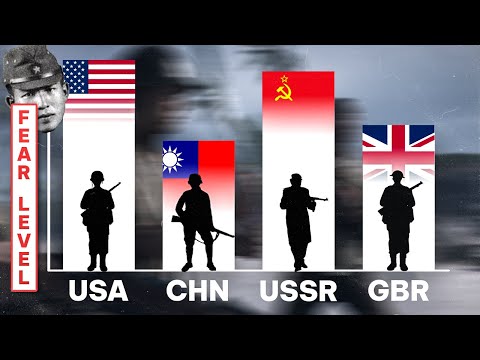
Through tales like these, a grim conclusion emerges. The Japanese had entered the war convinced of their own spiritual superiority, certain that material weakness could be overcome by sheer will. China had confirmed their contempt. Britain had disappointed them. The Soviet Union had humbled them. But the Americans—the Americans terrified them.
It wasn’t just their industrial might or their relentless advance across the Pacific. It was the unsettling realization that the Americans seemed to fight without the same rules, without the same limits. They were not merely an enemy to be defeated; they were a force that seemed to revel in the destruction itself.
This fear was never openly acknowledged, of course. To admit it would have been to betray the very foundations of Bushido. But it surfaced in the letters from Guadalcanal, in the desperate banzai charges, in the increasingly fanatical resistance as the tide turned. The Japanese had met an enemy whose capacity for brutality matched—and in some ways exceeded—their own.
And as the war entered its final, bloody phase, that fear would only deepen. The island-hopping campaign was grinding toward the Japanese homeland, and with every battle, the Americans proved that they were not the weak, decadent foe of Japanese propaganda. They were something far more dangerous: relentless, resourceful, and utterly unwilling to show mercy.
The question of who the Japanese feared most had a clear answer, though it was one they could never speak aloud. It was the enemy they had underestimated most catastrophically—the one whose factories, whose fury, and whose sheer, overwhelming force would eventually bring the empire to its knees.
The island battles that followed Guadalcanal only cemented this view. At Tarawa, Iwo Jima, and Okinawa, Japanese garrisons fought with a fanaticism born of desperation. They were no longer fighting to win—they were fighting to make the Americans bleed for every inch of black volcanic sand.
And the Americans obliged. At Iwo Jima, nearly twenty thousand Japanese defenders died, but not before inflicting over twenty-six thousand American casualties. The Marines who survived that hell were not the soft, decadent creatures of Japanese propaganda. They were hardened, relentless killers who used flamethrowers and satchel charges to root out defenders from tunnels and bunkers.
Japanese commanders began to notice something else—something that chilled them more than any weapon. The Americans did not break. When the Japanese expected them to retreat after heavy losses, they advanced. When the Japanese expected them to negotiate, they demanded unconditional surrender.
The kamikaze tactics that emerged in late 1944 were, in part, a response to this terrifying realization. If Japan could not match American material superiority, it would weaponize the one thing it believed the Americans lacked: the willingness to die without hesitation.
Vice Admiral Takijirō Ōnishi, the architect of the kamikaze, argued that only by turning pilots into human bombs could Japan “shatter the enemy’s resolve.” But the Americans, though shaken, did not shatter. They adapted, tightened their defensive screens, and kept coming.
What truly unnerved the Japanese high command, however, was the sheer scale of American production. The United States launched more aircraft carriers in a single year than Japan could build in its entire history. It fielded fleets so vast that Japanese pilots spoke of the sea itself turning black with ships.
One captured Japanese officer’s diary, recovered in the Philippines, put it with stark simplicity: “We cannot kill them fast enough. They come and come and come.” It was a confession of despair, not just of battlefield arithmetic.
Yet even as their world collapsed, Japanese propagandists doubled down. They portrayed the Americans as demons, savages, and subhuman creatures. But this was no longer confident contempt—it was the frantic whistling of men walking through a graveyard.
By the spring of 1945, the Japanese military had begun preparing for the ultimate confrontation: the defense of the homeland itself. Operation Ketsugō called for arming every man, woman, and child with bamboo spears and improvised explosives. The nation would fight to the last breath, they declared, and take as many Americans as possible into the abyss.
But behind the bravado lay a quieter, more private fear. The Americans had proved themselves not only strong, but unpredictable. They did not follow the rules of Bushido. They did not fight by the same code. And they were coming.
To the Japanese soldier, the American Marine was no longer a cowardly weakling or even a worthy adversary. He was something closer to a natural disaster—a force of nature that could not be reasoned with, could not be stopped, and could not be understood.
The fear was mutual, of course. But the Japanese had entered the war believing they were the master race of Asia. They would leave it knowing they had met their match—and possibly their superior—in the soldiers of the United States.
The atomic bombs that fell on Hiroshima and Nagasaki in August 1945 finally shattered the last vestiges of Bushido’s delusion. Emperor Hirohito’s radio address—the first time his subjects had ever heard his voice—spoke not of victory but of “a new and most cruel bomb.” The empire that had believed itself divine had been brought low by the very material power it had once dismissed.
In the war’s final irony, the Japanese discovered that the Americans they had feared most were also the ones who would rebuild their shattered nation. General MacArthur’s occupation brought not vengeance but transformation. The soldiers who had once been portrayed as demons now handed out chocolate to starving children.
So the answer to our question is clear. The Japanese feared the Americans most—not merely for their firepower, but for their terrifying refusal to play by the old rules. It was the fear of a warrior culture confronting an enemy who fought without limits, without mercy, and without end.
But perhaps the deeper truth is this: the Japanese feared most what they could not understand. And in the end, they never truly understood the Americans—or themselves.
What do you think? Was American brutality in the Pacific a necessary evil, or did it make the war’s ending inevitable? Share your thoughts below.
Report this article
Select a reason for reporting:






