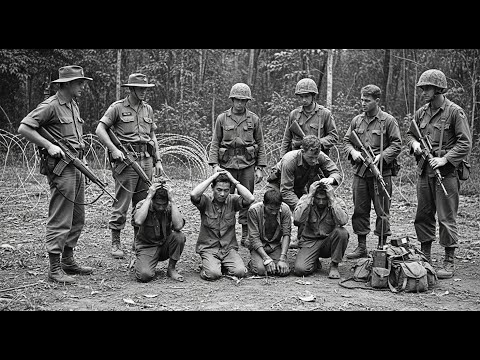
Staff Sergeant Mike Brennan crouched low in the sweltering elephant grass, his M-16 cradled in slick, calloused hands. The air was thick and soupy—every breath a fight against the jungle’s chokehold. Six days into the operation, his platoon had found nothing but ghost villages and ash-filled cooking pots. Then his point man hissed: “Movement! 2:00!”
Brennan froze, hand up, palm flat. Forty men dropped into position like dominoes. Silence—the kind that made your heartbeat feel like thunder. He peered through the green tangle. A lone figure darted between bamboo stalks, quick, deliberate, exposed. Too exposed.
He didn’t know it yet, but Brennan and his platoon were seconds from walking straight into a textbook ambush. Not by accident—by design.
Three hundred meters away, Captain Bob Milligan of the Australian Army Training Team lowered his binoculars and cursed under his breath. He had seen this exact setup a dozen times. The lone Viet Cong scout was bait, moving conspicuously to lure the Americans forward. Beyond the tree line, at least two dozen VC were dug in, rifles trained, waiting for the Americans to do what they always did.
“Charge forward. God damn it,” he muttered, reaching for his radio.
Milligan had no command authority over Brennan’s platoon—he was an advisor, technically. But that line blurred when you watched good men about to die for nothing. American infantry doctrine was gospel: seek contact, fix the enemy, destroy them with superior firepower. It was the creed of General Westmoreland, whose search-and-destroy mantra echoed from every command post.
In theory, it worked. The US had helicopters, artillery, and air support. When contact happened, the sky could rain hell in minutes. But in practice, the jungle rewrote the rules. The Viet Cong knew the American playbook—and they exploited it ruthlessly.
“They’re not even hunting,” Milligan had said to his sergeant the night before. “They’re marching into the teeth.”
He keyed his mic. “Lancer 3, this is Bravo 4. Enemy movement is bait. Full contact imminent. Recommend halt and redirect immediately. Over.”
Back in the grass, Brennan listened with growing confusion. His platoon had been moving by the book—staggered column, point security, ready to initiate fire and maneuver. But something in Milligan’s tone made him pause.
“All right,” Brennan said, rising slightly. “We’re taking a detour. Echo team, swing north, keep tight spacing.”
They spent the next two hours silently repositioning. No contact. No gunfire. Just the stifling quiet of the jungle. Two days later, a combined Australian-American patrol using coordinates from that redirection ambushed the VC unit they had nearly walked into. Seventeen enemy fighters killed. No friendly casualties.
Brennan survived—not because he was lucky, but because someone knew the rules of this war were backwards. You didn’t find the enemy by looking for them. You found them by letting them come to you.
That night, Brennan sat cross-legged on an ammo crate, picking at cold beans under a filtered flashlight. His rifle rested within arm’s reach. Around him, his men whispered in small huddles, helmets off, steam rising from sweat-soaked fatigues. Beyond the perimeter, the forest pulsed with its own rhythm—insects, frogs, the occasional rustle of a monkey. But no gunfire. No ambush. No body bags.
That was the part Brennan couldn’t stop thinking about. They’d followed every line of the playbook: sweep the grid, flush out the enemy, call in fire support. It was how they were trained. But tonight, they hadn’t flushed anyone. They’d been the ones almost flushed—and only a quiet Australian on a hill with a radio had kept them from being names etched in granite back home.
Doctrine doesn’t bleed. Soldiers do.
The American way of war had been born in the hedgerows of Normandy and refined in the hills of Korea: fast, violent, overwhelming. But that approach assumed the enemy wanted to stand and fight. In Vietnam, they didn’t. The Viet Cong weren’t fighting for hills or villages—they were fighting to exist, to wear you down. They didn’t care about winning firefights; they cared about surviving until America got tired.
Captain Milligan had told Brennan the truth as they smoked under a poncho later that week. “You’re fighting to win,” Milligan said. “Charlie’s fighting to not lose.”
Brennan frowned. “Same difference.”
Milligan shook his head. “Not in the jungle, mate. You’re playing checkers. He’s playing hide and die.”
The Australians had seen this war before—in Malaya, in Borneo, for over a decade. They’d learned to outlisten the enemy, to read broken twigs and boot prints in wet clay. Their doctrine wasn’t about charging in; it was about knowing where Charlie would be, not where he was.
Brennan finished his beans and stared into the black wall of jungle. Somewhere out there, the VC were regrouping. He didn’t feel victorious. He felt aware. They’d almost died following the book. Maybe it was time to learn a different book. Or write a new one.
The first thing the Americans noticed about the Australians was how slow they moved. Not sluggish—deliberate. Five men covering less than a click a day. No chatter, no visible radios. Boots padded with cloth. Rifles slung chest-high, eyes always scanning the ground, never the horizon.
To troops like Brennan, trained in aggressive patrolling, it felt almost passive. Wrong, even. But that was before they saw what came next.
In September of ’66, Brennan’s unit was temporarily paired with a five-man element from the Australian SAS, led by Warrant Officer Brian Wickens—a wiry man with a thick Queensland accent and eyes like granite. Day one, Wickens laid out the rules.
“You don’t talk. You don’t smoke. You don’t piss without looking twice. And for God’s sake, don’t step on anything you didn’t put there.”
The American platoon listened politely. Some chuckled. Brennan didn’t.
That afternoon, they moved through a dense section of Phuoc Tuy jungle so thick it swallowed noise and light. Wickens halted the team every ten minutes for a five-minute observation stop. While Americans typically moved until contact, Wickens moved until the jungle told him something.
He knelt to inspect a snapped branch, sniffed a dark patch of soil, pointed at an overturned leaf. “Three men came through yesterday. Light load—probably scouts. One of them’s limping.”
Brennan raised an eyebrow. “You can tell all that from a leaf?”
Wickens just smiled and kept walking.
By day three, Brennan’s skepticism had turned to awe. The Australians weren’t avoiding the enemy—they were herding him, tracking patterns, setting positions, planting ambushes where they knew Charlie would be tomorrow, not where he was yesterday.
“You don’t chase the tiger,” Wickens said. “You find his watering hole and wait.”
The difference wasn’t the rifles or the tactics. It was the mindset. American doctrine, forged in Europe and Korea, trained soldiers to advance, fix, flank, finish. Australian doctrine, refined in Malaya and Borneo, trained soldiers to listen, track, predict, ambush. One chased shadows; the other studied footprints.
And it worked. By late 1966, Australian-advised units in Phuoc Tuy were posting kill ratios of twenty to one or higher with almost zero friendly casualties. Tiny five-man patrols were destroying entire VC cells by predicting movement, setting traps, and waiting. It wasn’t glamorous. It didn’t look like victory on a headline. But it worked because it adapted to the war they were actually fighting.
Back at base, Brennan wrote it into his reports and told his COs. Some listened. Some didn’t. The brass still wanted results they could count—kills, grid squares cleared, munitions expended.
But Brennan had seen the quiet math that mattered. One Aussie patrol had tripled his platoon’s contact rate and dropped their casualty rate to zero. All because they did everything backwards.
April 1967, somewhere along the edge of Suoi Da Creek. Brennan’s boots sank an inch into the wet jungle floor as he crouched under a tangle of vines, motionless. His platoon hadn’t moved in hours—not because they were lost, but because they were already where the enemy would be.
Two days earlier, his men had tracked a faint VC trail through a banana grove. A snapped twig here, a patch of overturned mud there, a cigarette butt wedged under a root. To Brennan, trained now in the Australian way, it might as well have been a road map.
They weren’t chasing shadows anymore. They were setting a snare. The Australians called it forward ambush doctrine: don’t pursue the enemy—let him walk into you. Claymores were set in kill zones with overlapping arcs. Riflemen positioned above eye level, not behind trees. Radios wrapped in cloth to muffle static. No one spoke above a whisper.
And then, they waited.
At 0410, Brennan received the signal—a soft click on the squelch. The VC patrol was moving. Eleven men, heading up the same trail they’d used two nights prior. From his hide, Brennan could see nothing at first. Just mist. Then, one by one, silhouettes emerged. Slender frames, sandals, AKs slung casually, talking softly in Vietnamese. Not a care in the world.
The lead VC stepped between two trees marked by faintly disturbed moss—the trigger zone.
“Claymores,” Brennan whispered.
The jungle exploded. Twin flashes, a deafening crack, then screams—short, sharp, human. His men opened fire in precise, disciplined bursts. One shot, one body. Within forty seconds, it was over. Eleven VC lay sprawled along the trail. No Americans injured.
The ambush wasn’t just successful—it was surgical. And it had been made possible not by luck or superior firepower, but by the very thing American doctrine had long dismissed. Stillness.
Later, as Brennan’s men searched the bodies, they found maps, coded notebooks, and a marked trail to a rice and weapons cache. A week’s worth of intelligence from a forty-second engagement.
That night, back at their forward post, one of Brennan’s corporals finally spoke what they were all thinking. “It feels weird, Sarge. We didn’t fight them. We just killed them.”
Brennan looked at the ground. He didn’t smile. “That’s the point.”
By May 1967, the shift was underway—quiet but undeniable. In isolated outposts scattered across Phuoc Tuy and Binh Duong, platoon leaders were reworking everything they’d been taught stateside. The search-and-destroy days were fading, and in their place, a strange new rhythm taught not in manuals, but in sweat, silence, and stillness.
At Fire Base Bluebird, a few miles west of Long Tan, Warrant Officer Brian Wickens set up his impromptu schoolhouse. No chalkboards, no slideshows—just a patch of red clay, a pile of jungle debris, and two weeks of the most unorthodox field instruction any American had ever experienced.
“Forget everything you know about patrols,” Wickens began. “Forget columns, forget contact drills. You’ve got to see before you move.”
Day one, he had the Americans walk fifty meters into a thicket, then backtrack and point to what they’d just passed. None of them could. That changed fast. Within three days, they could identify where five VC had passed, what they carried, when they last urinated, and which direction they were headed.
At first, it felt like wizardry, but Wickens broke it down into science. A snapped twig bent toward the trail—recent passage. A rock with its damp side facing up—disturbed in the last few hours. Muddy impressions clustered too close together—a unit resting, not patrolling. Every inch of jungle told a story. You just had to slow down long enough to read it.
Noise discipline became religion. Metal gear was taped. Canteens were half-filled. Every man was trained to step toe-first, heel down only after confirming no crackling leaves. Hand signals replaced whispers. Patrols moved single file but staggered, no more than a meter apart. And they stopped every ten minutes to simply observe.
At first, the Americans grumbled. “Why are we wasting time sitting around?” Then they started seeing things. A sliver of sandal print in a dry wash. A broken banana frond, freshly bent. A faint cough in the distance. And suddenly, everything made sense.
One afternoon, Wickens had them shadow a known VC trail without making contact. For twelve hours, they trailed from a distance—close enough to hear murmurs, smell smoke, but far enough to remain invisible.
“Why not call in an airstrike?” one sergeant asked.
Wickens shook his head. “Because we don’t want to kill this patrol. We want to find where they sleep.”
The next night, they watched the same VC group settle near a dry stream bed. Wickens didn’t order an attack—he simply took notes. Three nights later, a different US platoon wiped out the entire cell in a textbook ambush. Rice, weapons, and documents intact. Zero friendly losses.
More and more American units were starting to get it. Captain Paul Boos of the 187th Infantry began limiting patrols to ten miles a week—but those ten miles were walked like predators, not tourists. His unit’s contact rate skyrocketed. Ambushes against them dropped by over sixty percent.
“They made the jungle feel smaller,” Boos recalled. “Like we weren’t lost in it anymore. Like we owned it.”
Still, not everyone was on board. Some battalion commanders called it timid. Others warned it wouldn’t scale. The Pentagon wanted body counts and maps covered in red Xs, not weeks spent crawling behind phantom footprints. But for the men doing the fighting, the change was real. And the results were undeniable.
They weren’t chasing ghosts anymore. They were setting traps. And Charlie was starting to notice.
By mid-1967, the Viet Cong had learned to read the shadows. False trails lured the hunters into kill zones; night movements erased the footprints the Australians had taught Americans to follow. “We’d own the jungle by day and give it back at night,” one sergeant wrote.
But Brennan’s men counter-adapted—spotting too-perfect trails, running decoy patrols, ambushing the ambushers. It became a silent duel of patience, a mirror match in the green hell.
Then came Tet. The VC shattered themselves against fortified lines, and America won every battle—yet lost the will to fight. By 1969 the withdrawals began, and the quiet professionals went home.
Years later, Brennan summed it up: “The way the jungle sounded when nothing was there, but you knew something was watching.” Milligan’s letter after Saigon fell said the rest—tactics had worked, but no ambush can save a war no one believes in.
Was the real defeat in the jungle—or in the living rooms back home?
Report this article
Select a reason for reporting:






