In the shadow of history’s darkest hour, the question lingers: How did ordinary people become killers? The Holocaust, a genocide that claimed six million Jewish lives, was not solely the work of fanatics. It was carried out by everyday citizens—men and women who, under the pressures of conformity, opportunism, and fear, became complicit in mass murder. This is the story of how ordinary people became killers.
In the 1930s, as the Nazi regime tightened its grip on Germany, Jews were systematically excluded from public life. Nazi activists and paramilitary groups used intimidation to enforce social norms, harassing those who associated with Jews. But even those who did not share the Nazis’ extreme beliefs participated in the persecution. Members of sports clubs and voluntary associations expelled Jews. Teenagers harassed Jewish classmates. Many Germans acquired Jewish businesses and property at bargain prices, developing a vested interest in the persecution. Some denounced neighbors for personal gain or out of prejudice.
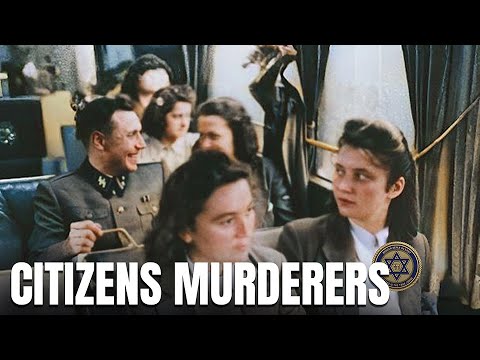
Most Germans passively accepted the isolation of Jews, and while many disapproved of the violence during the November 1938 pogroms, few spoke out. Fear and self-interest kept them silent. Nazi propaganda amplified long-standing anti-Semitism, and the regime’s control over public space prevented dissent. The majority cut ties with Jewish friends and neighbors, prioritizing their own livelihoods and families over the persecuted minority.
As German forces swept across Europe during World War II, they relied on tens of thousands of non-Germans to implement occupation policies, including measures against Jews. In Eastern Europe, local officials, police, and ordinary citizens helped carry out Nazi policies, from ghettoization to mass shootings. Some locals violently attacked Jews on their own initiative, robbing and murdering them. The motives varied: anti-Semitism, opportunism, fear, and a desire for revenge or personal gain.
In other parts of Europe, leaders and public officials helped implement anti-Jewish policies, enacting discriminatory laws and confiscating property. In countries like Romania, Hungary, Italy, Bulgaria, and France, non-German leaders acted on their own initiative, driven by anti-Semitism, racism, and nationalism. They helped identify, register, and mark Jews, and members of regular police forces captured Jews for transport to the east. Non-German railway workers transported deportees to the borders, and Jew hunters, tempted by monetary rewards, reduced the chances of survival for hidden Jews.
The Germans’ ability to gain cooperation diminished after their defeat at Stalingrad in early 1943. As the likelihood of German defeat grew, many Europeans became less willing to participate in actions for which they might later be held accountable. By autumn 1943, organized resistance efforts increased, but for most European Jews, it was too late. Five million were already dead.
A small minority risked their lives to help Jews. Some offered gestures of solidarity, while others hid Jews, provided food, warned them of danger, and protected their belongings. But these acts of rescue were exceptional. The majority of perpetrators were not sadistic or mentally ill; they were ordinary people who chose to participate in mass killings. Comradeship and the elimination of individual responsibility played a crucial role. As Sebastian Haffner noted in 1933, “Comradeship completely eliminates the feeling of individual responsibility. One simply behaves like everyone else does what everyone does.”
After the war, most perpetrators escaped justice. Only about 7,000 were convicted in German courts, with 172 receiving life sentences. This is a frustrating result considering the 170,000 accused by the authorities. Most simply disappeared, avoiding public prosecution. Without the accused, there is no trial. The lessons of history remain, a chilling reminder of how ordinary people can become killers.
But the question of how ordinary people became killers cannot be answered by looking only at those who pulled triggers or signed deportation orders. The machinery of destruction required a vast infrastructure of complicity— clerks, accountants, and civil servants who processed paperwork with bureaucratic indifference. These were not monsters in uniform; they were husbands, fathers, and neighbors who went home to dinner each evening after another day of facilitating genocide.
Consider the railway workers who scheduled trains to Treblinka and Auschwitz with the same precision they applied to commercial freight. Or the local police officers in occupied Poland who rounded up Jewish families at dawn, then returned to their villages to attend church on Sunday. The banality of evil was not a metaphor—it was a daily routine.
What made this possible? Historians point to several interlocking factors. First, the gradual escalation of persecution meant that each step seemed only slightly worse than the last. By the time mass murder began, the population had already been desensitized to Jewish suffering through years of propaganda, segregation, and small acts of exclusion. The line between acceptable and unacceptable had been moved so incrementally that many never noticed crossing it.
Second, the Nazi regime perfected the art of euphemism. Deportation was called ‘resettlement.’ Murder was ‘special treatment.’ Language was weaponized to obscure reality, allowing perpetrators to maintain psychological distance from their actions. A bureaucrat signing a transport list could convince himself he was merely doing his job, following orders, serving the state.
Third, peer pressure and social conformity proved extraordinarily powerful. In his study of Reserve Police Battalion 101, historian Christopher Browning found that the men who refused to participate in mass shootings were not punished severely—they were simply assigned other duties. Yet most chose to participate anyway, not out of fear but out of a desire to not appear weak before their comrades. The fear of social exclusion outweighed the voice of conscience.
This is perhaps the most disturbing insight of all. The perpetrators of the Holocaust were not primarily motivated by hatred or ideology. They killed because they wanted to belong, to advance, to avoid standing out. The same impulses that drive ordinary human behavior—loyalty to one’s group, ambition, the desire for approval—were harnessed to facilitate genocide.
In the aftermath, the world struggled to comprehend what had happened. The Nuremberg Trials established the principle that ‘following orders’ was not a valid defense for crimes against humanity. Yet the vast majority of perpetrators were never brought to justice. The silence of the post-war years allowed many to rebuild their lives as if nothing had happened, their crimes buried beneath the rubble of a defeated Reich.
Decades later, the children and grandchildren of perpetrators began asking uncomfortable questions. What did you do during the war, grandfather? The answers, when they came, often revealed a disturbing truth: the killers had not been monsters from another planet. They had been ordinary people, shaped by circumstance, ideology, and the terrifying human capacity to normalize the unthinkable.
This uncomfortable reckoning extended beyond Germany’s borders. In Poland, France, the Netherlands, and beyond, families discovered that their ancestors had not merely been bystanders but active participants in the machinery of death. Some had denounced hidden Jews for a reward; others had simply looked away while neighbors were taken.
The historian Jan Gross documented one such case in a small Polish town, where the local population participated in the massacre of their Jewish neighbors. The violence was not orchestrated by the Germans—it was spontaneous, intimate, and carried out by people who knew their victims by name. They divided the belongings of the dead among themselves, moving into their homes and wearing their clothes.
What does this tell us about human nature? The philosopher Hannah Arendt, who observed the trial of Adolf Eichmann, coined the phrase ‘the banality of evil.’ Eichmann was not a fanatic or a sociopath—he was a careerist, a man who wanted to advance in his job and please his superiors. He spoke in clichés, followed rules, and never questioned the morality of his actions.
Arendt’s insight was that evil does not require monstrous individuals. It requires only ordinary people who stop thinking critically, who surrender their moral judgment to authority, and who prioritize their own comfort over the suffering of others. This capacity for thoughtlessness, she argued, was far more dangerous than any innate cruelty.
Yet the story is not entirely one of darkness. Even in the midst of genocide, there were those who refused to participate. The righteous among the nations—over 27,000 recognized by Yad Vashem—chose to risk their lives for strangers. They hid families in attics and barns, forged documents, smuggled food, and guided Jews to safety across borders.
What distinguished these rescuers from the perpetrators? Research suggests that rescuers shared certain traits: a strong sense of individual moral identity, a history of standing apart from the crowd, and often a family background that emphasized compassion over conformity. They saw Jews as human beings, not as members of a despised category.
But the rescuers were the exception. For every person who hid a Jewish family, thousands more looked the other way, or actively collaborated, or profited from the persecution. The Holocaust was not a crime committed by a small group of madmen—it was a societal project, enabled by millions of small decisions, small silences, small acts of self-interest.
This is why the lessons of the Holocaust remain so urgent. The conditions that made it possible—authoritarian control, propaganda, economic hardship, scapegoating of minorities, and the erosion of individual conscience—are not unique to 1930s Germany. They can emerge anywhere, at any time, when ordinary people stop paying attention.
Today, as authoritarian movements gain strength across the globe and hate speech proliferates on social media, the warning signs are visible once again. The question is not whether ordinary people can become killers—history has answered that definitively. The question is whether we will recognize the warning signs in time, and whether we will have the courage to act differently.
In the end, the Holocaust teaches us that the line between good and evil runs through every human heart. It is not a line that separates us from them—it is a line that each of us must choose to cross or not cross, every day, in countless small decisions. The ordinary people who became killers were not so different from us. And that, perhaps, is the most terrifying lesson of all.
And yet, even as we absorb this terrifying lesson, we must ask: what made the rescuers different? They were ordinary too—farmers, teachers, nuns, and shopkeepers—but they chose to see a person where others saw a problem. Their courage was not the absence of fear, but the refusal to let fear dictate their humanity.
This is the paradox at the heart of the Holocaust: the same species that engineered industrial murder also produced acts of quiet, costly heroism. The line between good and evil does not run between nations or ideologies—it runs through every human heart. And each of us stands at that line every day, whether we acknowledge it or not.
So what will you do with this history? Will you be a bystander, silent and safe? Or will you recognize the warning signs—the propaganda, the scapegoating, the erosion of empathy—and act before it is too late? The past is not dead; it is not even past. It lives in every choice we make.
We have seen how ordinary people became killers. The harder question is: what would it take for ordinary people like us to become rescuers? What would you have done—and more importantly, what will you do now? Share your thoughts in the comments below.
Report this article
Select a reason for reporting:






