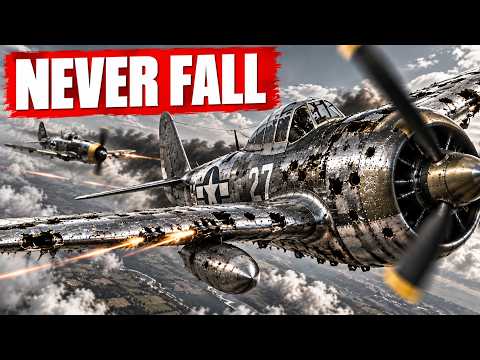
On June 26, 1943, a 23-year-old farm boy from Oklahoma was trapped inside a crippled American fighter plane over northern France. The cockpit was jammed shut. Hydraulic fluid splashed into his eyes. Cannon shells had torn holes in his wings. His oxygen was gone. His radio was dead. Then a German fighter pulled alongside him—so close he could see the other pilot’s face. The German looked at him slowly, like a man inspecting something he had already decided to kill. Then he dropped behind the American, aimed carefully, and opened fire. He came back again and again, firing until he had nothing left to shoot.
By the laws of physics and the lessons of that war, the American should have died that day. But he didn’t. The machine he was flying was mocked by its own pilots. They called it a milk jug with wings, a seven-ton brick, a dinosaur. Veteran American pilots who had flown Spitfires didn’t want to touch it. One of England’s best fighter leaders joked that it could land, but it certainly couldn’t climb. Within two years, German soldiers on the roads of France had their own word for it. They whispered it quietly, stealing glances at the sky. So what kind of aircraft was this that refused to die? And what did it cost the young men who strapped themselves inside?
To understand why that American pilot survived, you have to go back to a drafting table on Long Island in the last months before the world caught fire. The man hunched over that table was named Alexander Kartveli. Born in Tbilisi, Georgia, in 1896, he trained as a pilot in France, watched his homeland swallowed by revolution, and eventually crossed the Atlantic with nothing but a head full of ideas. In America, he found work with another immigrant, a volatile and brilliant Russian named Alexander de Seversky. Seversky had the charisma, the headlines, and the connections. Kartveli had the pen.
Together they built the P-35, a stubby, all-metal fighter with a radial engine and retractable landing gear. It was modern for its time, but never great. Then came the P-43 Lancer. It could fly high, but it couldn’t fight well. By 1939, Seversky himself had been pushed out of the company, renamed Republic Aviation. Kartveli stayed. He was now chief designer at a company whose fighters, frankly, had impressed no one of consequence.
Around that time, as 1939 turned into 1940, the Army Air Corps began looking for something audacious. They wanted a fighter that could fly above 30,000 feet and fight up there where the air is thin and cold and ordinary engines struggle to breathe. The key was the turbosupercharger—a spinning turbine driven by engine exhaust gases to force dense air back into the cylinders. The Army wanted this system integrated into a single-seat fighter. The problem was size. The turbosupercharger needed ducts. Ducts to carry hot exhaust rearward. Ducts to carry compressed air forward again. Intercoolers to strip that air of heat before it reached the engine.
Most designers would have tried to cram all that plumbing into a slim, elegant airframe. Kartveli did the opposite. He placed the turbine in the belly of the rear fuselage, far behind the pilot. Then he built the entire airplane around that network of ducts. He is said to have looked at his own drawings and remarked that it would be a dinosaur, but a dinosaur with harmonious proportions.
At the front of that dinosaur, he put the most powerful aircraft engine in America: the Pratt & Whitney R-2800 Double Wasp, eighteen cylinders in two rows, 2,000 horsepower. To turn that power into thrust, the plane needed a massive propeller, nearly twelve feet across. To keep that propeller from striking the runway, the landing gear had to be long. To fit that long gear inside the wings while leaving room for guns, the engineers designed legs that actually shortened as they folded inward. Every solution created a new problem, and every problem made the plane bigger.
Then came the armament: eight .50-caliber machine guns, four in each wing. When fired together, they threw a wall of heavy bullets that could shred an enemy fighter in a second or two. When the work was done, the new fighter had a wingspan of forty feet. It was thirty-six feet long. The fuselage was so deep and round that people said it looked like a milk jug standing on its base. The name stuck. For the rest of the war, the men who flew it and the men who fixed it simply called it the Jug.
In the fall of 1940, before the prototype even flew, the Army ordered 773 of them. It was a tremendous gamble. America was not yet at war, and its air arm was pitifully small. The generals had few other options, and they knew it.
On May 6, 1941, test pilot Lowery Brabham lifted the XP-47B off the runway at Farmingdale, Long Island. Smoke filled the cockpit on that first flight. Brabham stayed with the plane and landed it safely. In the months that followed, the big fighter proved something remarkable. Though it weighed nearly twice as much as the British Spitfire, it exceeded 400 miles per hour at high altitude. On paper, Republic had built one of the fastest fighters the Army had ever requested.
Then came Pearl Harbor, and the Thunderbolt went from a promise to an urgent necessity. The first unit chosen to take the new fighter to war was the 56th Fighter Group. In 1942, it was a young outfit still learning how to be a combat unit. Its pilots trained on gentle aircraft, trainers that forgave almost any mistake. The Thunderbolt forgave very little.
The group’s commander was a stocky, strong-jawed man named Hubert Zemke. Everyone called him Hub. Born in Missoula, Montana, in 1914 to German immigrant parents, he had boxed in his youth and boxed well. In 1941, before America entered the war, the Army sent him to the Soviet Union to help Russian pilots learn to fly American fighters. He had seen up close what real war looked like. He was not a friendly man. He was not easy to like, but he watched everything and forgot nothing.
Zemke’s pilots quickly learned that the Thunderbolt had a dark side. In a steep dive from high altitude, the heavy fighter gained speed so rapidly that the air flowing over its wings began to behave strangely. The pilots called it compressibility. The controls froze as if cast in concrete. The nose bent downward and kept going down. A pilot could haul back on the stick with both hands and feel almost no response. Those who reacted quickly, by cutting power and waiting until they reached denser air below, usually regained control. But some did not. They hit the ground straight on. The group lost several pilots in accidents before it fired a single shot in combat.
Among the young men who arrived to fill the empty seats was a farm boy from Lawton, Oklahoma. His name was Robert S. Johnson. He was twenty-two when he joined the group. He had wanted to fly since he was a small child, since the day he watched an Army air show and decided that nothing else in life mattered. He was a boxer too, quick and stubborn. But in flight school, he had one terrible weakness. He could not shoot. His gunnery scores were so bad that his instructors doubted he would hit anything in combat. He was a good pilot with poor aim, which in a fighter group meant he was nearly a dead man.
Another man would soon join the 56th. He was Francis Gabreski, son of Polish immigrants from Oil City, Pennsylvania. His friends called him Gabby. On the morning of December 7, 1941, he was at Wheeler Field in Hawaii when Japanese planes roared out of the sky. By the time he got airborne, the attackers had gone. Later he went to England and talked his way into flying Spitfires with a Polish squadron of the Royal Air Force—men who had lost their country and fought as if they had nothing left to lose. In early 1943, Gabreski came to the 56th. He knew the enemy. He knew the Spitfire. What he did not yet know was the Jug.
In January 1943, the 56th crossed the Atlantic and arrived in cold, wet England. The men expected to be the first Thunderbolt group in combat. They were not. That honor went to the 4th Fighter Group. And here the trouble began. The 4th was made up of the Eagle Squadrons, Americans who had volunteered for the RAF before their country entered the war. They had flown Spitfires. They loved Spitfires. The Spitfire was light and nimble and beautiful. It could turn and twist around almost anything in the sky. Then, in early 1943, the Americans took their Spitfires away and handed them Thunderbolts.
The veterans of the 4th looked at the huge new fighter the way a knight might look at a plow horse. It was heavy. It climbed slowly at low altitude. It guzzled fuel. Its old radios buzzed and squawked so badly that pilots could barely understand each other. Its engines suffered troubles that mechanics were still learning to fix. Some of these pilots said openly that they wanted their Spitfires back.
One of their leaders, Don Blakeslee, was among the most aggressive fighter pilots in England. He did not hide his opinion either. On April 15, 1943, Blakeslee was flying a Thunderbolt near the Belgian coast when he spotted Focke-Wulfs, the best fighters the German Air Force had. He did what the Thunderbolt did best. He turned and dove. The heavy fighter fell like an anvil, gathering speed, and the German could not escape. Blakeslee chased him down and blew him out of the sky. It was one of the first victories scored in a Thunderbolt.
On the ground, someone congratulated him for proving that the big fighter could out-dive a Focke-Wulf. Blakeslee was not impressed. “By God, it ought to dive,” he said. “It certainly can’t climb.” The line spread from base to base. It summed up everything people thought about the Thunderbolt that spring: a fighter that could fall fast but could not fight.
For the 56th, frustration mounted. Week after week, they flew sweeps over France and Belgium. Week after week, the Germans refused to come up and fight or struck from above and vanished before the Americans could respond. The first two months of Thunderbolt operations in England produced only a handful of confirmed kills. Some Thunderbolts were lost to German flak, others to engine failures. The pilots who had defended the Jug began to wonder if the critics were right.
Then on June 12, the 56th finally scored its first victory. The next day, Robert Johnson—the pilot who couldn’t shoot—broke formation without permission and chased a Focke-Wulf alone. It was a killing burst. It was also a serious breach of discipline. Zemke chewed him out hard about what happens to pilots who abandon their leaders. Johnson listened. Johnson learned. And Johnson still believed, deep down, that the Thunderbolt would bring him home no matter what.
Thirteen days later over northern France, the Luftwaffe put that belief to the test. On June 26, 1943, the 56th took off to cover American bombers returning from a raid near Paris. Robert Johnson was flying near the rear of the formation—the spot veterans knew as the most dangerous place in the sky. The rear is where the enemy hits first. The Germans came out of the sun. Johnson never saw them. There was a flash, a violent crack, and the cockpit filled with fire and smoke.
A cannon shell burst somewhere behind him. Bullets hammered the airframe like mallets on a steel drum. A hydraulic line exploded, spraying hot fluid into his face and eyes. His vision blurred and burned. His oxygen system failed, his radio was gone. Flames licked up from the floor around his feet. Every instinct told him to get out. He reached down and pulled the canopy release. It moved a few inches and stopped. The frame had been warped by cannon fire. He pushed with his hands. He braced his shoulders and heaved with all his strength. It would not open enough for a man to pass through. He was trapped inside a burning airplane at over 20,000 feet.
He did the only thing he could do. He pointed the nose down and dove—away from the fight, away from the fire, toward denser air. Somewhere in that terrifying descent, the flames blew out. For a moment there was only the roar of wind through the shattered cockpit and the sound of the big, heavy engine still turning, rough and uneven. Johnson wiped his eyes with his sleeve and tried to see. His hands were cut. There was shrapnel in his legs. His airplane was shaking and wobbling like a wounded animal, but it was still flying. He turned toward the English Channel, toward home.
Then he saw another plane. It was a Focke-Wulf 190, alone, sliding in from the side. Its pilot had seen the smoking American fighter and come to finish the job. The German pulled alongside, wingtip to wingtip, so close the two men could look at each other through their canopies. Johnson could see the German’s face. The German could see his. For a long moment they flew together over the French countryside. Then the Focke-Wulf dropped back, lined up directly behind the Thunderbolt, and opened fire.
Johnson hunched forward in his seat. Behind him was a thick plate of steel armor that Republic had built into the back of the cockpit. The bullets slammed into it and rang like hail on a tin roof. He felt every impact through his spine. Pieces of his airplane tore away and fell. The Thunderbolt shuddered. But it kept flying. The German stopped firing, pulled closer again, and looked at the wrecked American fighter as if he could not believe it was still in the air. Then he dropped back and fired again, and again. Johnson kicked the rudder and skidded, trying to spoil the German’s aim, but his plane was too damaged for real maneuvers. All he could do was wait, and pray, and keep the nose pointed toward the sea.
Finally, the Focke-Wulf came alongside one more time. The German pilot had nothing left to shoot. He looked at the American, then waggled his wings—a salute, or a gesture of disbelief—and turned away toward France. Who was that German pilot? Johnson never knew his name. He described him only as a skilled and deliberate hunter who took his time. Many historians later believed the pilot was Egon Mayer, one of the most dangerous men in the Luftwaffe. Mayer was twenty-five years old. He led a fighter group in Jagdgeschwader 2, the Richthofen Wing, and had already shot down dozens of Allied aircraft. Whether it was truly Mayer that day or not, the German pilot did everything right. He had simply run into an airplane that refused to fall.
Johnson crossed the Channel with his engine coughing and his eyes still burning. He found Manston field on the southeastern tip of England, a runway used by damaged aircraft returning from the continent. He lowered his landing gear and prayed it would hold. His hydraulics were gone. He had no flaps. He came in fast and heavy, touched down, and rolled across the grass until the huge fighter finally stopped. Men ran toward him. They tried to force the canopy open. They pulled him out. For a few seconds he simply stood there on the grass, swaying. His flight suit was soaked with hydraulic fluid and sweat. His eyes were swollen almost shut. The air smelled of hot oil and burned metal. The engine ticked and hissed as it cooled.
Somewhere behind him, a man let out a long, low whistle. Johnson turned and looked at his airplane. Really looked at it. For the first time since the Germans had come out of the sun. He could hardly believe what he saw. Then they started counting. There were ragged cannon holes in the wings and fuselage. There were bullet holes everywhere they looked. The tail was riddled. The engine had been hit too. By the end of the count, there were more than 200 holes in that airplane. The Thunderbolt that brought Johnson home would never fly again, but it had done its job.
When the men of the 56th heard the story, something changed in them. For months they had been told they were flying a brick. Now they had proof of what that brick could do. It could take punishment that would tear a lighter fighter to pieces and still bring its pilot home. The mechanics had a phrase for it. They said Republic had built the Thunderbolt tough. Soon people began using another name: the Flying Tank.
Johnson spent some time recovering from his wounds, then did something that says a lot about the young men of that war. He got back into a Thunderbolt and flew again. It wasn’t that he wasn’t afraid—he had felt the heat of the fire on his legs. He had pushed on a canopy that wouldn’t open and understood exactly how his story could have ended. Men who survive a moment like that carry it with them always. It comes back at night, when the hut is dark and the rain drums on the tin roof. But in the morning there was a briefing, and a map, and an airplane waiting on the grass, and his name on the list. And he went.
Hub Zemke wasn’t thinking about a single airplane. He was thinking about how to win. Zemke realized the Thunderbolt could never out-turn a Focke-Wulf at low altitude. It was too heavy for that. Any pilot who tried to dogfight the Germans on their terms was likely to die. But the Thunderbolt had two great advantages. It was strong at high altitude, where its turbosupercharger let it breathe while other engines struggled, and it was heavy. Once it started diving, nothing the Germans had could catch it.
So Zemke trained his pilots in a simple, brutal style. Stay high, spot the enemy first, slash down with all the speed your weight gives you, fire a short, hard burst from eight guns, then use your momentum to climb back up before the enemy can respond. Don’t turn. Don’t linger. Don’t chase the German down to the treetops and try to outmaneuver him. Hit, climb, and hit again.
Other fighter leaders were thinking the same way, but Zemke drilled it into his men until it became instinct, and he enforced it with an iron will. He flew at the front of his group. He watched every pilot. He praised little and noticed everything.
Something else was changing too. The Thunderbolt, for all its power, had a terrible weakness. It couldn’t go far. On internal fuel alone, it could barely reach the German border before it had to turn back. The heavy bombers of the Eighth Air Force had to go deep into Germany without any protection. On October 14, 1943, the Americans learned what that meant. The bombers struck the ball-bearing factories at Schweinfurt. The escorting fighters had to turn back at the limit of their range. The Luftwaffe was waiting. By the end of that day, 60 American heavy bombers had been shot down. Six hundred young men were killed or captured. The crews called it Black Thursday.
The answer was fuel. Thunderbolt pilots began flying farther into enemy territory, first with heavy fuel tanks, then with drop tanks slung under the belly, later under the wings. When the tanks ran dry or the fight began, pilots dropped them and fought on internal fuel. Every extra mile meant more bombers protected and more German fighters surprised.
The engineers at Republic were working too. New propellers with broad blades bit the air harder. Water injection gave the engine an extra surge of power in emergencies. The fighter that couldn’t climb was learning how to climb. And the pilots of the 56th were learning how to kill.
Through the late summer and fall of 1943, the group’s score began to rise, then to soar. They jumped German fighters as they formed up to attack the bombers. They dove out of the sun and vanished before the enemy knew what had happened. Newspapers back home began writing about a group of American pilots in England who were tearing the Luftwaffe apart. And over time, the Germans themselves learned to recognize the red-nosed Thunderbolts of the 56th. The men began calling themselves Zemke’s Wolfpack.
Robert Johnson, the man who supposedly couldn’t shoot, proved to be something else entirely. He wasn’t good at hitting towed targets in training, but in real combat, closing fast, he began hitting German planes with frightening precision. By the fall, he was an ace. His name started appearing in reports again and again. Gabby Gabreski rose just as fast. He scored his first victory in the late summer of 1943. Calm, precise, and patient, he became a master of the Zemke method. He wasted no ammunition. He wasted no movement. He treated every fight like a problem to be solved, not a brawl to be won. By the end of the year, he too was an ace, and a squadron commander in the group.
The pilots didn’t consider what they did glory. They considered it work. Most mornings began in darkness with a briefing in a cold hut, a map on the wall, and a colored string stretching toward Germany. They sat in cockpits with their hands in their laps, waiting for the signal. Then the engines coughed and roared. The huge propellers turned, and the Thunderbolts moved in pairs, rolling slowly and heavily across the English grass until they lifted at last into the gray sky.
Not everyone came back. Every week there was an empty bed in the huts. Every week new faces appeared, young men fresh from training, some of whom were gone before anyone knew their names. And on the other side, the Luftwaffe was bleeding too.
In early 1944, Egon Mayer became one of the most famous fighter pilots in Germany. He was now a group commander in Jagdgeschwader 2. He had helped develop one of the most terrifying tactics of the air war: attacking the American bombers head-on, where their defensive guns were weakest. In February 1944, he became the first German pilot to score 100 victories in combat on the Western Front alone. He was a hero in Germany. His men spoke his name with admiration, and his enemies remembered it with grudging respect.
On March 2, 1944, Mayer led an attack against American bombers near Montmédy in northeastern France. This time, the bombers were not alone. They were escorted by American Thunderbolts. Somewhere in the sky over Montmédy, Thunderbolts surprised Mayer’s formation. His Focke-Wulf was hit and fell. Egon Mayer was killed. He was twenty-six years old. If the historians were right, the man who had emptied his guns into Robert Johnson’s Thunderbolt and watched it refuse to fall had himself been shot down by the same kind of airplane.
The war in the air was changing, and Mayer’s death was part of that change. In January 1944, a new commander took over the Eighth Air Force. General James Doolittle made a decision that changed everything. American fighters would no longer stay close to the bombers. They would go hunting. They would find the German fighters wherever they were, in the air or on the ground, and destroy them.
In the last week of February 1944, the Americans launched a massive series of attacks against the German aviation industry. It would be known as Big Week. For six days, huge formations of bombers hammered factories across Germany. The Luftwaffe had to come up and fight. And when it came up, the Thunderbolts and other escort fighters were waiting. The Americans lost many bombers during Big Week. But the Luftwaffe lost something it could not replace: experienced pilots, hardened leaders, men who had flown since the first days of the war. Germany could still build airplanes. It could not build men like Egon Mayer.
That spring, a quiet race developed inside the 56th. It wasn’t a race anyone talked about openly, but everyone knew about it. In World War I, the great American hero Eddie Rickenbacker had shot down 26 enemy planes. For a quarter century, no American had surpassed that number. Now, in the skies over Europe, several young men were closing in.
On May 8, 1944, Robert Johnson shot down two more German fighters. His official score rose to 27. The farm boy from Oklahoma who couldn’t shoot, the man who had been trapped in a burning cockpit less than a year earlier, had passed Rickenbacker’s record. He was twenty-four years old. He had done his duty. The Army decided a living hero at home was better than a dead hero in Europe. Johnson was sent back to the United States to tour factories and sell war bonds. He never flew in combat again.
Gabreski kept flying. On June 6, 1944, Allied troops hit the beaches of Normandy. High above, thousands of aircraft filled the sky, and the war of the Thunderbolt began to change again. A new fighter arrived in England. It was the North American P-51 Mustang, lighter and sleeker, with a range that could reach almost anywhere in Germany. One by one, Eighth Air Force fighter groups traded their Thunderbolts for Mustangs. It seemed the big Republic fighter, which had fought so hard for respect, was being quietly phased out.
But Zemke refused to let his group give up their planes. The 56th kept flying Thunderbolts, and many other Thunderbolts were not retired from service. They were given a new mission. The Ninth Air Force was founded for a different kind of war. Its job was to fight alongside the army on the ground. That meant flying low—very low—among trees and rooftops, where every German soldier with a rifle was a threat and where anti-aircraft guns waited at crossroads, bridges, and railway stations.
In that world, a light, liquid-cooled fighter could be brought down by a single bullet in its cooling system. The Thunderbolt had no such weakness. Its great radial engine was air-cooled. It could lose a cylinder and keep running. It could lose part of a wing and still come home. And it could carry bombs, and later rockets, under its wings while its eight guns tore up anything on the ground.
German soldiers in Normandy learned to fear the sound of that engine. They had a word for the Allied fighter-bombers that swooped down on them from the sky: Jagdbomber, fighter-bomber. They shortened it to one bitter word: Jabo. In daylight, German columns could barely move. Trucks, tanks, and horse-drawn wagons hid under trees and waited for darkness. Soldiers learned to scan the sky before crossing any open field. Some units moved only at night, crawling along roads without lights, trying to reach the front before sunrise again. When a Jabo appeared, men threw themselves into ditches and prayed.
For the American pilots, it was savage, dangerous work. As they dove on a column of trucks at over 300 miles per hour, they saw vehicles explode, soldiers run, and horses bolt in panic. They also saw anti-aircraft fire rising toward them, tracers passing beside their cockpits. Many pilots who had survived months of air-to-air combat died in these low-level attacks, killed by guns they never saw.
At forward airfields, many of them carved out of French farmland, ground crews waited. They were mechanics, armorers, and crew chiefs. Most were young men who had never fired a shot at the enemy. They worked through the night by dim lamps, patching holes, changing cylinders, and loading bombs and belts of ammunition. When the Thunderbolts returned in the afternoon, the crew chief stood at the edge of the runway and counted the planes as they appeared over the trees. Every man knew the number that had taken off that morning. Every man knew when the number was short.
On July 5, 1944, Gabby Gabreski shot down his twenty-eighth German plane. He had passed Johnson. He was now the leading American ace in Europe. Like Johnson, he had completed his combat tour. Orders came for him to return home. He was going back to the United States. There was a young woman waiting for him there, and he intended to marry her. While he waited for transport, a mission was announced—an air strike over Germany. Gabreski didn’t have to go. He wanted one last mission.
On July 20, 1944, he led a group of Thunderbolts in an attack on a German airfield near Koblenz. He came in low, very low, and strafed the parked aircraft along the field. Then, pulling up, he pushed the nose down too far. The tips of his huge propeller struck the ground. A violent, harsh shudder ran through the airframe. The engine began to shake wildly, as if trying to tear itself from its mounts. The instrument panel blurred before his eyes. He pulled back on the stick and felt the heavy fighter struggle to gain every foot of altitude. He didn’t have enough height to bail out. He had no choice but to land the fighter. He crash-landed in a field beyond the airfield, climbed out of the wreck, and ran for the woods. For five days he evaded capture, hiding and moving through the German countryside. Then he was caught. The leading American fighter ace in Europe, the man just days away from going home to be married, was now a prisoner of the Third Reich.
Five days after Gabreski’s crash, the Americans in Normandy launched a massive offensive to break out. It was called Operation Cobra. Heavy bombers blasted a hole in the German lines, and American armored columns poured through. Above, Thunderbolts flew ahead of the tanks, attacking anything that tried to stop them. It became a system. A controller riding in a tank below could call a pilot flying above an armored column, and within minutes, Thunderbolts would swoop down on a German position that the tank crews could see but not reach.
By August, a large part of the German army in Normandy was trapped in a shrinking pocket near the town of Falaise. The only way out was through a narrow gap along a few crowded roads, and Allied fighter-bombers, including Thunderbolts, hammered that gap from dawn until dusk. What they left behind was almost indescribable. Burned trucks and tanks lined the roads for miles. Dead horses lay in the fields. Wagons, weapons, and bodies were piled together in ditches. When General Dwight Eisenhower toured the area days later, he wrote that a person could walk for hundreds of yards without stepping on anything but dead, decaying flesh.
The plane that had been mocked as a milk jug, the fighter that could only dive, had become one of the most feared weapons in the Allied arsenal. To the German soldiers on those roads, the Thunderbolt was no milk jug. It was a nightmare.
And the war was not over. By late summer 1944, Hub Zemke had led the Wolfpack for nearly two years. Under his command, the 56th had become one of the most successful fighter groups in the history of the U.S. Army Air Forces. He had turned a heavy, doubted airplane into a weapon, and a group of inexperienced young pilots into killers of the Luftwaffe. In August, the Army Air Forces gave him a new job. He was sent to take command of another fighter group, the 479th, a newer unit that needed his experience. His new group would soon begin flying Mustangs. For the first time in the war, Hub Zemke would go into battle without a Thunderbolt around him.
On October 30, 1944, he led a mission over Germany. The weather was bad. Towering clouds rose across the route, dark and turbulent. Zemke flew into one of those clouds, and inside it, severe turbulence tossed his Mustang violently. The plane was thrown about like a leaf in a storm. One wing tore loose and separated. Zemke was flung from the cockpit, or perhaps he managed to force his way out. He opened his parachute and drifted down through the gray mist, landing in German territory. Within a short time, he was a prisoner.
The man who had built the Wolfpack, who had refused to give up his Thunderbolts, had not been shot down by a German plane, but by the sky itself, in a plane that was not his beloved Thunderbolt. He was sent to a prison camp called Stalag Luft I, near the town of Barth, on the cold shore of the Baltic Sea. It held thousands of Allied airmen, American and British, pilots and gunners and navigators, men who had fallen from the sky all over Europe. One of those prisoners was Gabby Gabreski. The two commanders of the 56th, the leader and his leading ace, spent the last months of the war behind barbed wire, counting days, listening to rumors, and watching the guard towers.
Zemke, as the senior Allied officer in the camp, became responsible for the lives of thousands of hungry, anxious men. He did what he had always done. He watched. He planned. He waited. Life in the camp was monotonous and grim. Winds from the Baltic cut through the thin wooden walls of the barracks. Food was scarce, and as the months passed, it became scarcer. Men lost weight they could not afford to lose. They traded cigarettes for scraps of food, read the same worn books over and over, and walked along the wire just to keep their bodies moving. Some had been shot down years earlier. They watched the war go on without them, receiving news through rumors. Every aircraft that flew overhead made them look up and wonder whose it was.
Outside the wire, the war went on without them. In December 1944, the Germans launched a massive surprise attack through the snowy forests of the Ardennes. It was called the Battle of the Bulge. For days, thick fog and low clouds kept Allied aircraft on the ground. American soldiers fought alone, surrounded in places like Bastogne, freezing in their foxholes. Then, just before Christmas, the sky cleared. The Thunderbolts returned. They fell on German columns stretched along the icy roads, and once again, the soldiers on those roads looked up and saw the Jabos.
By the spring of 1945, Allied armies stood on the banks of the Rhine, the great river that had guarded Germany since the days of the Roman legions. Thunderbolt groups of the Ninth Air Force were now flying from captured airfields near the front lines. Some pilots were flying two or three missions a day. They attacked bridges, rail yards, gun positions, and retreating columns. Young replacements who arrived that spring were told plainly that low-level attack work was the most dangerous in the war. Many of them did not last long.
On the night of March 22, 1945, General George Patton’s Third Army moved. Around 10:30 p.m., soldiers of the 5th Infantry Division slipped quietly into assault boats near the town of Oppenheim and began paddling across the dark water. The river was wide and black and cold. The only sounds were the splash of oars and the soft scrape of boots on wooden hulls. Every man in those boats knew that a single flare, a single alert guard, a single machine gun on the far bank could turn the water into a killing ground. There was no heavy artillery barrage. There was no warning. By the time the Germans realized what was happening, the Americans were across. The crossing cost the attacking troops only a few dozen casualties.
Over the days that followed, American tanks and trucks poured across the river. Above them, day after day, Thunderbolts flew ahead of the columns, attacking anything that tried to slow the advance. The Luftwaffe was dying. Germany had lost its best pilots. Its fuel was running out. Its factories and rail lines were being destroyed day and night. Many of its aircraft sat on the ground, hidden at the edges of airfields and unable to fly.
On April 16, 1945, American fighters of the Eighth Air Force swept over airfields in southern Germany and Czechoslovakia. They strafed rows of parked aircraft again and again. By the end of the day, they claimed more than 700 German planes destroyed on the ground. It was the greatest single day of destruction the Luftwaffe had ever suffered.
In those last weeks, the 56th, still flying its Thunderbolts, was also tearing up German airfields. But even now, victory was not without cost. The airfields were ringed with anti-aircraft guns. Every raid meant flying straight and low into a wall of fire. Pilots who had survived the entire war died in those last few weeks, sometimes days before the end. Mothers in small American towns received telegrams dated after the fighting had already stopped.
On the northern edge of Germany, in Stalag Luft I, the prisoners could hear the rumble of Red Army guns coming closer. On the last night of April 1945, the German guards began to leave. Zemke negotiated with the camp commandant to ensure the prisoners would not be forced to march into the unknown. By the next morning, the guards were gone. On May 1, Soviet troops reached the camp. Thin, pale men came out of the barracks and stood in the open, blinking in the spring light, hardly believing what was happening. Some laughed, some cried, and others just stood at the fence staring at the empty guard towers, waiting for someone to tell them it was a trick.
The men of Stalag Luft I were free. Hub Zemke and Gabby Gabreski, the commanders of the Wolfpack, were free men again, together. One week later, on May 8, 1945, Germany surrendered. The war in Europe was over.
Thunderbolts stood silent on airfields across the continent. Many would never fly again. In the months that followed, most were cut up for scrap. Their aluminum was melted down, their huge engines pulled out and thrown on piles. Few survive today. But the numbers tell the story of what that dinosaur of an airplane became. More than 15,600 Thunderbolts were built, more than any other American fighter in the war. They fought over Europe, Italy, the Pacific, and Burma. They were flown by pilots from Britain, France, Brazil, and Mexico too. Zemke’s 56th, the Wolfpack, was the only fighter group in the Eighth Air Force to fly the Thunderbolt from its first mission to its last, and it finished the war with more enemy aircraft destroyed in the air than any other group in the Eighth. The price was high. Thousands of Thunderbolts were lost. Thousands of young men never came home. Many of them lie today in American cemeteries in France, Belgium, the Netherlands, and Luxembourg, under rows of marble crosses and Stars of David stretching across green lawns.
The men who survived returned to ordinary lives. Robert Johnson, the farm boy from Oklahoma who couldn’t shoot, went to work after the war for Republic Aviation, the same company whose airplane had carried him home through a storm of bullets. For years he helped build the planes that came after the Thunderbolt. He spoke often about the plane that saved his life, and about the German pilot who tried to end it. Gabby Gabreski married the woman who had waited for him. He stayed in the Air Force, and in Korea, flying jet fighters, he became an ace again. Hub Zemke stayed in the military too, and retired after years of long service, and his pilots still remember him as the man who taught them how to survive.
Egon Mayer, the German ace who may have faced Robert Johnson over France, never grew old. He died at twenty-six, far from home, like so many other young men on both sides of that war.
Today, when people talk about the great fighters of World War II, they often mention the Spitfire, with its grace and beauty, or the Mustang, with its elegance and speed and long range and famous shape. The Thunderbolt is often left out of those conversations. It was never beautiful. It was never elegant. It was a brute, a savage fighter that looked like a milk jug with wings. But ask the men who flew it. Ask the ones who came home with holes in their wings big enough to put a man’s head through. Ask the ones who landed with shattered cylinders and oil streaming down the sides of the fuselage. Ask the ones who flew through treetops and power lines and walls of flak and still found their way back to the runway. They will tell you the same thing. The Thunderbolt didn’t always win, but it never gave up.
And maybe somewhere in the memory of an old man, there is still a summer afternoon over northern France. A burning cockpit, a canopy that wouldn’t open, and a German fighter pilot pulling alongside, staring through the glass in disbelief at an American airplane that should have been destroyed a hundred times over but simply refused to fall.
So here is the question for you: If you had been that German pilot, lining up your sights on a shattered enemy plane that would not go down, would you have kept firing, or would you have waggled your wings and let him go? Tell us in the comments.
Report this article
Select a reason for reporting:






