At 4:14 a.m. on 14 May 1943, a torpedo tore through the fuel tank of the Australian hospital ship Centaur. She sank in three minutes. Of the 332 people aboard, only 64 would survive the water. One of them was a nurse named Ellen Savage—the sole survivor of twelve nurses on board. With broken ribs, a ruptured eardrum, and a broken nose, she told no one. This is the story of the next thirty-six hours.
The sea was black, the sky still starless. The Centaur had been lit up like a festival, her red crosses glowing, her hull painted white with a broad green band. She was a floating promise of safety under international law. That promise was broken in the space of a breath.
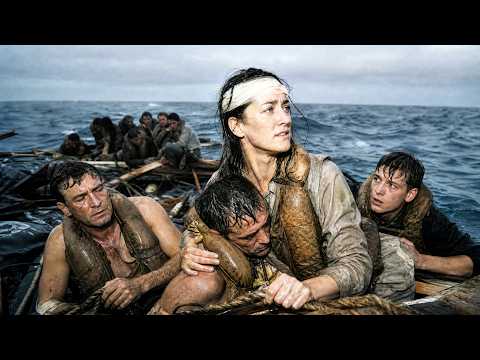
Ellen Savage was thirty years old, a country nurse from Quirindi, New South Wales. She had joined the army nursing service in 1941, not seeking adventure, but a way to do her part. On the night of 13 May, she went to sleep in a normal bed, on a normal night at sea. By 4:14 a.m., the world she had known was gone.
Two massive explosions threw her from her bunk. She grabbed her life jacket and reached for the woman in the next bed, Nurse Merle Muston. They scrambled through smoke and heat, then jumped. Savage was in the water within a minute. Muston was beside her—then a piece of falling timber struck her, and she did not resurface.
Savage surfaced covered in oil, her ribs cracked, both eardrums ruptured by the blast pressure, her nose broken. She said nothing about any of it. Not for the next few hours. Not for the next thirty or more. Not until she was in a hospital bed in Brisbane. What she asked instead was where the medical kit was.
Other survivors pulled her onto a raft. The pain must have been excruciating. She did not mention it. Instead, she began asking who was injured. There was a doctor among them—Lieutenant Colonel Leslie Outridge—and a few medics and stretcher-bearers. Together they formed a makeshift aid station. What they lacked was equipment. They had one lifeboat first-aid kit that someone had grabbed from the wreckage. A pair of scissors, limited bandages, rolls of dressings, some basic drugs. That was all.
On the raft, amid the oil and the cold tropical morning, with the sun beginning to rise over an empty horizon, 64 people had to be cared for with the contents of a cloth bag. Ellen Savage sat in the center, or knelt, and began to work. She bandaged wounds. She checked airways. She ordered men blinded by oil to keep their eyes closed and their heads out of the water. She told those still able to hold an oar or a broken plank to keep the raft pointed into the small waves so it would not capsize. She organized what she called ration groups to ensure the food and water they had was distributed equally and slowly. She spoke, according to all survivor accounts, in the same tone a nurse uses with new patients in a country hospital at three in the morning. Calm, practical, not personal, not distant—just a nurse doing her job.
The specific medical problems on that raft and on the second raft that soon tied alongside were varied. Burns from the fuel fire, some superficial and some deep. Oil in the eyes—a particularly cruel injury because it not only blinds but burns and cannot be easily washed out with seawater. Fractures from the explosion and the force of impact. Lacerations from every kind of metal edge. Concussion, which is hard to treat on a raft except by keeping the patient still and warm—and no one was warm. Shock, in the medical sense, from blood loss. Shock, in the ordinary sense, from the end of an entire world in three minutes at 4 a.m. And as the hours passed, exposure to cold in a tropical region—something people forget can cause hypothermia if one is covered in oil and salt and lying on a raft all night.
Savage did what she could with what she had: bandages for the worst wounds, splints improvised from broken pieces of wood, small sips of fresh water rationed into a cup from the medical kit. She talked to the men who were drifting into unconsciousness. She kept their eyes on her. When one man began to give up, she gave him a small task—watching the horizon for aircraft—so he had a reason to keep his head up. She rotated seating positions on the raft so no man spent too long on the outer edge where the wood dipped into the water. When someone could no longer hold on to the edge, they all rearranged the space to move him inward.
The sun rose on the raft world at about six o’clock. The Australian coast, invisible in the dark, remained invisible in daylight. It lay far beyond the horizon, some fifty nautical miles to the west. All that could be seen was ocean—a vast, empty, glittering expanse stretching in every direction, and in the middle of it, small dark shapes moving beneath the surface. The sharks had begun to arrive.
There is much to be said about the sharks of Australia’s east coast in May, and most of what has been said over the years is either exaggerated or minimized in various fictional accounts. The bare fact is that the waters around the Centaur’s wreck were teeming with sharks. They were not always the same sharks throughout the thirty hours the raft was at sea. They were not always in the same numbers. But they were sharks. They circled the rafts, sometimes bumping the wood from below.
The bodies of the men on the raft were covered in oil. Some had wounds that bled into the water. Some were initially in the water themselves, clinging to the outside of the rafts because there was not enough room on top. The sharks noticed all of these things. There is no polite way to describe the effect of a shark fin cutting the water at close range from a raft in broad daylight on the will of men who had already been through what the Centaur survivors had. Some broke down psychologically. Some stopped talking. Some got into fights over positions on the raft slightly farther from the water. Discipline on the raft in those early hours was as much a psychological problem as a medical one, and this burden also fell on Savage and Outridge.
In the end, the sharks did not kill anyone who was still alive on the rafts. This deserves mention because the sharks became a larger part of the story in later years than they were that day. But what they did do was keep minds utterly focused. They made every man on the raft realize that getting into the water for any reason would not end well. They kept the survivors on the rafts. They kept the rafts, in a sense, disciplined, and they made the sea a place where you could not rest for a moment.
The other thing they did, which is harder to talk about, was reach the bodies that floated from the wreck and were not alive. What the sharks did to those outside the raft is not something that needs description. The dead of the Centaur were not the rafts’ responsibility to bury. But the dead of the rafts, when they passed, were slid off the wood with a short prayer, and that is all that needs to be said.
Then there were the ships and the aircraft. There is a particular kind of hope that blooms in men on rafts and dies in them repeatedly when rescue is near and does not see them. In the early daylight hours of 14 May, ships passed—not many, not close, but they passed. Merchant ships sailing along the coast between Sydney and Brisbane, small coastal vessels. At one point, according to survivor accounts, an aircraft flew high overhead and either did not see them or, seeing them from that height over a sea reflecting light, took them for debris or floating wreckage. That is the way of survivors on rafts. From above, from any real height, they are indistinguishable from any other floating object. They are just dots on a very large flat surface. They wave their arms. They shout. They wave shirts they have taken off their backs and tied to any vertical piece of wood they can find. And from a bridge three miles away or a cockpit at two thousand feet, they are nothing. The ships went on. The aircraft flew on. No one came.
The arithmetic of this was cruel and unclear. The sinking had been so fast that no distress call had been sent. No one on shore knew the Centaur was overdue, and would not know for long hours to come. The ships that passed off the coast that morning were not looking for survivors, because as far as anyone on land knew, there was no reason to look. The pilots on coastal patrol were not looking for survivors for the same reason. They were looking for submarines. They were looking for enemy ships. They were not normally combing the sea for small dots that might be men on life rafts, because in May 1943, off the Queensland coast, there was supposed to be no reason for anyone to be on a life raft. A hospital ship had been sunk at 4 a.m., while the entire east coast of Australia was still going about a normal Friday. Fishermen were fishing. Freighters were carrying their cargo. The world had not yet been told, because the world had not yet discovered that this, more than any other element of the story, was what exhausted the survivors; not the pain, though it was constant, nor the thirst, though it was severe by midday of the first day and worse on the morning of the second, nor the cold, though tropical nights get colder than anyone on an open boat in oil-soaked clothes can bear. What truly drained them was watching help approach and then recede, again and again. This is the paralysis of imagination that a life raft can impose on strong men.
Savage’s response was not to make speeches. Her response was organization. And the two things she organized on the second day are among the most famous small details in this story. She organized, with the help of the men still able to hold a tune, a singalong. This is not the kind of detail that appears well in a battle history. It sounds sentimental. It sounds, when written, like the kind of thing a screenwriter might add. What must be said about it is that it was not sentiment. It was medicine. When men on a life raft are on the verge of giving up, giving them something to do together with their voices—not screaming or moaning—is a physical intervention. It regulates breathing. It slows the heart rate. It reminds the mind that there is a group here, not just an individual dying. She called for singing. The men asked for “Waltzing Matilda,” so they sang “Waltzing Matilda.” And when they had finished “Waltzing Matilda,” they sang every song they could remember that Australian soldiers and sailors had grown up with. And when their voices gave out, they began to hum. And when they were too tired to hum, they mouthed the words until the men next to them started singing again.
She also organized, quite seriously, a bet on the hour of rescue. Every survivor was invited to pick an hour of the day when they expected to be rescued. There was no money in this bet, because none of them had anything but wet clothes and a life jacket. The point was that there was a bet on the outcome. If you picked four in the afternoon and it was one in the afternoon, you would watch the sea with more attention than the man who had picked ten at night. The bet was imagination, and imagination did what imagination is supposed to do. It gave people something to hold on to other than their own thoughts.
After about the thirtieth hour of the rafts’ life, or a little more, that imagination began to look as though it might come true. An Avro Anson of the Royal Australian Air Force, a twin-engine reconnaissance aircraft, was flying cover for the American destroyer USS Mugford, which was escorting the British steamer Sussex outside Australian coastal waters to the north. The Anson crew was doing what such crews do on these missions: watching. Scanning the sea ahead and to the sides of the escorted merchant ship. Looking especially for submarines. What they saw in the early afternoon of 15 May was a cluster of objects in the water where, according to the charts, there should have been nothing. The Anson turned and descended and made a pass, and in that pass the crew looked down and saw not wreckage but people. Faces looking up, arms waving, rafts. The Anson circled over the Mugford and sent a signal. The signal, in plain English at that moment, was that there were survivors in the water ahead.
The Mugford turned, left the merchant ship she was escorting on her course, and headed at destroyer speed for the position the aircraft had indicated. She arrived there at about two in the afternoon on 15 May, some thirty-four to thirty-six hours after the torpedo struck. On the rafts, at that moment, the sea was covered with what looked to the destroyer’s observers like wreckage and men. The Mugford approached as gently as a destroyer can approach floating rafts. Her crew lowered boats to the side and pulled the men aboard. When necessary, they went into the water with hoists to retrieve men who could no longer pull themselves. They brought Ellen Savage aboard. They brought Colonel Outridge aboard. They brought the crew, the medics, the Torres Strait pilot, the merchant sailor who had been on watch when the ship sank. They pulled 64 Australians, one by one, from the water and headed for Brisbane.
The scene aboard the Mugford in the hours that followed was quiet, according to the memories of the American sailors. The survivors were in a state beyond celebration. Most lay on the destroyer’s deck under blankets. The ship’s American doctor and his assistants worked to triage the casualties by priority of treatment. Fresh water was carefully rationed at first, because you cannot give a dehydrated man a bucket of water and then leave him to drink freely. Clothes that had melted or torn were removed. Wounds were cleaned of oil residue. The most serious cases were stabilized for the voyage back to port, and Ellen Savage at some point during the first hours aboard allowed herself to be examined for the first time, and the American doctor learned the extent of the injuries she had been carrying, and she was put in a bed, and the war, for her, was over for a while.
The Mugford’s officers recorded the exact time of each event in their reports, but the number to hold on to is the most important one: 64 out of 332. That is the arithmetic. It must be done once, at the end, and clearly. There were 332 people on the Centaur when she sailed from Sydney on 12 May. 268 of them did not come home. Only 14 of approximately 200 officers and men of the 2/12th Field Ambulance survived. That is a unit, an entire unit of the Australian Army Medical Corps, almost wiped from existence on its way to a war it never saw. 11 of the 12 nurses of the Australian Army Nursing Service on board died. Almost every civilian merchant sailor who was below deck when the torpedo struck died. The ship’s captain, Alexander Murray, had died. The Torres Strait pilot had died. The number 64 is the number of people who came home. Every one of the others is a name on a wall in a hospital chapel, or on a stained-glass window in Concord, or on a war memorial somewhere between Brisbane and Perth.
The nurses who died came from every state in Australia. The most experienced was Matron Sarah Anne Jewell, who had trained at Perth Public Hospital, a professional nursing officer who was leading the twelve. Beside her were Sister Margaret Adams, Sister Mille Muston, Sister Doris Wylie of Bendigo, and seven other trained surgical nurses whose names are inscribed together on the memorial window at Concord Repatriation Hospital in Sydney. The average age of the twelve nurses was 34. Together they possessed more than 120 years of nursing experience. Six of them had served together earlier in the war on the Dutch hospital ship Orange. They were not, by any measure, beginners. They were, in the professional nursing language of the 1940s, hospital nurses; trained, experienced, and senior women in uniform on a hospital ship in the middle of a war at four in the morning, in beds where they were supposed to be entirely safe. Eleven of them are listed on the Roll of Honour of the Australian Army Nursing Service, alongside the nurses lost on Banka Island the previous year, and the nurses lost in dozens of other military operations throughout the war. Beside them, and in a much longer list, are the names of the field ambulance men, the eighteen doctors who died with them, the merchant sailors, the army personnel—names that appear on every honor roll in towns from Cairns to Perth, names still read aloud in many towns on Anzac Day with the name of the hospital ship Centaur, so that the children of the town know why a particular name is in the middle of the list.
And the number 63 is the number of survivors that one injured Australian nurse held together on a raft in the ocean off Moreton Island; the other 63 beside her are that number. That is what she did. Those were her thirty-six hours. The George Medal that Ellen Savage received in the months that followed was, quite simply, the appropriate medal. The George Medal is a Commonwealth decoration awarded for civilian gallantry in circumstances not amounting to direct combat. The Centaur was not under fire while the survivors were on the raft. What the survivors were doing was trying to stay alive. What Savage was doing was continuing to be a nurse. The citation in the London Gazette included the phrase “for distinguished service and high courage,” an official English phrase that serves its purpose. She did not want the medal, or more precisely, she wanted less fuss about her person than she received. She said, when pressed, that any nurse would have done the same. This is the kind of statement people make and only some of them truly mean. Ellen Savage truly meant it. She returned to her work. She served for the remainder of the war at the Australian General Hospital 113 in Sydney, on the site of what is now Concord Repatriation Hospital, and was discharged in March 1946 with the rank of lieutenant. She continued a long career in nursing after the war, quietly, within the New South Wales system. She never married. She died on 25 April 1985, aged 72, on Anzac Day itself, a fact not lost on anyone who knew her. Her name is on the memorial window at Concord beside the eleven nurses who did not come home.
Australia responded in May and June 1943 in a way it had not responded to any previous loss. The Centaur became a symbol overnight. Newspapers put her name in headlines that had until then been reserved for battles and defeats on the New Guinea coast. The details did the work themselves: a hospital ship fully lit, red crosses painted on her sides, torpedoed at 4 a.m. Nearly every nurse aboard was killed. That was the core of it.
Recruitment posters carried the Centaur’s image. War bond campaigns used her name. “Avenge the nurses” appeared in various forms on billboards, in newspaper pages, above public hall entrances. Whether the phrase convinced any Australian to buy a particular war bond is not, in the end, the important question. The important question is that the sinking of one ship and the killing of eleven nurses aboard changed the way Australians talked about the Pacific War for the rest of its duration.
The Centaur was not merely a war crime. It was, for a country of seven million people fighting a very large war far from home, a turning point. And it remained one. Australians who were young in 1943 could tell you, even in 1983, where they were and what they were doing when they heard about the Centaur.
The Centaur Memorial Fund for Nurses, established in Queensland in the years immediately after the war, raised fifty thousand pounds in a long collective effort. By the standards of the late 1940s, that was an enormous sum. It was dedicated to nursing education and support in the state. It carried the memory of the women of the Australian Army Nursing Service—those eleven who did not come out of the water, and Ellen Savage who did. Their memory remains alive today.
There are memorials at Caloundra on the Queensland coast pointing toward the sea in the direction of the wreck. There is a memorial at Point Danger in Coolangatta unveiled on the fiftieth anniversary in 1993. The stained-glass window at Concord Repatriation Hospital in Sydney bears their names, and for a long time that was all there was. The ship herself lay somewhere on the floor of the Coral Sea, and no one knew exactly where.
Survivors had described the sinking. The navigator, Second Officer Gordon Rippon, had been on the bridge that night fixing positions regularly, and he left behind a set of coordinates. Various expeditions searched for her intermittently for decades. A wreck found in 1995 was thought by some to be her, but turned out to be another ship. The Centaur remained missing.
She was found on 20 December 2009. The search was led by a shipwreck specialist named David Mearns, the same man who had found the wrecks of HMAS Sydney and Kormoran the previous year, and he located her on the ocean floor about thirty nautical miles east of the southern tip of Moreton Island. The ship was in one piece, despite the hull being cracked in a place or two from the fall. She settled at a depth of just over 2,000 meters—about two kilometers vertically—on the abyssal plain off the Queensland shelf.
The site was less than one nautical mile from the position Gordon Rippon had calculated on the bridge in the final minutes before the torpedoes struck. Sixty-six years of doubt ended with a margin of error of less than two kilometers between what a man wrote in his log at three in the morning on 14 May 1943 and what a sonar array read on the ocean floor on a screen in December 2009. The Centaur is now a war grave in the precise legal sense, protected under Australian law, closed to all diving and salvage. She lies there in the darkness, in one piece, on the mud.
This story began with a ship lit up as if for a festival. She was lit up because the men who ran her and the country that sent her believed that at her most visible, she was at her safest. She was a hospital ship. She carried the distinctive markings. She had been notified through diplomatic channels. Her number was 47, painted on her bow in white numerals large enough to read from a mile away. Every light was on because keeping the lights on was, theoretically, a means of protection. That was the promise.
At 4:14 a.m. on 14 May 1943, that promise was broken by a torpedo that cut through calm water and struck a fuel tank. Three minutes later, she was on the bottom. Thirty-six hours after that, an American destroyer pulled 64 Australians from the sea, guided by an RAAF reconnaissance aircraft that happened to look down at the right moment.
Of those sixty-four, sixty-three spent thirty-six hours alive in the simplest and least glamorous sense, thanks to a country nurse from Quirindi, New South Wales, who had a broken nose, two ruptured eardrums, and broken ribs, and chose to say nothing about any of it because there were others who needed care first. That was the promise the country had made to her when it put her in uniform, and that was the promise she kept when it turned out that the promises the world had made to a fully lit hospital ship in the middle of the ocean at four in the morning were not promises at all.
The Centaur’s lights are still on, in a sense. They stayed on through the sixty-six years the wreck was missing, they stayed on when she was found, and they stay on now every 14 May when Australia remembers. Sixty-four people came out of the water alive. Two hundred and sixty-eight did not. Eleven nurses stayed at their posts. One nurse, the twelfth, kept the other sixty-three together on rafts and wreckage for thirty-six hours, with a first-aid kit that fit in a cloth bag, with “Waltzing Matilda,” and with orders that remained nursing orders even when the sea was the ward. That is Ellen Savage. That is what she did. And that is why the ship lying on the floor of the sea off the Queensland coast remains, in every meaningful sense, lit up as if for a festival.
So here is the question that remains after all these years: when the world breaks its promise to the most vulnerable among us, who lights the lamps that keep the rest of us from drowning in the dark?
Report this article
Select a reason for reporting:






