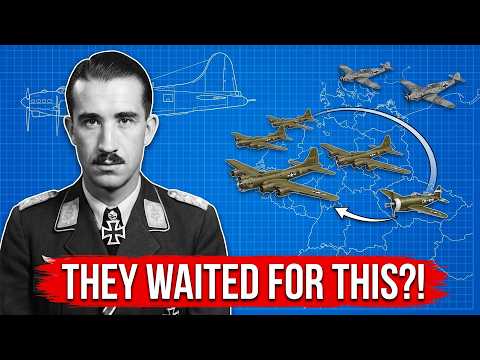
October 14, 1943. 291 American bombers cross the English coast heading for Schweinfurt. German fighter controllers don’t move. They wait—not out of caution, but because they know the math. P-47 Thunderbolts can’t reach Germany and return. So the German pilots circle above the clouds, conserve fuel, and watch the clock. When the escorts turn back near the Rhine, right on schedule, the Germans pounce. No protection. No escape. 60 B-17s never return. 600 men. The entire American daylight bombing strategy is collapsing, and the Luftwaffe hasn’t even broken a sweat.
That strategy was called patience. It sounds passive. It wasn’t. German controllers had reduced American bombing doctrine to a simple timing problem: the physical distance between English bases and German targets, divided by the fuel capacity of American escort fighters, gives you the window when bombers are finally unprotected. By late 1943, German defenders had worked these calculations long enough to treat them as a schedule. They knew when the Thunderbolts would hit their turn-back point. They knew what bomber formations looked like after that—bigger, slower, relying on overlapping gun positions that still left approach angles the gunners couldn’t cover. When the escorts turned for England, the Luftwaffe went to work. It wasn’t recklessness. It was, in the truest sense, professionalism.
The first major American raid on Schweinfurt had already happened on August 17, 1943. 36 bombers lost in a single day on that one strike. The Air Force publicly called it acceptable and privately knew it wasn’t. A loss rate of a few percent per mission, sustained across hundreds of missions, destroys a strategic bombing force before it destroys strategic targets. The math was merciless. The options being debated inside American Air Force headquarters weren’t good. Stop bombing the German interior and abandon the entire logic of the strategic campaign. Accept catastrophic losses and hope German industry collapses before the American bomber groups do. Neither answer satisfied anyone. The men in the aircraft had a shorter word for both options.
The actual answer was already in England. It just didn’t know what it was yet.
The British had come to North American Aviation in California in the summer of 1940 with a specific request—not to copy an existing fighter, not to manufacture under license, but to design and build something new. North American agreed and delivered a flying prototype in 117 days. That number still doesn’t make sense when you think about it. The aircraft that emerged, the Mustang Mark I, impressed every experienced pilot who flew it immediately. The wing design was more aerodynamically clean than anything else in production. North American’s engineers used a low-drag wing design that reduced resistance significantly compared to contemporary fighters. The fuselage was designed with the same priority. The aircraft had excellent speed at low altitude and good performance in the range that mattered for tactical missions.
Then pilots took it above 15,000 feet. The Allison engine powering the Mustang Mark I used a single-stage turbocharger. At low altitude, performance was superb. Above roughly 15,000 feet—where bombers fly because altitude makes anti-aircraft fire less accurate—the supercharger lost its ability to push enough air into the cylinders, and power dropped sharply. The aircraft that had flown so smoothly near the ground became sluggish exactly where the most important air battles of the war were being fought.
The Royal Air Force found real uses for the Mustang—armed reconnaissance, ground attack, tactical support. Useful. Not the role the aerodynamic quality seemed to deserve. The aircraft fell into a frustrating category: clearly designed for something greater, but mechanical shortcomings prevented it from achieving it.
On April 30, 1942, a Rolls-Royce test pilot named Ronald Harker flew a Mustang Mark I and came back with a note. He wrote an internal memo that looked like a routine technical observation but contained a direct engineering argument. The airframe was aerodynamically superior to most fighters in service, and the Merlin engine—already powering the Spitfire with a two-stage supercharger that maintained strong power at high altitude—would transform this aircraft entirely. That combination would produce high-altitude speed matching the best German fighters and within a range no current British fighter could reach. He put down performance estimates. They turned out to be conservative.
Harker wasn’t alone in seeing this. An American named Tommy Hitchcock arrived in London as a military attaché. His background was extraordinary—a World War I pilot, a prisoner of war in Germany, later one of the world’s top polo players, and now representing American military interests in Britain. He watched the Mustang. Talked to pilots who flew it. He immediately understood what fitting a Merlin engine would produce and began pressing Washington to take it seriously. He wrote cables. Built alliances. Made his case in rooms where the argument wasn’t welcome yet. These things move slowly when the idea precedes the evidence, but Hitchcock kept pushing. He didn’t live to see what he was pushing for. He died in a test flight accident in England in April 1944, weeks before the spring campaigns proved everything he’d argued for correct. His name appears sometimes in technical histories and rarely anywhere else.
The aircraft he spent years advocating for became one of the most consequential machines in aviation history. Packard Motor Car Company was already producing Merlin engines under license for American military use. The engine was in production. The airframe existed. When the two were combined in a modified Mustang, tested in late 1942, and entered production as the P-51B during 1943, the performance confirmed Harker’s memo and exceeded some of his estimates. Top speed approaching 440 miles per hour at high altitude, two-stage supercharger performance matching the Bf 109G and Fw 190A in the range where bombers flew, handling qualities praised by experienced pilots, and genuine range.
But range is more complicated than it appears. Range isn’t just a function of how much fuel you carry, but how that fuel is consumed across a thousand miles of hostile air. Mustang pilots were trained to fly at economical cruise, leaning fuel mixture below maximum power settings during transit—reducing consumption per mile, saving internal fuel for the fight at the target and the long return trip. The pilot who mastered this had far greater reach than the aircraft’s tank capacity suggested on paper. The pilot who failed faced a serious problem over Germany without help.
Add to that external droppable fuel tanks. British engineers developed composite containers of paper and metal, holding 108 gallons each. Cheap enough to mass-produce, cheap enough to drop the moment combat began, because external tanks destroy an aircraft’s maneuverability. Attach them for transit, drop them for engagement, use remaining internal fuel for combat and the return trip. The manufacturing and logistics behind this were unglamorous—supply chains, shipping, distribution, ground crews hanging tanks before every mission. None of it had a dramatic moment. All of it was essential.
With external tanks and disciplined fuel management, the P-51 could fly from England to Berlin and back. The P-47 Thunderbolt, at its maximum range with tanks, could escort bombers roughly 400 miles from English bases near the German border—sometimes a little farther. The P-51 covered more than double that distance. The trip from Schweinfurt to Berlin and back—over 1,000 miles—became possible. That wasn’t a modest improvement. It was the cancellation of a limit upon which the entire German defense system was built.
That system required the P-51 not to be deployed in the right role at the right time. And for a frustrating period in late 1943, that was almost exactly what happened. When the 354th Fighter Group became the first P-51 unit operational in Europe in November 1943, they were assigned to the Ninth Air Force—a tactical command focused on short-range support missions. The Eighth Air Force bombers were the ones taking catastrophic losses over Germany. The Mustangs weren’t initially assigned to cover them. Matching capability to need took bureaucratic time. Meanwhile, the winter of 1943 continued.
On January 6, 1944, Jimmy Doolittle took command of the Eighth Air Force. He reviewed the escort situation and changed something as important as any aircraft in the theater. The standing doctrine required escort fighters to stay close to bomber formations—absorbing attacks, protecting the aircraft, never leaving the formation exposed. It sounded like a precaution. In practice, it was a passive approach. Fighters were reacting to German attacks instead of preventing them. Doolittle replaced this approach. His fighters began roaming the areas ahead of the formations. They hunted Luftwaffe aircraft before interception runs began. They pursued German fighters over German territory, over German airfields, deep into airspace the Luftwaffe considered safe. Stop protecting. Start hunting.
The P-51B deployed in this new role faced one major problem, consistently documented in pilot reports through early 1944. Its .50-caliber machine guns were prone to jamming when the aircraft turned sharply or under high-G loads. Ammunition feed angles created conditions where the guns stopped working at the exact moment the pilot needed them most. It was a real operational constraint. The P-51D, arriving with units in increasing numbers during 1944, addressed this with six guns and a redesigned feed system, along with a bubble canopy replacing the earlier framed design—giving pilots unrestricted rear visibility the previous cockpit lacked. These weren’t cosmetic upgrades. The jamming problem cost them lost opportunities to shoot down enemy aircraft. The blind spot cost them lives. The D model fixed both, and made an aircraft that had already changed the air campaign progressively more lethal.
But the tactical change Doolittle made in January was already achieving something aircraft improvements alone wouldn’t have. Under the old doctrine, a German pilot who saw a P-51 and didn’t want to engage on those terms had other options. He could climb away, preserve his position and altitude, wait for a moment that suited him. Under Doolittle’s order, the P-51 followed him wherever he went. Over his airfield, hundreds of miles inside Germany with fuel to spare. There was no safe geography left for the strategy of patience.
Many assumed the P-51 became dominant because it could outmaneuver the Bf 109 and Fw 190. The combat history of 1944 is more complicated than that narrative. Below 20,000 feet in a close air battle, experienced German pilots in either type were not helpless. They could match P-51s and did so when they controlled the terms of engagement. Early 1944 combat reports include outcomes in both directions. The Mustang wasn’t a machine that erased German pilot skill. What it erased was German tactical patience. When P-51s penetrated hundreds of miles into Germany, the calculations that made the patient strategy work stopped producing useful results. You couldn’t circle near the border waiting for the Americans to run out of fuel. The escorts were there at the target. They were there over the airfields during refueling. They were present at altitudes and locations the Luftwaffe had assumed were safe. The choice for German pilots was no longer waiting for a better moment—it was fighting now on terms they hadn’t set, or watching bombers move freely. Neither option was good. One was survivable. The other wasn’t.
Adolf Galland commanded German fighters through this period, and his memoir “The First and the Last” documents how the situation looked from inside. Reports of P-51s escorting bombers reached Berlin in early March 1944. Göring questioned whether pilots had correctly identified the aircraft type. The model said American fighters couldn’t reach Berlin. The model was preserved briefly despite the evidence. That exchange revealed something important: the entire German air defense structure was built around a real physical constraint. It was true for every fighter in the theater except one. When that exception arrived in force, the system had no adjustment ready.
Göring’s response was to demand aggression. He publicly criticized experienced pilots for what he called cowardice. He relieved commanders. He pressed frontline units into the direct, costly engagement with escorted bombers that German pilots had spent two years carefully avoiding. The patient strategy—rational, effective, built around preserving an irreplaceable skill base—was dismantled by command order at the moment its strategic justification collapsed. German pilots were pushed into a war of attrition American planners had hoped to create since 1942.
The attrition wasn’t symmetrical. The United States graduated thousands of pilots yearly, trained far from any front line with adequate fuel and time. When an American pilot died, a replacement was available and reached the theater within months. North American’s factories in California and Texas built P-51s in numbers reaching 15,000 by war’s end, and replacement aircraft reached units faster than losses consumed them. Germany’s situation was the mirror image. Oil raids on synthetic fuel plants began restricting training. New Luftwaffe pilots reached frontline units with fewer flight hours and less mastery of their aircraft than the veterans they replaced. German fighter pilot losses in the first months of 1944 exceeded, according to various postwar historical reviews, the total German fighter pilot losses of the entire previous year. There is no serious disagreement about the direction and scale, even if specific numbers vary by source.
The 354th and the growing number of Mustang groups assigned to the Eighth Air Force grew more capable each month. The force opposing them moved in the opposite direction. When these two paths met in the same sky over the same targets, the result wasn’t complicated. Big Week came in late February 1944—six days of sustained bombing against German aircraft production from the 20th to the 25th. The Luftwaffe engaged heavily because the targets were the factories producing their replacement aircraft. Losses were severe—several hundred aircraft according to postwar statistics, with pilot losses adding to the accumulated attrition. German aircraft production was temporarily disrupted. The core of experienced pilots shrank further. The training pipeline had fewer resources to replace what was lost.
On March 6, 1944, the Eighth Air Force sent more than 600 bombers to Berlin. P-51s escorted them the entire way from England across the Reich to the capital and back. German pilots defending Berlin faced a choice with no good exit. Refuse engagement and let the bombs fall. Or engage and fight a protective screen deployed specifically to make that engagement as costly as possible. American losses that day were real—69 bombers and 11 fighters. Real crews, not abstract numbers. But the mission succeeded. The capital was bombed. The escorts were over the target the entire time. The thing German patience had prevented for two years had now happened, and there was no mechanism left to prevent its repetition.
By June 6, 1944, when Allied soldiers landed on the beaches of Normandy, Eisenhower’s famous promise to those troops—that any aircraft in the sky would be theirs—was an honest one. The Luftwaffe’s ability to contest air control over northern France had dwindled to near insignificance, thanks to months of forced engagements, rising attrition, and a pilot replacement crisis German aviation never solved. The simple explanation for all this is the P-51 Mustang. The aircraft deserves every credit, but the mechanism was broader. German aviation fuel production had been systematically targeted since mid-1944, and the oil raids succeeded. Synthetic fuel plant output fell sharply. The Luftwaffe pilot who couldn’t complete training flights for lack of fuel didn’t reach the front with the experience that makes combat survivable.
The Me 262, Germany’s jet fighter that was technically superior to anything the Allies flew, could have changed the interception picture if deployed in that role earlier and in meaningful numbers. Galland advocated for exactly that, consistently and at heavy personal cost. Hitler’s insistence on developing it primarily as a bomber delayed its defensive deployment beyond any window where numbers could have strategic impact. Galland was relieved of his post in January 1945, partly because this conflict became too direct to manage. The JV 44 unit in the war’s final weeks—a squadron of surviving aces flying Me 262s—was a final act of professional defiance that was technically stunning and strategically irrelevant. The decisions that would have made a difference were made or obstructed eighteen months earlier. The P-51 was the tool, but the broader system was the cause.
What the Mustang did was eliminate the tactical maneuvering space that allowed Germany’s core of experienced pilots to operate through the second year of American strategic bombing. By forcing the Luftwaffe into sustained attrition on American terms, it turned every other German weakness—fuel shortages, deteriorating training, production disruption, political interference in weapons development—into compounding problems rather than manageable ones. The aircraft didn’t win the air campaign alone. It created the conditions that made Germany incapable of winning it.
Tommy Hitchcock, who pushed hard for merging the Merlin engine with the Mustang in Washington and London before the evidence was clear, died in a test aircraft crash in April 1944, weeks before the spring campaigns demonstrated what he’d advocated for years. Ron Harker’s memo dated April 30, 1942, remains preserved in Rolls-Royce records as a technical document—a precise note on engine compatibility, not a piece of deliberate history-making. Both men argued for something specific before the results were clear, against institutional inertia, without seeing the outcome. People who push toward the right solution rarely get to see it working. That’s how things usually go.
North American Aviation went on to build the F-86 Sabre, which faced MiG-15s over Korea in 1950. The same engineering priorities that shaped the Mustang—high-altitude performance and pilot visibility—appeared in the Sabre’s design. The bubble canopy, which removed the blind spot behind P-51D pilots, became standard equipment on jet aircraft almost immediately. The company that built a flying prototype in 117 days in 1940 was still building working fighters a decade later. Good solutions tend to outlast the specific machines that first demonstrated them.
Let’s return to October 14, 1943. German fighter pilots circle above the Rhine, watching the clock and conserving fuel. Their patience wasn’t irrational. It was rooted in a physical fact that had held since American bombers first crossed that coast: Allied escort fuel ran out before German pilots ran out of targets. That fact held true for every fighter in the theater except one. When that aircraft arrived in sufficient numbers, under the right command structure, with the correct tactical doctrine, the physical limit their strategy rested on moved from the German border to Berlin and beyond. Not because the physics of fuel changed, but because the engineering that worked within those physical laws improved in exactly the right way, at exactly the right moment. The escorts were no longer turning back. There was nothing left worth waiting for.
So here’s the question that lingers: if a single aircraft could redraw the map of air power in months, what quiet engineering breakthrough today is being dismissed because it doesn’t fit the model we’ve built our defenses around—and who will be the Hitchcock or Harker pushing for it, unseen, before the evidence arrives? What are we missing right now?
Report this article
Select a reason for reporting:






