June 1944. Somewhere behind the Normandy coastline, in a concrete bunker lit by humming electric lamps, three German signals intelligence operators sit at their receiver sets, headphones clamped tight. Their job is to listen to American tactical radio traffic and break it open. They have been doing this since the invasion of Poland. They have broken American codes before. They will break them again tomorrow. The equipment works. The procedures work. The mathematics work.
And then one of them stops writing. He adjusts the dial. He presses the headphones tighter against his skull. He listens for another 30 seconds, then pulls one earpiece away and says something to the man beside him. The second operator tunes to the same frequency. He listens. He shakes his head. They call over a senior technician. The technician listens. Nobody writes anything down because there is nothing to write.
What they are hearing is a human voice. That much is clear. The signal is strong. The transmission discipline is professional. But the content is not German. It is not English. It is not French or Russian or any of the roughly two dozen European languages the Horchdienst has cataloged in its training manuals. It is not Morse code. It is not a mechanical cipher output. It is a voice speaking what sounds like a language, but a language that fits no pattern any of them have ever encountered.
The vowel sounds are wrong for any European tongue. The consonant clusters do not match any Indo-European root. The rhythms have a tonal quality that European languages do not possess. If you did not know it was a human being on the other end, you might reasonably conclude the equipment was malfunctioning and that something had gone wrong in the circuitry and the receiver was producing distorted noise shaped roughly like speech.
This is the detail that the entire story turns on. The German signals intelligence service in 1944 was not a collection of amateurs stumbling through the radio spectrum. It was one of the most capable cryptanalytic organizations on Earth. The Horchdienst had been operating since the mid-1930s. Its operators had monitored Soviet military traffic during the invasion of Russia. They had intercepted British communications during the North Africa campaign. They had tracked French resistance transmissions and helped the Gestapo locate clandestine radio operators across occupied Europe. By the time the Allies landed in France, German intercept units had broken American tactical codes that the Americans believed were secure. They were reading Allied traffic in some cases within hours of transmission.
They understood American radio procedures. They recognized American call sign patterns. They could identify American unit movements by analyzing traffic volume even before they broke the content. They had the equipment. They had the trained linguists. They had the mathematics. And yet, on a frequency carrying voice traffic from the American 4th Infantry Division, they could not identify the language being spoken. They could not categorize it. They could not begin to analyze it. They could not even determine with confidence whether it was a language at all or simply noise.
This is the story of why. It is the story of 17 men from Oklahoma who carried into the most devastating war in human history a weapon that no army on earth could have manufactured, no government could have requisitioned, and no intelligence service could have defeated. It was not a machine. It was not a cipher. It was a language. A language that their own government had spent 60 years trying to destroy. And it is the story of how the men who spoke it went from being punished for using it in childhood to being decorated for using it in war.
To understand how a language spoken by fewer than 2,000 people on the southern plains of Oklahoma ended up confounding the most sophisticated signals intelligence apparatus in Europe, we have to go back further than the war. We have to go back further than the army. We have to go to a place that most Americans in 1944 had never heard of, and most Americans today would prefer to forget. We have to go to the schools.
In 1879, a United States Army officer named Richard Henry Pratt founded the Carlisle Indian Industrial School in Carlisle, Pennsylvania. Pratt had served in the Indian Wars. He believed, with the full conviction of a man who considered himself progressive for his era, that Native Americans could be assimilated into white American society, but only if everything that made them Native American was systematically stripped away. His philosophy, which he stated publicly and which was the explicit policy of the United States government for the next five decades, was captured in a phrase he delivered at an 1892 conference. He said, “Kill the Indian in him and save the man.”
The idea was simple and it was brutal. Take Native American children from their families, sometimes by persuasion, sometimes by coercion, sometimes by force. Ship them to boarding schools hundreds of miles from their reservations. Cut their hair. Dress them in military-style uniforms. Forbid them from speaking their languages. Punish them when they did. Replace everything they knew, every story, every song, every word their mothers had spoken to them, with English, with Christianity, with manual trades, with obedience.
The schools operated on a military model with uniforms, drilling, rigid schedules, and corporal punishment. Children were assigned new English names. They were separated from siblings to prevent them from speaking their native language to each other. Many children did not see their families for years at a time. Carlisle was the model. Dozens of similar schools followed across the country, from New Mexico to Montana, from Oklahoma to Wisconsin. By the early 20th century, tens of thousands of Native American children had passed through a system designed with cold institutional precision to eliminate the very thing that made them who they were, and the enforcement was not gentle.
Children who spoke their native language were beaten. They were locked in closets. They were made to stand holding heavy objects for hours. In some schools, they had their mouths washed with lye soap for speaking a word of Comanche or Navajo or Cherokee. The message was absolute. Your language is not wanted here. Your language is a mark of backwardness. Your language belongs to a world we are going to erase, and we will drive it out of you by whatever means necessary.
Among the children who passed through this system was a boy named Charles Chibitty. He was born on November 20th, 1921 in a tent near Medicine Park, Oklahoma, a member of the Comanche Nation. On his mother’s side, he was a descendant of Chief Ten Bears, one of the great Comanche leaders, a man who had signed the Medicine Lodge Treaty of 1867. Chibitty’s Comanche name translates roughly to “holding on good.” He was sent first to the Fort Sill Indian School, then later to Haskell Indian School in Lawrence, Kansas. At Fort Sill, he was punished for speaking Comanche. The language that had been spoken across the Southern Great Plains for centuries, the language his mother had taught him at home, the language that connected him to Ten Bears and to every Comanche who had ever lived was forbidden inside those walls. He was told it had no value. He was told it had no place in the modern world. He was told to stop using it.
He did not stop. Neither did the other Comanche children at those schools. They spoke it to each other in whispers, in dormitories after lights out, in corners of the yard where the teachers could not hear. They kept the language alive the way people keep anything alive that someone is trying to kill. They hid it. And they waited.
What none of them could have known, what Charles Chibitty could not possibly have imagined as a child being disciplined for speaking his own language, was that within 20 years the United States Army would come to the Comanche Nation and ask them to do the one thing the United States government had spent his entire childhood trying to prevent. The Army would ask them to speak Comanche, and it would ask them to do it in the middle of the deadliest war the world had ever seen, because that language, the one they had been told was worthless, was going to turn out to be the one thing the enemy could not defeat.
The idea of using Native American languages as military codes did not begin with the Second World War. It began in the First. In October of 1918, during the Meuse-Argonne Offensive in northeastern France, an American colonel named Alfred Bloor of the 142nd Infantry Regiment, 36th Infantry Division, had a problem that was costing lives. German intelligence was intercepting every message his regiment sent by telephone or runner. The Germans had broken the American field codes. They had captured American soldiers who spoke German and were using them to monitor telephone lines. They were reading American communications almost in real time, and they were using the information to prepare for American attacks before the first soldier went over the top.
Bloor knew he had Choctaw soldiers in his regiment. He knew the Choctaw language had never been written down in any form the Germans could study. There was no Choctaw dictionary in any library in Germany. There was no Choctaw grammar in any university in Europe. He made a decision that would change the history of military communication. He put two Choctaw speakers on field telephones at opposite ends of the line and told them to transmit orders in Choctaw. The Choctaw men improvised military terms on the spot. A machine gun became “little gun shoot fast.” Poison gas became “bad air.” Artillery became “big gun.” Casualties became “scalps.” They turned their language into a weapon in real time without training, without preparation, without a manual.
Within 24 hours, the Germans noticed that American communications had changed. They could still intercept the transmissions. They could still hear the voices on the wire, but they could no longer understand a single word. The effect on German command in that sector was immediate and devastating. Their intelligence dried up overnight. They were operating blind. A withdrawal that Bloor ordered on October 26th was executed without the Germans anticipating it. An attack on a position called Forest Farm went forward without the Germans preparing for it. The Choctaw telephone squad had done something no cipher machine in existence could do at that speed. They had made American communications invisible to the enemy in a matter of hours.
The Choctaw operated for only a few weeks before the armistice ended the war, but the idea had been proven. A language that existed outside the entire framework of European linguistics, that had no written form, no published grammar, no dictionary a foreign intelligence service could obtain, was not merely difficult to break. It was impossible to break. You could not cryptanalyze something that was not a code in any mathematical sense. It was a living language. To break it, you would have to learn it. And to learn it, you would need a native speaker willing to teach you, and years of immersion in the culture that produced it. The Germans had neither.
Between the wars, the idea lay mostly dormant. The American military filed the Choctaw experiment as an interesting curiosity and moved on to developing mechanical cipher machines and mathematical encryption systems. The assumption was that modern cryptography would render language-based codes obsolete. Machines were predictable. Machines could be mass-produced. Machines did not require finding speakers of obscure languages and convincing them to serve. The military establishment, as military establishments tend to do, chose the solution that looked like engineering over the solution that looked like culture. But there was a problem with the engineering solution, and it was a problem that the Germans would eventually prove. Machines are systems. Systems have patterns. Patterns, given enough time and enough intercepted traffic, can be broken.
The history of cryptography in the 20th century is, in many ways, a story of machines being built and then being broken in a cycle that repeated itself faster and faster as the mathematicians on both sides grew more capable. The Choctaw telephone experiment had worked on a completely different principle. It had not been a system at all. It had been a human capability, and human capabilities cannot be reverse-engineered by a man sitting at a desk with a pencil and a frequency chart. The military professionals who dismissed the Choctaw experiment as a curiosity were thinking like engineers. They should have been thinking like anthropologists.
In 1940, as the United States began preparing for a war that many in Washington believed was inevitable, the army looked at the Choctaw idea again with fresh eyes. Cherokee soldiers of the 30th Division had also used their language in the autumn of 1918, possibly even before the Choctaw, and the broader concept had proven sound. This time, the service expanded its search beyond the Choctaw. This time, it reached for the Comanche.
The Comanche language was, from a cryptographic standpoint, an almost perfect instrument. It was tonal, polysynthetic, and had never been systematically written down. No Comanche dictionary or grammar existed in any European library. The total number of fluent speakers was fewer than 2,000, almost all within a small area of southwestern Oklahoma. A German cryptanalyst could not learn Comanche from any published source, because the source did not exist.
In December 1940 and January 1941, the Army recruited 17 Comanche men from around Lawton, Oklahoma. Charles Chibitty, Haddon Codynah, Robert Holder, Forest Kassanavoid, Wellington Mihecoby, Perry Noyabad, Clifford Otitivo, Simmons Parker, Melvin Pomani, Elgin Red Elk, Roderick Red Elk, Albert Naquaddy Jr., Larry Saupitty, Morris Tabbyetchy, Anthony Tabbytite, Ralph Wockne, Willie Yackeschi. Most were teenagers. Several had attended the same boarding schools that had tried to beat their language out of them.
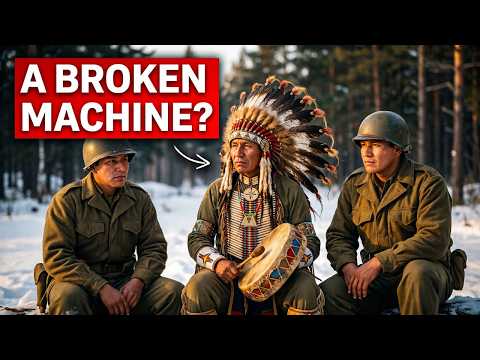
They were assigned to the Fourth Signal Company, Fourth Infantry Division. Lieutenant Hugh Foster gave them 250 military terms to translate. They built the code the way their ancestors had always described the world. A tank became wakaree, turtle. A bomber became a pregnant airplane. A machine gun became a sewing machine gun. Adolf Hitler they called posa taibo: crazy white man.
They memorized the entire vocabulary. No codebook ever went to the field. The whole system lived inside their heads, in a language that existed nowhere on paper.
June 6th, 1944. Utah Beach. The landing craft drifted 2,000 yards south of the planned sector. Brigadier General Theodore Roosevelt Jr. walked the sand under fire, compared the shoreline to his map, and made the call. “We’ll start the war from right here.”
Larry Saupitty was beside him. Within minutes he transmitted the first Comanche combat message of the war: “We made a good landing. We landed in the wrong place.” It traveled in the clear, past every German intercept antenna on the coast, and arrived perfectly understood. Charles Chibitty followed: the regiment was five miles inland, fighting was fierce, they needed support.
No cipher machine. No code pad. Just a man speaking a language almost no one on earth outside a small Oklahoma community could understand.
Through the hedgerows, Cherbourg, the Cobra breakout, the Siegfried Line, the Hürtgen Forest, and the Bulge, the code held. Roderick Red Elk earned a Bronze Star climbing a twenty-foot pole under direct fire to splice a severed line. Not one Comanche transmission was ever broken. Postwar captured German records never even name it.
All 13 who landed on Utah Beach came home alive. Haddon Codynah credited the blessed peyote buttons given before deployment. “It must have worked, for all of us came back home.”
They returned to Oklahoma and to silence. No classification order bound them; the quiet was their own. Recognition came slowly. France decorated the survivors in 1989. Charles Chibitty, the last living voice of the code, died in 2005. By the time Congress struck the Congressional Gold Medal in 2013, every Comanche code talker was gone.
Forest Kassanavoid, scarred by shrapnel, said it best: “We brought home a lot of Purple Hearts and Bronze Stars, but no one was killed. There was some joy in the fact that we served this country of ours.”
His country. Spoken without bitterness by a man who had every right to be bitter.
So the answer to the question those German operators never resolved is this: they were not hearing a code. They were hearing a culture, a living language carried in the memories of seventeen men from Oklahoma, a language their own government had spent sixty years trying to destroy. You cannot pick a lock that is not a lock.
Now I want to hear from you. Did a father or grandfather in your family serve in the Second World War? What unit, what theater, what small detail do they remember? Tell me their story in the comments below.
Report this article
Select a reason for reporting:






