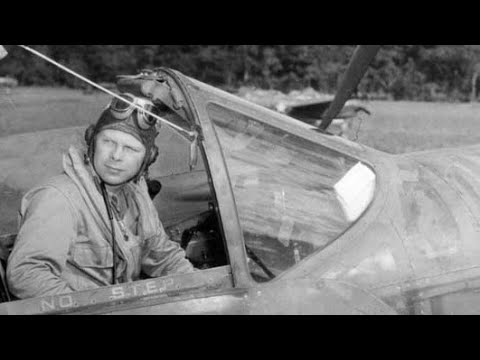
September 1944, above Borneo. Major Richard Ira Bong eased his P-38 Lightning into a shallow dive, twin Allison engines purring with 3,000 horsepower as he scanned the sky below. Japanese fighters were climbing desperately toward a formation of American B-24 Liberators—unaware that one of the deadliest fighter pilots in American history was already positioning himself above them.
What those Japanese pilots didn’t know was that the unassuming farm boy from Poplar, Wisconsin, now tracking them through his gunsight, had already destroyed dozens of enemy aircraft. By war’s end, he would achieve 40 confirmed victories—a record that stands unbroken 80 years later. This is the story of how a mild-mannered young man became America’s deadliest fighter pilot.
The path to 40 victories began not with natural aggression, but with something far more mundane: disciplinary problems and unauthorized aerobatics in California. Second Lieutenant Richard Bong, fresh from Luke Field with limited flight time, was still learning the P-38 when he made decisions that nearly ended his career before it began.
Reports indicate he performed unauthorized low-altitude aerobatic displays over the San Francisco area, violating Army Air Force regulations. His commanding officer, General George Kenney, was not amused. The reprimand was immediate and severe. But Kenney saw something in the young pilot—exceptional aircraft control, spatial awareness, and reflexes that operated with remarkable speed.
Instead of grounding Bong permanently, Kenney assigned him additional training and kept him under observation. What Kenney recognized was that Bong possessed qualities that separated good pilots from exceptional ones: excellent depth perception, the ability to calculate deflection angles instinctively, and composure under stress.
By September 1942, Bong was assigned to the 9th Fighter Squadron, 49th Fighter Group, deploying to New Guinea as part of the Fifth Air Force. He carried limited combat experience. The Japanese, by contrast, had been fighting continuously since 1937—veterans of China, the Philippines, and brutal air battles across the Pacific. The odds on paper favored the enemy.
December 1942. Above Buna, New Guinea. Bong’s first combat missions. P-38s from the 9th Squadron climbed to intercept Japanese bombers escorted by Zero fighters. Lieutenant Bong, flying wing position, watched as enemy formations materialized against the clouds.
The P-38 Lightning was unlike anything the Japanese had encountered: twin booms, twin engines, tricycle landing gear, counter-rotating propellers that eliminated torque, four .50-caliber machine guns, and a 20mm cannon mounted in the nose for devastating concentrated firepower. With top speeds exceeding 400 mph and a service ceiling above 40,000 feet, it could outrun and outclimb most Japanese aircraft.
But the Zero could turn inside the P-38 at lower speeds. Japanese pilots, masters of low-speed dogfighting, could exploit this advantage ruthlessly. American pilots who tried to turn with Zeros often died quickly.
Bong didn’t try to turn. His early kills came when he learned to use the P-38’s advantages: speed, altitude, and firepower. His nose-mounted weapons created a concentrated cone of destruction. When enemy aircraft were caught in this convergence zone, the results were often catastrophic.
Bong’s combat reports were characteristically understated, noting altitude, engagement conditions, and outcomes with minimal embellishment. What became clear during his early missions was his understanding of how to fight in the P-38: Don’t turn. Don’t try to dogfight. Use speed, altitude, and firepower. Position carefully. Fire precisely.
Over the next three years, he would refine this philosophy into a system of remarkable efficiency.
The P-38 Lightning, designed by Lockheed’s legendary engineer Clarence “Kelly” Johnson, was a revolutionary aircraft that required equally revolutionary tactics. Its twin Allison V-1710 engines delivered performance that seemed extraordinary to pilots accustomed to single-engine fighters. But the aircraft had quirks that killed inexperienced pilots: the counter-rotating propellers created unusual handling characteristics, the turbo-superchargers were temperamental, and most dangerously, the P-38 suffered from compressibility in high-speed dives.
Dozens of American pilots died learning these limitations. Bong mastered them.
His tactical evolution happened rapidly. By early 1943, he had multiple confirmed victories and a growing reputation as an exceptional marksman. Other pilots fired long bursts, expending large amounts of ammunition. Bong fired short, precise bursts. His gun camera footage showed consistent patterns: patient stalking, careful positioning, brief firing pass, immediate disengagement.
Major Thomas Lynch, Bong’s squadron mate and fellow ace, described Bong’s technique as patient and precise. Bong would position himself carefully, sometimes maneuvering extensively for advantage, then close to effective range and fire controlled bursts. His ammunition efficiency was notably superior to average pilot performance.
The key to Bong’s success was deflection shooting—the ability to calculate where a moving target would be when bullets arrived, not where it was when fired. Most pilots struggled with these calculations. Bong’s ability to make these adjustments instinctively, moving controls smoothly and effectively, set him apart.
July 1943, above Lae, New Guinea. Bong’s victory count continued climbing. A formation of Japanese bombers escorted by Zeros attempted to attack Allied positions. American fighters climbed to intercept. The engagement demonstrated Bong’s evolving tactical sophistication. Instead of diving immediately, he positioned his flight with altitude advantage. He waited for gaps in defensive coverage, moments when bombers were exposed. Then he struck.
Diving from altitude at high speed, Bong’s P-38 attacked before defenders could react effectively. He engaged bombers with concentrated firepower. The combined output of four machine guns and one cannon could destroy aircraft rapidly when accurately aimed. Bong’s approach emphasized converting altitude into speed, making high-speed attack passes, then climbing back to altitude for another engagement.
Japanese fighters with superior maneuverability at lower speeds often couldn’t intercept the faster P-38s using these tactics. Multiple kills in single missions became increasingly common. Ammunition expenditure per kill remained notably low compared to average pilot performance.
Japanese forces analyzing combat reports noted patterns in American fighter tactics: attacks from altitude, rapid engagement and disengagement, high precision. Reports identified specific aircraft by markings, including Bong’s P-38 marked with “Marge” after his girlfriend back in Wisconsin.
By November 1943, Bong had 21 confirmed victories, making him one of America’s top aces. General Kenney personally decorated Bong with the Distinguished Service Cross and sent him back to the United States for a war bond tour. The American public embraced the young pilot, but Bong requested return to combat.
By March 1944, he was back in New Guinea flying an upgraded P-38J with improved engines, better cockpit heating, and hydraulically boosted ailerons that improved high-speed maneuverability. The Japanese air forces, struggling to replace losses from years of attrition, now fielded many pilots with limited training. American pilots like Bong had extensive flight time and thorough gunnery training. The experience gap had become significant.
April 1944, above Hollandia, New Guinea. Bong led flights on bomber escort. Intelligence reported numerous Japanese fighters attempting to intercept American strike packages. Bong’s tactical approaches continued evolving. He would position formations advantageously, maintain altitude superiority when possible, and time attacks to exploit enemy vulnerabilities. Engagements often resulted in favorable kill ratios.
Bong personally continued adding to his victory total while leading effective defensive operations for bomber formations. His technique emphasized several principles: maintain energy advantage through altitude, use speed for engagement and disengagement, exploit P-38 firepower concentration, avoid turning fights that negated American advantages. Head-on attacks required nerve and precise timing. Engagement windows were brief. Most pilots broke off early. Bong’s willingness to maintain attack runs gave him consistent advantages.
When Japanese fighters attempted diving escapes, Bong would pursue—his P-38 capable of maintaining high speeds in dives that many enemy aircraft couldn’t match safely. His ammunition efficiency remained exceptional. While specific round counts vary in records, his confirmed kills per sortie ratio and ammunition usage patterns were significantly better than average pilot performance.
By June 1944, Bong’s victory total stood at 28, surpassing Eddie Rickenbacker’s World War I record of 26 and making him America’s highest-scoring ace. General Kenney initially prohibited Bong from routine combat missions, declaring him too valuable to risk. Bong, frustrated, advocated for return to operations. Kenney relented with restrictions: Bong could fly, but primarily as flight leader on high-priority missions with experienced pilots providing coverage.
The restrictions didn’t significantly slow Bong’s kill rate. Flying priority missions often meant facing capable enemy pilots and defeating them.
October 1944, above Balikpapan, Borneo. A large-scale Japanese counterattack against American bombers striking oil refineries. Bong led P-38s climbing to intercept. His tactical approach emphasized positioning formations with sun advantage and altitude superiority, then timing attacks when enemy fighters were focused on bomber targets. Initial attacks were often highly effective with multiple enemy aircraft destroyed rapidly.
But increasingly Japanese forces employed coordinated responses. During one engagement, Bong’s aircraft sustained combat damage, including engine hits. Most pilots would have disengaged immediately. Bong feathered the damaged engine, activated fire suppression, and continued engaging on single-engine power. The P-38, designed with redundancy, could fly and fight on one engine—though performance degraded significantly. Despite damage, Bong continued the engagement and scored additional kills before returning to base on compromised systems.
His damaged aircraft showed multiple hits. Ground crews assessed extensive damage. Despite predictions that the aircraft was combat ineffective, repairs were completed and Bong flew the repaired fighter successfully.
By December 1944, Bong had 40 confirmed victories. General Kenney, under orders from General Douglas MacArthur, permanently grounded America’s top ace. Bong was too valuable as a symbol and training asset to risk in further combat. Bong’s final combat mission was December 17, 1944—a patrol that resulted in no enemy contact. He returned to the United States as America’s highest-scoring fighter pilot, recipient of the Medal of Honor, and a national hero.
But the statistics tell only part of the story. The real measure of Bong’s impact wasn’t just the 40 aircraft he destroyed. It was the bomber crews he protected, the ground troops who received air support from missions he flew, and the tactical innovations he pioneered that became standard doctrine for American fighter pilots throughout the Pacific. His gunnery techniques were incorporated into training manuals. His tactical approaches—using altitude advantage, attacking from favorable positions, exploiting the P-38’s strengths while avoiding its weaknesses—became fundamental fighter doctrine. New pilots studied his gun camera footage and combat reports.
Japanese pilots who survived the war and were later interviewed described encountering highly skilled American pilots who used altitude, speed, and concentrated firepower effectively. They acknowledged facing opponents whose precision and tactical discipline were extremely difficult to counter.
Letters to his fiancée Marge Vattendahl reveal a thoughtful young man who understood the gravity of his role. In correspondence, Bong reflected that he was focused on doing his job effectively—protecting bomber formations and supporting ground operations.
The P-38 Lightning deserves recognition as one of history’s most successful fighter designs. Over 10,000 were produced during the war, serving in every theater. In the Pacific, with pilots who understood how to exploit its characteristics, the Lightning became highly effective. The twin-engine configuration provided redundancy that improved survivability. The tricycle landing gear improved ground handling. The nose-mounted weapons eliminated convergence issues affecting wing-mounted guns. The turbo-superchargers delivered high-altitude performance that many Japanese fighters couldn’t match. The concentrated firepower—four .50-caliber machine guns combined with a 20mm cannon—created impressive destructive capability at effective ranges. When accurately aimed, this firepower could destroy aircraft rapidly.
Bong, with his exceptional marksmanship and deflection shooting skills, achieved remarkably short engagement times. Technical analysis of gun camera footage by Army Air Force experts showed Bong’s hit percentage was extraordinarily high compared to average fighter pilots. While exact percentages vary in different analyses, his accuracy was consistently noted as exceptional, far exceeding typical pilot performance.
August 6, 1945. Burbank, California. Lockheed Air Terminal. Major Richard Bong, recently married to Marge and assigned as a test pilot for Lockheed, was conducting acceptance flights on new P-80 Shooting Star jet fighters—America’s first operational jet aircraft. The P-80 represented the future of aviation: jet engine producing 4,000 pounds of thrust, speeds exceeding 500 mph, cutting-edge technology that made piston fighters obsolete. Bong was transitioning from P-38s to jets, learning an entirely new flight regime.
That afternoon, during a test flight, Bong’s P-80 suffered catastrophic fuel pump failure shortly after takeoff. The engine failed at low altitude, leaving insufficient time or altitude for recovery. Bong attempted restart procedures without success. He attempted to reach the runway but couldn’t. In the final seconds, he attempted to bail out, but altitude was insufficient. The P-80 crashed. Major Richard Ira Bong, America’s ace of aces, died instantly. He was 24 years old.
The same day, an American B-29 bomber named Enola Gay dropped an atomic bomb on Hiroshima, Japan. The news of Bong’s death received limited coverage beneath headlines announcing the atomic age.
Eighty years later, Richard Bong’s record of 40 confirmed victories remains unbroken—and likely will remain so permanently. Modern air combat, dominated by beyond-visual-range missiles and radar-guided weapons, will never again produce the close-range dogfighting that characterized World War II aerial combat.
The young pilot who faced disciplinary issues early in his career became a legend by mastering fundamentals: patience, precision, and effective deflection shooting. He didn’t rely on aggression or recklessness. He relied on calculated positioning and flawless execution. Every engagement reflected careful planning. Every kill resulted from proper positioning and accurate fire.
At the Richard I. Bong Veterans Historical Center in Superior, Wisconsin, visitors can see his Medal of Honor, his flight logs documenting 200 combat missions, and displays honoring his service. A restored P-38 with “Marge” nose art represents his wartime aircraft.
General George Kenney, who recognized Bong’s potential and supported his development, later wrote that Bong was the most effective fighter pilot he observed. Kenney noted that Bong’s approach emphasized precision and technique rather than aggression, making effectiveness look effortless through consistent application of sound tactical principles.
The battlefields where Bong earned his 40 victories are now peaceful. The wrecks of Japanese fighters have long since deteriorated into tropical soil. But the record remains. The young man from Wisconsin who became America’s deadliest fighter pilot. The ace of aces who turned precision and discipline into highly effective combat performance. The pilot who proved that in aerial combat, superior technique and consistent execution produce exceptional results.
40 confirmed victories. Survival through 200 combat missions. Complete success in air-to-air engagements. The numbers tell the story. The record speaks for itself. And nearly eight decades later, no American pilot has surpassed what Richard Ira Bong accomplished during Pacific combat—exceptional precision in aerial warfare delivered through careful positioning and accurate fire from the most successful American fighter ace in history.
Yet the story does not end with the record. It ends with a question that still hangs over every airfield where young pilots learn their craft: what makes a legend?
Bong never sought the title. He asked only to fly, to protect the bombers, to do his job. “I just wanted to be a good fighter pilot,” he once wrote to Marge. The rest—the medals, the headlines, the 40 kills—followed from that simple devotion.
His P-38, marked with her name, now rests in a museum. The skies above Borneo are empty of contrails. But the lesson endures: precision beats aggression, discipline outlasts daring, and the quiet farm boy who mastered his machine became the ace of aces.
So we ask you, reader—when the odds are stacked and the stakes are high, will you chase glory, or will you master the fundamentals and let history decide your place?
Report this article
Select a reason for reporting:






