The frost-coated binoculars trembled in the German officer’s hands as he peered through the early morning haze. Just eight kilometers away, the spires of the Kremlin pierced the sky—so close he could almost taste the victory that had eluded Napoleon a century before. It was November 30, 1941, and the motorcycle troops of the Wehrmacht’s engineer battalion had reached Khimki, a suburb of Moscow. The ultimate prize of Operation Barbarossa seemed within reach.
But the city would not fall. Not that day, nor any day thereafter. What unfolded over the following weeks would shatter the myth of German invincibility and mark the first great turning point of World War II.
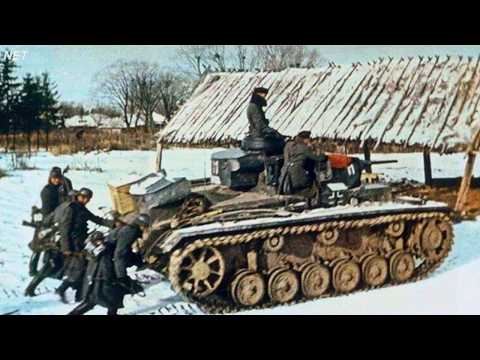
The seeds of this moment had been sown months earlier. Operation Typhoon—the German plan to capture Moscow—was launched on September 30, 1941, with a force of 1.8 million men, 1,700 tanks, and 14,000 artillery pieces. The Red Army, defending the capital, could muster only 1.25 million soldiers, 1,000 tanks, and 7,100 guns. The numerical advantage appeared overwhelming.
Yet the Germans had underestimated their enemy. The Soviet defense at Smolensk had already delayed the advance by two months, and the autumn rains had turned roads into rivers of mud. “The days of waiting are over,” read the order from the 4th Panzer Group. “All we have to do is destroy the last line of defense before Moscow.” But that line would prove anything but easy.
As the panzers crawled forward, they encountered a defense unlike any they had faced before. Along the Mozhaisk line, Soviet engineers had constructed three belts of fortifications—anti-tank ditches, minefields, and dug-in tanks. At Borodino, where Napoleon’s Grande Armée had met its match in 1812, the 32nd Rifle Division from Siberia stood firm against the elite SS Das Reich Division. “In Borodino, the regiments first measured their strength against the Siberians,” wrote the Nazi Paul Carell. “They fought steadily and never panicked, never gave up a foot of ground without fierce fighting.”
The Germans pushed on, but the cost was staggering. By mid-November, the freezing temperatures had hardened the ground, allowing tanks to move off the roads. The 3rd and 4th Panzer Groups lunged toward the Moscow-Volga Canal, while Guderian’s 2nd Panzer Army swept around Tula to the south. On November 24, they captured Klin and Solnechnogorsk, just 50 kilometers from the Kremlin. German commanders could see Moscow through their binoculars.
But the Soviet resistance only stiffened. General Rokossovsky’s 16th Army, defending the Istra line, was ordered by Marshal Zhukov to hold at any cost. The 2nd Guards Cavalry Corps under General Belov, fighting dismounted, halted the German armor. And in the Far East, a critical intelligence report had convinced Stalin that Japan would not attack—allowing him to transfer 30 fresh divisions from Siberia to the defense of Moscow.
By early December, the German offensive had spent itself. The troops were exhausted, the supply lines stretched to breaking point, and the winter clothing promised by Berlin had never arrived. “Our hopes of knocking Russia out of the war in 1941 were dashed at the last moment,” admitted General Blumentritt, chief of staff of the 4th Army.
On December 5, 1941, the Red Army launched a massive counteroffensive. Three Soviet fronts struck the frozen, unprepared German troops, pushing them back 100 to 350 kilometers from the capital. It was the first major defeat of the German army in World War II—and the beginning of a long, bloody road that would end in Berlin.
Yet the counteroffensive did not begin as a single, coordinated thunderclap. It began with smaller, probing strikes that tested the German lines like a boxer feeling for weakness. On November 27, Soviet forces near Kashira hurled back Guderian’s advanced units; two days later, another local attack north of Moscow bloodied Reinhardt’s panzer group. These were not yet the main event—but they were the first cracks in the frozen German wall.
What the Red Army discovered in those early blows was electrifying. The Wehrmacht, so long invincible, was shivering in its summer coats, its tanks frozen to the ground, its supply trucks stranded in snowdrifts. For the first time, Soviet commanders saw not a juggernaut but a wounded beast. The intelligence was passed up the chain with urgency: the enemy’s spearheads were exposed, their flanks thin, their reserves spent.
Stalin, however, demanded more than local victories. At a late-night meeting in the Kremlin, he pressed Zhukov for a decisive answer: could Moscow be held? Zhukov, exhausted and gaunt, replied with characteristic bluntness that the city could hold—but only if fresh reserves were committed at once, before the Germans could dig in. “The enemy is at the end of his tether,” he reportedly said. “But so are we. Whoever strikes first now will win the winter.”
The reserves were already moving. Trains from Siberia, their passengers sworn to secrecy, rolled west through the endless night. Soldiers who had never seen Moscow stepped onto frozen platforms and marched straight into the line. Among them were ski battalions trained for winter warfare—a weapon the Germans had never anticipated. These men in white camouflage would soon appear out of the snow like ghosts, striking at night and vanishing before the panzers could turn.
On the German side, the picture was grim. General Hoepner, commander of the 4th Panzer Group, reported to Army Group Center that his divisions were “fighting with the last of their strength.” Tanks that had once spearheaded the blitzkrieg now sat immobile, their engines cracked by frost. Horses died in their thousands, and soldiers burned furniture to stay warm. “We are on the edge of a catastrophe,” wrote one German officer in his diary. “If the Russians attack now, we have nothing left to stop them.”
Still, the German high command refused to believe the worst. Hitler, from his headquarters in East Prussia, dismissed reports of Soviet reinforcements as fantasy. He ordered that no ground be surrendered, that the line be held at all costs. It was a decision born of pride—and it would cost the Wehrmacht dearly. The order to stand and fight, issued from a bunker hundreds of kilometers away, would soon trap the German army in the snow.
By the first days of December, the temperature had plunged to forty degrees below zero. The German offensive had frozen solid. And in the forests and villages west of Moscow, the Red Army was quietly assembling the largest counterattack of the war so far. The trap was being set—and the men who would spring it were already moving into position.
On the morning of December 5, 1941, the sky over Moscow was clear and brutally cold. Along a front of nearly a thousand kilometers, three Soviet fronts—Kalinin, Western, and Southwestern—unleashed their fury. Artillery thundered from the treelines, and white-clad ski troops surged forward through the snow. The Germans, frozen in their positions and forbidden to retreat, could only watch as the horizon filled with advancing figures.
The first day alone saw the Red Army tear open the German lines north of Moscow. T-34s, their engines howling in the cold, rolled past abandoned panzers and shattered infantry columns. “The Russians came at us like wolves,” a German survivor later recalled. “We had no fuel, no food, and no orders except to die where we stood.”
Within three days, Hitler signed Directive No. 39, ordering the entire Eastern Front onto the defensive. It was an admission of failure unlike any the Wehrmacht had ever issued. “This was the turning point of our eastern campaign,” conceded General Blumentritt. “Our hopes of knocking Russia out of the war in 1941 collapsed at the last moment.”
By January, the Germans had been hurled back 100 to 350 kilometers from the capital. Moscow—the prize Napoleon had seized and lost—remained unconquered. The myth of invincibility was broken forever.
What do you think was the single most decisive factor in saving Moscow—the Siberian divisions, the winter, or the sheer stubbornness of the Soviet soldier? Share your thoughts below.
Report this article
Select a reason for reporting:






