She was only 22 when they put the noose around her neck, but by then, Irma Grese had already earned a reputation as one of the most sadistic figures of the Third Reich. Known as the “Belsen Witch” and the “Beast of Belsen,” she stood in the dock at Lüneburg, her uniform immaculate, her hair perfectly arranged, her eyes cold and unrepentant. The world watched as survivors recounted horrors that seemed impossible for such a young woman to have committed. Yet, as the trial unfolded, it became clear that Grese was no ordinary guard—she was a predator in the guise of a schoolgirl, a woman who found pleasure in the suffering of thousands.
But how did this daughter of a devout Protestant family become one of the most feared women in the Nazi death camps? And what happened in the final months of her life that led her to the gallows with a defiant “Schnell” on her lips? This is the story of Irma Grese’s last days—her capture, her trial, and the testimonies that sealed her fate.
Irma Grese’s journey into infamy began in 1942, when at 18, she applied to become a guard at Ravensbrück. Her father, openly anti-Nazi, threw her out of the house when she appeared in an SS uniform. In revenge, she reported him to the authorities. From Ravensbrück, she moved to Auschwitz in 1943, where her cruelty caught the attention of her superiors. By the end of the year, she was promoted to supervisor, the second-highest-ranking woman in the camp, overseeing 30,000 Jewish inmates. Her methods were unspeakable: she set her dogs on prisoners, shot people at random, and beat them with her braided whip. She took particular pleasure in selecting beautiful young women for torture, whipping them on the breasts so that the wounds would fester, often leading to amputations without anesthesia.
In 1945, as the war drew to a close, Grese was transferred to Bergen-Belsen. When British troops liberated the camp on April 15, 1945, they found her standing among the SS personnel, still arrogant and unbroken. The photos of the “Beasts of Belsen” made headlines worldwide, and Grese became one of the main defendants in the Bergen-Belsen trial.
The trial, held between September and December 1945, was a media sensation. Survivors testified against her, describing her sadistic rituals: the selections every Monday, Wednesday, and Saturday, where she would choose women for torture and death; the sexual abuse; the random shootings. One survivor, Sella Pearl, a Hungarian gynecologist, recounted how Grese would whip well-endowed young women on the breasts, causing wounds that required amputation without anesthesia. Another testified that Grese seemed sexually aroused by the suffering of her victims.
Grese’s defense was predictable: she denied everything, claiming she only knew the final destination of the prisoners from their own accounts. She admitted to beating prisoners, but only with her bare hands and for good reason. She used the whip to maintain order, she said. She never denied her Nazi ideology; in fact, she sang SS hymns in her cell. During the trial, she was absent and distant, answering every question with “No, I don’t know” or “I don’t remember.”
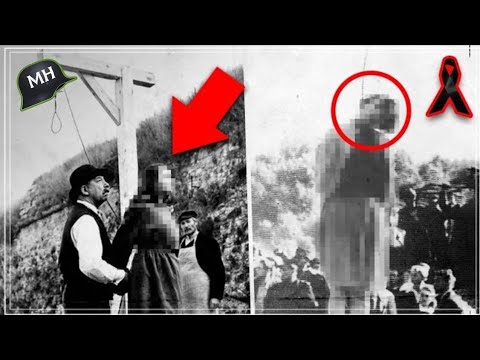
On the 54th day of the trial, she was found guilty of war crimes committed at Bergen-Belsen and Auschwitz. At 22, she became the youngest person sentenced to death under British law in the 20th century. She was executed at Hamelin prison on December 13, 1945.
But even in death, Irma Grese stood out. According to documents of the time, she had a confrontation with the famous English executioner Albert Pierrepoint. When he tried to place the dark hood over her head, she violently refused. Pierrepoint slapped her repeatedly until he managed to overpower her. In the haste, the noose was not properly placed, and it is believed that Grese died by strangulation rather than a clean hanging. Her last word was “Schnell”—quick—as if demanding that the process be carried out immediately.
After her execution, her body was mutilated and cremated, and the ashes were thrown into a drainage river, a common practice to prevent the graves of Nazi criminals from becoming pilgrimage sites for neo-Nazi groups.
But the story of Irma Grese does not end with her death. The questions linger: How could a young woman become such a monster? And what does her case tell us about the nature of evil? In the next part, we will delve deeper into her early life, her path to radicalization, and the psychological profile of a killer who found joy in pain.
To understand how Irma Grese became the “Belsen Witch,” one must look beyond the trial transcripts and into the soil that nurtured her cruelty. She was born in 1923 in Wrechen, a small village in Mecklenburg, into a Protestant farming family. Her father, Alfred, was a devout man who openly despised the Nazis; her mother, Berta, died by suicide in 1936, when Irma was just thirteen. The loss shattered the family, and Irma grew withdrawn, resentful, and hungry for approval. School records describe her as an average student with a stubborn streak, but neighbors remembered a girl who seemed oddly detached, as if something inside her had already closed off.
When she was fifteen, she left school and took a job at a local dairy, then at a shop. But the quiet life of a village girl bored her. In 1942, at eighteen, she saw an advertisement for female SS auxiliaries and applied without hesitation. Her father was furious. When she came home in uniform, he threw her out, and she retaliated by reporting him to the Gestapo. It was a chilling preview of the loyalty she would show—not to family, but to the ideology that gave her power.
At Ravensbrück, Grese learned quickly. She was trained by seasoned guards, women who had already hardened into instruments of the state. She absorbed their lessons: prisoners were not people but numbers, and cruelty was a tool of control. Her superiors noted her efficiency and her enthusiasm. By 1943, she was transferred to Auschwitz-Birkenau, the largest of the Nazi death camps, where her ascent continued. Within months, she was promoted to SS-Oberaufseherin, overseeing some 30,000 female inmates. She was twenty years old.
Survivors of Auschwitz remembered her as a figure of terrifying beauty—always immaculate, always smiling. She wore heavy boots and carried a whip, and she walked among the prisoners as if she owned them. She selected women for the gas chambers with a flick of her gloved hand, favoring the young and beautiful for special torture. “She was sexually aroused by the suffering,” testified one survivor. Another described how Grese would set her dogs on pregnant women, laughing as they screamed.
But it was at Bergen-Belsen, in the final months of the war, that her sadism reached its peak. As the camp descended into chaos, with typhus and starvation claiming thousands, Grese seemed to relish the disorder. She beat prisoners for the slightest infraction, shot them for sport, and once, according to testimony, she smashed a woman’s skull with a wooden clog because the prisoner had failed to stand at attention. When British troops liberated the camp in April 1945, they found her standing among the SS staff, her uniform still crisp, her expression one of defiance rather than fear.
The trial that followed was not just a legal proceeding but a public reckoning. The British press dubbed her “the most evil woman in the world,” and the courtroom was packed with reporters and survivors. Grese sat in the dock, often smirking, occasionally yawning. She denied everything, but the evidence was overwhelming. “I don’t remember,” she repeated, again and again. But the survivors remembered. They remembered the whip, the dogs, the selections, the screams.
When the verdict came, Grese showed no emotion. She was sentenced to death by hanging, and she accepted it with the same cold indifference she had shown her victims. In her cell, she sang SS songs and refused to repent. “I am not guilty,” she told her captors. “I was only following orders.”
But the story of Irma Grese is not just about one woman’s crimes. It is about the system that created her, the ideology that empowered her, and the silence that allowed her to thrive. As the world moves further from the events of the Holocaust, her case remains a stark warning: that ordinary people, when given absolute power and moral permission, can become extraordinary monsters. And the question that lingers, as we will explore in the next part, is whether Irma Grese was a singular aberration—or a reflection of something far more common in the human heart.
The question of how an ordinary village girl became a predator is not answered by her death, but by the banality of her choices. Grese was not born a monster; she was made—by ideology, by ambition, and by the silence of a society that rewarded cruelty. Her last word, “Schnell,” was not a plea for mercy but a final command, as if even at the gallows she believed she was still in control.
In the decades since, historians and psychologists have dissected her case, searching for a definitive explanation. Some point to her mother’s suicide and her father’s rejection; others to the heady power of absolute authority. But none can fully explain the particular gleam in her eye that survivors described—a pleasure in pain that went beyond duty. “She was not a sadist because she was a Nazi,” one scholar noted, “she was a Nazi because she was a sadist.”
Today, the name Irma Grese is largely forgotten outside historical circles, but her story remains a chilling case study in the human capacity for evil. The photographs of the “Beasts of Belsen” still shock, not because they are grotesque, but because they are ordinary—young men and women in neat uniforms, standing in the sunlight, their faces betraying nothing of the horrors they had committed.
Her ashes, scattered in a nameless river, left no grave to venerate. But the memory of her victims—the women she whipped, the children she sent to the gas chambers, the lives she extinguished with a flick of her gloved hand—demands that we remember. For in remembering, we guard against the conditions that made her possible.
What do you think—was Irma Grese a singular monster, or does her story reveal something darker about human nature? Share your thoughts in the comments below.
Report this article
Select a reason for reporting:






