You think your neighbors are bad? Try running an empire with a cabinet full of men who couldn’t find their way out of a paper bag. Winston Churchill didn’t suffer fools gladly—in fact, he barely suffered them at all. He had a front-row seat to the greatest collection of dim-witted aristocrats, bumbling generals, and idealistic dreamers the twentieth century could produce. And he took notes.
His weapon wasn’t a gun or a treaty. It was his tongue. A tongue so sharp it could flay a man alive and leave him thanking Churchill for the privilege. “He is a modest man who has much to be modest about,” he said of Clement Attlee, the man who would eventually succeed him as Prime Minister. It was a surgical strike, delivered with the calm of a man ordering tea.
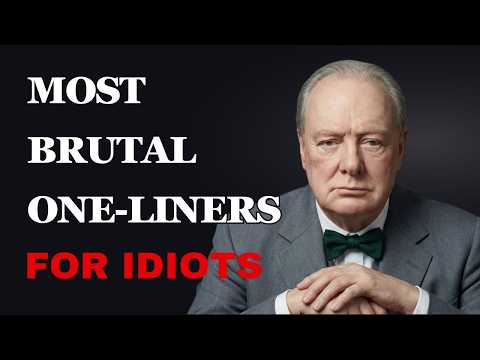
But Churchill’s disdain for the mediocre wasn’t just personal. It was philosophical. He saw the world as a place where the loudest voices often had the least to say, and where the truth was constantly losing a race against a lie. “A lie gets halfway around the world before the truth has a chance to get its pants on,” he observed, and every politician since has nodded in weary agreement.
He didn’t just mock individuals, either. He took aim at entire systems. “The best argument against democracy is a five-minute conversation with the average voter,” he quipped, a line that still stings because it’s uncomfortably close to home. And of his own profession, he said, “Politics is the ability to foretell what is going to happen tomorrow, next week, next month, and next year. And to have the ability afterwards to explain why it didn’t happen.”
Yet for all his biting wit, Churchill knew he was no saint. He admitted, “We are all worms, but I believe that I am a glowworm.” It was this self-awareness that made his insults so devastating—he never pretended to be above the fray. He was simply better at it.
His encounters with political rivals became the stuff of legend. When Bessie Braddock accused him of being drunk, he fired back, “And you, Bessie, are ugly, but I shall be sober in the morning.” When Lady Astor told him that if she were his wife she’d poison his coffee, he didn’t miss a beat: “If I were your husband, I’d drink it.” These weren’t just comebacks; they were executions.
But Churchill’s wit wasn’t only for show. It was a survival mechanism. In a world filled with fanatics who “can’t change their minds and won’t change the subject,” he used humor to keep his own sanity. He knew that “the greatest lesson in life is to know that even fools are right sometimes,” and he never forgot it.
As the war raged and the fate of the world hung in the balance, Churchill’s contempt for the foolish became a kind of armor. He could stare down Hitler and out-talk Stalin, but he saved his most withering scorn for the people who should have known better—the appeasers, the socialists, the empty suits who “compress the largest amount of words into the smallest amount of thought.”
And yet, for all his fire, there was a strange tenderness in his view of humanity. He knew we were all stumbling toward the truth, picking ourselves up, and carrying on. “Success is stumbling from failure to failure with no loss of enthusiasm,” he said, and it was as much a description of himself as it was of anyone else.
But make no mistake: Churchill’s patience had limits. And when he reached them, the results were unforgettable.
One such limit was tested in the early 1930s, when a delegation of Labour MPs arrived at his office to lecture him on the virtues of disarmament. They spoke for nearly an hour, painting a picture of a world where reason and goodwill would replace guns and battleships. Churchill listened, his cigar burning slowly between his fingers, his eyes half-closed as if he were dozing.
When they finished, he opened his eyes and said, “An appeaser is one who feeds a crocodile, hoping it will eat him last.” The room went silent. One of the MPs stammered that they were merely trying to prevent another war. Churchill leaned forward. “You were given the choice between war and dishonour. You chose dishonour and you will have war.” The delegation left without another word.
He was equally merciless with his own generals. During a tense strategy meeting in 1940, a senior officer suggested a cautious retreat. Churchill, who had been staring at a map of the Channel, turned slowly. “In war, resolution. In defeat, defiance. In victory, magnanimity. In peace, goodwill.” He let the words hang in the air. “I don’t hear any of those in your proposal, General.” The plan was scrapped before the coffee went cold.
Yet the people who frustrated him most weren’t his enemies—they were the clever ones who refused to think. He once described a fellow MP as “a sheep in sheep’s clothing,” a phrase that somehow managed to be both absurd and devastating. And of another colleague, he remarked, “He has all the virtues I dislike and none of the vices I admire.” The man never quite recovered his reputation.
But Churchill’s sharpest barbs were often reserved for himself. He knew that “man will occasionally stumble over the truth, but most of the time he will pick himself up and continue on,” and he counted himself among the stumblers. When a young aide once asked how he maintained his confidence in the darkest days of the Blitz, Churchill paused. “I am prepared to meet my maker. Whether my maker is prepared for the great ordeal of meeting me is another matter.” The aide laughed, but Churchill didn’t. He was only half joking.
His humor was a shield, but it was also a scalpel. He used it to cut through the fog of war, to expose the cowardice dressed up as caution, and to remind everyone—including himself—that “when the eagles are silent, the parrots begin to jabber.” And Winston Churchill was never silent.
He once said that “kites rise highest against the wind, not with it,” and he lived that truth every day. The fools, the fanatics, the empty suits—they were the wind. And he rose against them, higher and higher, until the world had no choice but to listen.
But the wind didn’t always blow from the direction he expected. In 1945, just months after victory in Europe, Churchill was unceremoniously voted out of office. The man who had rallied a nation from the brink of annihilation was replaced by the very Labour Party he had spent years skewering. He took the news with characteristic grace—which is to say, he didn’t take it well at all.
His wife Clementine tried to console him, suggesting it might be a blessing in disguise. Churchill scowled. “At the moment, it seems very effectively disguised,” he muttered. And yet, when the results came in, he didn’t rage. He didn’t storm the palace. He simply sat in his study, lit another cigar, and began drafting the memoirs that would win him the Nobel Prize.
That was the thing about Churchill that his enemies never quite understood. He could be beaten, but he could never be broken. “Continuous effort, not strength or intelligence, is the key to unlocking our potential,” he had once said, and he proved it in the years that followed. While the new government fumbled through rationing and reconstruction, he sharpened his pen and waited.
He didn’t have to wait long. By 1951, the same voters who had thrown him out were begging him to return. The parrots had jabbered themselves hoarse, and the eagles were needed once more. Churchill, now in his late seventies, accepted the call with a mixture of grim satisfaction and genuine weariness. “I have taken more out of alcohol than alcohol has taken out of me,” he joked to a friend, but the truth was that the years had taken their toll.
His second term was quieter, less dramatic, but no less consequential. He negotiated a fragile peace in Korea, strengthened the special relationship with America, and kept a wary eye on the Soviet Union. But the fire that had once burned so brightly was dimming. He suffered a stroke in 1953 and kept it secret from everyone—even his own cabinet. “Nothing in life is so exhilarating as to be shot at without result,” he had said, but this was a shot he couldn’t dodge forever.
When a young journalist asked him, near the end of his career, whether he had any regrets, Churchill paused for a long moment. The cigar smoke curled around his face like a ghost. “I am fond of pigs,” he said finally, apropos of nothing. “Dogs look up to us. Cats look down on us. Pigs treat us as equals.” The journalist blinked, confused. Churchill smiled. “That’s the secret, you see. Find the people who treat you as an equal. Then do everything in your power to prove them wrong.”
He retired in 1955, leaving behind a world that was safer, freer, and infinitely more complicated than the one he had inherited. And as he walked out of 10 Downing Street for the last time, he didn’t look back. There was no need. “History will be kind to me,” he had predicted. “For I intend to write it.”
And write it he did. Volumes poured from his pen like reinforcements to a battlefield, each page a trench dug against oblivion. He filled his study at Chartwell with books and cats and the quiet hum of a man settling scores with history—on his own terms, at his own pace.
In his final years, the wit never dulled, even as the body faltered. When a visitor remarked that he looked tired, Churchill grunted. “I’m not tired. I’m bored. There’s a difference, and only clever people can tell them apart.” He still drank his champagne, still painted his ponds, still held court for anyone foolish enough to argue.
He died in 1965, and the world mourned a man who had been, by turns, its savior and its scourge. But perhaps his truest epitaph came from his own lips, spoken decades earlier to a room full of admirers who had asked him the secret to a life well lived. “I am an optimist,” he said. “It does not seem to be much use being anything else.”
So here’s the real question, the one he’d want you to chew on: if the parrots are still jabbering, what’s stopping you from being the eagle?
Report this article
Select a reason for reporting:






