October 18th, 1944. Aachen, Germany. The first major German city to fall to the Western Allies. Second Lieutenant William Ratchford of the 26th Infantry Regiment stands at the front door of the Hotel Quellenhof, a four-story building converted into a Wehrmacht strongpoint at the center of the city’s defense. Inside, German troops have killed every American who tried to enter for two days. Ratchford goes through the front door with his pistol drawn—a Colt M1911A1 chambered in .45 ACP. Within an hour, the lobby is American. By nightfall, so are the upper floors. The defenders are pushed into the basement. Three days later, the city surrenders.
There is a reason Wehrmacht officers had every reason to fear that exact moment more than any other. The room with no exit. The American with the heavy pistol. The bullet that broke men in half.
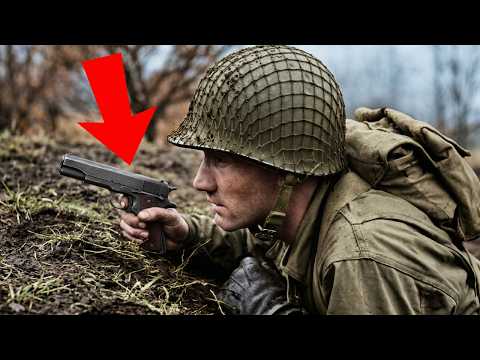
Most of the Second World War was fought from a distance. Artillery dropped from beyond the horizon. Bombers came from 20,000 feet. Tanks killed each other across open ground at two kilometers. But every army that fought in Europe and the Pacific eventually found itself somewhere else. Inside a building. Inside a bunker. Inside a hedgerow. Inside a cave on Peleliu, where the man you were trying to kill was close enough to grab your ankle.
At close range, the rifle in your hands was too long. The bayonet, too slow. The grenade, too dangerous to your own men. What you reached for, if you had it, was the pistol on your hip.
The Wehrmacht officer carried one of two. The Luger P08, an artisan’s weapon, hand-fitted, chambered in 9mm Parabellum. Or the Walther P38, adopted in 1938 to replace the Luger because the Luger was too expensive to mass produce and too tightly machined to function in mud. Both fired the same cartridge, a 124-grain bullet at over 1,000 feet per second. Fast, accurate, elegant.
The American officer carried something else entirely.
September 24th, 1944, south of Aachen in the Stolberg Corridor. Staff Sergeant Joseph Shafer of the 18th Infantry Regiment defended a single house against a German counterattack across the entire morning. By the time the fight was over, between 15 and 20 German dead lay around the building. Ten more had surrendered, and Shafer had walked out with a Medal of Honor citation. The architecture had been his ally. The men closing on him had to come through doorways one at a time—and one at a time was a problem the American sidearm had been designed to solve.
The Colt M1911A1, designed by John Moses Browning, adopted by the United States Army in 1911 after a four-year trials process, refined into its final wartime configuration in the mid-1920s. It fired the .45 ACP cartridge. 230 grains of full metal jacket lead propelled at roughly 830 feet per second. By the math of the era, that velocity was unremarkable. The German 9mm round was faster and lighter. The British .303 rifle round was faster still. The .45 was something else. Wider, heavier, slower—and built for a specific problem.
That problem began on a chain of islands in the Pacific at the turn of the 20th century when American soldiers fighting the Moro insurrection found that their service-issue .38 revolvers would not stop a charging warrior. Not even with multiple hits. The army went looking for a bigger round. Browning gave them one.
The first time it answered for itself happened on October 8th, 1918, in a clearing in the Argonne Forest. Corporal Alvin York of the 82nd Division, alone after a German counterattack had cut his squad to pieces, was charged by six German soldiers with fixed bayonets. He drew his M1911 and shot the last man in line first. Then the next. Then the next. Then the next. Then the next. He had learned the trick turkey hunting in Tennessee. The man at the back falls, and the man at the front does not notice. The surviving German battalion commander, Lieutenant Paul Vollmer, emptied his own pistol at York from 20 feet and missed every shot. Then Vollmer surrendered. York walked 132 prisoners back to American lines.
That was 1918. The men who fought in 1944 inherited that story.
By October 1942, the First Marine Division had been on Guadalcanal for two months. The jungle around Henderson Field was thick enough that a man could lose his platoon by stepping eight feet to one side. On the night of October 24th, Gunnery Sergeant John Basilone of the 7th Marines ran a relay of ammunition between two machine gun positions while a Japanese regiment came at his line in the dark. When the guns jammed, he cleared them. When they overheated, he cooled the barrels with his bare hands. When the Japanese came inside the wire, he fired his pistol into the rush. Reloaded by feel and fired again. He earned the Medal of Honor for what he did that night.
Two years later, two oceans away, a different problem.
The city of Aachen was the first piece of German soil the Western Allies tried to take whole. Every block had been turned into a fortress. The defenders—a mix of Volksgrenadiers, Fallschirmjäger paratroopers, and an SS battalion—had wired the sewers and railway tunnels to let them reappear in cleared buildings hours after the Americans had moved on. At a foundry on the north end of the city, they had bolted captured tank armor plate to the walls. American Shermans put rounds through it and watched them bounce.
The only way to take Aachen was to go inside it, room by room, floor by floor. And inside the building, with a doorway between you and a defender you could not see, the rifle in your hands was no longer the right tool.
The reality of urban combat was about to flip on its head. The same weapon that had been a backup piece for officers and tankers and machine gunners now became the primary instrument of a particular kind of fight. A man with a pistol going through a doorway with the intent of being the last person breathing in the next room.
Then came the tankers.
Lieutenant Belton Cooper of the 3rd Armored Division spent the war recovering knocked-out Shermans from the battlefield, sometimes still warm, sometimes still occupied. He kept a record. In one engagement near the German village of Hastenrath, he documented a Sherman crew abandoned by its supporting infantry holding a road junction by themselves against a German infantry advance. The tank’s 75mm main gun ran dry first, then the .50 caliber on the turret, then the Thompson submachine guns. By the time relief arrived, the surviving tanker was at the hatch with his sidearm in one hand and a grenade in the other. A half-dozen German bodies were stacked at the foot of the tank.
In the Pacific, the same weapon told a different story.
Eugene Sledge fought in the 5th Marines through Peleliu and Okinawa carrying his father’s M1911 from the previous war. His father had been issued the pistol as an army doctor in 1917 and had shipped it to his son in the Pacific in a parcel with the original paperwork inside. In the rain on Okinawa, on a railroad embankment in the mud, Sledge and a Marine the men called Snafu lay flat in the dark and watched two figures move along the high ground above them. Snafu raised his pistol. He fired several shots. He missed. The figures vanished. Sledge wrote about that moment four decades later because of what it had felt like in his hands at the time. The weight, the kick, the fear that the round had not done what it was supposed to do.
There is no German quote in the surviving records that praises the American .45. There is no Wehrmacht document that warns against it by name. The German files speak instead, again and again, of American artillery, American air, American material abundance. But the close fight tells its own story.
In every street battle in every German city the Allies took, defenders surrendered to cleared buildings rather than die in cellars they could not back out of. In every cave system on every Pacific island, the calculus broke the same way. A defender behind a barricade had every advantage until the moment an American with a pistol came through the doorway. And then the math shifted.
The .45 had its limits, and the men who carried it knew them. Seven rounds in the magazine, one fewer than the Luger. A heavy trigger that intimidated unpracticed shooters as much as it intimidated the enemy. A bullet that fell 15 inches over a hundred yards. The .45 was not a rifle. It was never meant to be. It was a sledgehammer pressed into a fist, useful only at the distance at which a man could touch another man.
That distance in this war was where the worst of it happened.
The M1911 served in American hands until 1985, when the Beretta 9mm replaced it as the standard sidearm. By then, it had been in continuous service for 74 years. Marine special operations units carried it into the early 2020s—longer than any other firearm in the modern American arsenal.
Eugene Sledge brought his father’s pistol home from the Pacific. He kept the paperwork that proved it was a family weapon and not a captured one. It sat on his desk in Alabama for the rest of his life.
In the Hotel Quellenhof in Aachen, the lobby where Second Lieutenant Ratchford had gone through the door with his pistol drawn is now an unremarkable corridor. The German officers who held the building that day surrendered 72 hours later. None of them, in the records that have survived, ever wrote a word about the .45.
They did not have to.
The men who carried it knew what it was for. So did the men on the other side of the door.
What do you think—was the .45’s fearsome reputation earned on the battlefield, or does the legend outrun the paper ballistics?
Report this article
Select a reason for reporting:






