At 8:15 on the morning of August 6, 1945, the world outside a concrete bunker near Hiroshima Castle simply vanished. Inside, a fourteen-year-old girl named Yoshioka was manning a military phone, part of a student mobilization unit tasked with relaying air-raid warnings. She had just returned to her post after the all-clear sounded at 7:31—a single American bomber had passed over and left. Hiroshima was getting back to work. Then the light came, and everything she knew was gone.
When she climbed out into the open air, the buildings that should have blocked her view had disappeared. Standing in the center of Hiroshima, she could see the sea. She went back down the stairs. Almost every line was dead, but one military phone still worked—a line connected to a unit in Fukuoka, further east along the coast. She told the voice on the other end that Hiroshima had been annihilated. “Annihilated? Impossible. Give me a reason,” the voice said. Yoshi had no answer, so she borrowed the words of a soldier she had seen lying outside. “We have been bombed with a new type of bomb,” she said. That call is remembered as the first report of Hiroshima’s destruction to reach the outside world. A schoolgirl on a military line, and a listener who could not quite believe it.
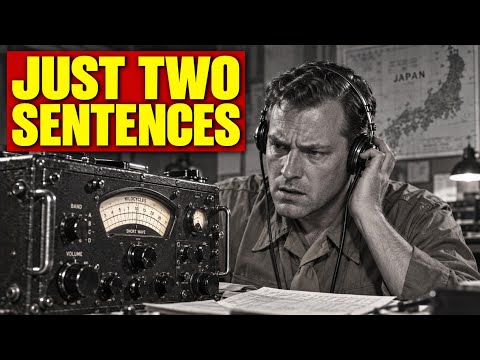
For the next day and a half, many people were listening closely to what Japan would say about that morning. Among the most attentive were Americans whose sole job was to listen. When the Japanese government finally spoke publicly, its statement consisted of just two sentences. This is the story of those two sentences—what America heard on Japanese radio the morning after Hiroshima, what it did not hear, and what it did with the silence.
For nine days, the end of World War II became a race in eavesdropping. Two enemy governments that trusted not a word from each other learned everything important about each other through radio. Before it was over, the Emperor himself would repeat those two sentences. A radio announcer would find a gun pointed at him. And the English text of Japan’s surrender, still quoted today, would carry a line crediting the last American agency you might expect.
The listening had begun even before America entered the war. In February 1941, President Roosevelt gave the Federal Communications Commission—the agency that normally handed out radio licenses—a strange new assignment: record what foreign governments were broadcasting, translate it, and tell Washington what it meant. The Foreign Broadcast Monitoring Service, soon renamed the Foreign Broadcast Intelligence Service, opened its first office outside the capital that October, pointed toward Japan. Twenty employees traveled west, most by train, including three Japanese linguists and one Chinese linguist. They settled in a farmhouse on Northeast Glisan Street, about ten miles from Portland, Oregon. Pearl Harbor was a little over nine weeks away.
There is a bitter footnote to that address. By the end of May 1942, Army orders had removed every person of Japanese ancestry from the county where the farmhouse stood. For most of the war, the government listened to Japanese in a place where no one of Japanese ancestry was allowed to live.
By the summer of 1945, the service had grown into a network with monitoring stations on both coasts, in Hawaii, and since January in Guam, advancing across the Pacific toward the transmitters it chased. Its monitors were receiving nearly two and a half million words a day. Broadcasts were recorded on discs so difficult phrases could be replayed until someone was sure of them. Important material was sent by teletype to Washington and from there to nineteen different war agencies.
When it came to Japan, the monitors took everything. Tokyo Radio’s English-language propaganda aimed at American troops, Domei news agency dispatches sent abroad in Morse code, and most valuable of all, the domestic service—the programs Tokyo made for its own people. Propaganda aimed at Americans told you what Tokyo wanted Americans to believe. Broadcasts aimed at Japanese told you what Tokyo needed its own people to believe, and that was far more revealing. Analysts read these broadcasts the way a doctor reads a patient’s chart. The claims mattered less than the changes. A new word, a missing word, a story that had led the news and suddenly did not. To these people, silence was information.
On August 6, it was Washington that was talking. Harry Truman was in the middle of the Atlantic, sailing home from the Potsdam conference aboard the cruiser USS Augusta. He was having lunch with the crew when an officer from the White House map room handed him a message. The bomb had been dropped on Hiroshima. Early reports indicated complete success. “This is the greatest thing in history,” Truman said. Then he stood up and announced the news to the crew himself.
In Washington, at eleven o’clock that morning, the White House released a statement that had been drafted and redrafted for weeks. It read: “Sixteen hours ago an American airplane dropped one bomb on Hiroshima and destroyed its usefulness to the enemy. That bomb had more power than 20,000 tons of TNT.” It added: “It is an atomic bomb.” And: “If the Japanese leaders do not now accept our terms they may expect a rain of ruin from the air, the like of which has never been seen on this earth.”
Every American network broadcast the statement. So did shortwave transmitters aimed across the Pacific. Eleven a.m. in Washington meant midnight in Tokyo. The Domei news agency had its own monitors, listening to American radio the way Americans listened to Japan. They recorded the President’s words, and by the morning of August 7, the text was in the hands of the men running the country. The Japanese government learned what had happened to one of its cities by listening in on the man who had ordered it.
Until then, Tokyo had known about Hiroshima mainly through what it could not hear. The national broadcaster finally issued a statement. On the West Coast of America, it was still the night of August 6. By the time Washington woke up, the words were in American hands. Here is the full text. First: “Yesterday, August 6, Hiroshima suffered severe damage in an attack by a small number of enemy B-29s.” Second: “In this attack, it appears the enemy used a new type of bomb, the details of which are still under investigation.”
That was Japan’s official response to the most destructive weapon ever used in war. Now, read it the way the trained listeners read it. Start with “a small number of B-29s.” That was accurate and astonishing in its silence. For months, Japanese cities had been burned by raids of hundreds of bombers at a time. Now, the high command was admitting that a handful of planes had severely damaged a major city. Anyone paying attention could do that math.
Then, “severe damage.” Japanese statements had a vocabulary for destruction, and the people who read them daily knew the scale. Damage was almost always described as “slight” or “minor.” Once in a long while, it was described as “grave.” A young Filipino diplomat stranded in Japan, León María Guerrero, recorded in his diary the precise place of the word “severe” on that ladder. Much higher than the usual reassurance, and still below “grave.” It was a government admitting that something had happened without admitting its true size.
Then there was the word that was not there. Fifteen hours earlier, the President of the United States had told the world this was an atomic bomb. Tokyo had heard him. The statement mentioned a new type of bomb. Tokyo was not confused about what the Americans were claiming. It was refusing to repeat it. And the phrase “under investigation” meant what it always meant: we do not know yet, or we are not ready to tell you. This time it meant both.
Guerrero, as a diplomat, could listen to American shortwave. So he already knew what the Americans were saying. He was forbidden to share it with the Japanese around him. But on the day of the statement, the boy who cleaned the toilets asked him what he imagined these new bombs were like. The boy shrugged. Then he tilted his head and guessed. Maybe they kill a hundred people instead of ten. In Hiroshima, tens of thousands were already dead.
The next morning’s newspapers showed how little anyone in Tokyo knew. The Asahi Shimbun reported that the new bombs had descended by parachute and exploded before reaching the ground. The parachutes people had seen over Hiroshima that morning actually carried instruments dropped by a second B-29 to measure the blast. The paper also warned readers not to underestimate an air raid just because there were few planes overhead. Unintentionally, the newspaper wrote a eulogy for everyone who had heard the all-clear at 7:31 and gone back to work.
Washington noticed what was missing. The word “atomic,” for instance. Any hint of accepting the Potsdam terms, for another. And the American codebreakers secretly reading Tokyo’s diplomatic cables could see the Foreign Ministry still urging its ambassador in Moscow to persuade Stalin to mediate for peace. Everything America could hear, publicly and secretly, pointed in one direction. Japan had taken the hardest blow of the war and was still looking for a way out short of surrender.
That mattered because the next step required no one’s permission. A directive issued in late July had given the bomb group on Tinian the green light to deliver more bombs as soon as they were ready. No one had to decide to use the second bomb. Someone had to decide to stop it, and the only thing that could give him a reason was a signal from Tokyo. That signal never came.
With forecasts of bad weather over Japan for several days, the second mission was moved up to August 9. In the meantime, America kept talking. Millions of new leaflets were rushed into print, and as the presses ran, their text was broadcast in Japanese from the American transmitter on Saipan every fifteen minutes. “We possess the most destructive explosives ever devised by man,” the leaflets said. If you still have any doubt, ask what happened to Hiroshima.
One side of the ocean was shouting. The other side’s government was barely trying to speak. Inside the Japanese government, the argument had already begun. Foreign Minister Shigenori Togo told his colleagues that the President’s statement changed everything. If one bomb could erase a city, the Americans would use everything they had. War Minister Korechika Anami pushed back, the Army’s voice in the cabinet. Perhaps the enemy was exaggerating. Before anyone spoke of ending the war, the Army wanted to see for itself.
So investigators flew to Hiroshima, among them Japan’s leading nuclear physicist, Yoshio Nishina. He arrived on August 8. By that evening, his verdict reached the Prime Minister’s office. It was an atomic bomb. The physical evidence piled up over the following days. At the Red Cross hospital in Hiroshima, a stock of unused X-ray film sat locked in a wall safe behind a door more than a centimeter thick. Every film had turned black. Something had passed straight through the door.
On the eighth, Togo went to the palace. The Emperor’s reply was unusually direct. “Now that such a weapon has been used, Japan must end the war as quickly as possible and not miss the chance by bargaining over terms.” Finally, Japanese radio changed its tone. On August 8, after more than sixty hours of near-total silence, Tokyo Radio began to describe Hiroshima. The city was in ruins. The dead were too many to count. Many could no longer be identified even as men or women. Practically every living thing, human and animal, had been burned to death, by the broadcast’s own account.
Then came Sato, begging the Soviets to receive an envoy from the Emperor to help end the war, warning Tokyo it was hopeless. At five p.m. Moscow time on August 8, Foreign Commissar Vyacheslav Molotov finally agreed to see him. Sato opened with pleasantries. Molotov cut him off and read him a declaration. As of August 9, the Soviet Union would consider itself at war with Japan. Sato was allowed to send a cable home. The cable never arrived. And so Tokyo learned that the country it had counted on to save it was now attacking it, in the same way it had learned about the bomb: by radio.
Moscow Radio announced the declaration, and Japanese monitors copied it before dawn. By then, Soviet armies were already pouring into Manchuria from three directions. On the morning of August 9, the six men who effectively controlled Japan’s war policy met. Prime Minister Kantaro Suzuki, Togo, Anami, the Navy minister, and two chiefs of staff. By the rules they operated under, ending the war required all six to agree. They deadlocked.
Togo, backed by Navy Minister Mitsumasa Yonai, wanted to accept the Potsdam terms with one condition: the preservation of the Emperor’s position. Anami and the two chiefs wanted four: the Emperor kept, no occupation, Japanese forces disarmed by their own officers, and any war crimes tried in Japanese courts. Togo warned the Allies would read that as a rejection. And as they argued, news arrived from Kyushu. At two minutes past eleven that morning, a B-29 named Bockscar dropped a second atomic bomb.
Its primary target, the city of Kokura with its military arsenal, was hidden by smoke and haze. So the crew turned toward their secondary, and the bombardier found a hole in the clouds over Nagasaki at the last moment. Imperial General Headquarters announced officially that two large enemy planes had entered Nagasaki and appeared to have used a new type of bomb. Details were still under investigation. It added that damage appeared to be relatively slight. Relatively slight? More than seventy thousand people in Nagasaki would be dead by the end of the year. If you were in Washington trying to judge whether Tokyo had grasped it yet, it is hard to imagine a worse answer.
The council broke up without a decision, and the full cabinet deadlocked too. So Suzuki took a step with no precedent in modern Japanese history. Shortly before midnight, the council met again, this time with the Emperor present, in a stifling air-raid shelter in the palace grounds, and the arguments were made one last time. Then, at about two a.m. on August 10, Suzuki turned to the Emperor and asked him to decide. Hirohito spoke. He said the Army’s promises had never once matched its preparations. He could no longer bear to see his people suffer more. It was time to endure the unendurable. Japan would accept the Potsdam Declaration, provided it did not prejudice the Emperor’s prerogatives as a sovereign ruler.
What happened next showed how far the listening war had come. That evening in Tokyo, while the formal acceptance was still traveling through neutral capitals, officers from the War Minister’s staff broadcast a statement in Anami’s name. The Army would fight to the end, even if soldiers had to chew grass, eat dirt, and sleep in the fields. Anami had not approved it. The government’s information chief let it air anyway, afraid the younger officers would kill the War Minister if he stopped it. At the Foreign Ministry, that broadcast set off an alarm. If the Americans heard “eat grass” before they heard Japan’s acceptance, they might conclude Japan had chosen to keep fighting, and another city might pay the price.
So the Ministry used the fastest channel it had. Domei put the acceptance out as a news item on its foreign service, in English, in Morse code, where it could slip past Army censors. Japan was, in effect, offering its surrender to anyone who happened to be listening. The Americans were listening. At 7:42 a.m. Washington time on August 10, Japanese radio was heard announcing that Japan was ready to accept the Potsdam terms. By nine o’clock, Truman had gathered his senior advisers in his office.
The formal note, relayed through the Swiss with all the proper ceremony, did not reach Washington until about seven that evening. Radio had beaten the diplomats by eleven hours. So for a few hours, the monitoring stations heard Japan speaking in two voices. In Japanese, to its soldiers: “Fight on, eat grass.” In English, in Morse: “We accept.” Which was the real Japan? The frightening answer was both. The only question was which voice would win.
Washington now had to answer that one condition. War Secretary Henry Stimson argued the Emperor might be the only authority every Japanese soldier would obey. Secretary of State James Byrnes feared accepting any condition would look like America backing down. Byrnes wrote the reply, and he wrote it carefully. It never said the Emperor could stay, and it never said he must go. It stipulated that from the moment of surrender, the Emperor’s authority to rule would be subject to the Supreme Commander of the Allied Powers, and that the ultimate form of Japan’s government would be determined by the freely expressed will of its people.
Truman made another decision that day. No more atomic bombs would be used without his explicit order. According to Commerce Secretary Henry Wallace’s diary, the President said the thought of wiping out another hundred thousand people was too horrible. He didn’t like the idea of killing all those kids. The firebombing continued. The reply reached the Swiss at ten-thirty on the morning of August 11, and the text was released to the public at the same moment, which meant it went out over the radio.
Now it was Tokyo’s turn to eavesdrop. Shortly after midnight on August 12, Japanese monitors picked up an American broadcast carrying the Byrnes note hours before the official copy arrived through Switzerland. Once again, enemy radio had outrun the diplomats. Then Japan’s leaders fell to arguing over two words: “subject to.” Foreign Ministry translators chose the gentlest Japanese phrasing they could honestly defend. Something like “placed under the restraints of a limited Emperor, but still an Emperor.” Army officers read the same two words as “subordination.” A sacred Emperor placed under an American general. The fate of ending the war now hung on a translation.
For two more days, the Japanese government kept arguing while the world waited. Americans had started celebrating after the August 10 broadcast. Now newspapers were asking where Japan’s reply was. Byrnes concluded, from the best information he had, that Tokyo had not even told its own people it had offered to surrender. American shortwave had been broadcasting the whole exchange toward Japan since noon on the eleventh, but as Byrnes wrote to the War Department, shortwave was an inadequate means of reaching the Japanese public. Few ordinary Japanese owned sets that could pick it up. So he asked for leaflets.
On August 13 and 14, American bombers scattered leaflets over Japanese cities, printing Japan’s offer and the Allied reply in Japanese for all to read. On the morning of the fourteenth, the Emperor’s closest adviser, Lord Keeper of the Privy Seal Koichi Kido, got one. He realized at once what it could do. If angry officers read it before the government moved, the Army might explode. Kido went straight to the Emperor.
Late that morning, Hirohito summoned his ministers before him once more and told them his opinion had not changed. Accept the reply. Then he asked for something no Emperor had ever done. He would read the decision to the nation himself, over the radio. Across the Pacific, listeners caught the signals before any diplomat relayed them. In the early hours of August 14, Washington time, FCC monitors recorded a broadcast from Tokyo saying an imperial message accepting the Potsdam terms would be issued soon.
Later came a practical detail so chilling it was almost comic. Tokyo Radio announced that at noon the next day, electricity would be turned on even in areas that normally went without it during the day, so everyone could hear an important broadcast. Hours before the scheduled time, America knew that an entire nation was about to stop and listen. It was recorded that night shortly before eleven-thirty inside the Ministry of the Imperial Household, before microphones set up by engineers from NHK. His first reading was too quiet, so he read it again. The discs were placed in a safe inside a small office used by one of the Empress’s attendants, to be carried to the broadcast station in the morning.
Within hours, soldiers were tearing the palace apart looking for them. A group of young Army officers led by a major named Kenji Hatanaka had decided this broadcast must never happen. In the early hours of August 15, Hatanaka demanded that the commander of the Imperial Guard Division, Lieutenant General Takeshi Mori, join them. When Mori did not give him the answer he wanted, Hatanaka shot him dead. On forged orders in Mori’s name, the conspirators told the guards to seal the palace, cut the telephone lines, and search for the discs. Kido hid. One chamberlain was beaten, but told them nothing. In the dark, in a maze of unfamiliar rooms, they never found the safe.
Hatanaka did not want mere silence. He wanted his own voice on the air. His men seized the NHK building. He demanded airtime to call the nation to keep fighting. The announcer on duty, Morio Tateno, refused. They put a gun to his head and he still refused, insisting nothing could be broadcast during an air-raid alert without approval from the regional military command. On the last morning of the war, part of what stood between the coup and a national broadcast was one announcer who would not break the rules.
As dawn broke, the coup was collapsing. General Shizuichi Tanaka, commander of the Eastern District Army, entered the palace grounds and ordered the guards back to their barracks. Faced with a real general giving real orders, they obeyed. Later that morning, the discs left the palace, one in a lacquered box, the other inside an ordinary lunch bag. At about eleven o’clock, less than an hour before the broadcast he had tried to stop, Hatanaka shot himself near the palace. War Minister Anami had neither joined the coup nor stopped it. He spent that night drinking sake and writing farewell letters. In the early morning, he ended his life in the traditional way. He had argued for four conditions to end the war. Yet his name was on the imperial rescript that ended it.
At noon on August 15 in Japan, it was eleven p.m. on August 14 in Washington. Truman announced the surrender at seven that evening, after Japan’s formal reply arrived through the Swiss. Times Square was already packed. For Americans, the war was over. In Japan, it was just ending. An announcer asked every listener to stand in respect. The national anthem played. For the first time, ordinary Japanese heard their Emperor’s voice.
The recording was scratchy. He spoke in formal court language that many listeners barely understood, and the word “surrender” never appeared. He said: “The war situation has developed not necessarily to Japan’s advantage.” Then came the mention of the bomb. In the English version Domei broadcast to the world: “The enemy has begun to employ a new and most cruel bomb.” The Emperor spoke for a little over four and a half minutes. The broadcast continued for another half hour, most of it spent explaining what he had just said, because so few people had understood it.
Eight days earlier, “a new type of bomb” had been a way of saying as little as possible. Now the Emperor himself cited it as the reason the war had to end. That English version is still the most quoted, and it carries a line of attribution few people notice. It was broadcast by Domei and recorded by the Federal Communications Commission, the agency that handed out broadcast licenses. The line carries two dates, August 15 for Domei and August 14 for the FCC, because in America it was still the fourteenth. According to the agency’s later account, its Pacific stations were the only source for the Emperor’s address at the moment of surrender. The same listeners who had recorded two cautious sentences about a new type of bomb were now recording the Emperor’s words as he asked his people to endure the unendurable.
Then the counting began. By the end of 1945, some 140,000 people had died in Hiroshima and more than 70,000 in Nagasaki, killed by blast and fire and by the same invisible force that had blackened the X-ray film in a hospital across a vault door. Twelve of Hiroshima’s dead were Americans, airmen from the B-24s Lonesome Lady and Taloa, and Navy fliers shot down near the city in late July and held as prisoners in the center of town. The youngest was a nineteen-year-old Navy pilot from Lowell, Massachusetts, named Normand Brissette. He survived the blast and died of radiation sickness thirteen days later, four days after the Emperor’s address. Their families were told very little. The presence of American POWs in Hiroshima was not confirmed until the 1970s, when American documents were declassified.
The man who eventually gave many of those families answers was Shigeaki Mori, who had been an eight-year-old schoolboy in Hiroshima that morning and survived because of shallow water in a river full of weeds. As a boy, he had seen the captive American airmen from his schoolyard. As an adult, he spent four decades identifying them. When he had nothing but a list of names, he borrowed phone books from the library and called matching names until relatives answered. In 2016, when an American president finally came to Hiroshima and mourned the dozens of Americans who died there as prisoners, Mori was in the audience. The President embraced him.
Most families never find a Shigeaki Mori. What they get is a name, a photograph of a young man in a uniform no one can quite identify, and a box of small objects no one ever explained. I wrote a book devoted to exactly that box. It is called Finding Your Grandfather’s War, and it walks you through reconstructing an American soldier’s World War II service record from those few pieces. If there is such a box in your family, the book is in the description.
Paper, in the end, is what remains. The listeners of 1945 left mountains of it. The service that began in a farmhouse in Portland nearly did not survive peacetime. Facing postwar cuts at the end of 1945, it came close to closing for good. Instead, the War Department took it over, and in the summer of 1946 it moved into the Central Intelligence Group, the predecessor of the CIA. The farmhouse on Glisan Street is gone now, but the listening never stopped. Renamed the Foreign Broadcast Information Service, it went on recording and translating the world’s broadcasts for another sixty years, until it was folded into a new open-source intelligence center in 2005.
Let us return one last time to where it all began. A room partly buried beside Hiroshima Castle. A girl of fourteen on a military phone, and a voice on the other end that could not believe her. Everything that followed was that same moment between nations. Two sentences drafted to say as little as possible. A presidential statement copied at midnight in Tokyo. Moscow Radio before dawn. An offer of surrender tapped out in Morse to slip past the censors. An American reply intercepted across the ocean, and a gun pointed at an announcer. At every step, someone heard the truth and decided whether they could bear to believe it.
Yoshi Oka lived to be eighty-six. For the last thirty years of her life, she told her story to anyone who would listen, to schoolchildren and university students, often standing on the site of that very shelter. She was the first voice to tell the world what had happened in Hiroshima. And she spent the rest of her life making sure she would not be the last.
So here is the question that remains: when the next voice comes through the static with news too terrible to believe, will we be the kind of listeners who demand a reason—or the kind who already know how to hear?
Report this article
Select a reason for reporting:






