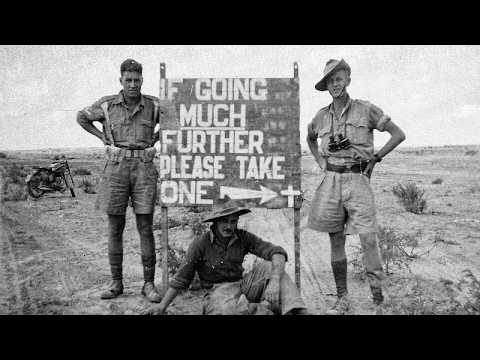
Just after midnight on 26 October 1942, the lead companies of the 9th Australian Division began crossing open ground in the dark toward a German artillery observation tower southwest of Tel el Eisa. The tower stood six meters tall, sandbagged at the base, and crawling with German spotters and machine gun crews at the top. It had eyes on every move the British Eighth Army made for kilometers around, and its guns had been calling fire down on Australian positions for weeks. The Germans called it Hill 28 on their maps; the Australians called it Trig 29. Taking it would mean breaking the spine of Rommel’s northern line at El Alamein, and the men crossing the desert in the dark that morning knew it.
The men moving on the tower came from the 26th Australian Brigade under Brigadier David Whitehead. Three Australian battalions made up the brigade’s rifle strength, and every one of them had been at Tobruk through the long siege of 1941. Behind them in the dark rolled 30 British tanks from the 40th Royal Tank Regiment, armored support attached to Australian infantry, not the other way around. Every digger in the assault wave understood what that meant. The riflemen walking toward the German machine guns were Australian, and the British armor was working for them.
The fight for Trig 29 took the rest of the night. Bren guns on fixed lines tore into the German parapets. Grenades went over the sandbags at point-blank range, and Australian sections worked through the bunkers at the base of the tower one slit trench at a time. By first light, the position had fallen, and 240 German and Italian prisoners were already on their way back toward the cages. The concrete tower that had dominated the El Alamein sector for months belonged to the 9th Australian Division.
Rommel, back from sick leave in Germany only a day earlier, looked at his maps in the divisional headquarters and understood what had happened. The British were trying to break through in the north, and the Australian position at Trig 29 was the leading edge of the attempt. He had no choice but to pull the 21st Panzer Division up from the southern sector and commit the last of his armored reserves against the Australians on the coast. The elite of the Panzer Army Africa was now fixed in place in front of a single Australian division, while the rest of the Eighth Army front hadn’t yet shown its hand.
The 9th Australian Division was doing exactly what Montgomery wanted them to do. They were the bait. While Rommel poured his last fuel and his last armor into the northern sector against the diggers on the coast, the actual breakthrough was being prepared in the center of the line, just south of them, against the part of the front Rommel had stripped bare to send help north. The Australians were a small fraction of Montgomery’s army at El Alamein on the order of battle. Before the battle was over, the 9th Division would take one in every five Eighth Army casualties in 12 days of fighting, the highest per capita figure of any formation in Montgomery’s army by a wide margin.
Montgomery picked the 9th Australian Division for the northern sector for a reason that went back four months. In the brutal heat of July 1942, the same division had done something at El Alamein that no other Eighth Army formation had managed to do all summer. They had attacked a German position in the desert, and they had held it under counterattack. The Eighth Army had been retreating from one defensive position to the next for the better part of a year before that morning. To understand the price the diggers paid in October, you have to start with what they had done in July when the line was about to break.
The 9th Division arrived in Egypt in early July 1942 with a reputation already burned into the Wehrmacht. These were the men who had held Tobruk through 242 days of siege the year before, the original Rats of Tobruk. They had since been on garrison duty in Syria and were back in the desert just as Rommel reached the gates of Alexandria. The commanding officer was Lieutenant General Sir Leslie Morshead, and his own troops called him Ming the Merciless behind his back after the comic book villain. He took it as a compliment.
Leslie Morshead was 53 years old when he brought the 9th Australian Division back to the desert. He had served as a junior infantry officer on Gallipoli in 1915 and commanded a battalion on the Western Front through the rest of the First War. He was known in the Australian Imperial Force as a commander who would replace any subordinate officer who hesitated under fire. The Tobruk garrison had given him the Ming the Merciless nickname during the siege the year before after the villain in the Flash Gordon newspaper strips of the 1930s. By July 1942, he had spent the better part of three years training infantry to attack German positions in the dark, and the 9th Division was the result of that training.
The Eighth Army Morshead joined in July was a beaten force. Tobruk had fallen the month before. 25,000 prisoners had gone into the bag—the worst British surrender of the war so far and a defeat that nearly cost Churchill his government in a Commons vote of no confidence. The Eighth had retreated 400 kilometers back to the El Alamein line, a 60-kilometer bottleneck between the Mediterranean coast and the impassable Qattara Depression. There was nothing behind them now except the Nile Delta and the Suez Canal, and if the line broke at El Alamein, Egypt was gone, with the British war effort in the Middle East gone with it.
On 10 July, six days after disembarking from his troop train at the railhead behind the line, Morshead sent the 26th Brigade forward against the German positions at Tel el Eisa. The attack was brutal and direct. Australian infantry walked into Italian and German trench lines behind a creeping artillery barrage, and by the end of the day, the low ridge at Tel el Eisa was an Australian position. 240 prisoners came in. So did something far more valuable than any of them.
Inside the captured headquarters of the 621st German Radio Intercept Company, Australian intelligence officers found the cipher equipment and the operational logs of the unit that had been reading Eighth Army radio traffic for over a year. The implications were enormous for the British war effort across the entire Mediterranean theater. Rommel’s ability to anticipate every British move in the desert had been built on that one company’s intercept work, and the 9th Australian Division had just blinded him in the radio waves. The captured documents were on their way to Eighth Army headquarters in Cairo within hours of the Australian sections clearing the building. And the German officer who had built the intercept operation from scratch in the desert was lost to wounds taken in the same action.
The intelligence picture available to the Eighth Army in the months before Operation Lightfoot was the most complete it had ever been in the desert war. Code breakers at Bletchley Park were reading high-level German signals through the Ultra channel. The Tel el Eisa capture had taken out one of Rommel’s most important tactical intercept units back in July. By October, the Eighth Army knew the order of battle and the supply state of every German formation on the El Alamein line, and could time its build-up against the fuel deliveries Rommel was getting from Italy across the Mediterranean.
Through the rest of July, the 9th Australian Division kept attacking. They went in on Ruin Ridge on the 22nd, a position they were ordered to take and then ordered to hold against German tanks they couldn’t stop. The casualties were heavy through that fortnight, with one of the 24th Brigade’s battalions taking severe losses in a single morning’s action against dug-in German armor. By the end of the month, the division had taken over 2,000 losses, but the line at El Alamein was holding and the diggers hadn’t given a meter back. The Eighth Army’s first offensive success of the Desert War had been delivered by Australian infantry walking forward into machine guns under a barrage.
In August 1942, Bernard Montgomery arrived to take command of the Eighth Army. He sacked half the existing staff in his first week and threw out the operational plans they had been working on for the summer. He gave himself three months to build a new offensive from scratch. Fresh infantry came up from the Nile Delta, and 300 American Sherman tanks were landed at Alexandria for the build-up. The 9th Australian Division held the most exposed sector of the front through the whole period, dug in against the strongest part of the Axis line and waiting for the order to attack.
Montgomery’s plan, code-named Operation Lightfoot, was a set-piece breakthrough on a 15-kilometer front. Infantry would clear corridors through the Axis minefields under a massive artillery barrage, and tanks would exploit through those corridors into the open desert beyond. Half a million mines had been laid across the El Alamein front through the summer, a defensive belt deeper than anything either army had built before in the desert. Lightfoot depended on one thing above all. Axis armored reserves had to be drawn away from where the actual breakthrough was going to happen. And that job, pulling the elite of the Panzer Army onto themselves, went to the 9th Australian Division on the coast.
The Panzer Army Africa facing them in late October was the cream of the Axis military in North Africa. Erwin Rommel commanded the army on paper, though he was on sick leave in Germany when the battle started. His deputy, Georg Stumme, would lose his life to a heart attack in his staff car on the second day of fighting. The German 164th Light Division held the coastal sector north of Tel el Eisa with the 90th Light Division in reserve behind it, while the armored striking force was split between the 15th Panzer Division in the north and the 21st Panzer Division in the south of the El Alamein line. Italian formations made up the bulk of the numbers, including the Trento and Bologna divisions on the central front, but the Germans were the spine of the whole defense.
On the night of 22 October, the 9th Australian Division was in its forming-up positions along the northernmost stretch of the El Alamein line. Every man in the formation knew the assault was going in the next night. Most of them had already been at Tel el Eisa in July and at Ruin Ridge in the dust storms of August. The division had been at El Alamein continuously for three and a half months, and the original Tobruk veterans were thinned out across the battalions. What they had ahead of them was the heaviest set-piece attack in British Army history since the Western Front of 1918.
By the time Operation Supercharge went in on the night of 1 November, the German armored force in North Africa had spent itself against the Australians on the coast. Both Panzer divisions were down to a handful of operational tanks each. Rommel’s army had no reserves left to commit to the center of the line, where the New Zealanders and British armor were now coming through.
The Axis retreat began on 4 November. Over the next three months, the Panzer Army Africa would fall back 2,400 kilometers to Tunisia, losing 95 percent of its tanks along the way. Tobruk—the port the same Australians had held for 242 days in 1941—was back in British hands by mid-November.
Across the El Alamein campaigns, the 9th Division’s casualty list ran to 5,809 men. Montgomery wrote afterwards that the battle couldn’t have been won in 12 days without the magnificent 9th Australian Division. He didn’t know of any other Allied division he could have asked to do what the 9th had done.
A survivor, asked decades later what El Alamein had been like, said he hadn’t really had time to be frightened. That was about the level of explanation the division ever offered. They had broken the spine of a German army, and then they mostly just got on with the rest of their lives.
Was the 9th Australian Division’s role at El Alamein the most underrated contribution of the entire Desert War? Share your thoughts below.
Report this article
Select a reason for reporting:






