There is a name whispered by American veterans—a name you won’t find in most history books. It belongs to a man who flew a plane so fragile a single rifle shot could bring it down, yet he used it to hold back an entire battalion. For 11 hours, he was the only thing standing between an American patrol and a shallow grave. He wasn’t one of theirs, yet he refused to leave them behind.
Who was this Australian pilot who earned America’s highest honors, only to vanish into the shadows of a tragic fate? This is the story of Vance Drummond.
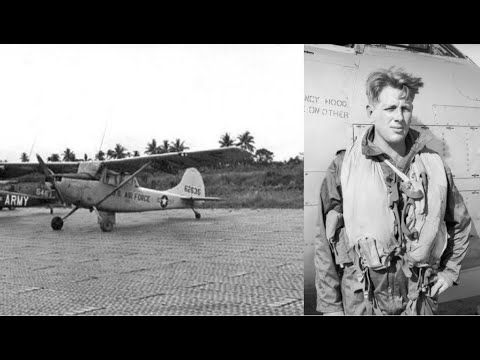
The jungle of Vietnam was never truly silent, but on this morning in 1965, deep within the Central Highlands, a U.S. Army patrol was screaming into their radios. The sound of their voices was barely audible over the relentless clack-clack-clack of heavy machine guns and the earth-shaking crump of mortar rounds.
They were pinned down in a kill zone, a patch of dense scrub where the green canopy offered no protection against the jagged shards of hot steel raining down from three sides. Medics struggled to patch up wounded soldiers while hunched in the mud, their hands slick with crimson as they worked under a canopy of flying lead.
Every time a soldier tried to raise his head to identify the muzzle flashes hidden in the tree line, a volley of sniper fire would kick up the dirt inches from his face. The radio operator, his eyes wide with a mixture of terror and grim determination, shouted the same desperate plea into the handset: “Request immediate air support. We are taking heavy fire. Danger close. I repeat, danger close.”
High above the churning smoke and the emerald roof of the forest, the deafening roar of the battlefield fades into the steady mechanical hum of a single-engine cockpit. Here, the air is cooler, and the chaos below is translated into frantic bursts of static and urgent coordinates through a headset.
Inside the cramped cabin of a Cessna O-1 Bird Dog, a man sits with a calmness that seems almost supernatural given the carnage beneath his wings. He is not wearing the patches of the United States Air Force. Instead, the small kangaroo on his uniform identifies him as a member of the Royal Australian Air Force.
This is Squadron Leader Vance Drummond. With a grease pencil in one hand and his eyes locked onto the shifting patterns of smoke and muzzle flashes below, he begins to calculate the geometry of survival. Drummond isn’t just flying—he is dissecting the battlefield. He ignores the tracers reaching up like glowing red fingers to snatch his fragile, unarmored plane from the sky.
He focuses on the seam between the American patrol and the North Vietnamese ambushers. In a war defined by overwhelming noise and indiscriminate firepower, Drummond represents a different kind of power: the quiet, calculated heroism of a man who knows that a single degree of error in his calculations could mean the end for the men bleeding in the mud.
He banks his plane into a steep, harrowing turn, his thumb resting on the rocket release. The angel from down under has arrived, and the sky is about to answer the prayers of the trapped.
To understand the man circling the fires of Vietnam, one must look back to a different war in a different sky. Vance Drummond was a seasoned warrior whose character had been forged in the freezing altitudes of the Korean Peninsula over a decade earlier.
During a high-stakes mission in 1951, his Gloster Meteor was shot down by Soviet-built MiG-15s. He bailed out only to be plunged into 23 months as a prisoner of war in North Korea. He did not break. Instead, he observed. He survived.
When released in 1953, he returned not as a broken man, but as a veteran who understood the terrifying weight of being left behind. Most men would have sought a desk job. Drummond fought to stay in the cockpit.
By the time Vietnam escalated, he had risen to squadron leader and was selected for the USAF Exchange Program, embedded with the 19th Tactical Air Support Squadron as a forward air controller. He knew exactly what was at stake for the men on the ground.
He earned a reputation for unconventional accuracy, circling a contact area for hours, refusing to leave until he was certain of the target’s location. Soon the nickname circulated through foxholes: “We have an Australian angel up there.”
The ultimate test came during a mission that lasted an incredible 11 hours. A U.S. Army long-range patrol was ambushed in a remote valley. Drummond arrived on station and refused to let a ticking clock dictate the fate of the men below.
As his fuel ran dangerously low, he performed hot refuels at a primitive dirt strip—landing, gassing up with the engine still running, and leaping back into the sky within minutes. He had made a silent pact: he would not leave until every American soldier was out.
He coordinated a complex web of assets—F-4 Phantoms, Huey gunships, and Dust Off medevac helicopters—talking the jets onto targets often less than 50 meters from the American line. By the 11th hour, his eyes were bloodshot, but his voice remained the same calm, steady lilt.
Through his tireless coordination, he held back an entire enemy battalion, creating a window for the extraction helicopters. When the last soldier was winched up, Drummond was still there, circling like a faithful sentry.
The U.S. military took the exceptional step of recommending him for the Distinguished Flying Cross. One veteran recalled: “We were waiting for the end, and then this voice with an Aussie accent comes on and tells us to hang tight. And he didn’t. He stayed until the last man was winched up.”
Upon returning to Australia, Drummond was promoted to Wing Commander and given command of No. 75 Squadron, flying the supersonic Mirage III. But the sky that had been his sanctuary finally claimed him.
On May 17th, 1967, during a training exercise off New South Wales, his Mirage entered a catastrophic flat spin. Wing Commander Vance Drummond made his final descent into the Pacific Ocean. He was only 39 years old.
Today, few in Sydney or Melbourne would recognize his name. There are no grand statues, no cinematic epics. Yet to the American veterans he saved, he is not a footnote. He is the reason they returned home.
Vance Drummond proved that mateship is a universal language. It doesn’t matter if the accent is from the Outback or the Midwest when the goal is to bring everyone home alive.
Have you ever heard of an unsung hero whose story deserves to be told? Share their name in the comments below.
Report this article
Select a reason for reporting:






