The sky over Europe was a killing field, and the Allies were losing. German fighters, led by the fearsome Focke-Wulf Fw 190, tore through British and American bomber formations with impunity. “The Butcher Bird” they called it—a radial-engined monster that outclassed everything the RAF could throw at it. In the desperate summer of 1941, a group of Spitfire pilots encountered these new German fighters for the first time. They never came back.
It was a wake-up call that shattered British complacency. The Luftwaffe had seized air superiority, and the Allies needed a miracle. That miracle would come from an unlikely marriage: an American airframe and a British engine, brought together by a twist of fate and the stubbornness of a few visionaries.
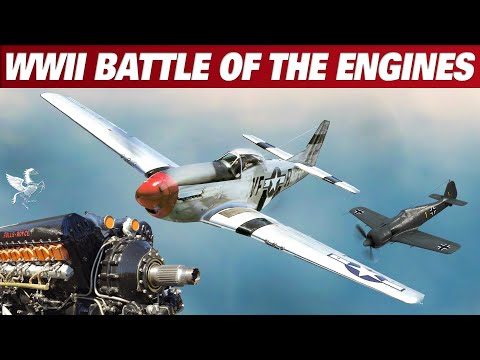
But to understand how the P-51 Mustang became the war-winning weapon it was, we must go back—back to the birth of flight itself, and the furious race to build the perfect engine. From the Wright brothers’ fragile 12-horsepower motor to the roaring V12s of the 1930s, every ounce of power was bought with blood and genius.
In Europe, speed was everything. British and German designers pushed their inline engines to the limit, creating legends like the Spitfire and the Messerschmitt Bf 109. Meanwhile, America clung to radial engines—reliable, but not fast enough for the high-altitude duels over Fortress Europe.
Then came Kurt Tank, the maverick German designer who did the unthinkable: he built a world-class fighter around a radial engine. The Fw 190 was an instant terror. Its BMW 801 engine delivered brutal power, and its sleek airframe could out-turn and out-run anything the Allies had.
For the RAF, the shock was profound. “We lost our edge,” one pilot recalled. Desperate, they turned to Rolls-Royce and its legendary Merlin engine. The solution? A two-stage supercharger that could unleash unheard-of power at high altitude. The result was the Spitfire Mk IX—a match for the Fw 190, but not a war-winner.
What Britain needed was range: a fighter that could escort bombers all the way to Berlin and back. And that fighter was already taking shape across the Atlantic—a sleek, laminar-winged machine called the Mustang.
The Mustang was born from a British request and built by North American Aviation in a staggering 117 days. Its designer, Edgar Schmued, crafted an airframe with a laminar-flow wing that sliced through the air with minimal drag. It was a thoroughbred, but it had a weak heart. The Allison V-1710 engine, while reliable, lost power rapidly above 15,000 feet—exactly where the air war was being fought.
Enter Rolls-Royce test pilot Ronald Harker. In April 1942, he flew a Mustang I and saw its potential immediately. “The airframe is superb,” he reported. “But the engine is holding it back.” Harker proposed bolting the two-stage Merlin 61 into the Mustang. The math was staggering: the combination would create a fighter with speed, agility, and—crucially—range that no other aircraft could match.
The marriage was not immediate. The British Air Ministry resisted, and the Americans were skeptical. But Harker and his allies at Rolls-Royce pushed relentlessly. By late 1942, the first Merlin-powered Mustang took to the skies. The transformation was breathtaking. The aircraft now had a service ceiling of over 40,000 feet and a top speed exceeding 440 miles per hour.
In America, Packard began license-building the Merlin as the V-1650. The P-51B and P-51C models rolled off the lines, equipped with drop tanks that extended their range to over 1,800 miles. At last, the Allies had an escort fighter that could go the distance.
When the first Mustangs arrived in England in late 1943, RAF pilots were stunned. “It was a revelation,” recalled Air Vice-Marshal “Paddy” Harbison. “More comfortable than the Spitfire, and with legs that could take you to Berlin and back.” The Mustang was not just a match for the Fw 190—it was superior.
The Merlin-powered Mustang entered combat at a critical moment. The U.S. Eighth Air Force was suffering catastrophic losses, with bomber crews facing relentless attacks from German fighters. The P-51B and P-51C, with their extended range, arrived just in time. They could escort the heavy bombers all the way to Berlin and back, a feat no other Allied fighter could achieve.
On December 1, 1943, the first Mustang mission over Germany took place. The results were immediate. German pilots, accustomed to easy kills, were suddenly confronted by an enemy fighter that could outrun, outclimb, and outturn them at high altitude. The Fw 190, once the terror of the skies, now met its match.
Luftwaffe commander Hermann Göring was stunned. “When I saw the Mustangs over Berlin, I knew the jig was up,” he later admitted. The tide had turned.
But the Mustang was not finished evolving. The P-51D, with its bubble canopy and six .50-caliber machine guns, became the definitive version. Its range and firepower made it the ultimate escort fighter, and it also excelled in ground attack. By mid-1944, Mustangs were sweeping the skies clear of German opposition, paving the way for the Normandy invasion.
Meanwhile, in the Pacific, a new challenge emerged. The vast distances of the ocean made even the Mustang’s range insufficient for escorting B-29 Superfortresses. North American’s solution was radical: the twin Mustang, or F-82. Two fuselages joined by a common wing, it had a range of over 2,000 miles. But the war ended before it could see combat.
After World War II, the Mustang continued to serve. It fought in Korea as a ground-attack aircraft, proving its versatility. And in a twist of fate, the F-82 scored the first aerial kill of the Korean War. The Mustang’s legacy was secure.
Yet the true measure of the Mustang’s greatness lies not in its combat record alone, but in the fragile chain of decisions that brought it to life. Had the British Air Ministry not swallowed its pride, had Ronald Harker not pushed so relentlessly, had Packard not secured the Merlin license—the war might have ended differently. The Mustang was never inevitable. It was a triumph of collaboration over bureaucracy.
Frank Whittle, the man who gave the world the jet engine, watched from the sidelines as his own nation nearly discarded his vision. “I was quite astonished to know what it was,” recalled Eric Brown of his first jet flight, “because it had no propeller.” The jet age arrived just as the Mustang’s piston-driven era peaked—a passing of the torch.
Today, the P-51 Mustang sits in museums beside the Spitfire and the Messerschmitt, silent witnesses to a time when engineering genius and human courage collided. Its story reminds us that the greatest weapons are not forged by nations alone, but by the unlikely partnerships that defy them.
So here is the question that lingers: if a single engine swap could change the course of a world war, what quiet collaboration today might be waiting for someone to see its potential? What would you have done differently?
Report this article
Select a reason for reporting:






