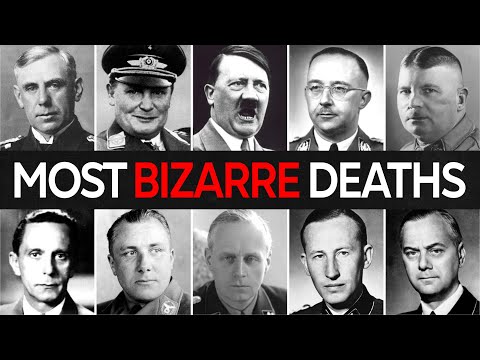
In the end, the Reich didn’t fall in glory. It tripped over its own shoelaces. These were the men who dreamed of a thousand-year empire and exited like punchlines in a tragic farce. From botched disguises and poison skin care to fatal tantrums and staircase showdowns, these are the 33 dumbest, most avoidable Nazi deaths. Each more absurd than the last. No glory, no martyrdom, just irony, incompetence, and poetic collapse. Because sometimes evil doesn’t go out with a bang. It slips on its own ego and falls down the stairs.
Before we dive in, make sure you’re subscribed so you never miss a dive into the strange, the dark, and the accidentally hilarious. Drop a comment below: Where in the world are you watching from, and what time is it right now? We’re always curious who’s out there staying up late with us to watch history face plant.
One. Adolf Hitler. It’s almost poetic that the man who claimed to control the fate of Europe ended up arguing with a map. By April 1945, Hitler was a bunker-dwelling ghost, barking orders at divisions that didn’t exist and shuffling pins on a table like they were chess pieces, not evidence of actual cities on fire. His staff tiptoed around his delusions, afraid to mention that his vaunted alpine fortress was a fantasy and his reinforcements were imaginary.
He could have fled. He could have negotiated. He could have at least gone outside, but instead he chose to stay underground, hunched over fantasy battle plans while the walls literally shook from Soviet artillery. His final decision: die inside the metaphor he created. Not a martyr, not a warrior, just a stubborn man playing general with fake armies until the ceiling collapsed. The real irony? He lived long enough to see himself lose and still refused to believe it.
Of course, he wasn’t the only one who thought vanity could outsmart reality.
Two. Hermann Göring. You’d think the man who once ran the Luftwaffe would meet his end in a blaze of misguided glory. But no, Hermann Göring went out like a pageant diva denied her crown. Once Hitler’s golden boy, he spiraled into ridicule as his drug habit ballooned along with his body weight. By the time the Allies caught him, he looked like a rhinestone-draped parody of his former self, strutting through Nuremberg with a velvet swagger.
Convicted and sentenced to hang, he still thought he could win the final round with charm. But Göring had one last trick, and it came in the form of a cyanide capsule hidden in a jar of face cream. Yes, the feared Reichsmarschall smuggled his way out of justice using his skincare routine. The Allies had him in the most secure prison in the world, but they didn’t check his moisturizer. And just like that, the most flamboyant fascist oiled his way out of the noose while another was about to bite down harder.
If you’ve made it this far, you clearly have a taste for the tragically ridiculous. So go ahead and subscribe for more deep dives into history’s strangest unravelings. And while you’re here, tell us in the comments: where are you tuning in from, and what time is it as you watch this madness unfold? We’re watching the fall of fascism. One absurd misstep at a time.
Three. Heinrich Himmler. Heinrich Himmler’s death wasn’t grand. It wasn’t cinematic. It was awkward, pathetic, a bureaucrat’s exit. This was the man who built the SS like a franchise, who turned mass surveillance into a murderous science, who strutted like a priest of pure bloodlines, and who died because he couldn’t sit still in a dentist’s chair.
After disguising himself in the chaotic collapse of the Reich, Himmler was caught by British soldiers who didn’t even recognize him at first. But during a routine mouth inspection—standard procedure for high-value prisoners—he panicked and in a clumsy, twitchy move, he bit down on the cyanide capsule he’d been hiding in his cheek. That was it. No dramatic last words, no clever twist, just a whimper during a dental check. The man who dreamed of a thousand-year empire killed himself like a sitcom spy caught with stolen gum.
Fitting, really, that his cowardice was outdone by the man who refused to even step outside.
Four. Joseph Goebbels. Joseph Goebbels was a man who lived and died by narrative control. The master propagandist who once convinced an entire nation that losing was winning ended up cornered by the one truth he couldn’t spin: the war was over, and it wasn’t in his favor. Berlin was collapsing. His escape routes were open. His rank could have bought him time. But Goebbels chose the bunker, not because he believed in Hitler’s last-minute miracle, but because he couldn’t bear the optics of surrender.
He loathed the bunker. He knew Hitler’s wonder weapons were fiction. And still he stayed. Why? Because walking outside would have meant admitting the story was over. That the Reich was a bad script with no third act. He didn’t die for ideology. He died for PR consistency. His final act wasn’t martyrdom. It was brand loyalty.
Of course, some Nazis didn’t wait for poetic endings. They improvised their own with towels and hubris.
Five. Robert Ley. Robert Ley bragged a lot. He bragged about his rank, his power, his drinking capacity, and strangely about how important he was to the Nazi cause. So important, he claimed, that no jail cell could hold him. He made bold speeches during his captivity, telling guards that he’d show the world what dignity looked like under duress.
What the world actually saw was a man who twisted a towel into a rope and strangled himself in the most embarrassingly inefficient way imaginable. Ley’s cell wasn’t a dungeon. It was a standard Allied holding room with apparently enough slack linen for a poorly planned exit. It wasn’t noble. It wasn’t graceful. It was the bureaucratic equivalent of tripping on your own shoelaces while yelling, “I’m invincible.” His ego wrote a check his coordination couldn’t cash.
Compare that to the next guy, who met his end not with flair, but with awkward silence and weirdly specific pride.
Six. Ernst Röhm. Ernst Röhm had options. Not good ones, mind you, but options nonetheless. After being arrested during the infamous Night of the Long Knives—a purge orchestrated by his old friend Hitler—he was offered the barest scrap of dignity: a pistol, a chance to take the honorable way out. Röhm declined. Not with a fight, not with tears. He just sat there in a cell, quiet, waiting.
He refused to defend himself at his sham trial. Refused to flee when warned. Refused to even stand when the guards came to kill him. Maybe it was pride. Maybe it was confusion. Maybe he genuinely thought this was just another power game he could win by doing nothing. But the clock ran out, and Röhm did what he did best: absolutely nothing, until the bullets did the rest. His death wasn’t tragic or brave. It was slow-motion denial in khaki.
And denial would become a running theme—especially for the philosopher who never understood why people were mad at him.
Seven. Alfred Rosenberg. Alfred Rosenberg was supposed to be the intellectual of the Nazi regime—a term here used as loosely as a belt in a collapsing pants factory. He wrote dense books no one finished, made speeches no one listened to, and championed an ideology even other Nazis found convoluted. At Nuremberg, he sat calmly, as if the trial were just an inconvenient seminar.
His defense? Confusion. He didn’t understand the charges, didn’t understand the outrage, didn’t even understand why anyone was looking at him. He insisted he had no power, no real influence, and certainly no responsibility. He was just there. Watching. Writing the human shrug emoji of fascism. He died not because of guilt, but because of genuine bafflement that anyone might think he was guilty—a man executed for crimes he didn’t think were crimes, by a world that finally disagreed.
And yet, compared to the next guy, Rosenberg looked almost self-aware.
Eight. Joachim von Ribbentrop. If arrogance were a survival tactic, Joachim von Ribbentrop would have lived forever. Once Hitler’s foreign minister, Ribbentrop styled himself as a genius diplomat, despite leaving behind a trail of failed negotiations, ruined alliances, and unread treaties. At Nuremberg, he took that same delusion and cranked it to eleven.
While awaiting execution, he frantically told his guards that everyone else was more guilty than him. Himmler. Göring. The guy who served the coffee, probably. He wasn’t pleading. He was snitching. He believed throwing everyone under the bus would spare him from its wheels. But no one cared. His attempts at self-exoneration were so transparent they became jokes. Even his last words were a muddled tangle of self-pity and name-dropping. In the end, he died as he lived: overconfident, underwhelming, and entirely misreading the room.
The next man, meanwhile, wasn’t misreading anything. He just couldn’t put the bottle down long enough to leave the bunker.
Nine. Wilhelm Burgdorf. Wilhelm Burgdorf drank like the world was ending—which, in fairness, it was. As Berlin crumbled, Burgdorf clung to Hitler like a barfly to a sinking stool. Unlike others who used the chaos as an excuse to flee, bargain, or fake a change of heart, Burgdorf doubled down. He drank, barked orders, and swore loyalty to a man who had already told him, “Do what you want.”
That was permission to leave. A golden ticket out. But instead, Burgdorf stayed in the bunker, pickled and defiant, insisting he’d go down with the ship, even though no one had asked him to. His death wasn’t one of duty. It was one of toxic loyalty and alcoholic inertia. He could have lived. Instead, he poured another drink and waited for history to collapse on top of him.
His drinking buddy didn’t fare much better—especially when his final act was getting rejected by the Soviets.
Ten. Hans Krebs. Hans Krebs fancied himself a negotiator—unfortunate, since by the time he tried, the Soviets had already decided there was nothing left to negotiate. In the final days of Berlin, with artillery flattening the streets above, Krebs emerged from the bunker with a peace proposal in hand, presuming Germany still had leverage. They looked at his proposal like it was a restaurant menu written in crayon. He returned with no deal, no response, and no future. Humiliated, he saw no way out. His death was less about defeat than ego collapse. He didn’t die in battle. He died because no one took him seriously.
Eleven. Ernst Kaltenbrunner. Ernst Kaltenbrunner was one of the highest-ranking officials in the SS, yet when captured, he attempted the classic toddler defense: “Wasn’t me.” Standing nearly two meters tall with a face like a Bond villain, he tried to convince the Allies he was merely a bureaucratic bystander. His excuse was so disconnected from reality that it made the prosecutor’s job almost too easy. He leaned into the “who, me?” routine while everyone else read from documents signed by his own hand. His downfall wasn’t just evil—it was arrogant incompetence masquerading as cluelessness.
Twelve. Fritz Sauckel. Fritz Sauckel had a strange approach to courtroom survival: try to win everyone over by claiming he had the biggest heart in the Reich. This from the man who orchestrated mass forced labor across Europe. At Nuremberg, Sauckel insisted he was simply a misunderstood family man with a generous soul—the kindest Nazi, as if that were a competitive title. He spoke about morality and faith as if quoting scripture would unchain the workers he’d trafficked. The prosecutors didn’t need to build a case; they just let him talk. His execution wasn’t just for what he did—it was for how casually he pretended it wasn’t happening.
Thirteen. Otto Günsche. Otto Günsche was the kind of loyalist who made loyalty look like a full-time delusion. As Hitler’s personal adjutant, he’d been tasked with many bizarre duties, but in the final hours, his one remaining job was to guard the Führer’s remains—not Hitler, not the bunker, just the charred remnants of the man who’d set Europe on fire. The Soviets were minutes away. Survival was still an option. But Günsche chose to stand watch over a pile of scorched debris as if it were sacred treasure. He ended up a footnote in Soviet archives, captured and interrogated for guarding a ghost.
Fourteen. Martin Bormann. Martin Bormann, Hitler’s private secretary and power behind the throne, was never meant for fieldwork. A backroom manipulator, he thrived in shadowy meetings, not high-stakes escape plans across bombed-out Berlin. But when the bunker emptied, Bormann tried to flee undercover of darkness, dressed as a civilian with a fake identity and a suicide capsule. And then it all unraveled. He tripped, fell, possibly broke something. In the confusion, he bit down on the cyanide—either on purpose or by clumsy reflex. The man who had climbed to the heart of Nazi power died half-buried in rubble, mistaken for a looter for decades. His last act wasn’t a speech or a standoff. It was a pratfall into oblivion.
Fifteen. Walter Frentz. Walter Frentz had one job: capture the grandeur of Hitler’s Reich on film. As Hitler’s personal cameraman, he stood closer to the inner circle than most generals, yet remained largely invisible. That anonymity might have saved him—if only he hadn’t taken it so personally. When the end came and Hitler was choosing who to evacuate by plane, Frentz didn’t make the list. It was probably an oversight, maybe even intentional. Either way, Frentz took it as a cosmic insult. He had filmed the Reich’s rise, its parades, its propaganda dreams—and now no one cared. He wasn’t in the script anymore, so he checked out—not because he was hunted, but because he was forgotten.
Sixteen. Ludwig Stumpfegger. Ludwig Stumpfegger was Hitler’s personal surgeon—an unsettling job title made worse by his eagerness to hold it. Known for carrying cyanide capsules at all times like breath mints, he was paranoid, precise, and fully prepared for things to go wrong. So naturally, when Berlin turned into a firestorm, he joined the group attempting to flee. But fleeing required coordination, something the Nazis severely lacked. In the chaos, disoriented and panicking, Stumpfegger either mistook his own cyanide capsule for something else or decided the situation was beyond repair. He died not in a hospital or operating theater, but in a pile of concrete, consumed by the very fear he had rehearsed for. It wasn’t loyalty. It wasn’t bravery. It was overprepared doom.
Seventeen. General Georg-Hans Reinhardt. General Georg-Hans Reinhardt wasn’t supposed to die in battle. He was trying to surrender. As the Allies closed in, Reinhardt chose the rational route: wave the white flag and head west toward the Americans. That was the plan. That’s what his map told him. Unfortunately, he misread the coordinates or trusted a bad guide. Instead of greeting GIs with arms raised, he wandered straight into Soviet lines. The Soviets didn’t welcome him as a POW. They saw a German general walking toward them and acted accordingly. The irony is excruciating: a man who understood military logistics better than most died because he got lost on his way to surrender.
Eighteen. General Friedrich Fromm. Friedrich Fromm had a gift for picking the wrong time to do the right thing. After the failed July 20th plot to assassinate Hitler, Fromm, who had been dancing between loyalty and quiet resistance, panicked. Instead of owning up or staying silent, he decided to save face by executing the actual conspirators immediately. No trial, no strategy—just a snap decision meant to say, “See, I’m still on your side.” But it was too late. His hesitation had already been noted, and his desperate cleanup only made him look guiltier. He died not because he betrayed Hitler, but because he couldn’t make up his mind fast enough. In a regime built on brutality, Fromm tried subtlety, and it killed him.
Nineteen. General Erich Fellgiebel. Erich Fellgiebel had one fatal flaw: he couldn’t keep a secret to save his life. Literally. As a key player in the July 20th plot, he was responsible for cutting communication lines after the bomb went off. But after the attempt failed, Fellgiebel started bragging about his involvement while in custody—not to enemies, not in court, but to fellow prisoners. Maybe he thought he’d be seen as a hero in postwar history. Instead, he fast-tracked his own execution. The Gestapo didn’t need to dig deep. He practically handed them a signed confession with a flourish. His death wasn’t a tragedy of circumstance. It was a masterclass in self-sabotage.
Twenty. Reinhard Heydrich. Reinhard Heydrich, architect of terror and human ice sculpture, thought he was unkillable. When Czech resistance fighters ambushed his car in Prague, Heydrich did what only a Nazi demigod would do: he stood up, inspected the damage, waved away help, and declined immediate medical treatment. He even told one of the attackers that they’d barely scratched him. The reality: shrapnel had pierced him in several places. Infections set in quickly. But Heydrich, convinced of his own indestructibility, delayed hospitalization until it was too late. He didn’t die in a firefight. He died of pride and untreated wounds because he was too arrogant to admit he wasn’t invincible.
Twenty-One. Dietrich Eckart. Dietrich Eckart styled himself as a spiritual visionary, a poet, an occultist, a mentor to Hitler. Unfortunately, he also had a dangerous fondness for self-prescribed magical remedies and an utter disregard for medical advice. Eckart insisted that traditional doctors were part of a corrupt order and that his body answered only to higher powers. So he consumed a cocktail of mysticism and chemicals, convinced it was divine fuel. It wasn’t. His health deteriorated rapidly. He ignored every warning. When his organs started failing, he chalked it up to spiritual cleansing. He didn’t die for a cause or from an attack. He died from believing his own nonsense.
Twenty-Two. Karl Hanke. Karl Hanke’s escape plan had one fatal flaw: he thought putting on a dress would make him invisible. The last Nazi Gauleiter of Lower Silesia, Hanke was surrounded, out of options, and clearly inspired by slapstick comedies. In a final panicked attempt to flee, he disguised himself as a woman—long coat, shawl, skirt, and his full beard. That’s right. He forgot to shave. Or maybe he thought no one would notice. Either way, the result was instant failure. He was spotted, arrested, and quickly recognized. His final act was less an escape and more a tragic farce—proof that even fascists can’t pull off drag without commitment.
Twenty-Three. Adolf Wagner. Adolf Wagner had a talent for turning meals into statements. Known for his hardline views and theatrical speeches, he once tried to prove how indestructible he was by downing a cocktail of alcohol mixed with chemicals that were at best questionably edible. It was supposed to be a performance—a “look how strong I am” moment. Instead, it became a case study in toxic bravado. He collapsed not long after, the contents of his guts waging war against his ego. Wagner didn’t die fighting the Allies or leading troops. He died trying to show off. In the end, his toast became a cautionary tale.
Twenty-Four. Franz Kutschera. Franz Kutschera’s death is a reminder that sometimes the stairs really are out to get you. As the Allies advanced, Kutschera attempted a last-minute escape from his position. No elaborate plan, no convoy—just a quick, clumsy dash. Unfortunately, the first obstacle he encountered was a staircase. In his frantic retreat, he slipped, fell, and suffered injuries that soon led to fatal complications. It was the most literal interpretation of falling from power imaginable. For a man who had styled himself as an immovable authority, it’s hard to imagine a more absurd exit: tripping over his own feet during a one-man retreat. His legacy wasn’t sealed by war crimes or ideology. It was sealed by gravity and poor footwear.
Twenty-Five. Fritz Bracht. Fritz Bracht had a choice—and as with many on this list, he made the worst possible one. As Gauleiter of Upper Silesia, Bracht watched the war collapse from the comfort of his lavish mountain villa. Orders to evacuate came down. The writing was on every scorched wall. But Bracht, in a fit of inflated self-worth, declared he was too important to leave. He believed the war couldn’t end without him. It didn’t. The Allies advanced. The structure failed. He died not because he was hunted, but because he couldn’t accept that the world had moved on without him. Pride convinced him to stay in a house that no longer had a future.
Twenty-Six. Karl Litzmann. Karl Litzmann had spent his whole life clinging to discipline like a lifeline. As a military officer turned Nazi official, he believed in stamina, perseverance, and never letting your enemies—or your arteries—see you falter. Which is exactly how he died. Litzmann had been warned repeatedly to rest. He was aging, weakening, visibly deteriorating. But in his mind, pausing would mean showing weakness. So he kept working, traveling, giving speeches, pushing himself beyond common sense. When he finally collapsed, he insisted on continuing. When complications arose, he again refused treatment. Rest was for traitors. Lying down was for cowards. And so Karl Litzmann became a casualty of his own ideology, worn down not by the Allies, but by the demands he placed on his own fragile body.
Twenty-Seven. Viktor Lutze. Viktor Lutze wanted to avoid being seen. That’s why in 1943 he took a high-speed drive at night with his headlights off—because nothing says low profile like barreling down a dark road in a military vehicle at top speed. Lutze had replaced Ernst Röhm as head of the SA after that infamous purge, and he’d been desperately trying to hold on to that job ever since, despite being mostly sidelined and forgotten. So when he took that late-night drive, it may have been an attempt at stealth, or maybe just a man trying to outrun irrelevance. Either way, it ended abruptly. The car veered off. The damage was massive, and Lutze didn’t walk away. His death was not in war or conspiracy. It was the product of his own reckless desire not to be noticed.
Twenty-Eight. Werner von Blomberg. Werner von Blomberg’s career didn’t collapse on the battlefield. It collapsed at the altar. As Hitler’s minister of war and a decorated field marshal, Blomberg had power, prestige, and a front-row seat to the Nazi hierarchy. Then he got married to a woman with a criminal record and a scandalous past—facts known to the Gestapo and soon everyone else. The marriage became national gossip. Himmler and Göring gleefully used it to ruin him. Blomberg, humiliated and cornered, was forced to resign. His once-sterling reputation turned into tabloid fodder, and the regime that once praised him now wanted nothing to do with him. He died shortly after in obscurity, sick and disgraced, not because of ideology or battle, but because he fell in love and refused to vet the guest list.
Twenty-Nine. Wilhelm Canaris. Wilhelm Canaris, the head of Nazi military intelligence, might have survived the war if he hadn’t kept a diary. A very detailed diary, one that outlined in suspiciously clear prose his growing disillusionment with Hitler, his secret opposition to the regime, and his knowledge of assassination plots. He was a master spy who couldn’t resist narrating his own story. And when the Nazis inevitably found it, they didn’t need a trial. They had his own words, gift-wrapped. For a man who spent his life in the shadows, manipulating whispers and decoding secrets, he fell with the grace of a loud confession. Canaris didn’t die for what he did. He died because he wrote it all down. His greatest betrayal wasn’t to Hitler, but to himself, in ink.
Thirty. Max Wünsche. Max Wünsche believed in gut instinct. He didn’t trust maps, didn’t like planning, and apparently had little regard for common military sense. As an SS officer commanding tank divisions, this was less than ideal. One day, in the thick fog of combat, he decided to go off-script, literally. He refused to consult his map, claiming that intuition would guide him. It didn’t. He got lost. Not just wrong-turn lost—completely cut off behind enemy lines. Captured by Allied forces, he was taken as a prisoner of war and eventually died in captivity. His downfall wasn’t the result of overwhelming force or betrayal. It was pure overconfidence in his own battlefield vibes. He was the Nazi equivalent of someone refusing to ask for directions and ending up in a different country.
Thirty-One. Hans-Valentin Hube. General Hans-Valentin Hube was supposed to be celebrating. He’d survived brutal campaigns on the Eastern Front, was considered a tactical genius, and had just received high military honors. A banquet was thrown in his name, complete with all the trimmings of wartime arrogance. But just as the party hit its stride, Hube boarded a plane for a brief return flight. That decision would be his last. The aircraft malfunctioned almost immediately after takeoff. The man being toasted as a hero died in a preventable crash on the very day designed to honor his survival. He wasn’t killed by the enemy. He was killed by timing, overconfidence, and a deeply ironic RSVP. His banquet was still serving dessert when news of his death arrived.
Thirty-Two. Wilhelm Nöken. Wilhelm Nöken’s death was less a dramatic fall from grace and more a slow-motion stumble into irrelevance. Once a key SS official overseeing occupied France, Nöken was arrested after the war and imprisoned by the Allies. There, in the quiet tedium of a prison cell, he met his end—not from justice or assassination, but from a clumsy accident. While cleaning his cell, he tripped, hit his head, and true to character, refused medical treatment. Why? Because he didn’t trust Allied doctors. The same man who once managed vast intelligence operations chose pride over basic first aid. What followed were complications that could have been easily avoided. But Nöken, like many on this list, let arrogance and distrust do the job history hadn’t. His fall was not symbolic. It was literal.
Thirty-Three. Paul Giesler. Paul Giesler’s end wasn’t grand. It wasn’t planned. It was just messy. As Gauleiter of Bavaria and an increasingly paranoid alcoholic, Giesler was known for outbursts and crude speeches, even by Nazi standards. But when the Reich began unraveling, so did he. In one final drunken confrontation, Giesler threatened a colleague, trying to bark his way back into relevance. But this time, someone shouted back, and it stuck. The room fell silent. Giesler realized mid-rant that no one feared him anymore. His power, like the Reich itself, had evaporated. He stormed off, reportedly muttering to himself, and disappeared behind a door. When it opened again, Giesler was gone. Not taken, not exiled—just done. His death wasn’t a symbol of resistance or martyrdom. It was the sound of someone finally realizing the nightmare was over and he no longer mattered.
And so the curtain closes—not with honor, not with clarity, but with a slow collapse of cowards, clowns, and deluded men who mistook cruelty for power. Which of these absurd exits surprised you the most—and what does it say about the regimes that produce such men? Let us know in the comments below.
Report this article
Select a reason for reporting:






