The tropical air hangs heavy with aviation fuel and sweat as Major Sam Boxes adjusts his perfectly pressed uniform one final time. It’s 4:30 p.m. on March 9th, 1945, at the Coral Air Strip on Guam, and something is terribly wrong. Unlike every other mission briefing in his 18 months of Pacific combat, today his fellow B-29 pilots are removing their .50 caliber ammunition. All of it.
Boxes, a meticulous Montana rancher turned bomber pilot, inspects every rivet and wire of his Superfortress with precision. But watching crate after crate of defensive ammunition being wheeled away, he can’t shake one terrifying question: Why would General Curtis LeMay send America’s most expensive aircraft into the most heavily defended airspace in the Pacific completely defenseless?
Across three islands—Guam, Saipan, and Tinian—334 identical scenes play out in the fading daylight. B-29 Superfortresses, each worth more than most small towns’ annual budgets, sit on coral runways being loaded not with precision bombs, but with clusters of six-pound incendiary cylinders. The mechanics joke nervously as they handle what look like oversized thermite grenades. Nobody’s laughing.
21-year-old radio operator Carl Barold watches his tail gunner Rodriguez methodically pack his personal effects into a small canvas bag. The ritual has become all too familiar: crew members organizing their belongings like men preparing for their own funeral. Rodriguez hasn’t spoken in two hours—not since the briefing revealed they’d be flying at 5,000 feet instead of their usual 28,000.
“That guy has me spooked,” Barold whispers to his navigator, nodding toward Rodriguez.
The briefing rooms buzz with incredulous conversations. Flight commanders, their voices cracking slightly, explain the revolutionary new tactics: low-level, no guns, maximum fire load. Every pilot knows Japanese anti-aircraft guns are designed to track slow, high-altitude targets. At 5,000 feet, they become sitting ducks for every machine gun, rifle, and angry civilian with a rock.
But perhaps the most unsettling detail isn’t tactical. It’s personal. For the first time in Pacific theater history, no one will tell the crews their exact target until they’re airborne. The mystery destination has a code name: Target Area X. Even the weathermen seem nervous, reporting perfect conditions for something they won’t specify—dry air, strong winds, and clear skies over the Japanese mainland.
As the sun sets behind the palm trees, painting the Pacific in shades of fire, 334 crews prepare for what they’re beginning to suspect might be either the most important mission of the war or the largest air disaster in military history. The question burning in every man’s mind is simple: What could possibly be worth sending them all to die for?
6,000 miles away, 12-year-old Katsumoto Saotoi finishes his shift at the Tokyo munitions factory as air raid sirens begin their familiar wail. It’s just past 10 p.m., and like every night for the past six months, the American B-29s are coming. Saotoi barely looks up. By now, everyone in Tokyo knows the routine: the silver bombers will cruise overhead at impossible heights, drop a few scattered bombs on military targets, and disappear back into the Pacific darkness.
What Saotoi doesn’t know as he walks through the wooden neighborhoods toward his family’s traditional home is that tonight will be different. Tonight, the Americans aren’t coming for Japan’s factories or military bases. They’re coming for him.
Tokyo in March 1945 is a city living on borrowed time, though its six million residents don’t realize it yet. The government has trained every civilian in firefighting techniques, issuing detailed instructions on how to combat incendiary attacks: form bucket brigades, soak rooftops, fight every fire immediately. The strategy has worked reasonably well against scattered bombing. Tokyo’s residents have become expert at containing small blazes before they spread.
But no one has considered what might happen if the fires were too big, too hot, and too numerous to fight.
French journalist Robert Guillain, trapped in Tokyo since Pearl Harbor, watches the familiar scene unfold from his apartment window. Japanese families emerge from their wooden homes carrying leather fire buckets and wet quilts, positioning themselves according to government instructions. Children as young as eight know their roles in the neighborhood fire brigades. The preparation has become almost choreographed. Everyone knows exactly where to stand, exactly what to do when the Americans come.
But tonight, for reasons Guillain can’t explain, something feels different. The spring air carries an unusual dryness, and the wind patterns have shifted. Weather stations across Japan are reporting conditions meteorologists describe as perfect—though perfect for what, no one will say.
3,000 miles to the southeast, the first B-29s begin their takeoff sequence as darkness falls over the Pacific. The process is carefully orchestrated: 334 bombers launching from three different islands over the course of two hours and 45 minutes. It’s the largest single bomber formation ever assembled in the Pacific theater. Yet somehow the Japanese have no advanced warning.
On Guam, Major Boxes runs through his final pre-flight checklist with mechanical precision, but his mind keeps returning to the mission briefing’s most disturbing detail: they’ll be flying at altitudes where Japanese fighters excel. Every American pilot knows that Zero fighter planes lose effectiveness above 20,000 feet—their engines simply can’t generate enough power in the thin air. But at 5,000 feet in thick tropical air, Zeros become lethal predators. Why would LeMay deliberately send them into the enemy’s strongest defensive zone?
The answer, locked in LeMay’s headquarters safe, is a weather report that changes everything. Meteorologists have identified a rare atmospheric condition over Tokyo: dry air masses from Siberia meeting warm, humid air from the Pacific, creating wind patterns that could turn small fires into massive firestorms. The Japanese weather service has the same information, but they’re interpreting it as favorable for firefighting. More wind means faster bucket brigade organization. They have no idea they’re reading their own death warrant.
Carl Barold climbs into his radio compartment as his B-29 lumbers down the coral runway. The engine noise is different tonight—heavier, more labored. Without defensive ammunition, each plane carries an additional 3,000 pounds of incendiary bombs. The aircraft are flying at maximum weight capacity, which means longer takeoff runs, higher fuel consumption, and reduced maneuverability. Every safety margin has been eliminated to carry more fire.
In Tokyo, Katsumoto Saotoi’s family gathers around their radio for the evening news broadcast. The announcer’s voice carries its usual confident tone: “American bombing raids continue to target military installations with minimal success. Japanese defenses remain strong. Citizens should continue following established firefighting procedures. The government has everything under control.”
What the announcer doesn’t mention—what no one in Tokyo’s government realizes—is that American intelligence has been studying Japanese firefighting techniques for months. They know about the bucket brigades, the neighborhood organizations, the detailed evacuation routes. More importantly, they know these tactics only work against conventional bombing. Tonight’s attack will use a completely different kind of fire.
At 11:15 p.m., the first wave of B-29s crosses the Japanese coastline at altitudes so low that coastal defense batteries, calibrated for high-altitude intercepts, fire uselessly over their heads. Japanese radar operators, trained to track aircraft at 25,000 feet or higher, lose contact as the bombers drop below their detection threshold. For the first time in the Pacific War, a massive American air armada is approaching Tokyo completely undetected.
The stage is set for what will become the deadliest air raid in human history. But nobody—not the American crews flying blind into unknown danger, not the Japanese civilians preparing to fight fires with buckets of water, not even the strategic planners who designed the mission—fully understands what’s about to unfold over Tokyo in the next three hours. The only certainty is that by dawn, the world will never think about warfare the same way again.
At exactly 12:15 a.m. on March 10th, 1945, the first Pathfinder B-29s appear over Tokyo like mechanical angels of death, flying so low that Japanese civilians can see the individual rivets on their aluminum bellies. For the first time in the Pacific War, American bombers are cruising at altitudes where people on the ground can hear individual engine cylinders firing.
French correspondent Robert Guillain presses his face against his apartment window in disbelief. These aircraft, he will later write, were flying lower than the Tokyo telephone wires. The massive bombers, each weighing 60 tons fully loaded, navigate between the city’s tallest buildings with precision that seems physically impossible. Their engines create a sound Tokyo has never heard before—not the distant drone of high-altitude raiders, but the immediate, overwhelming roar of heavy aircraft in attack formation.
The first incendiary clusters begin falling at 12:47 a.m., and immediately, every assumption about air warfare proves catastrophically wrong. Japanese anti-aircraft gunners, trained for months to engage targets at 25,000 feet, frantically attempt to depress their weapons to ground level. The guns literally cannot aim low enough. Searchlight operators sweep desperately across empty sky while the actual bombers fly beneath their illumination. Japan’s entire defensive strategy, perfected through hundreds of raids, becomes useless in less than 60 seconds.
But it’s the bombs themselves that shatter every rule of conventional warfare. Instead of single large explosions that destroy buildings and create rubble, the M-69 incendiary clusters burst open at 2,000 feet, scattering hundreds of six-pound thermite bomblets across entire city blocks. Each bomblet burns at 1,800 degrees Fahrenheit—hot enough to melt copper pipes, hot enough to turn concrete into powder, hot enough to ignite human beings where they stand.
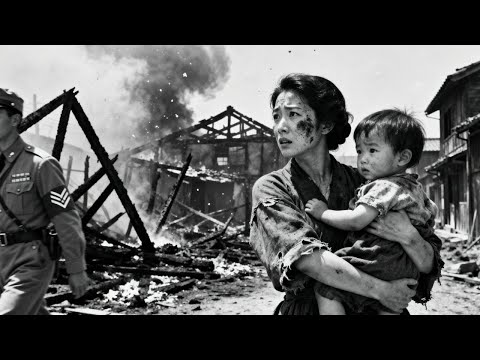
Katsumoto Saotoi, the 12-year-old munitions worker, runs from his family’s traditional wooden home as the first fires erupt three blocks away. But these aren’t the manageable blazes that Tokyo’s fire brigades have been trained to combat. These are chemical fires that burn through water, that turn firefighting equipment into molten metal, that create their own weather patterns. Within 15 minutes, individual fires begin merging into something Tokyo has never experienced: a true firestorm.
The physics are terrifyingly simple. As fires consume oxygen, cooler air rushes in to replace it, creating wind patterns that fan the flames even higher. The wooden buildings of Tokyo, dried by months of spring weather, ignite like matchsticks. But instead of burning building by building, entire neighborhoods burst into flames simultaneously as superheated air ignites everything combustible within a half-mile radius.
“The fires were creating their own hurricane,” Guillain observes from his window, watching 70-mile-per-hour winds tear roofs from buildings that haven’t even caught fire yet. Trees, telephone poles, and fleeing people are sucked into the flames by winds stronger than any natural typhoon.
Radio operator Carl Barold, flying in the third wave of bombers at 5,000 feet, can smell burning flesh through his aircraft’s ventilation system. The stench is so overwhelming that crew members begin vomiting into their oxygen masks. Below them, Tokyo is transforming into a vision from Dante’s Inferno—not a city under attack, but a city becoming fire itself.
The Japanese government’s firefighting strategy, so carefully planned and rehearsed, collapses within the first hour. Bucket brigades find their water boiling before it reaches the flames. Fire engines discover that their hoses melt when they approach within 50 yards of the blazes. Emergency evacuation routes become death traps as superheated air turns city streets into open-air ovens.
Saotoi’s family joins a massive exodus of civilians fleeing toward the Sumida River, following government evacuation procedures that assume people can outrun fires moving at walking speed. But tonight’s fires advance at 30 miles per hour, pushed by hurricane-force winds and feeding on the oxygen of panicked human beings.
“The asphalt of the roads had begun to melt and burn,” Saotoi will remember 70 years later. “People were catching fire as they ran.” Those who thought they had found safety by reaching concrete buildings discovered that concrete doesn’t burn—but everything inside it does, including the people.
Above the chaos, American bomber crews experience something unprecedented in military aviation: they can see the results of their attack in real time. Previous bombing raids involved dropping explosives from such high altitudes that crews never witnessed the destruction. Tonight, flying at eye level with Tokyo’s tallest buildings, they watch an entire city die beneath them.
B-29 pilot Major Sam Boxes maintains his methodical precision even in the face of unprecedented destruction. He radios back to base with clinical accuracy: “Target area completely obscured by smoke and flame. Individual structures no longer visible. Bombing continuing by area saturation.” But his crew can hear something in his voice that wasn’t there during previous missions—a recognition that they’re witnessing something that will haunt them forever.
The firestorm’s intensity begins creating its own weather system. Superheated air rises so rapidly that it forms towering columns visible from 100 miles away. These thermal columns create downdrafts that spread burning material across an ever-widening area. What began as precision bombing of specific neighborhoods becomes total area destruction as the fire develops its own momentum independent of continued bombing.
By 2:30 a.m., the temperature at ground level in central Tokyo reaches 1,800 degrees Fahrenheit—identical to the burning temperature of the thermite bombs themselves. The city has become a single massive furnace consuming everything within a 16-square-mile area. Fleeing civilians discover that survival depends not on reaching safety, but on finding pockets of air cool enough to breathe.
Japanese radio stations, broadcasting emergency instructions until the final moments, begin going silent as their broadcasting equipment melts. The last transmission recorded by American intelligence captures the desperation of a government realizing that all their civil defense preparations were designed for the wrong kind of war: “Citizens are advised to seek immediate shelter in concrete structures. Previous firefighting instructions are no longer effective. Repeat, firefighting instructions are no longer effective.”
At 3:15 a.m., the final wave of B-29s completes their bomb runs and turns toward the Pacific. Behind them, Tokyo burns with such intensity that the flames are visible from 150 miles away—farther than the distance from New York City to Philadelphia. The firestorm has become entirely self-sustaining, consuming everything combustible within its reach and creating weather patterns that spread the destruction far beyond the original target zone.
In three hours and 47 minutes, 334 American bombers have transformed Japan’s largest city into 16 square miles of ash and melted metal. More people died in those three hours than would die instantly in either Hiroshima or Nagasaki. But perhaps more importantly, both sides now understand that the rules of warfare have permanently changed. This isn’t strategic bombing aimed at military targets—this is the deliberate incineration of civilian populations using fire as a weapon of mass destruction. The world will never be the same.
When the sun rises over Tokyo on March 10th, 1945, Katsumoto Saotoi discovers he’s living in a city that no longer exists. Where neighborhoods once stood, only ash remains—ash so fine and deep that survivors sink to their knees while walking through it. The 12-year-old factory worker, now one of approximately 100,000 people whose homes vanished in a single night, makes a decision that will define the rest of his life: Someone must remember what happened here.
For the next 70 years, Saotoi dedicates himself to documenting the Tokyo firebombing, collecting testimonies from fellow survivors, arguing with government officials who prefer to focus on nuclear attacks rather than conventional bombing, and fighting against a world that seems determined to forget that March 9th to 10th, 1945 was the deadliest night in the history of aerial warfare.
The statistics alone tell an impossible story. More people died in the Tokyo firebombing than in the atomic bombing of Hiroshima. More area was destroyed than in any other air raid in human history. More families were separated, more children orphaned, more lives permanently shattered than in any single military operation of World War II. Yet outside of Japan, almost no one knows it happened.
General Curtis LeMay, the architect of the low-altitude incendiary strategy, will later reflect on that night with characteristic bluntness: “I suppose if I had lost the war, I would have been tried as a war criminal.” His aide, Robert McNamara—decades later Secretary of Defense during Vietnam—admits, “LeMay and I were behaving as war criminals.”
But the moral complexity runs deeper than postwar guilt. The Tokyo firebombing worked exactly as intended. Within weeks, LeMay’s bombers systematically incinerated 66 other Japanese cities using identical tactics. The psychological impact on Japanese leadership was devastating. If Americans could turn their largest city into ash in a single night using conventional weapons, what hope did Japan have of continued resistance?
Emperor Hirohito, surveying the destruction from his palace, privately tells advisers that continuing the war has become unthinkable. The firebombing demonstrated American capability to destroy Japanese civilization entirely without ever invading the home islands. When the atomic bombs fell on Hiroshima and Nagasaki four months later, they confirmed what the Tokyo raid had already proven: American technological superiority had made Japanese defeat inevitable.
The human cost was immediately apparent, but the strategic implications took years to understand. The Tokyo firebombing established the precedent that civilian populations were legitimate military targets, that area destruction was preferable to precision bombing, and that psychological warfare through terror was an acceptable military strategy. These lessons would influence American military planning through Korea, Vietnam, and beyond.
Perhaps most remarkably, the Japanese government’s postwar response to LeMay reveals the complexity of international relationships after total war. In 1964, Japan awarded Curtis LeMay the Order of the Rising Sun—the nation’s highest civilian honor—recognizing his role in ending the war quickly and avoiding a costly invasion. The general who incinerated their largest city was officially thanked for his service.
For survivors like Katsumoto Saotoi, this honor represents the ultimate betrayal—official recognition that the Japanese government values strategic effectiveness over the lives of its own citizens. “We should have raised our voices much louder,” he says in his final interviews, now in his 80s and watching the last generation of firebombing survivors pass away.
The technological revolution that began over Tokyo that night fundamentally changed how nations think about warfare. The firebombing proved that conventional weapons properly employed could achieve destruction previously associated only with siege warfare or natural disasters. It demonstrated that modern industrial cities were inherently vulnerable to area attacks, that civilian populations could not be protected from determined aerial assault, and that the distinction between military and civilian targets had become strategically meaningless.
Today, as international conflicts increasingly involve urban warfare and civilian casualties, the moral questions raised by the Tokyo firebombing remain painfully relevant. When does military effectiveness justify civilian casualties? How many innocent lives is strategic advantage worth? At what point does warfare become genocide?
Katsumoto Saotoi spent seven decades searching for answers to these questions, documenting not just what happened on March 9th to 10th, 1945, but why the world chose to forget. His final message is simple but haunting: “The people who died that night deserve to be remembered—not as statistics, but as individuals whose lives had meaning beyond their strategic value.” Their voices, preserved in his archives, remind us that behind every military innovation, every strategic breakthrough, every technological revolution in warfare, are human beings whose lives were forever changed by decisions made in distant headquarters by people who never smelled the smoke.
As the last survivors fade into history, the question remains: Will we remember the firestorm that changed everything, or will we continue to let the ashes of Tokyo blow away unnoticed? What do you think—should the Tokyo firebombing be as widely remembered as Hiroshima and Nagasaki, or does its absence from our collective memory reveal something uncomfortable about the way we choose which tragedies to memorialize?
Report this article
Select a reason for reporting:






